
Bamberg
u. Brücke, 96049 Bamberg, Deutschland
Lower Bridge Bamberg | History & Flea Market
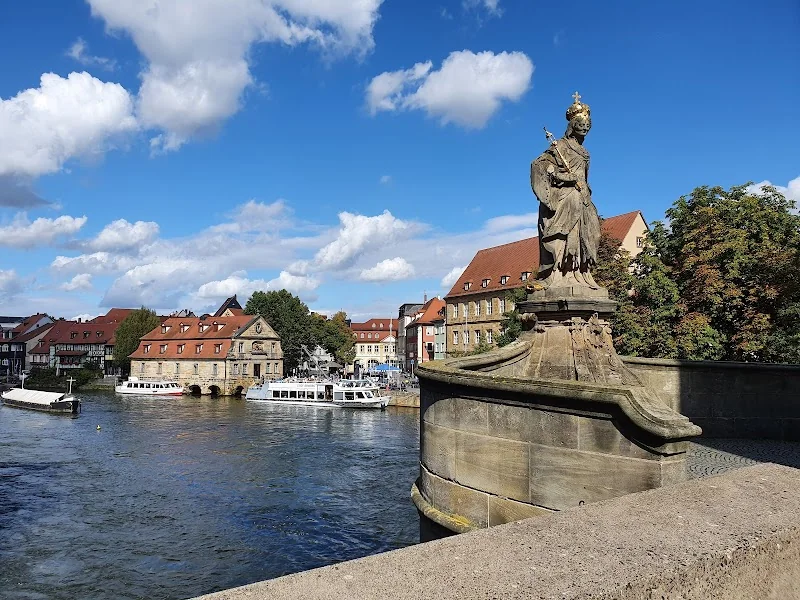
The Lower Bridge in Bamberg is not a classic event venue with a stage, hall, or fixed seating, but an urban place with its own identity: a pedestrian bridge, a path in the historic center, a meeting point by the river, and a location where everyday life, city history, and local events overlap. Those who arrive here find themselves in the middle of Bamberg's old town and at the same time at a crossing that connects the left arm of the Regnitz and the Ludwig-Donau-Main Canal. The official tourism website locates the Lower Bridge at Am Kranen; it also shows the statue of Saint Kunigunde and points out a barrier-free public restroom directly at the site. This mix of orientation point, riverside location, and practical infrastructure makes the Lower Bridge a striking, well-integrated part of the cityscape. ([bamberg.info](https://www.bamberg.info/poi/untere_bruecke-4950/))
History of the Lower Bridge in Bamberg
The history of the Lower Bridge is closely linked to the tumultuous development of the city and wars in Bamberg. A TÜV-Süd report on the bridge describes it as a pedestrian bridge over the left arm of the Regnitz and the Ludwig-Donau-Main Canal. At the same time, the report notes that the historic bridge was destroyed in 1945 and rebuilt in 1967 as a simple concrete bridge. This is important for visitors because the current impression does not reflect a medieval stone bridge but rather a functional post-war solution that is still located in one of the city's most historically significant areas. The report also mentions that there is no monument protection for the structure. This explains why the bridge is perceived today primarily as a reliable connection, not as a museum-like individual monument. ([stadt.bamberg.de](https://www.stadt.bamberg.de/buergerinformationssystem/wicket/resource/org.apache.wicket.Application/doc224601.pdf))
What is interesting is the specific construction and usage perspective: The report states a total width of 740 centimeters and describes the parapet on both sides as about 70 centimeters thick with an inward-leaning wall crown. The inner side of the parapet is also given a height of about 75 centimeters. In practice, this means: The Lower Bridge is compact, urban, and clearly oriented towards pedestrian and bicycle traffic. The inspection report also notes that there was active pedestrian and bicycle traffic at the time of the inspection. This technical description is sober but explains very well why the Lower Bridge is so present in everyday life in Bamberg: It is not a peripheral object but an actively used crossing in the densely populated old town area. In conjunction with the river, the canals, and the surrounding UNESCO World Heritage site, even this simple bridge has a strong urban impact. ([stadt.bamberg.de](https://www.stadt.bamberg.de/buergerinformationssystem/wicket/resource/org.apache.wicket.Application/doc224601.pdf))
Route, Location, and Access to the Lower Bridge
Those who do not happen to pass by the Lower Bridge on their way through the old town can easily plan it as part of a walk or a thematic route. The official river path “In the Flow of History” begins at the Tourist Info and continues through stations such as the Bridge Town Hall and the Lower Bridge to the Kranen or Old Harbor. The circular walk is 3.8 kilometers long, with a walking time of about one to two hours, and is described as easy and stroller-friendly. This fits perfectly with the Lower Bridge itself: It is not an isolated point but part of a coherent urban space where one constantly gains new perspectives on the Regnitz, old town, bridges, and historical buildings. Those seeking the bridge as a destination find not only a place but an entire exploration logic for Bamberg. ([en.bamberg.info](https://en.bamberg.info/media-download/pdf/downloads/wege/tour-2-im-fluss-der-geschichte.pdf))
The location at Kranen makes the Lower Bridge particularly interesting for visitors who are transitioning between the most important historical areas of the city center. The tour in the official tourism material shows that from here, paths lead towards fishing, shipbuilding, Little Venice, Upper and Lower Mills, and the World Heritage Center. This is more than just a pretty backdrop: The Lower Bridge sits at an urban junction where one can reinterpret the old town in just a few steps. For access by car, central parking options in the city center are the obvious choice. The tourism site mentions, among others, the underground parking at Untere Königstraße with 118 parking spaces, two disabled parking spaces, an elevator, and a maximum entrance height of 2 meters, as well as the underground parking at Maximiliansplatz with 205 parking spaces, 24-hour access, and a maximum entrance height of 1.90 meters. These are not parking spaces directly on the bridge, but they are the most practical official options for accessing the old town. ([bamberg.info](https://www.bamberg.info/poi/tiefgarage_untere_koenigstrass-11002/?utm_source=openai))
Children's and Youth Flea Market at the Lower Bridge
One of the most important events around the Lower Bridge is the children's and youth flea market of the city of Bamberg. The city describes it as an event that takes place once a month on Saturdays from April to October, each time from 10:00 to 13:00. Children and teenagers aged 7 to 17 are allowed to participate; adults are excluded. Registration takes place online and begins 8 days before the respective flea market date. Thus, the Lower Bridge is not only a thoroughfare but also a fixed stage for a very local, generational format that has been part of city life for many years. This is particularly attractive for families because it involves child-friendly goods, uncomplicated participation, and a clearly structured time frame. ([stadt.bamberg.de](https://www.stadt.bamberg.de/Schnellnavigation/Seiten%C3%BCbersicht/index.php?NavID=2730.802.1&utm_source=openai))
The city of Bamberg additionally emphasizes that the children's and youth flea market has now existed for nearly 45 years and that the Lower Bridge has established itself as a location for just as long. This makes the event a small but surprisingly lasting part of Bamberg's urban culture. So, those searching for “flea market lower bridge bamberg” or “children's flea market lower bridge bamberg” are actually looking for a developed tradition with clear rules, not a spontaneous single date. The city also provides a layout overview as a PDF, which shows that the organization is systematic. It is also relevant for seekers that it is a free event and that the city has published specific dates for 2026. Thus, the Lower Bridge regularly becomes a place on a few clearly planned Saturdays where children and teenagers sell their items, visitors browse, and the city center takes on a very family-friendly character. ([stadt.bamberg.de](https://www.stadt.bamberg.de/Schnellnavigation/Seiten%C3%BCbersicht/index.php?NavID=2730.802.1&utm_source=openai))
Meeting Point, Beer Garden, and Quality of Stay by the River
The Lower Bridge is perceived in Bamberg not only as a passage but also very consciously as a place to stay. Visit Bamberg describes it as a popular meeting point; at the same time, it is pointed out that drinks and food must be brought along. This results in a very special character: The bridge is not a consumption space with fixed offerings, but an open urban meeting point where people meet outdoors, perceive the river, and experience the atmosphere of the old town directly on the bridge. For many visitors, this is precisely the charm because the Bamberg way of life is very directly expressed here. Those who linger at the Lower Bridge experience not just a crossing but a piece of urban outdoor room with a view of water, historic facades, and the vibrant surroundings of the city center. ([visitbamberg.com](https://www.visitbamberg.com/gastronomie/bars-und-kneipen/))
The public debate also shows that the bridge is taken seriously as a place to stay. The city of Bamberg has dealt with the gastronomic use of the Lower Bridge in recent years and has publicly consulted on it. This is SEO-relevant because many search queries like “lower bridge bamberg beer garden” are not just looking for a restaurant but asking whether the bridge itself is intended as a place for longer stays, summer use, or gastronomic use. The solid facts show: The Lower Bridge is a place with meeting point quality, and at the same time, it remains an important traffic connection for pedestrians and cyclists. This dual role makes it exciting. It is open enough for spontaneous encounters and solid enough in the structure of the city to regularly be the focus of administration, the public, and city marketing. So, those researching the term beer garden in connection with the Lower Bridge will find a place where urban life, outdoor use, and traffic function are continually recalibrated. ([stadt.bamberg.de](https://www.stadt.bamberg.de/buergerinformationssystem/to020?0--anlagenVoHeaderPanel-attachmentsList-13-attachment-link=&SILFDNR=3105&TOLFDNR=32969))
Parking, Restroom, and Practical Information for the Visit
For the practical planning of a visit, two things are especially important at the Lower Bridge: good accessibility and simple infrastructure. The tourism site mentions a public restroom at the Lower Bridge that is barrier-free and offers a changing facility; the price is €0.50. This is a tangible advantage for families, walkers, and day visitors because one does not have to search for a sanitary solution in the old town area. Furthermore, this facility emphasizes that the Lower Bridge is not only a tourist point of interest but also a functional place in the everyday life of the city center. The bridge itself is marked as a pedestrian bridge, and the TÜV report simultaneously states that there is also active bicycle traffic taking place there. Therefore, one should always expect a mixed, lively usage profile during the visit. ([visitbamberg.com](https://www.visitbamberg.com/en/poi/public-toilet-untere-brucke/?utm_source=openai))
For parking, the official old town underground garages are helpful. The underground garage at Untere Königstraße has 118 parking spaces, two disabled parking spaces, an elevator, and a maximum entrance height of 2 meters. The underground garage at Maximiliansplatz is even larger with 205 spaces, open continuously, and also centrally located in the city center; the maximum entrance height there is 1.90 meters. For many visitors, this is the best practical solution if they want to combine their visit to the Lower Bridge with a stroll through the old town, a visit to the flea market, or a tour to the Old Town Hall. Since the bridge itself does not offer its own parking area, the combination of a central parking garage and a short walk through the city center is worthwhile. This way, the visit remains relaxed, and one utilizes the actual strength of the location: short distances, historic backdrop, and very good integration into the Bamberg city center. ([bamberg.info](https://www.bamberg.info/poi/tiefgarage_untere_koenigstrass-11002/?utm_source=openai))
Attractions around the Lower Bridge
A large part of the attractiveness of the Lower Bridge arises from its surroundings. The official river path shows how closely the bridge is connected to the Bridge Town Hall, the Kranen, the Old Harbor, fishing, the shipbuilding site, and later also to the Upper and Lower Mills. Additionally, there are other strong motifs of Bamberg's old town such as Little Venice, the World Heritage Center, and the paths along the Regnitz. Therefore, those visiting the Lower Bridge are not standing in front of a single attraction but in front of a very dense network of sights, water locations, and historical sightlines. This is precisely what makes the place so attractive for walks and photo stops: Just a few meters further, the urban space changes noticeably, and the view of Bamberg is continually reframed. ([en.bamberg.info](https://en.bamberg.info/media-download/pdf/downloads/wege/tour-2-im-fluss-der-geschichte.pdf))
Particularly strong is the contrast between the functional bridge and the picturesque urban space. The Lower Bridge itself was simply rebuilt after World War II, but all around unfolds the full historical depth of the World Heritage city. The tourism and city information refer to the Old Town Hall, the mill quarters, Little Venice, and the paths along the Regnitz as defining elements of the surroundings. Those who linger here can thus very well understand why Bamberg is perceived as a city by the river: The bridge is a connection point between everyday life and monument space, between a short crossing and a long walk, between flea market, meetings, restroom, parking, and sightseeing. This is precisely why search queries related to the Lower Bridge are so versatile. They range from history to route and access to flea market, beer garden, parking, and the desire for good orientation in the old town. The Lower Bridge answers all these questions not as a grand monument but as a lively, practical, and historically charged place in the heart of Bamberg. ([en.bamberg.info](https://en.bamberg.info/media-download/pdf/downloads/wege/tour-2-im-fluss-der-geschichte.pdf))
Sources:
- Bamberg Tourism - Lower Bridge
- City of Bamberg - Children's and Youth Flea Market at the Lower Bridge
- Bamberg Tourism - In the Flow of History
- Visit Bamberg - Bars and Pubs
- Bamberg Tourism - Underground Garage Untere Königstraße
- Bamberg Tourism - Underground Garage Maximiliansplatz
- Visit Bamberg - Public toilet: Lower Bridge
- City of Bamberg - Safety Assessment Lower Bridge (PDF)
Mehr anzeigenWeniger anzeigen
Lower Bridge Bamberg | History & Flea Market
The Lower Bridge in Bamberg is not a classic event venue with a stage, hall, or fixed seating, but an urban place with its own identity: a pedestrian bridge, a path in the historic center, a meeting point by the river, and a location where everyday life, city history, and local events overlap. Those who arrive here find themselves in the middle of Bamberg's old town and at the same time at a crossing that connects the left arm of the Regnitz and the Ludwig-Donau-Main Canal. The official tourism website locates the Lower Bridge at Am Kranen; it also shows the statue of Saint Kunigunde and points out a barrier-free public restroom directly at the site. This mix of orientation point, riverside location, and practical infrastructure makes the Lower Bridge a striking, well-integrated part of the cityscape. ([bamberg.info](https://www.bamberg.info/poi/untere_bruecke-4950/))
History of the Lower Bridge in Bamberg
The history of the Lower Bridge is closely linked to the tumultuous development of the city and wars in Bamberg. A TÜV-Süd report on the bridge describes it as a pedestrian bridge over the left arm of the Regnitz and the Ludwig-Donau-Main Canal. At the same time, the report notes that the historic bridge was destroyed in 1945 and rebuilt in 1967 as a simple concrete bridge. This is important for visitors because the current impression does not reflect a medieval stone bridge but rather a functional post-war solution that is still located in one of the city's most historically significant areas. The report also mentions that there is no monument protection for the structure. This explains why the bridge is perceived today primarily as a reliable connection, not as a museum-like individual monument. ([stadt.bamberg.de](https://www.stadt.bamberg.de/buergerinformationssystem/wicket/resource/org.apache.wicket.Application/doc224601.pdf))
What is interesting is the specific construction and usage perspective: The report states a total width of 740 centimeters and describes the parapet on both sides as about 70 centimeters thick with an inward-leaning wall crown. The inner side of the parapet is also given a height of about 75 centimeters. In practice, this means: The Lower Bridge is compact, urban, and clearly oriented towards pedestrian and bicycle traffic. The inspection report also notes that there was active pedestrian and bicycle traffic at the time of the inspection. This technical description is sober but explains very well why the Lower Bridge is so present in everyday life in Bamberg: It is not a peripheral object but an actively used crossing in the densely populated old town area. In conjunction with the river, the canals, and the surrounding UNESCO World Heritage site, even this simple bridge has a strong urban impact. ([stadt.bamberg.de](https://www.stadt.bamberg.de/buergerinformationssystem/wicket/resource/org.apache.wicket.Application/doc224601.pdf))
Route, Location, and Access to the Lower Bridge
Those who do not happen to pass by the Lower Bridge on their way through the old town can easily plan it as part of a walk or a thematic route. The official river path “In the Flow of History” begins at the Tourist Info and continues through stations such as the Bridge Town Hall and the Lower Bridge to the Kranen or Old Harbor. The circular walk is 3.8 kilometers long, with a walking time of about one to two hours, and is described as easy and stroller-friendly. This fits perfectly with the Lower Bridge itself: It is not an isolated point but part of a coherent urban space where one constantly gains new perspectives on the Regnitz, old town, bridges, and historical buildings. Those seeking the bridge as a destination find not only a place but an entire exploration logic for Bamberg. ([en.bamberg.info](https://en.bamberg.info/media-download/pdf/downloads/wege/tour-2-im-fluss-der-geschichte.pdf))
The location at Kranen makes the Lower Bridge particularly interesting for visitors who are transitioning between the most important historical areas of the city center. The tour in the official tourism material shows that from here, paths lead towards fishing, shipbuilding, Little Venice, Upper and Lower Mills, and the World Heritage Center. This is more than just a pretty backdrop: The Lower Bridge sits at an urban junction where one can reinterpret the old town in just a few steps. For access by car, central parking options in the city center are the obvious choice. The tourism site mentions, among others, the underground parking at Untere Königstraße with 118 parking spaces, two disabled parking spaces, an elevator, and a maximum entrance height of 2 meters, as well as the underground parking at Maximiliansplatz with 205 parking spaces, 24-hour access, and a maximum entrance height of 1.90 meters. These are not parking spaces directly on the bridge, but they are the most practical official options for accessing the old town. ([bamberg.info](https://www.bamberg.info/poi/tiefgarage_untere_koenigstrass-11002/?utm_source=openai))
Children's and Youth Flea Market at the Lower Bridge
One of the most important events around the Lower Bridge is the children's and youth flea market of the city of Bamberg. The city describes it as an event that takes place once a month on Saturdays from April to October, each time from 10:00 to 13:00. Children and teenagers aged 7 to 17 are allowed to participate; adults are excluded. Registration takes place online and begins 8 days before the respective flea market date. Thus, the Lower Bridge is not only a thoroughfare but also a fixed stage for a very local, generational format that has been part of city life for many years. This is particularly attractive for families because it involves child-friendly goods, uncomplicated participation, and a clearly structured time frame. ([stadt.bamberg.de](https://www.stadt.bamberg.de/Schnellnavigation/Seiten%C3%BCbersicht/index.php?NavID=2730.802.1&utm_source=openai))
The city of Bamberg additionally emphasizes that the children's and youth flea market has now existed for nearly 45 years and that the Lower Bridge has established itself as a location for just as long. This makes the event a small but surprisingly lasting part of Bamberg's urban culture. So, those searching for “flea market lower bridge bamberg” or “children's flea market lower bridge bamberg” are actually looking for a developed tradition with clear rules, not a spontaneous single date. The city also provides a layout overview as a PDF, which shows that the organization is systematic. It is also relevant for seekers that it is a free event and that the city has published specific dates for 2026. Thus, the Lower Bridge regularly becomes a place on a few clearly planned Saturdays where children and teenagers sell their items, visitors browse, and the city center takes on a very family-friendly character. ([stadt.bamberg.de](https://www.stadt.bamberg.de/Schnellnavigation/Seiten%C3%BCbersicht/index.php?NavID=2730.802.1&utm_source=openai))
Meeting Point, Beer Garden, and Quality of Stay by the River
The Lower Bridge is perceived in Bamberg not only as a passage but also very consciously as a place to stay. Visit Bamberg describes it as a popular meeting point; at the same time, it is pointed out that drinks and food must be brought along. This results in a very special character: The bridge is not a consumption space with fixed offerings, but an open urban meeting point where people meet outdoors, perceive the river, and experience the atmosphere of the old town directly on the bridge. For many visitors, this is precisely the charm because the Bamberg way of life is very directly expressed here. Those who linger at the Lower Bridge experience not just a crossing but a piece of urban outdoor room with a view of water, historic facades, and the vibrant surroundings of the city center. ([visitbamberg.com](https://www.visitbamberg.com/gastronomie/bars-und-kneipen/))
The public debate also shows that the bridge is taken seriously as a place to stay. The city of Bamberg has dealt with the gastronomic use of the Lower Bridge in recent years and has publicly consulted on it. This is SEO-relevant because many search queries like “lower bridge bamberg beer garden” are not just looking for a restaurant but asking whether the bridge itself is intended as a place for longer stays, summer use, or gastronomic use. The solid facts show: The Lower Bridge is a place with meeting point quality, and at the same time, it remains an important traffic connection for pedestrians and cyclists. This dual role makes it exciting. It is open enough for spontaneous encounters and solid enough in the structure of the city to regularly be the focus of administration, the public, and city marketing. So, those researching the term beer garden in connection with the Lower Bridge will find a place where urban life, outdoor use, and traffic function are continually recalibrated. ([stadt.bamberg.de](https://www.stadt.bamberg.de/buergerinformationssystem/to020?0--anlagenVoHeaderPanel-attachmentsList-13-attachment-link=&SILFDNR=3105&TOLFDNR=32969))
Parking, Restroom, and Practical Information for the Visit
For the practical planning of a visit, two things are especially important at the Lower Bridge: good accessibility and simple infrastructure. The tourism site mentions a public restroom at the Lower Bridge that is barrier-free and offers a changing facility; the price is €0.50. This is a tangible advantage for families, walkers, and day visitors because one does not have to search for a sanitary solution in the old town area. Furthermore, this facility emphasizes that the Lower Bridge is not only a tourist point of interest but also a functional place in the everyday life of the city center. The bridge itself is marked as a pedestrian bridge, and the TÜV report simultaneously states that there is also active bicycle traffic taking place there. Therefore, one should always expect a mixed, lively usage profile during the visit. ([visitbamberg.com](https://www.visitbamberg.com/en/poi/public-toilet-untere-brucke/?utm_source=openai))
For parking, the official old town underground garages are helpful. The underground garage at Untere Königstraße has 118 parking spaces, two disabled parking spaces, an elevator, and a maximum entrance height of 2 meters. The underground garage at Maximiliansplatz is even larger with 205 spaces, open continuously, and also centrally located in the city center; the maximum entrance height there is 1.90 meters. For many visitors, this is the best practical solution if they want to combine their visit to the Lower Bridge with a stroll through the old town, a visit to the flea market, or a tour to the Old Town Hall. Since the bridge itself does not offer its own parking area, the combination of a central parking garage and a short walk through the city center is worthwhile. This way, the visit remains relaxed, and one utilizes the actual strength of the location: short distances, historic backdrop, and very good integration into the Bamberg city center. ([bamberg.info](https://www.bamberg.info/poi/tiefgarage_untere_koenigstrass-11002/?utm_source=openai))
Attractions around the Lower Bridge
A large part of the attractiveness of the Lower Bridge arises from its surroundings. The official river path shows how closely the bridge is connected to the Bridge Town Hall, the Kranen, the Old Harbor, fishing, the shipbuilding site, and later also to the Upper and Lower Mills. Additionally, there are other strong motifs of Bamberg's old town such as Little Venice, the World Heritage Center, and the paths along the Regnitz. Therefore, those visiting the Lower Bridge are not standing in front of a single attraction but in front of a very dense network of sights, water locations, and historical sightlines. This is precisely what makes the place so attractive for walks and photo stops: Just a few meters further, the urban space changes noticeably, and the view of Bamberg is continually reframed. ([en.bamberg.info](https://en.bamberg.info/media-download/pdf/downloads/wege/tour-2-im-fluss-der-geschichte.pdf))
Particularly strong is the contrast between the functional bridge and the picturesque urban space. The Lower Bridge itself was simply rebuilt after World War II, but all around unfolds the full historical depth of the World Heritage city. The tourism and city information refer to the Old Town Hall, the mill quarters, Little Venice, and the paths along the Regnitz as defining elements of the surroundings. Those who linger here can thus very well understand why Bamberg is perceived as a city by the river: The bridge is a connection point between everyday life and monument space, between a short crossing and a long walk, between flea market, meetings, restroom, parking, and sightseeing. This is precisely why search queries related to the Lower Bridge are so versatile. They range from history to route and access to flea market, beer garden, parking, and the desire for good orientation in the old town. The Lower Bridge answers all these questions not as a grand monument but as a lively, practical, and historically charged place in the heart of Bamberg. ([en.bamberg.info](https://en.bamberg.info/media-download/pdf/downloads/wege/tour-2-im-fluss-der-geschichte.pdf))
Sources:
- Bamberg Tourism - Lower Bridge
- City of Bamberg - Children's and Youth Flea Market at the Lower Bridge
- Bamberg Tourism - In the Flow of History
- Visit Bamberg - Bars and Pubs
- Bamberg Tourism - Underground Garage Untere Königstraße
- Bamberg Tourism - Underground Garage Maximiliansplatz
- Visit Bamberg - Public toilet: Lower Bridge
- City of Bamberg - Safety Assessment Lower Bridge (PDF)
Lower Bridge Bamberg | History & Flea Market
The Lower Bridge in Bamberg is not a classic event venue with a stage, hall, or fixed seating, but an urban place with its own identity: a pedestrian bridge, a path in the historic center, a meeting point by the river, and a location where everyday life, city history, and local events overlap. Those who arrive here find themselves in the middle of Bamberg's old town and at the same time at a crossing that connects the left arm of the Regnitz and the Ludwig-Donau-Main Canal. The official tourism website locates the Lower Bridge at Am Kranen; it also shows the statue of Saint Kunigunde and points out a barrier-free public restroom directly at the site. This mix of orientation point, riverside location, and practical infrastructure makes the Lower Bridge a striking, well-integrated part of the cityscape. ([bamberg.info](https://www.bamberg.info/poi/untere_bruecke-4950/))
History of the Lower Bridge in Bamberg
The history of the Lower Bridge is closely linked to the tumultuous development of the city and wars in Bamberg. A TÜV-Süd report on the bridge describes it as a pedestrian bridge over the left arm of the Regnitz and the Ludwig-Donau-Main Canal. At the same time, the report notes that the historic bridge was destroyed in 1945 and rebuilt in 1967 as a simple concrete bridge. This is important for visitors because the current impression does not reflect a medieval stone bridge but rather a functional post-war solution that is still located in one of the city's most historically significant areas. The report also mentions that there is no monument protection for the structure. This explains why the bridge is perceived today primarily as a reliable connection, not as a museum-like individual monument. ([stadt.bamberg.de](https://www.stadt.bamberg.de/buergerinformationssystem/wicket/resource/org.apache.wicket.Application/doc224601.pdf))
What is interesting is the specific construction and usage perspective: The report states a total width of 740 centimeters and describes the parapet on both sides as about 70 centimeters thick with an inward-leaning wall crown. The inner side of the parapet is also given a height of about 75 centimeters. In practice, this means: The Lower Bridge is compact, urban, and clearly oriented towards pedestrian and bicycle traffic. The inspection report also notes that there was active pedestrian and bicycle traffic at the time of the inspection. This technical description is sober but explains very well why the Lower Bridge is so present in everyday life in Bamberg: It is not a peripheral object but an actively used crossing in the densely populated old town area. In conjunction with the river, the canals, and the surrounding UNESCO World Heritage site, even this simple bridge has a strong urban impact. ([stadt.bamberg.de](https://www.stadt.bamberg.de/buergerinformationssystem/wicket/resource/org.apache.wicket.Application/doc224601.pdf))
Route, Location, and Access to the Lower Bridge
Those who do not happen to pass by the Lower Bridge on their way through the old town can easily plan it as part of a walk or a thematic route. The official river path “In the Flow of History” begins at the Tourist Info and continues through stations such as the Bridge Town Hall and the Lower Bridge to the Kranen or Old Harbor. The circular walk is 3.8 kilometers long, with a walking time of about one to two hours, and is described as easy and stroller-friendly. This fits perfectly with the Lower Bridge itself: It is not an isolated point but part of a coherent urban space where one constantly gains new perspectives on the Regnitz, old town, bridges, and historical buildings. Those seeking the bridge as a destination find not only a place but an entire exploration logic for Bamberg. ([en.bamberg.info](https://en.bamberg.info/media-download/pdf/downloads/wege/tour-2-im-fluss-der-geschichte.pdf))
The location at Kranen makes the Lower Bridge particularly interesting for visitors who are transitioning between the most important historical areas of the city center. The tour in the official tourism material shows that from here, paths lead towards fishing, shipbuilding, Little Venice, Upper and Lower Mills, and the World Heritage Center. This is more than just a pretty backdrop: The Lower Bridge sits at an urban junction where one can reinterpret the old town in just a few steps. For access by car, central parking options in the city center are the obvious choice. The tourism site mentions, among others, the underground parking at Untere Königstraße with 118 parking spaces, two disabled parking spaces, an elevator, and a maximum entrance height of 2 meters, as well as the underground parking at Maximiliansplatz with 205 parking spaces, 24-hour access, and a maximum entrance height of 1.90 meters. These are not parking spaces directly on the bridge, but they are the most practical official options for accessing the old town. ([bamberg.info](https://www.bamberg.info/poi/tiefgarage_untere_koenigstrass-11002/?utm_source=openai))
Children's and Youth Flea Market at the Lower Bridge
One of the most important events around the Lower Bridge is the children's and youth flea market of the city of Bamberg. The city describes it as an event that takes place once a month on Saturdays from April to October, each time from 10:00 to 13:00. Children and teenagers aged 7 to 17 are allowed to participate; adults are excluded. Registration takes place online and begins 8 days before the respective flea market date. Thus, the Lower Bridge is not only a thoroughfare but also a fixed stage for a very local, generational format that has been part of city life for many years. This is particularly attractive for families because it involves child-friendly goods, uncomplicated participation, and a clearly structured time frame. ([stadt.bamberg.de](https://www.stadt.bamberg.de/Schnellnavigation/Seiten%C3%BCbersicht/index.php?NavID=2730.802.1&utm_source=openai))
The city of Bamberg additionally emphasizes that the children's and youth flea market has now existed for nearly 45 years and that the Lower Bridge has established itself as a location for just as long. This makes the event a small but surprisingly lasting part of Bamberg's urban culture. So, those searching for “flea market lower bridge bamberg” or “children's flea market lower bridge bamberg” are actually looking for a developed tradition with clear rules, not a spontaneous single date. The city also provides a layout overview as a PDF, which shows that the organization is systematic. It is also relevant for seekers that it is a free event and that the city has published specific dates for 2026. Thus, the Lower Bridge regularly becomes a place on a few clearly planned Saturdays where children and teenagers sell their items, visitors browse, and the city center takes on a very family-friendly character. ([stadt.bamberg.de](https://www.stadt.bamberg.de/Schnellnavigation/Seiten%C3%BCbersicht/index.php?NavID=2730.802.1&utm_source=openai))
Meeting Point, Beer Garden, and Quality of Stay by the River
The Lower Bridge is perceived in Bamberg not only as a passage but also very consciously as a place to stay. Visit Bamberg describes it as a popular meeting point; at the same time, it is pointed out that drinks and food must be brought along. This results in a very special character: The bridge is not a consumption space with fixed offerings, but an open urban meeting point where people meet outdoors, perceive the river, and experience the atmosphere of the old town directly on the bridge. For many visitors, this is precisely the charm because the Bamberg way of life is very directly expressed here. Those who linger at the Lower Bridge experience not just a crossing but a piece of urban outdoor room with a view of water, historic facades, and the vibrant surroundings of the city center. ([visitbamberg.com](https://www.visitbamberg.com/gastronomie/bars-und-kneipen/))
The public debate also shows that the bridge is taken seriously as a place to stay. The city of Bamberg has dealt with the gastronomic use of the Lower Bridge in recent years and has publicly consulted on it. This is SEO-relevant because many search queries like “lower bridge bamberg beer garden” are not just looking for a restaurant but asking whether the bridge itself is intended as a place for longer stays, summer use, or gastronomic use. The solid facts show: The Lower Bridge is a place with meeting point quality, and at the same time, it remains an important traffic connection for pedestrians and cyclists. This dual role makes it exciting. It is open enough for spontaneous encounters and solid enough in the structure of the city to regularly be the focus of administration, the public, and city marketing. So, those researching the term beer garden in connection with the Lower Bridge will find a place where urban life, outdoor use, and traffic function are continually recalibrated. ([stadt.bamberg.de](https://www.stadt.bamberg.de/buergerinformationssystem/to020?0--anlagenVoHeaderPanel-attachmentsList-13-attachment-link=&SILFDNR=3105&TOLFDNR=32969))
Parking, Restroom, and Practical Information for the Visit
For the practical planning of a visit, two things are especially important at the Lower Bridge: good accessibility and simple infrastructure. The tourism site mentions a public restroom at the Lower Bridge that is barrier-free and offers a changing facility; the price is €0.50. This is a tangible advantage for families, walkers, and day visitors because one does not have to search for a sanitary solution in the old town area. Furthermore, this facility emphasizes that the Lower Bridge is not only a tourist point of interest but also a functional place in the everyday life of the city center. The bridge itself is marked as a pedestrian bridge, and the TÜV report simultaneously states that there is also active bicycle traffic taking place there. Therefore, one should always expect a mixed, lively usage profile during the visit. ([visitbamberg.com](https://www.visitbamberg.com/en/poi/public-toilet-untere-brucke/?utm_source=openai))
For parking, the official old town underground garages are helpful. The underground garage at Untere Königstraße has 118 parking spaces, two disabled parking spaces, an elevator, and a maximum entrance height of 2 meters. The underground garage at Maximiliansplatz is even larger with 205 spaces, open continuously, and also centrally located in the city center; the maximum entrance height there is 1.90 meters. For many visitors, this is the best practical solution if they want to combine their visit to the Lower Bridge with a stroll through the old town, a visit to the flea market, or a tour to the Old Town Hall. Since the bridge itself does not offer its own parking area, the combination of a central parking garage and a short walk through the city center is worthwhile. This way, the visit remains relaxed, and one utilizes the actual strength of the location: short distances, historic backdrop, and very good integration into the Bamberg city center. ([bamberg.info](https://www.bamberg.info/poi/tiefgarage_untere_koenigstrass-11002/?utm_source=openai))
Attractions around the Lower Bridge
A large part of the attractiveness of the Lower Bridge arises from its surroundings. The official river path shows how closely the bridge is connected to the Bridge Town Hall, the Kranen, the Old Harbor, fishing, the shipbuilding site, and later also to the Upper and Lower Mills. Additionally, there are other strong motifs of Bamberg's old town such as Little Venice, the World Heritage Center, and the paths along the Regnitz. Therefore, those visiting the Lower Bridge are not standing in front of a single attraction but in front of a very dense network of sights, water locations, and historical sightlines. This is precisely what makes the place so attractive for walks and photo stops: Just a few meters further, the urban space changes noticeably, and the view of Bamberg is continually reframed. ([en.bamberg.info](https://en.bamberg.info/media-download/pdf/downloads/wege/tour-2-im-fluss-der-geschichte.pdf))
Particularly strong is the contrast between the functional bridge and the picturesque urban space. The Lower Bridge itself was simply rebuilt after World War II, but all around unfolds the full historical depth of the World Heritage city. The tourism and city information refer to the Old Town Hall, the mill quarters, Little Venice, and the paths along the Regnitz as defining elements of the surroundings. Those who linger here can thus very well understand why Bamberg is perceived as a city by the river: The bridge is a connection point between everyday life and monument space, between a short crossing and a long walk, between flea market, meetings, restroom, parking, and sightseeing. This is precisely why search queries related to the Lower Bridge are so versatile. They range from history to route and access to flea market, beer garden, parking, and the desire for good orientation in the old town. The Lower Bridge answers all these questions not as a grand monument but as a lively, practical, and historically charged place in the heart of Bamberg. ([en.bamberg.info](https://en.bamberg.info/media-download/pdf/downloads/wege/tour-2-im-fluss-der-geschichte.pdf))
Sources:
- Bamberg Tourism - Lower Bridge
- City of Bamberg - Children's and Youth Flea Market at the Lower Bridge
- Bamberg Tourism - In the Flow of History
- Visit Bamberg - Bars and Pubs
- Bamberg Tourism - Underground Garage Untere Königstraße
- Bamberg Tourism - Underground Garage Maximiliansplatz
- Visit Bamberg - Public toilet: Lower Bridge
- City of Bamberg - Safety Assessment Lower Bridge (PDF)
Frequently Asked Questions
Reviews
No reviews found