
Bamberg
Stephanspl. 5, 96049 Bamberg, Deutschland
St. Stephan Bamberg | Directions & Church Music
St. Stephan in Bamberg is much more than a historical church building. The place connects city history, sacred architecture, Protestant community life, and a remarkably vibrant music offering in a compact space. Those who enter the Stephansberg experience a church that dates back to an early foundation in the 11th century, but whose current form mainly originates from the 17th century. At the same time, St. Stephan remains a place for services, concerts, exhibitions, and encounters. It is precisely this connection of history and present that makes the location so interesting for people searching for St. Stephan Bamberg, for photos, for directions, for parking, or for church music. The church prominently overlooks the urban area, while the adjacent Stephanshof, with its rooms, cultural work, and open character, complements the ensemble. This creates a destination that is spiritually, culturally, and practically relevant. ([stephanskirche.de](https://www.stephanskirche.de/die-beiden-kirchen/die-kirche-st-stephan))
The current perception of St. Stephan is fed by several layers: from the old founding history surrounding the consecration in 1020, from the baroque reconstruction of the 17th century, from the repurposing after secularization, and from the ongoing care by the Protestant community since the early 19th century. Additionally, there is the Mühleisen organ with its impressive tonal range, the artworks in the interior, the regularly occurring musical formats, and the nativity scene, which attracts additional visitors during the Advent and Christmas season. Anyone who views St. Stephan merely as a church building is therefore missing the point. It is rather an ensemble of church space, community center, music tradition, and urban prime location. This complexity is also reflected in the search queries that range from history and photos to directions and parking, as well as services and organ concerts. ([stephanskirche.de](https://www.stephanskirche.de/die-beiden-kirchen/die-kirche-st-stephan))
History and Significance of St. Stephan in Bamberg
The history of St. Stephan goes back very far in Bamberg. According to the official account of the community, the St. Stephan Church was consecrated in 1020 by Pope Benedict VIII, who was then in Bamberg. The legend attributes the construction to Saint Kunigunde, and the relief at the emperor's grave in the cathedral also refers to this tradition. Nothing remains of the first church building today, but the long tradition continues to shape the place. The location on the Stephansberg, centrally above the urban area, further underscores its historical significance. Thus, anyone contemplating the term St. Stephan Bamberg encounters a place that plays a special role not only locally but also in church and urban history. It belongs to the series of significant historical sacred buildings in the city and is closely related to its Protestant history. ([stephanskirche.de](https://www.stephanskirche.de/die-beiden-kirchen/die-kirche-st-stephan))
The oldest part of the current church is the tower from the 13th century. The actual reconstruction began in 1626 with the choir by Giovanni Bonalino, was interrupted due to the Thirty Years' War, and was only continued in 1677 by Antonio Petrini. The building is organized as a regular-armed cross and connects the west wing, transept, and choir into a clear, geometric spatial concept. In 1808, the secularized church was entrusted to the Protestant community of Bamberg. This granted St. Stephan its current function as the main Protestant church of the city. This is important for visitors because this history explains the current use: a space that comes from Catholic roots, was reshaped in the Baroque period, and today serves as a Protestant center for liturgy, music, and culture. This layering of epochs is what makes the place appealing and explains why interest in history, photos, and background information is so high. ([stephanskirche.de](https://www.stephanskirche.de/die-beiden-kirchen/die-kirche-st-stephan))
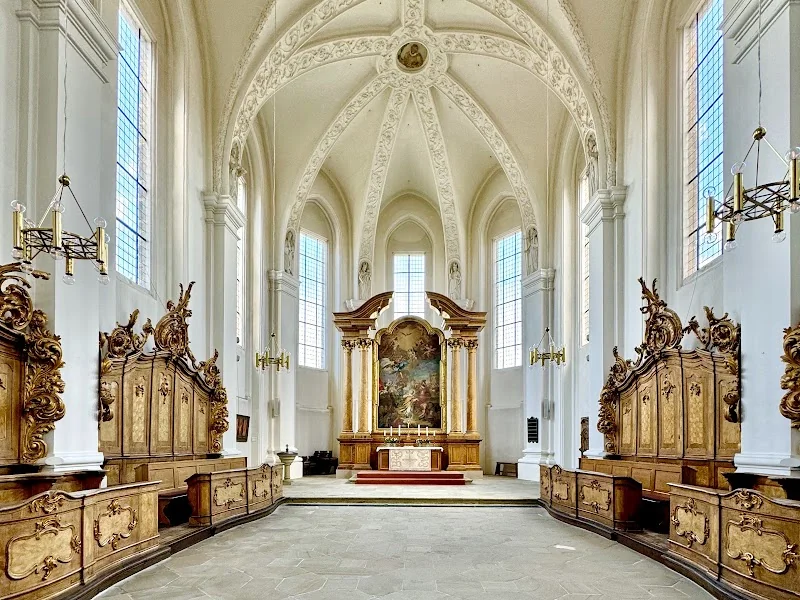
The historical significance also includes a look at the artistic development of the interior. The ceiling in the center features a stucco relief of the martyrdom of Stephen, created in 1688 by Johann Jakob Vogel. The motif is not only decorative but visibly carries the identity of the church as a place dedicated to the martyr Stephen into the space. Additionally, the interior renovation of 1987, with its uniform white finish, enhanced the effect of light and space. The community also emphasizes that in 1985, Jürgen Goertz added the current central altar, as well as the baptismal font and ambo. Since then, further artworks by Walter Green, Rui Chafes, and Brigitte Schwacke have been added. Thus, the church does not develop as a museum with a completed past but as a living sacred space, whose history continues to be visibly written today. ([stephanskirche.de](https://www.stephanskirche.de/die-beiden-kirchen/die-kirche-st-stephan))
Directions and Parking at St. Stephan Church
Those wishing to visit St. Stephan in Bamberg benefit from its location on the Stephansberg but must, as in many parts of the old town, expect limited parking space. According to the city of Bamberg, there are two disabled parking spaces behind the church at Stephansplatz 3. This is particularly helpful for guests with limited mobility or for short visits in the church environment. For all other visitors, it is advisable to approach the city center with a realistic travel plan, as Bamberg Tourism generally recommends using Park & Ride services from Monday to Saturday. This is especially relevant for St. Stephan if one wishes to visit not only the church itself but also other attractions in the city. The advantage: one avoids searching for parking in the city center and arrives more relaxed in the historic area around the Stephansberg. ([stadt.bamberg.de](https://www.stadt.bamberg.de/media/custom/3481_4314_1.PDF?1702299608=))
Orientation within the area is also well organized. The Stephanshof and the church community are located directly at the ensemble, and the community center is architecturally connected to the church. The official address of the church environment is listed at Stephansplatz 5, while the church itself is known as St. Stephan or Stephanskirche. This makes the journey practical, as visitors do not have to switch between widely separated buildings. Those who wish to inform themselves in advance about paths and visiting procedures can find the appropriate contact points on the official pages of the Stephanshof and the community. Additionally, the facility is equipped with barrier-free or low-barrier elements; the Stephanshof describes itself as open, friendly, and barrier-free. For a location search regarding directions, parking, and barrier-free visits, these are strong signals, as they make the visit not only possible but also planable. ([stephanshof-bamberg.de](https://www.stephanshof-bamberg.de/willkommen-im-stephanshof?utm_source=openai))
Another practical tip concerns visitor flows around events. Concerts, exhibitions, or services can enliven the environment more than a normal weekday. Therefore, those attending a musical event or a guided tour should plan for a bit more time, especially if the visit is combined with a walk through the old town or with further stops on the Stephansberg. For travel buses and larger groups, Bamberg Tourism also provides general information on how to get to the city. The place St. Stephan is located in a tourist-popular area, which is why the decision between car, public transport, and Park & Ride is always also a matter of comfort and daily program. For SEO search intentions regarding parking at St. Stephan and directions to St. Stephan, this combination of urban location, few direct parking spaces, and recommended Park & Ride is particularly relevant. ([bamberg.info](https://www.bamberg.info/anreise/?utm_source=openai))
Church Music, Organ Concerts, and Special Sounds
St. Stephan is an important place for church music in Bamberg. The official website explicitly points to concerts, choir work, and organ programs that take place in and around the church. The focus is particularly on the Mühleisen organ. The community describes it as a wonderful instrument, and church music regularly utilizes it for concerts with varying repertoire. For visitors, this means: those searching for St. Stephan concerts or St. Stephan organ concerts will find here not just a footnote but a real focus of the place. Music is not just an addition but part of the identity. This is also evident in the fact that the community maintains its own subpages for organ concerts, choir, CrossOver, brass choir, and other musical groups. St. Stephan is thus a church space with a clear musical soul. ([stephanskirche.de](https://www.stephanskirche.de/kirchenmusik/orgelkonzerte))
The history of the organs is central to the perception of the church. Only the artistically designed prospect from the organ built in 1710 remains, which, according to the community, is one of the most artistically valuable and oldest preserved organ prospects in the region. In 1892, a new organ was built by Georg Friedrich Steinmeyer, followed by modifications, until finally, in 2008, the current Mühleisen organ was inaugurated. This instrument comprises a total of 3556 pipes and connects the tonal unity of space, prospect, and instrument with the stylistic connection of tradition and present. In 2012, the organ was additionally expanded with an angel play featuring 25 tubular bells. For a church of this size and history, this is remarkable because the organ not only accompanies liturgy but is also perceived as a concert instrument of high standards. ([stephanskirche.de](https://www.stephanskirche.de/die-beiden-kirchen/die-orgeln/die-geschichte-der-muehleisen-orgel?utm_source=openai))
Since Easter 2022, there is also a choir organ from the company Eichfelder in St. Stephan. This gives the church an additional tonal layer, opening up new possibilities for services, choral works, and smaller musical formats. The community regularly informs about organ concerts on its website, including programs featuring works by Bach, Florentz, Vierne, or thematic evenings centered around the Mühleisen organ. In some cases, admission is free, while in others, tickets and advance sales are available. This mixture is attractive for visitors: one can experience a concert in a sacred atmosphere while also relying on professionally curated programs and a clear connection to the musical tradition. For search queries like St. Stephan services, St. Stephan concerts, or St. Stephan organ concerts, this combination of regularity and quality is particularly relevant. ([stephanskirche.de](https://www.stephanskirche.de/die-beiden-kirchen/die-orgeln?utm_source=openai))
The musical range does not end with the organ. The community points to the choir, gospel choir, CrossOver, brass choir, and the liturgical choir. This is important because St. Stephan thus not only presents historical church music but also incorporates contemporary forms and large community choirs. The church building thus becomes an acoustic center where liturgical forms and concert formats intertwine. Visitors interested in atmosphere and sound receive more than just a beautiful view of a baroque church space. They experience a place where music is cultivated in many forms, from choral pieces to organ evenings. The official website documents both current dates and retrospectives. This shows how sustainably the musical profile of St. Stephan in Bamberg is designed and why the church is in such high demand among culture enthusiasts. ([stephanskirche.de](https://www.stephanskirche.de/kirchenmusik?utm_source=openai))
Stephanshof: Rooms, Culture, and Encounters
Directly adjacent to the church is the Stephanshof, and it is here that the profile of St. Stephan expands from a pure church space to a versatile event address. The Stephanshof describes itself as a place of community and encounter in the church's space. Here, not only the church community and the church office are located, but also spaces for concerts, theater performances, cultural events, conferences, training sessions, and private celebrations. For people looking for a place with a church ambiance and good usability, this is a strong offer. The Stephanshof also emphasizes free, fast Wi-Fi and presents itself as open, friendly, and barrier-free. Thus, the ensemble also meets practical requirements that are often decisive in location searches. ([stephanshof-bamberg.de](https://www.stephanshof-bamberg.de/willkommen-im-stephanshof?utm_source=openai))
Particularly helpful for organizers is the clear room structure. The Stephanshof lists different rooms with size specifications, including the chapter hall, Martin Luther hall, Johannes Schwanhauser foyer, Otto Dietz hall, children's church, Kunigunde vault, Dietrich Bonhoeffer room, and Dorothee Sölle room. Some rooms are not intended for rental to private individuals, while others are open for larger or smaller formats. Additionally, there are notes on technology, kitchen use, catering, and visits by phone arrangement. This makes the Stephanshof a true complement to the Stephanskirche, as it covers not only the sacred but also the organizational and cultural needs. For SEO topics like Stephanshof Bamberg, renting rooms, or events, this functional mix is particularly important. ([stephanshof-bamberg.de](https://stephanshof-bamberg.de/raeume-mieten?utm_source=openai))
The proximity to the church is also remarkable spatially. The community describes that children can access the Stephanshof directly from the Stephanskirche through a new passage. On the ground floor, there are foyer, office, meeting rooms, and the office of the managing pastor; on the first floor, several community rooms are available. For major events, additional rooms in the chapter house or, in warm weather, the courtyard can be used. This infrastructure explains why not only services but also rehearsals, cultural events, and community life take place in and around St. Stephan. The location is thus not static but spatially flexible. Those visiting the ensemble experience not just a single church but a whole ecclesiastical-cultural area with different types of use. This versatility makes the location in Bamberg so multifaceted and search-relevant. ([stephanshof-bamberg.de](https://www.stephanshof-bamberg.de/im-ueberblick/kirchengemeinde-st-stephan/gemeindezentrum?utm_source=openai))
Artworks, Baptismal Font, and the Special Interior Effect
The interior of St. Stephan is strongly shaped by art and light in its current form. The community emphasizes that the interior renovation of 1987, with its uniform white finish, greatly benefited the effect of light and space. This is not just a renovation detail but influences the entire perception of the church space. Bright surfaces, clear lines, and the baroque basic structure together create an atmosphere that is both expansive and concentrated. Additionally, there is the central altar by Jürgen Goertz, which liturgically reorganizes the space. For visitors who pay attention to photos, architecture, and spatial feeling, St. Stephan is therefore particularly appealing. The church does not appear overloaded but consciously reduced, making its historical layering all the more impressive. ([stephanskirche.de](https://www.stephanskirche.de/die-beiden-kirchen/die-kirche-st-stephan))
Particular attention should be paid to the baptismal font. On the official subpage, it is interpreted in great detail: The Christ child appears naked and vulnerable, while the golden orb of sovereignty refers to the power of Jesus. The artist Jürgen Goertz has, according to the community, combined Christmas and Passion in a single sculpture. The child is from the very beginning the suffering Christ, and the life path of Jesus is thus not told separately from the cross. For visitors, this is a strong image because it connects the theological depth of the interior with a modern artistic language. The baptismal font is thus not only a liturgical object but a central image sign of the church. Those visiting St. Stephan quickly understand through this artwork that the space is more than architecture; it is also theological storytelling in form and material. ([stephanskirche.de](https://www.stephanskirche.de/die-beiden-kirchen/die-kirche-st-stephan/der-taufstein?utm_source=openai))
Further artworks that the community explicitly mentions also contribute to the interior effect, including works by Walter Green, Rui Chafes, and Brigitte Schwacke. On the Fermate page, for example, two steles by Walter Green made from discarded construction wood are mentioned, which greet visitors just behind the entrance. This shows that in St. Stephan, historical heritage and contemporary art do not exist separately from each other. Rather, a dialogue emerges between old and new, between baroque structure, white interior finish, and modern object art. This mixture makes the place attractive for photo motifs, architecture enthusiasts, and spiritually interested individuals alike. St. Stephan is thus relevant not only because of its history but also because of its aesthetic presence. ([stephanskirche.de](https://www.stephanskirche.de/die-beiden-kirchen/die-kirche-st-stephan))
Nativity Scene, Services, and Practical Visiting Tips
A special attraction is the nativity scene in St. Stephan. According to Bamberg Tourism, it is a winter highlight with a large nativity landscape of about 15 square meters. The figures are up to 80 centimeters tall, made of colored stone, and created by the artist Wini Bechtel-Kluge. The creation period spans from 1958 to 2008. The nativity scene depicts scenes from the pre- and post-Christmas season as well as from church history. For visitors, this is interesting because the nativity scene is not only decorative but designed as an artistic and content-rich ensemble. Especially during the Advent season, this place attracts people looking for a special, quiet, and simultaneously impressive experience. The search for St. Stephan nativity scene is therefore by no means a marginal topic but a clear reason to visit. ([bamberg.info](https://www.bamberg.info/poi/krippe_in_st_stephan-4767/?utm_source=openai))
The opening hours of the nativity scene are seasonally regulated: from November 30 to February 2, Monday to Saturday and on holidays from 9:00 AM to 5:00 PM, Sundays from 12:00 PM to 5:00 PM. During Sunday services at 9:30 AM and 11:00 AM, a visit is not possible. Additionally, access is described as wheelchair accessible; from the main entrance, there is a wheelchair-accessible entrance door around the corner on the right. This information is very valuable for practical planning, as it makes the visit not only seasonal but also barrier-aware. Those visiting St. Stephan during the Christmas season should pay attention to these times and ideally combine the visit with a quiet walk around the Stephansberg. ([bamberg.info](https://www.bamberg.info/poi/krippe_in_st_stephan-4767/?utm_source=openai))
Also, the services and event offerings are important for visit planning. The community publishes current service dates and events online, and the Stephanshof regularly hosts cultural events. This means that St. Stephan is not only a sight for one-time visits but also a recurring place for community life and cultural audiences. Therefore, those preparing for a visit should check whether a concert, exhibition, or service is taking place, as this can influence access to the space and the experience on-site. For search queries like St. Stephan Bamberg photos, St. Stephan Bamberg directions, or St. Stephan Bamberg services, this mixture of permanent presence and changing program is crucial. The church thus remains a fixed point in the cityscape but is not a static place. It lives from the rhythm of appointments, from music, and from seasonal highlights like the nativity scene. ([stephanskirche.de](https://www.stephanskirche.de/kirchengemeinde/gottesdienste-und-veranstaltungen?utm_source=openai))
Sources:
- St. Stephan Bamberg - Official Website ([stephanskirche.de](https://www.stephanskirche.de/die-beiden-kirchen/die-kirche-st-stephan))
- Stephanshof Bamberg - Official Website ([stephanshof-bamberg.de](https://www.stephanshof-bamberg.de/willkommen-im-stephanshof?utm_source=openai))
- Bamberg Tourism - St. Stephan and Nativity Scene ([bamberg.info](https://www.bamberg.info/poi/st_stephan-4642/?utm_source=openai))
- City of Bamberg - Disabled Parking General ([stadt.bamberg.de](https://www.stadt.bamberg.de/media/custom/3481_4314_1.PDF?1702299608=))
- Bamberg Tourism - Arrival and Parking ([bamberg.info](https://www.bamberg.info/anreise/?utm_source=openai))
Mehr anzeigenWeniger anzeigen
St. Stephan Bamberg | Directions & Church Music
St. Stephan in Bamberg is much more than a historical church building. The place connects city history, sacred architecture, Protestant community life, and a remarkably vibrant music offering in a compact space. Those who enter the Stephansberg experience a church that dates back to an early foundation in the 11th century, but whose current form mainly originates from the 17th century. At the same time, St. Stephan remains a place for services, concerts, exhibitions, and encounters. It is precisely this connection of history and present that makes the location so interesting for people searching for St. Stephan Bamberg, for photos, for directions, for parking, or for church music. The church prominently overlooks the urban area, while the adjacent Stephanshof, with its rooms, cultural work, and open character, complements the ensemble. This creates a destination that is spiritually, culturally, and practically relevant. ([stephanskirche.de](https://www.stephanskirche.de/die-beiden-kirchen/die-kirche-st-stephan))
The current perception of St. Stephan is fed by several layers: from the old founding history surrounding the consecration in 1020, from the baroque reconstruction of the 17th century, from the repurposing after secularization, and from the ongoing care by the Protestant community since the early 19th century. Additionally, there is the Mühleisen organ with its impressive tonal range, the artworks in the interior, the regularly occurring musical formats, and the nativity scene, which attracts additional visitors during the Advent and Christmas season. Anyone who views St. Stephan merely as a church building is therefore missing the point. It is rather an ensemble of church space, community center, music tradition, and urban prime location. This complexity is also reflected in the search queries that range from history and photos to directions and parking, as well as services and organ concerts. ([stephanskirche.de](https://www.stephanskirche.de/die-beiden-kirchen/die-kirche-st-stephan))
History and Significance of St. Stephan in Bamberg
The history of St. Stephan goes back very far in Bamberg. According to the official account of the community, the St. Stephan Church was consecrated in 1020 by Pope Benedict VIII, who was then in Bamberg. The legend attributes the construction to Saint Kunigunde, and the relief at the emperor's grave in the cathedral also refers to this tradition. Nothing remains of the first church building today, but the long tradition continues to shape the place. The location on the Stephansberg, centrally above the urban area, further underscores its historical significance. Thus, anyone contemplating the term St. Stephan Bamberg encounters a place that plays a special role not only locally but also in church and urban history. It belongs to the series of significant historical sacred buildings in the city and is closely related to its Protestant history. ([stephanskirche.de](https://www.stephanskirche.de/die-beiden-kirchen/die-kirche-st-stephan))
The oldest part of the current church is the tower from the 13th century. The actual reconstruction began in 1626 with the choir by Giovanni Bonalino, was interrupted due to the Thirty Years' War, and was only continued in 1677 by Antonio Petrini. The building is organized as a regular-armed cross and connects the west wing, transept, and choir into a clear, geometric spatial concept. In 1808, the secularized church was entrusted to the Protestant community of Bamberg. This granted St. Stephan its current function as the main Protestant church of the city. This is important for visitors because this history explains the current use: a space that comes from Catholic roots, was reshaped in the Baroque period, and today serves as a Protestant center for liturgy, music, and culture. This layering of epochs is what makes the place appealing and explains why interest in history, photos, and background information is so high. ([stephanskirche.de](https://www.stephanskirche.de/die-beiden-kirchen/die-kirche-st-stephan))
The historical significance also includes a look at the artistic development of the interior. The ceiling in the center features a stucco relief of the martyrdom of Stephen, created in 1688 by Johann Jakob Vogel. The motif is not only decorative but visibly carries the identity of the church as a place dedicated to the martyr Stephen into the space. Additionally, the interior renovation of 1987, with its uniform white finish, enhanced the effect of light and space. The community also emphasizes that in 1985, Jürgen Goertz added the current central altar, as well as the baptismal font and ambo. Since then, further artworks by Walter Green, Rui Chafes, and Brigitte Schwacke have been added. Thus, the church does not develop as a museum with a completed past but as a living sacred space, whose history continues to be visibly written today. ([stephanskirche.de](https://www.stephanskirche.de/die-beiden-kirchen/die-kirche-st-stephan))
Directions and Parking at St. Stephan Church
Those wishing to visit St. Stephan in Bamberg benefit from its location on the Stephansberg but must, as in many parts of the old town, expect limited parking space. According to the city of Bamberg, there are two disabled parking spaces behind the church at Stephansplatz 3. This is particularly helpful for guests with limited mobility or for short visits in the church environment. For all other visitors, it is advisable to approach the city center with a realistic travel plan, as Bamberg Tourism generally recommends using Park & Ride services from Monday to Saturday. This is especially relevant for St. Stephan if one wishes to visit not only the church itself but also other attractions in the city. The advantage: one avoids searching for parking in the city center and arrives more relaxed in the historic area around the Stephansberg. ([stadt.bamberg.de](https://www.stadt.bamberg.de/media/custom/3481_4314_1.PDF?1702299608=))
Orientation within the area is also well organized. The Stephanshof and the church community are located directly at the ensemble, and the community center is architecturally connected to the church. The official address of the church environment is listed at Stephansplatz 5, while the church itself is known as St. Stephan or Stephanskirche. This makes the journey practical, as visitors do not have to switch between widely separated buildings. Those who wish to inform themselves in advance about paths and visiting procedures can find the appropriate contact points on the official pages of the Stephanshof and the community. Additionally, the facility is equipped with barrier-free or low-barrier elements; the Stephanshof describes itself as open, friendly, and barrier-free. For a location search regarding directions, parking, and barrier-free visits, these are strong signals, as they make the visit not only possible but also planable. ([stephanshof-bamberg.de](https://www.stephanshof-bamberg.de/willkommen-im-stephanshof?utm_source=openai))
Another practical tip concerns visitor flows around events. Concerts, exhibitions, or services can enliven the environment more than a normal weekday. Therefore, those attending a musical event or a guided tour should plan for a bit more time, especially if the visit is combined with a walk through the old town or with further stops on the Stephansberg. For travel buses and larger groups, Bamberg Tourism also provides general information on how to get to the city. The place St. Stephan is located in a tourist-popular area, which is why the decision between car, public transport, and Park & Ride is always also a matter of comfort and daily program. For SEO search intentions regarding parking at St. Stephan and directions to St. Stephan, this combination of urban location, few direct parking spaces, and recommended Park & Ride is particularly relevant. ([bamberg.info](https://www.bamberg.info/anreise/?utm_source=openai))
Church Music, Organ Concerts, and Special Sounds
St. Stephan is an important place for church music in Bamberg. The official website explicitly points to concerts, choir work, and organ programs that take place in and around the church. The focus is particularly on the Mühleisen organ. The community describes it as a wonderful instrument, and church music regularly utilizes it for concerts with varying repertoire. For visitors, this means: those searching for St. Stephan concerts or St. Stephan organ concerts will find here not just a footnote but a real focus of the place. Music is not just an addition but part of the identity. This is also evident in the fact that the community maintains its own subpages for organ concerts, choir, CrossOver, brass choir, and other musical groups. St. Stephan is thus a church space with a clear musical soul. ([stephanskirche.de](https://www.stephanskirche.de/kirchenmusik/orgelkonzerte))
The history of the organs is central to the perception of the church. Only the artistically designed prospect from the organ built in 1710 remains, which, according to the community, is one of the most artistically valuable and oldest preserved organ prospects in the region. In 1892, a new organ was built by Georg Friedrich Steinmeyer, followed by modifications, until finally, in 2008, the current Mühleisen organ was inaugurated. This instrument comprises a total of 3556 pipes and connects the tonal unity of space, prospect, and instrument with the stylistic connection of tradition and present. In 2012, the organ was additionally expanded with an angel play featuring 25 tubular bells. For a church of this size and history, this is remarkable because the organ not only accompanies liturgy but is also perceived as a concert instrument of high standards. ([stephanskirche.de](https://www.stephanskirche.de/die-beiden-kirchen/die-orgeln/die-geschichte-der-muehleisen-orgel?utm_source=openai))
Since Easter 2022, there is also a choir organ from the company Eichfelder in St. Stephan. This gives the church an additional tonal layer, opening up new possibilities for services, choral works, and smaller musical formats. The community regularly informs about organ concerts on its website, including programs featuring works by Bach, Florentz, Vierne, or thematic evenings centered around the Mühleisen organ. In some cases, admission is free, while in others, tickets and advance sales are available. This mixture is attractive for visitors: one can experience a concert in a sacred atmosphere while also relying on professionally curated programs and a clear connection to the musical tradition. For search queries like St. Stephan services, St. Stephan concerts, or St. Stephan organ concerts, this combination of regularity and quality is particularly relevant. ([stephanskirche.de](https://www.stephanskirche.de/die-beiden-kirchen/die-orgeln?utm_source=openai))
The musical range does not end with the organ. The community points to the choir, gospel choir, CrossOver, brass choir, and the liturgical choir. This is important because St. Stephan thus not only presents historical church music but also incorporates contemporary forms and large community choirs. The church building thus becomes an acoustic center where liturgical forms and concert formats intertwine. Visitors interested in atmosphere and sound receive more than just a beautiful view of a baroque church space. They experience a place where music is cultivated in many forms, from choral pieces to organ evenings. The official website documents both current dates and retrospectives. This shows how sustainably the musical profile of St. Stephan in Bamberg is designed and why the church is in such high demand among culture enthusiasts. ([stephanskirche.de](https://www.stephanskirche.de/kirchenmusik?utm_source=openai))
Stephanshof: Rooms, Culture, and Encounters
Directly adjacent to the church is the Stephanshof, and it is here that the profile of St. Stephan expands from a pure church space to a versatile event address. The Stephanshof describes itself as a place of community and encounter in the church's space. Here, not only the church community and the church office are located, but also spaces for concerts, theater performances, cultural events, conferences, training sessions, and private celebrations. For people looking for a place with a church ambiance and good usability, this is a strong offer. The Stephanshof also emphasizes free, fast Wi-Fi and presents itself as open, friendly, and barrier-free. Thus, the ensemble also meets practical requirements that are often decisive in location searches. ([stephanshof-bamberg.de](https://www.stephanshof-bamberg.de/willkommen-im-stephanshof?utm_source=openai))
Particularly helpful for organizers is the clear room structure. The Stephanshof lists different rooms with size specifications, including the chapter hall, Martin Luther hall, Johannes Schwanhauser foyer, Otto Dietz hall, children's church, Kunigunde vault, Dietrich Bonhoeffer room, and Dorothee Sölle room. Some rooms are not intended for rental to private individuals, while others are open for larger or smaller formats. Additionally, there are notes on technology, kitchen use, catering, and visits by phone arrangement. This makes the Stephanshof a true complement to the Stephanskirche, as it covers not only the sacred but also the organizational and cultural needs. For SEO topics like Stephanshof Bamberg, renting rooms, or events, this functional mix is particularly important. ([stephanshof-bamberg.de](https://stephanshof-bamberg.de/raeume-mieten?utm_source=openai))
The proximity to the church is also remarkable spatially. The community describes that children can access the Stephanshof directly from the Stephanskirche through a new passage. On the ground floor, there are foyer, office, meeting rooms, and the office of the managing pastor; on the first floor, several community rooms are available. For major events, additional rooms in the chapter house or, in warm weather, the courtyard can be used. This infrastructure explains why not only services but also rehearsals, cultural events, and community life take place in and around St. Stephan. The location is thus not static but spatially flexible. Those visiting the ensemble experience not just a single church but a whole ecclesiastical-cultural area with different types of use. This versatility makes the location in Bamberg so multifaceted and search-relevant. ([stephanshof-bamberg.de](https://www.stephanshof-bamberg.de/im-ueberblick/kirchengemeinde-st-stephan/gemeindezentrum?utm_source=openai))
Artworks, Baptismal Font, and the Special Interior Effect
The interior of St. Stephan is strongly shaped by art and light in its current form. The community emphasizes that the interior renovation of 1987, with its uniform white finish, greatly benefited the effect of light and space. This is not just a renovation detail but influences the entire perception of the church space. Bright surfaces, clear lines, and the baroque basic structure together create an atmosphere that is both expansive and concentrated. Additionally, there is the central altar by Jürgen Goertz, which liturgically reorganizes the space. For visitors who pay attention to photos, architecture, and spatial feeling, St. Stephan is therefore particularly appealing. The church does not appear overloaded but consciously reduced, making its historical layering all the more impressive. ([stephanskirche.de](https://www.stephanskirche.de/die-beiden-kirchen/die-kirche-st-stephan))
Particular attention should be paid to the baptismal font. On the official subpage, it is interpreted in great detail: The Christ child appears naked and vulnerable, while the golden orb of sovereignty refers to the power of Jesus. The artist Jürgen Goertz has, according to the community, combined Christmas and Passion in a single sculpture. The child is from the very beginning the suffering Christ, and the life path of Jesus is thus not told separately from the cross. For visitors, this is a strong image because it connects the theological depth of the interior with a modern artistic language. The baptismal font is thus not only a liturgical object but a central image sign of the church. Those visiting St. Stephan quickly understand through this artwork that the space is more than architecture; it is also theological storytelling in form and material. ([stephanskirche.de](https://www.stephanskirche.de/die-beiden-kirchen/die-kirche-st-stephan/der-taufstein?utm_source=openai))
Further artworks that the community explicitly mentions also contribute to the interior effect, including works by Walter Green, Rui Chafes, and Brigitte Schwacke. On the Fermate page, for example, two steles by Walter Green made from discarded construction wood are mentioned, which greet visitors just behind the entrance. This shows that in St. Stephan, historical heritage and contemporary art do not exist separately from each other. Rather, a dialogue emerges between old and new, between baroque structure, white interior finish, and modern object art. This mixture makes the place attractive for photo motifs, architecture enthusiasts, and spiritually interested individuals alike. St. Stephan is thus relevant not only because of its history but also because of its aesthetic presence. ([stephanskirche.de](https://www.stephanskirche.de/die-beiden-kirchen/die-kirche-st-stephan))
Nativity Scene, Services, and Practical Visiting Tips
A special attraction is the nativity scene in St. Stephan. According to Bamberg Tourism, it is a winter highlight with a large nativity landscape of about 15 square meters. The figures are up to 80 centimeters tall, made of colored stone, and created by the artist Wini Bechtel-Kluge. The creation period spans from 1958 to 2008. The nativity scene depicts scenes from the pre- and post-Christmas season as well as from church history. For visitors, this is interesting because the nativity scene is not only decorative but designed as an artistic and content-rich ensemble. Especially during the Advent season, this place attracts people looking for a special, quiet, and simultaneously impressive experience. The search for St. Stephan nativity scene is therefore by no means a marginal topic but a clear reason to visit. ([bamberg.info](https://www.bamberg.info/poi/krippe_in_st_stephan-4767/?utm_source=openai))
The opening hours of the nativity scene are seasonally regulated: from November 30 to February 2, Monday to Saturday and on holidays from 9:00 AM to 5:00 PM, Sundays from 12:00 PM to 5:00 PM. During Sunday services at 9:30 AM and 11:00 AM, a visit is not possible. Additionally, access is described as wheelchair accessible; from the main entrance, there is a wheelchair-accessible entrance door around the corner on the right. This information is very valuable for practical planning, as it makes the visit not only seasonal but also barrier-aware. Those visiting St. Stephan during the Christmas season should pay attention to these times and ideally combine the visit with a quiet walk around the Stephansberg. ([bamberg.info](https://www.bamberg.info/poi/krippe_in_st_stephan-4767/?utm_source=openai))
Also, the services and event offerings are important for visit planning. The community publishes current service dates and events online, and the Stephanshof regularly hosts cultural events. This means that St. Stephan is not only a sight for one-time visits but also a recurring place for community life and cultural audiences. Therefore, those preparing for a visit should check whether a concert, exhibition, or service is taking place, as this can influence access to the space and the experience on-site. For search queries like St. Stephan Bamberg photos, St. Stephan Bamberg directions, or St. Stephan Bamberg services, this mixture of permanent presence and changing program is crucial. The church thus remains a fixed point in the cityscape but is not a static place. It lives from the rhythm of appointments, from music, and from seasonal highlights like the nativity scene. ([stephanskirche.de](https://www.stephanskirche.de/kirchengemeinde/gottesdienste-und-veranstaltungen?utm_source=openai))
Sources:
- St. Stephan Bamberg - Official Website ([stephanskirche.de](https://www.stephanskirche.de/die-beiden-kirchen/die-kirche-st-stephan))
- Stephanshof Bamberg - Official Website ([stephanshof-bamberg.de](https://www.stephanshof-bamberg.de/willkommen-im-stephanshof?utm_source=openai))
- Bamberg Tourism - St. Stephan and Nativity Scene ([bamberg.info](https://www.bamberg.info/poi/st_stephan-4642/?utm_source=openai))
- City of Bamberg - Disabled Parking General ([stadt.bamberg.de](https://www.stadt.bamberg.de/media/custom/3481_4314_1.PDF?1702299608=))
- Bamberg Tourism - Arrival and Parking ([bamberg.info](https://www.bamberg.info/anreise/?utm_source=openai))
St. Stephan Bamberg | Directions & Church Music
St. Stephan in Bamberg is much more than a historical church building. The place connects city history, sacred architecture, Protestant community life, and a remarkably vibrant music offering in a compact space. Those who enter the Stephansberg experience a church that dates back to an early foundation in the 11th century, but whose current form mainly originates from the 17th century. At the same time, St. Stephan remains a place for services, concerts, exhibitions, and encounters. It is precisely this connection of history and present that makes the location so interesting for people searching for St. Stephan Bamberg, for photos, for directions, for parking, or for church music. The church prominently overlooks the urban area, while the adjacent Stephanshof, with its rooms, cultural work, and open character, complements the ensemble. This creates a destination that is spiritually, culturally, and practically relevant. ([stephanskirche.de](https://www.stephanskirche.de/die-beiden-kirchen/die-kirche-st-stephan))
The current perception of St. Stephan is fed by several layers: from the old founding history surrounding the consecration in 1020, from the baroque reconstruction of the 17th century, from the repurposing after secularization, and from the ongoing care by the Protestant community since the early 19th century. Additionally, there is the Mühleisen organ with its impressive tonal range, the artworks in the interior, the regularly occurring musical formats, and the nativity scene, which attracts additional visitors during the Advent and Christmas season. Anyone who views St. Stephan merely as a church building is therefore missing the point. It is rather an ensemble of church space, community center, music tradition, and urban prime location. This complexity is also reflected in the search queries that range from history and photos to directions and parking, as well as services and organ concerts. ([stephanskirche.de](https://www.stephanskirche.de/die-beiden-kirchen/die-kirche-st-stephan))
History and Significance of St. Stephan in Bamberg
The history of St. Stephan goes back very far in Bamberg. According to the official account of the community, the St. Stephan Church was consecrated in 1020 by Pope Benedict VIII, who was then in Bamberg. The legend attributes the construction to Saint Kunigunde, and the relief at the emperor's grave in the cathedral also refers to this tradition. Nothing remains of the first church building today, but the long tradition continues to shape the place. The location on the Stephansberg, centrally above the urban area, further underscores its historical significance. Thus, anyone contemplating the term St. Stephan Bamberg encounters a place that plays a special role not only locally but also in church and urban history. It belongs to the series of significant historical sacred buildings in the city and is closely related to its Protestant history. ([stephanskirche.de](https://www.stephanskirche.de/die-beiden-kirchen/die-kirche-st-stephan))
The oldest part of the current church is the tower from the 13th century. The actual reconstruction began in 1626 with the choir by Giovanni Bonalino, was interrupted due to the Thirty Years' War, and was only continued in 1677 by Antonio Petrini. The building is organized as a regular-armed cross and connects the west wing, transept, and choir into a clear, geometric spatial concept. In 1808, the secularized church was entrusted to the Protestant community of Bamberg. This granted St. Stephan its current function as the main Protestant church of the city. This is important for visitors because this history explains the current use: a space that comes from Catholic roots, was reshaped in the Baroque period, and today serves as a Protestant center for liturgy, music, and culture. This layering of epochs is what makes the place appealing and explains why interest in history, photos, and background information is so high. ([stephanskirche.de](https://www.stephanskirche.de/die-beiden-kirchen/die-kirche-st-stephan))
The historical significance also includes a look at the artistic development of the interior. The ceiling in the center features a stucco relief of the martyrdom of Stephen, created in 1688 by Johann Jakob Vogel. The motif is not only decorative but visibly carries the identity of the church as a place dedicated to the martyr Stephen into the space. Additionally, the interior renovation of 1987, with its uniform white finish, enhanced the effect of light and space. The community also emphasizes that in 1985, Jürgen Goertz added the current central altar, as well as the baptismal font and ambo. Since then, further artworks by Walter Green, Rui Chafes, and Brigitte Schwacke have been added. Thus, the church does not develop as a museum with a completed past but as a living sacred space, whose history continues to be visibly written today. ([stephanskirche.de](https://www.stephanskirche.de/die-beiden-kirchen/die-kirche-st-stephan))
Directions and Parking at St. Stephan Church
Those wishing to visit St. Stephan in Bamberg benefit from its location on the Stephansberg but must, as in many parts of the old town, expect limited parking space. According to the city of Bamberg, there are two disabled parking spaces behind the church at Stephansplatz 3. This is particularly helpful for guests with limited mobility or for short visits in the church environment. For all other visitors, it is advisable to approach the city center with a realistic travel plan, as Bamberg Tourism generally recommends using Park & Ride services from Monday to Saturday. This is especially relevant for St. Stephan if one wishes to visit not only the church itself but also other attractions in the city. The advantage: one avoids searching for parking in the city center and arrives more relaxed in the historic area around the Stephansberg. ([stadt.bamberg.de](https://www.stadt.bamberg.de/media/custom/3481_4314_1.PDF?1702299608=))
Orientation within the area is also well organized. The Stephanshof and the church community are located directly at the ensemble, and the community center is architecturally connected to the church. The official address of the church environment is listed at Stephansplatz 5, while the church itself is known as St. Stephan or Stephanskirche. This makes the journey practical, as visitors do not have to switch between widely separated buildings. Those who wish to inform themselves in advance about paths and visiting procedures can find the appropriate contact points on the official pages of the Stephanshof and the community. Additionally, the facility is equipped with barrier-free or low-barrier elements; the Stephanshof describes itself as open, friendly, and barrier-free. For a location search regarding directions, parking, and barrier-free visits, these are strong signals, as they make the visit not only possible but also planable. ([stephanshof-bamberg.de](https://www.stephanshof-bamberg.de/willkommen-im-stephanshof?utm_source=openai))
Another practical tip concerns visitor flows around events. Concerts, exhibitions, or services can enliven the environment more than a normal weekday. Therefore, those attending a musical event or a guided tour should plan for a bit more time, especially if the visit is combined with a walk through the old town or with further stops on the Stephansberg. For travel buses and larger groups, Bamberg Tourism also provides general information on how to get to the city. The place St. Stephan is located in a tourist-popular area, which is why the decision between car, public transport, and Park & Ride is always also a matter of comfort and daily program. For SEO search intentions regarding parking at St. Stephan and directions to St. Stephan, this combination of urban location, few direct parking spaces, and recommended Park & Ride is particularly relevant. ([bamberg.info](https://www.bamberg.info/anreise/?utm_source=openai))
Church Music, Organ Concerts, and Special Sounds
St. Stephan is an important place for church music in Bamberg. The official website explicitly points to concerts, choir work, and organ programs that take place in and around the church. The focus is particularly on the Mühleisen organ. The community describes it as a wonderful instrument, and church music regularly utilizes it for concerts with varying repertoire. For visitors, this means: those searching for St. Stephan concerts or St. Stephan organ concerts will find here not just a footnote but a real focus of the place. Music is not just an addition but part of the identity. This is also evident in the fact that the community maintains its own subpages for organ concerts, choir, CrossOver, brass choir, and other musical groups. St. Stephan is thus a church space with a clear musical soul. ([stephanskirche.de](https://www.stephanskirche.de/kirchenmusik/orgelkonzerte))
The history of the organs is central to the perception of the church. Only the artistically designed prospect from the organ built in 1710 remains, which, according to the community, is one of the most artistically valuable and oldest preserved organ prospects in the region. In 1892, a new organ was built by Georg Friedrich Steinmeyer, followed by modifications, until finally, in 2008, the current Mühleisen organ was inaugurated. This instrument comprises a total of 3556 pipes and connects the tonal unity of space, prospect, and instrument with the stylistic connection of tradition and present. In 2012, the organ was additionally expanded with an angel play featuring 25 tubular bells. For a church of this size and history, this is remarkable because the organ not only accompanies liturgy but is also perceived as a concert instrument of high standards. ([stephanskirche.de](https://www.stephanskirche.de/die-beiden-kirchen/die-orgeln/die-geschichte-der-muehleisen-orgel?utm_source=openai))
Since Easter 2022, there is also a choir organ from the company Eichfelder in St. Stephan. This gives the church an additional tonal layer, opening up new possibilities for services, choral works, and smaller musical formats. The community regularly informs about organ concerts on its website, including programs featuring works by Bach, Florentz, Vierne, or thematic evenings centered around the Mühleisen organ. In some cases, admission is free, while in others, tickets and advance sales are available. This mixture is attractive for visitors: one can experience a concert in a sacred atmosphere while also relying on professionally curated programs and a clear connection to the musical tradition. For search queries like St. Stephan services, St. Stephan concerts, or St. Stephan organ concerts, this combination of regularity and quality is particularly relevant. ([stephanskirche.de](https://www.stephanskirche.de/die-beiden-kirchen/die-orgeln?utm_source=openai))
The musical range does not end with the organ. The community points to the choir, gospel choir, CrossOver, brass choir, and the liturgical choir. This is important because St. Stephan thus not only presents historical church music but also incorporates contemporary forms and large community choirs. The church building thus becomes an acoustic center where liturgical forms and concert formats intertwine. Visitors interested in atmosphere and sound receive more than just a beautiful view of a baroque church space. They experience a place where music is cultivated in many forms, from choral pieces to organ evenings. The official website documents both current dates and retrospectives. This shows how sustainably the musical profile of St. Stephan in Bamberg is designed and why the church is in such high demand among culture enthusiasts. ([stephanskirche.de](https://www.stephanskirche.de/kirchenmusik?utm_source=openai))
Stephanshof: Rooms, Culture, and Encounters
Directly adjacent to the church is the Stephanshof, and it is here that the profile of St. Stephan expands from a pure church space to a versatile event address. The Stephanshof describes itself as a place of community and encounter in the church's space. Here, not only the church community and the church office are located, but also spaces for concerts, theater performances, cultural events, conferences, training sessions, and private celebrations. For people looking for a place with a church ambiance and good usability, this is a strong offer. The Stephanshof also emphasizes free, fast Wi-Fi and presents itself as open, friendly, and barrier-free. Thus, the ensemble also meets practical requirements that are often decisive in location searches. ([stephanshof-bamberg.de](https://www.stephanshof-bamberg.de/willkommen-im-stephanshof?utm_source=openai))
Particularly helpful for organizers is the clear room structure. The Stephanshof lists different rooms with size specifications, including the chapter hall, Martin Luther hall, Johannes Schwanhauser foyer, Otto Dietz hall, children's church, Kunigunde vault, Dietrich Bonhoeffer room, and Dorothee Sölle room. Some rooms are not intended for rental to private individuals, while others are open for larger or smaller formats. Additionally, there are notes on technology, kitchen use, catering, and visits by phone arrangement. This makes the Stephanshof a true complement to the Stephanskirche, as it covers not only the sacred but also the organizational and cultural needs. For SEO topics like Stephanshof Bamberg, renting rooms, or events, this functional mix is particularly important. ([stephanshof-bamberg.de](https://stephanshof-bamberg.de/raeume-mieten?utm_source=openai))
The proximity to the church is also remarkable spatially. The community describes that children can access the Stephanshof directly from the Stephanskirche through a new passage. On the ground floor, there are foyer, office, meeting rooms, and the office of the managing pastor; on the first floor, several community rooms are available. For major events, additional rooms in the chapter house or, in warm weather, the courtyard can be used. This infrastructure explains why not only services but also rehearsals, cultural events, and community life take place in and around St. Stephan. The location is thus not static but spatially flexible. Those visiting the ensemble experience not just a single church but a whole ecclesiastical-cultural area with different types of use. This versatility makes the location in Bamberg so multifaceted and search-relevant. ([stephanshof-bamberg.de](https://www.stephanshof-bamberg.de/im-ueberblick/kirchengemeinde-st-stephan/gemeindezentrum?utm_source=openai))
Artworks, Baptismal Font, and the Special Interior Effect
The interior of St. Stephan is strongly shaped by art and light in its current form. The community emphasizes that the interior renovation of 1987, with its uniform white finish, greatly benefited the effect of light and space. This is not just a renovation detail but influences the entire perception of the church space. Bright surfaces, clear lines, and the baroque basic structure together create an atmosphere that is both expansive and concentrated. Additionally, there is the central altar by Jürgen Goertz, which liturgically reorganizes the space. For visitors who pay attention to photos, architecture, and spatial feeling, St. Stephan is therefore particularly appealing. The church does not appear overloaded but consciously reduced, making its historical layering all the more impressive. ([stephanskirche.de](https://www.stephanskirche.de/die-beiden-kirchen/die-kirche-st-stephan))
Particular attention should be paid to the baptismal font. On the official subpage, it is interpreted in great detail: The Christ child appears naked and vulnerable, while the golden orb of sovereignty refers to the power of Jesus. The artist Jürgen Goertz has, according to the community, combined Christmas and Passion in a single sculpture. The child is from the very beginning the suffering Christ, and the life path of Jesus is thus not told separately from the cross. For visitors, this is a strong image because it connects the theological depth of the interior with a modern artistic language. The baptismal font is thus not only a liturgical object but a central image sign of the church. Those visiting St. Stephan quickly understand through this artwork that the space is more than architecture; it is also theological storytelling in form and material. ([stephanskirche.de](https://www.stephanskirche.de/die-beiden-kirchen/die-kirche-st-stephan/der-taufstein?utm_source=openai))
Further artworks that the community explicitly mentions also contribute to the interior effect, including works by Walter Green, Rui Chafes, and Brigitte Schwacke. On the Fermate page, for example, two steles by Walter Green made from discarded construction wood are mentioned, which greet visitors just behind the entrance. This shows that in St. Stephan, historical heritage and contemporary art do not exist separately from each other. Rather, a dialogue emerges between old and new, between baroque structure, white interior finish, and modern object art. This mixture makes the place attractive for photo motifs, architecture enthusiasts, and spiritually interested individuals alike. St. Stephan is thus relevant not only because of its history but also because of its aesthetic presence. ([stephanskirche.de](https://www.stephanskirche.de/die-beiden-kirchen/die-kirche-st-stephan))
Nativity Scene, Services, and Practical Visiting Tips
A special attraction is the nativity scene in St. Stephan. According to Bamberg Tourism, it is a winter highlight with a large nativity landscape of about 15 square meters. The figures are up to 80 centimeters tall, made of colored stone, and created by the artist Wini Bechtel-Kluge. The creation period spans from 1958 to 2008. The nativity scene depicts scenes from the pre- and post-Christmas season as well as from church history. For visitors, this is interesting because the nativity scene is not only decorative but designed as an artistic and content-rich ensemble. Especially during the Advent season, this place attracts people looking for a special, quiet, and simultaneously impressive experience. The search for St. Stephan nativity scene is therefore by no means a marginal topic but a clear reason to visit. ([bamberg.info](https://www.bamberg.info/poi/krippe_in_st_stephan-4767/?utm_source=openai))
The opening hours of the nativity scene are seasonally regulated: from November 30 to February 2, Monday to Saturday and on holidays from 9:00 AM to 5:00 PM, Sundays from 12:00 PM to 5:00 PM. During Sunday services at 9:30 AM and 11:00 AM, a visit is not possible. Additionally, access is described as wheelchair accessible; from the main entrance, there is a wheelchair-accessible entrance door around the corner on the right. This information is very valuable for practical planning, as it makes the visit not only seasonal but also barrier-aware. Those visiting St. Stephan during the Christmas season should pay attention to these times and ideally combine the visit with a quiet walk around the Stephansberg. ([bamberg.info](https://www.bamberg.info/poi/krippe_in_st_stephan-4767/?utm_source=openai))
Also, the services and event offerings are important for visit planning. The community publishes current service dates and events online, and the Stephanshof regularly hosts cultural events. This means that St. Stephan is not only a sight for one-time visits but also a recurring place for community life and cultural audiences. Therefore, those preparing for a visit should check whether a concert, exhibition, or service is taking place, as this can influence access to the space and the experience on-site. For search queries like St. Stephan Bamberg photos, St. Stephan Bamberg directions, or St. Stephan Bamberg services, this mixture of permanent presence and changing program is crucial. The church thus remains a fixed point in the cityscape but is not a static place. It lives from the rhythm of appointments, from music, and from seasonal highlights like the nativity scene. ([stephanskirche.de](https://www.stephanskirche.de/kirchengemeinde/gottesdienste-und-veranstaltungen?utm_source=openai))
Sources:
- St. Stephan Bamberg - Official Website ([stephanskirche.de](https://www.stephanskirche.de/die-beiden-kirchen/die-kirche-st-stephan))
- Stephanshof Bamberg - Official Website ([stephanshof-bamberg.de](https://www.stephanshof-bamberg.de/willkommen-im-stephanshof?utm_source=openai))
- Bamberg Tourism - St. Stephan and Nativity Scene ([bamberg.info](https://www.bamberg.info/poi/st_stephan-4642/?utm_source=openai))
- City of Bamberg - Disabled Parking General ([stadt.bamberg.de](https://www.stadt.bamberg.de/media/custom/3481_4314_1.PDF?1702299608=))
- Bamberg Tourism - Arrival and Parking ([bamberg.info](https://www.bamberg.info/anreise/?utm_source=openai))
Frequently Asked Questions
Reviews
No reviews found