
Bamberg
Theuerstadt 2, 96050 Bamberg, Deutschland
St. Gangolf Bamberg | Church & Services
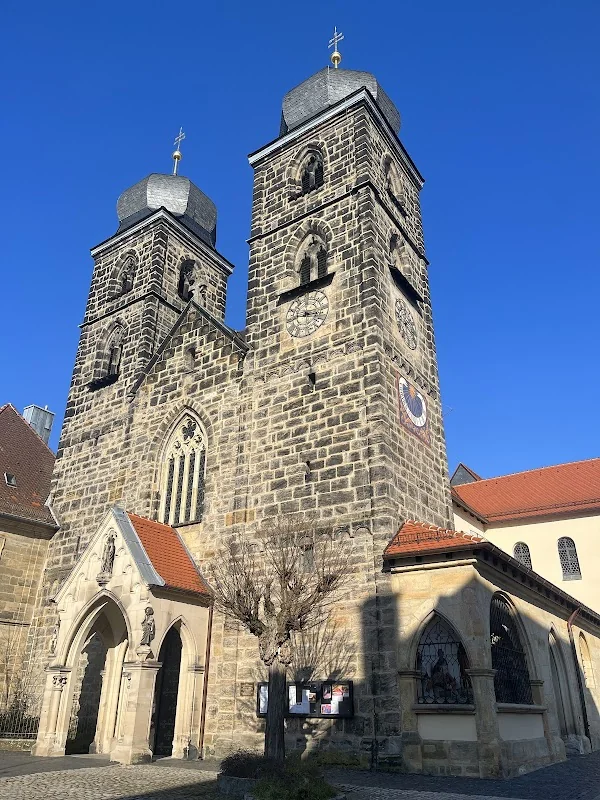
St. Gangolf in Bamberg is more than just a church for the everyday life of the parish. The church is one of the oldest still existing sacred buildings in the city and is located in a district that is itself one of the historical nuclei of Bamberg. Those searching for St. Gangolf Bamberg are often looking for not just an address, but also history, atmosphere, spiritual life, and a church that has changed repeatedly over the centuries while maintaining its identity. This mixture is what makes the Gangolf Church appealing: a structure that combines Romanesque origins, Gothic modifications, Baroque expansions, and Rococo decorative elements in a single space. Additionally, there is the vibrant present with services, parish life, and events in the community's surroundings. The church is located in the east of Bamberg in Theuerstadt and is firmly anchored in the ecclesiastical and cultural life of the city as part of the pastoral area of Bamberg East. For visitors, St. Gangolf is therefore both a quiet place of devotion and a piece of city history that is particularly condensed in architecture, art, and usage. Anyone interested in Bamberg should not only search for St. Gangolf on the map but understand it as a historical experiential space where early urban development, ecclesiastical tradition, and the community still lived today come together.
History of St. Gangolf Bamberg
The history of St. Gangolf is closely linked to Theuerstadt, one of the oldest settlement cores of Bamberg. According to the official information from the parish, this area was an important site of development early on, as a prehistoric trade route is known to have passed through Theuerstadt. From this early settlement history, the ecclesiastical community of St. Gangolf emerged as part of an urban and ecclesiastical order that has shaped Bamberg sustainably. Between 1057 and 1059, Bishop Gunther founded the collegiate foundation of St. Mary and Gangolf, although a founding document has not been preserved. The ecclesiastical consecration could already take place in 1063. Thus, St. Gangolf, along with St. Stephen, St. Michael, and St. Jacob, is counted among the early Bamberg foundations and holds a significant position in the city's development. This is also relevant for today's visitors, as here not only a single house of worship becomes visible but also a piece of Bamberg's early history. The church was originally a Marian church, but over time, the patronage of Saint Gangolf increasingly came to the forefront. The parish points out that the church has incorporated features in all epochs that shape its current image. This is precisely what makes the historical appeal: St. Gangolf is not a static monument but the result of many changes, renovations, and spiritual functions. In the Middle Ages, canons lived here, meaning they were not monks but clergy of a collegiate foundation. To this day, houses of the foundation lords, i.e., canonicate farms, can be traced around the church. Sources also mention that the spiritual foundations symbolically formed a cross with the cathedral, which was of great significance for medieval thinking. Equally fascinating is the development of property and legal relationships: The foundation had income from donations, feudal estates, and tithes and possessed rights in many places over time. However, the history was marked not only by growth but also by crises. The Hussite invasion of 1430, the Peasants' War of 1525, the invasion of Margrave Albrecht of Brandenburg-Kulmbach in 1553, as well as the fire and the consequences of the Swedish War in the 17th century took their toll on the foundation. Later, disputes over jurisdiction and immunity arose, which only ended in 1786. With the secularization, the function changed fundamentally: St. Gangolf was designated as the general parish church of the district. Various furnishings were taken from other churches, showing how closely history and liturgical practice were intertwined at that time. For visitors, this means: entering St. Gangolf is to enter a church with a very deep stratification of time, where early foundation history, urban development, and the upheavals of secularization remain discernible to this day.
Services at St. Gangolf Bamberg
Many people seek St. Gangolf Bamberg not only for its history but especially for the services. The official service page of the parish shows that St. Gangolf is an active liturgical place where regular evening masses, parish services, and Eucharistic celebrations take place. Thus, the church remains not just a monument but continues to fulfill its central religious function. For believers from Bamberg and the surrounding area, this is important because here tradition and present meet directly. The parish also lists additional services such as morning prayers and special liturgical forms throughout the year, clearly indicating that St. Gangolf is a lively parish community with recurring rituals and special occasions. This also adds value for visitors: those attending a mass or liturgical celebration experience not only architecture and art but the space in its true purpose. Especially in a church with such a long history, the service is the moment when the building particularly strongly demonstrates its spiritual continuity. Therefore, those searching for St. Gangolf Bamberg services will find a community that is actively present in the official calendars of the pastoral area of Bamberg East. St. Gangolf is also an important place for church festivals, anniversaries, or community days. The parish website mentions festive services and processions, as well as celebrations like parish festivals and liturgical actions throughout the year. This shows that the community fills its historical framework with current community life. For practical planning, it is important that the service times are regularly updated and align with the liturgical times of the church year. Therefore, anyone planning a visit should check the current service schedule in advance. Content-wise, it is already clear: St. Gangolf is a church where services are not marginal but central. This distinguishes it from many purely tourist attractions. At the same time, it remains open to people who just want to linger briefly, light a candle, or seek silence. This combination of open accessibility and active community life makes the place so attractive. The search for St. Gangolf Bamberg services is therefore always also a search for lived tradition, reliable liturgy, and a place where Bamberg's ecclesiastical culture can still be experienced concretely today.
Architecture and Artworks of the Gangolf Church
Architecturally, St. Gangolf is one of the most exciting churches in Bamberg because it clearly shows how a sacred building has developed over many centuries. The official tour of the parish describes the church as a former collegiate church built as a three-nave basilica on the eastern transept. As early as the early 12th century, Bishop Otto had one or perhaps both towers erected. In the 14th and 15th centuries, the nave was redesigned in the Gothic style, and around the middle of the 15th century, the Romanesque choir was replaced by a long Gothic structure. After a collapse, this choir had to be renewed and consecrated again later. Thus, St. Gangolf is not a uniform style building but a living architectural archive. Those who look closely will recognize Romanesque, Gothic, Baroque, and Rococo in a carefully shaped overall structure. Particularly impressive is that the Baroque period not only brought changes to the towers but also incorporated parts of the cloister into the church. In the Rococo period, the church received a complete new furnishing. Preserved from this are, among other things, the ceiling painting created in 1753 for the crossing by Johann Joseph Scheubel the Elder, as well as the altars of the side chapels and the choir stalls. These pieces are said by the parish to come from the Mutschele family, who lived in Theuerstadt and were closely connected to the church. The high altar is also associated with this family and content-wise refers to the fact that the church was originally a Marian church. Art historically particularly valuable are also the late Gothic Madonna in the transept, which comes from the demolished Franciscan church, and the Christ on the Tree of Life from the 13th century, which was transferred from Alt St. Martin. Additionally, there is the late Rococo pulpit, which came to St. Gangolf in 1938. The interior thus shows not only sacred furnishings but a genuine collection of Franconian art and piety history. The side elements are also significant: the left side altars are dedicated to Saints Nepomuk, Joseph, and Sebastian, while the right ones are dedicated to the Holy Trinity, the Mother of God, and Saint Charles Borromeo. All of this makes the church particularly exciting for art-interested visitors. There is not only a beautiful church space here but a complex interplay of building traditions, repurposing, and art transfers. Therefore, those visiting St. Gangolf as an architectural destination should take time for careful observation. The mix of the oldest building substance, later additions, and valuable furnishings gives the church its unmistakable character. This also explains why St. Gangolf appears so frequently in search queries like St gangolf church, St gangolf photos, or Gangolfskirche Bamberg: the building has a lot to tell visually and historically.
Opening Hours, Location, and Contact
For practical planning, the location and opening hours of St. Gangolf are particularly important. The church is located in Bamberg in Theuerstadt and thus in a historical urban area that is well embedded in the old city structure. Bamberg Tourism lists St. Gangolf as a sight in the Market Gardeners' District and World Heritage area, underscoring the cultural significance of the place. According to the local Winter in the World Heritage flyer, St. Gangolf is open daily from 9:00 AM to 5:00 PM year-round. This is very convenient for visitors, as the church remains accessible independently of a purely service visit. At the same time, St. Gangolf, as a parish church, is of course not a purely museum-like space but a place of prayer and community life. For direct contact, the official parish mentions the parish office of St. Gangolf at Theuerstadt 4, 96050 Bamberg, with opening hours on Tuesday from 4:30 PM to 6:00 PM and Thursday from 9:00 AM to 12:00 PM. Therefore, anyone with organizational questions, such as about weddings, baptisms, community events, or general inquiries, will find a reliable point of contact there. It is important for the location that St. Gangolf does not stand isolated but is anchored in the ecclesiastical network of the pastoral area of Bamberg East. This makes orientation easy: those heading to the Theuerstadt area reach a historically significant yet practically accessible place. When searching for St gangolf address or St gangolf opening hours, this information is particularly relevant. However, visitors should note that the opening hours of the parish office should not be confused with the daily church opening hours. The church itself is open during the day according to tourist information, while the office has its own hours. For a visit, a quiet morning or afternoon within the specified opening hours is recommended. Those planning according to the church year can also check the official service pages, as special liturgical dates and celebrations are published there. Overall, St. Gangolf is thus easily accessible, well documented, and suitable for both spontaneous and planned visits. This practical reliability makes the place attractive: historical significance, genuine community, and clear accessibility interconnect.
Photos, Tour, and Community Life
Anyone wanting to photograph or explore St. Gangolf Bamberg should take time for the tour. The official tour page of the parish makes it clear that the church in its current form holds many layers visible. For photos, this is particularly appealing because multiple epochs often overlap in a single motif: the historical exterior view, the towers, the richly decorated altar spaces, and the artworks inside. The tour itself leads to the most important points of the church space and explains how the patronage of Saint Gangolf has asserted itself against the original Marian church. This is exciting for both photography enthusiasts and culture-historically interested visitors, as the depicted elements can later be recognized in images. Particularly suitable are shots of the choir, the transept, and the side chapels, as the stylistic differences are most pronounced there. The Gothic Nicholas Chapel, the late Gothic group of Anna Selbdritt, and the side walls with their valuable panel paintings also make the interior photographically interesting. Therefore, those searching for St. Gangolf in pictures will find not only a beautiful facade but a multifaceted motif with sacred depth. At the same time, community life shows that the church is not a dormant place. On the pages of the pastoral area, parish festivals, services, altar server work, and events in the parish hall are published. Thus, St. Gangolf is also visible in everyday life as a lively community. The parish mentions, among other things, an active altar server group and regular community events. The parish hall itself is barrier-free accessible and has wheelchair-accessible access as well as a wheelchair-accessible restroom. Although this may initially seem more relevant for event planning, it is important for the overall impression: St. Gangolf thinks not only of liturgy and history but also of accessibility and use in community life. Therefore, anyone searching for St gangolf photos often unconsciously seeks the interplay of aesthetics and lived community. This is precisely what this place delivers. A visit is best enjoyed with some calm, as St. Gangolf unfolds its effect not in a quick glance but in the combination of exterior view, interior, art, and atmosphere. Especially since the church is open daily, it can also be spontaneously incorporated into a city tour. For Bamberg visitors, it is thus an ideal stop between the historic center, city stroll, and spiritual pause. Those wanting to understand the city should not only mark St. Gangolf as a destination on the map but see it as a place where Bamberg brings together its early history, its church art, and its present community life in a compact space.
Sources:
Mehr anzeigenWeniger anzeigen
St. Gangolf Bamberg | Church & Services
St. Gangolf in Bamberg is more than just a church for the everyday life of the parish. The church is one of the oldest still existing sacred buildings in the city and is located in a district that is itself one of the historical nuclei of Bamberg. Those searching for St. Gangolf Bamberg are often looking for not just an address, but also history, atmosphere, spiritual life, and a church that has changed repeatedly over the centuries while maintaining its identity. This mixture is what makes the Gangolf Church appealing: a structure that combines Romanesque origins, Gothic modifications, Baroque expansions, and Rococo decorative elements in a single space. Additionally, there is the vibrant present with services, parish life, and events in the community's surroundings. The church is located in the east of Bamberg in Theuerstadt and is firmly anchored in the ecclesiastical and cultural life of the city as part of the pastoral area of Bamberg East. For visitors, St. Gangolf is therefore both a quiet place of devotion and a piece of city history that is particularly condensed in architecture, art, and usage. Anyone interested in Bamberg should not only search for St. Gangolf on the map but understand it as a historical experiential space where early urban development, ecclesiastical tradition, and the community still lived today come together.
History of St. Gangolf Bamberg
The history of St. Gangolf is closely linked to Theuerstadt, one of the oldest settlement cores of Bamberg. According to the official information from the parish, this area was an important site of development early on, as a prehistoric trade route is known to have passed through Theuerstadt. From this early settlement history, the ecclesiastical community of St. Gangolf emerged as part of an urban and ecclesiastical order that has shaped Bamberg sustainably. Between 1057 and 1059, Bishop Gunther founded the collegiate foundation of St. Mary and Gangolf, although a founding document has not been preserved. The ecclesiastical consecration could already take place in 1063. Thus, St. Gangolf, along with St. Stephen, St. Michael, and St. Jacob, is counted among the early Bamberg foundations and holds a significant position in the city's development. This is also relevant for today's visitors, as here not only a single house of worship becomes visible but also a piece of Bamberg's early history. The church was originally a Marian church, but over time, the patronage of Saint Gangolf increasingly came to the forefront. The parish points out that the church has incorporated features in all epochs that shape its current image. This is precisely what makes the historical appeal: St. Gangolf is not a static monument but the result of many changes, renovations, and spiritual functions. In the Middle Ages, canons lived here, meaning they were not monks but clergy of a collegiate foundation. To this day, houses of the foundation lords, i.e., canonicate farms, can be traced around the church. Sources also mention that the spiritual foundations symbolically formed a cross with the cathedral, which was of great significance for medieval thinking. Equally fascinating is the development of property and legal relationships: The foundation had income from donations, feudal estates, and tithes and possessed rights in many places over time. However, the history was marked not only by growth but also by crises. The Hussite invasion of 1430, the Peasants' War of 1525, the invasion of Margrave Albrecht of Brandenburg-Kulmbach in 1553, as well as the fire and the consequences of the Swedish War in the 17th century took their toll on the foundation. Later, disputes over jurisdiction and immunity arose, which only ended in 1786. With the secularization, the function changed fundamentally: St. Gangolf was designated as the general parish church of the district. Various furnishings were taken from other churches, showing how closely history and liturgical practice were intertwined at that time. For visitors, this means: entering St. Gangolf is to enter a church with a very deep stratification of time, where early foundation history, urban development, and the upheavals of secularization remain discernible to this day.
Services at St. Gangolf Bamberg
Many people seek St. Gangolf Bamberg not only for its history but especially for the services. The official service page of the parish shows that St. Gangolf is an active liturgical place where regular evening masses, parish services, and Eucharistic celebrations take place. Thus, the church remains not just a monument but continues to fulfill its central religious function. For believers from Bamberg and the surrounding area, this is important because here tradition and present meet directly. The parish also lists additional services such as morning prayers and special liturgical forms throughout the year, clearly indicating that St. Gangolf is a lively parish community with recurring rituals and special occasions. This also adds value for visitors: those attending a mass or liturgical celebration experience not only architecture and art but the space in its true purpose. Especially in a church with such a long history, the service is the moment when the building particularly strongly demonstrates its spiritual continuity. Therefore, those searching for St. Gangolf Bamberg services will find a community that is actively present in the official calendars of the pastoral area of Bamberg East. St. Gangolf is also an important place for church festivals, anniversaries, or community days. The parish website mentions festive services and processions, as well as celebrations like parish festivals and liturgical actions throughout the year. This shows that the community fills its historical framework with current community life. For practical planning, it is important that the service times are regularly updated and align with the liturgical times of the church year. Therefore, anyone planning a visit should check the current service schedule in advance. Content-wise, it is already clear: St. Gangolf is a church where services are not marginal but central. This distinguishes it from many purely tourist attractions. At the same time, it remains open to people who just want to linger briefly, light a candle, or seek silence. This combination of open accessibility and active community life makes the place so attractive. The search for St. Gangolf Bamberg services is therefore always also a search for lived tradition, reliable liturgy, and a place where Bamberg's ecclesiastical culture can still be experienced concretely today.
Architecture and Artworks of the Gangolf Church
Architecturally, St. Gangolf is one of the most exciting churches in Bamberg because it clearly shows how a sacred building has developed over many centuries. The official tour of the parish describes the church as a former collegiate church built as a three-nave basilica on the eastern transept. As early as the early 12th century, Bishop Otto had one or perhaps both towers erected. In the 14th and 15th centuries, the nave was redesigned in the Gothic style, and around the middle of the 15th century, the Romanesque choir was replaced by a long Gothic structure. After a collapse, this choir had to be renewed and consecrated again later. Thus, St. Gangolf is not a uniform style building but a living architectural archive. Those who look closely will recognize Romanesque, Gothic, Baroque, and Rococo in a carefully shaped overall structure. Particularly impressive is that the Baroque period not only brought changes to the towers but also incorporated parts of the cloister into the church. In the Rococo period, the church received a complete new furnishing. Preserved from this are, among other things, the ceiling painting created in 1753 for the crossing by Johann Joseph Scheubel the Elder, as well as the altars of the side chapels and the choir stalls. These pieces are said by the parish to come from the Mutschele family, who lived in Theuerstadt and were closely connected to the church. The high altar is also associated with this family and content-wise refers to the fact that the church was originally a Marian church. Art historically particularly valuable are also the late Gothic Madonna in the transept, which comes from the demolished Franciscan church, and the Christ on the Tree of Life from the 13th century, which was transferred from Alt St. Martin. Additionally, there is the late Rococo pulpit, which came to St. Gangolf in 1938. The interior thus shows not only sacred furnishings but a genuine collection of Franconian art and piety history. The side elements are also significant: the left side altars are dedicated to Saints Nepomuk, Joseph, and Sebastian, while the right ones are dedicated to the Holy Trinity, the Mother of God, and Saint Charles Borromeo. All of this makes the church particularly exciting for art-interested visitors. There is not only a beautiful church space here but a complex interplay of building traditions, repurposing, and art transfers. Therefore, those visiting St. Gangolf as an architectural destination should take time for careful observation. The mix of the oldest building substance, later additions, and valuable furnishings gives the church its unmistakable character. This also explains why St. Gangolf appears so frequently in search queries like St gangolf church, St gangolf photos, or Gangolfskirche Bamberg: the building has a lot to tell visually and historically.
Opening Hours, Location, and Contact
For practical planning, the location and opening hours of St. Gangolf are particularly important. The church is located in Bamberg in Theuerstadt and thus in a historical urban area that is well embedded in the old city structure. Bamberg Tourism lists St. Gangolf as a sight in the Market Gardeners' District and World Heritage area, underscoring the cultural significance of the place. According to the local Winter in the World Heritage flyer, St. Gangolf is open daily from 9:00 AM to 5:00 PM year-round. This is very convenient for visitors, as the church remains accessible independently of a purely service visit. At the same time, St. Gangolf, as a parish church, is of course not a purely museum-like space but a place of prayer and community life. For direct contact, the official parish mentions the parish office of St. Gangolf at Theuerstadt 4, 96050 Bamberg, with opening hours on Tuesday from 4:30 PM to 6:00 PM and Thursday from 9:00 AM to 12:00 PM. Therefore, anyone with organizational questions, such as about weddings, baptisms, community events, or general inquiries, will find a reliable point of contact there. It is important for the location that St. Gangolf does not stand isolated but is anchored in the ecclesiastical network of the pastoral area of Bamberg East. This makes orientation easy: those heading to the Theuerstadt area reach a historically significant yet practically accessible place. When searching for St gangolf address or St gangolf opening hours, this information is particularly relevant. However, visitors should note that the opening hours of the parish office should not be confused with the daily church opening hours. The church itself is open during the day according to tourist information, while the office has its own hours. For a visit, a quiet morning or afternoon within the specified opening hours is recommended. Those planning according to the church year can also check the official service pages, as special liturgical dates and celebrations are published there. Overall, St. Gangolf is thus easily accessible, well documented, and suitable for both spontaneous and planned visits. This practical reliability makes the place attractive: historical significance, genuine community, and clear accessibility interconnect.
Photos, Tour, and Community Life
Anyone wanting to photograph or explore St. Gangolf Bamberg should take time for the tour. The official tour page of the parish makes it clear that the church in its current form holds many layers visible. For photos, this is particularly appealing because multiple epochs often overlap in a single motif: the historical exterior view, the towers, the richly decorated altar spaces, and the artworks inside. The tour itself leads to the most important points of the church space and explains how the patronage of Saint Gangolf has asserted itself against the original Marian church. This is exciting for both photography enthusiasts and culture-historically interested visitors, as the depicted elements can later be recognized in images. Particularly suitable are shots of the choir, the transept, and the side chapels, as the stylistic differences are most pronounced there. The Gothic Nicholas Chapel, the late Gothic group of Anna Selbdritt, and the side walls with their valuable panel paintings also make the interior photographically interesting. Therefore, those searching for St. Gangolf in pictures will find not only a beautiful facade but a multifaceted motif with sacred depth. At the same time, community life shows that the church is not a dormant place. On the pages of the pastoral area, parish festivals, services, altar server work, and events in the parish hall are published. Thus, St. Gangolf is also visible in everyday life as a lively community. The parish mentions, among other things, an active altar server group and regular community events. The parish hall itself is barrier-free accessible and has wheelchair-accessible access as well as a wheelchair-accessible restroom. Although this may initially seem more relevant for event planning, it is important for the overall impression: St. Gangolf thinks not only of liturgy and history but also of accessibility and use in community life. Therefore, anyone searching for St gangolf photos often unconsciously seeks the interplay of aesthetics and lived community. This is precisely what this place delivers. A visit is best enjoyed with some calm, as St. Gangolf unfolds its effect not in a quick glance but in the combination of exterior view, interior, art, and atmosphere. Especially since the church is open daily, it can also be spontaneously incorporated into a city tour. For Bamberg visitors, it is thus an ideal stop between the historic center, city stroll, and spiritual pause. Those wanting to understand the city should not only mark St. Gangolf as a destination on the map but see it as a place where Bamberg brings together its early history, its church art, and its present community life in a compact space.
Sources:
St. Gangolf Bamberg | Church & Services
St. Gangolf in Bamberg is more than just a church for the everyday life of the parish. The church is one of the oldest still existing sacred buildings in the city and is located in a district that is itself one of the historical nuclei of Bamberg. Those searching for St. Gangolf Bamberg are often looking for not just an address, but also history, atmosphere, spiritual life, and a church that has changed repeatedly over the centuries while maintaining its identity. This mixture is what makes the Gangolf Church appealing: a structure that combines Romanesque origins, Gothic modifications, Baroque expansions, and Rococo decorative elements in a single space. Additionally, there is the vibrant present with services, parish life, and events in the community's surroundings. The church is located in the east of Bamberg in Theuerstadt and is firmly anchored in the ecclesiastical and cultural life of the city as part of the pastoral area of Bamberg East. For visitors, St. Gangolf is therefore both a quiet place of devotion and a piece of city history that is particularly condensed in architecture, art, and usage. Anyone interested in Bamberg should not only search for St. Gangolf on the map but understand it as a historical experiential space where early urban development, ecclesiastical tradition, and the community still lived today come together.
History of St. Gangolf Bamberg
The history of St. Gangolf is closely linked to Theuerstadt, one of the oldest settlement cores of Bamberg. According to the official information from the parish, this area was an important site of development early on, as a prehistoric trade route is known to have passed through Theuerstadt. From this early settlement history, the ecclesiastical community of St. Gangolf emerged as part of an urban and ecclesiastical order that has shaped Bamberg sustainably. Between 1057 and 1059, Bishop Gunther founded the collegiate foundation of St. Mary and Gangolf, although a founding document has not been preserved. The ecclesiastical consecration could already take place in 1063. Thus, St. Gangolf, along with St. Stephen, St. Michael, and St. Jacob, is counted among the early Bamberg foundations and holds a significant position in the city's development. This is also relevant for today's visitors, as here not only a single house of worship becomes visible but also a piece of Bamberg's early history. The church was originally a Marian church, but over time, the patronage of Saint Gangolf increasingly came to the forefront. The parish points out that the church has incorporated features in all epochs that shape its current image. This is precisely what makes the historical appeal: St. Gangolf is not a static monument but the result of many changes, renovations, and spiritual functions. In the Middle Ages, canons lived here, meaning they were not monks but clergy of a collegiate foundation. To this day, houses of the foundation lords, i.e., canonicate farms, can be traced around the church. Sources also mention that the spiritual foundations symbolically formed a cross with the cathedral, which was of great significance for medieval thinking. Equally fascinating is the development of property and legal relationships: The foundation had income from donations, feudal estates, and tithes and possessed rights in many places over time. However, the history was marked not only by growth but also by crises. The Hussite invasion of 1430, the Peasants' War of 1525, the invasion of Margrave Albrecht of Brandenburg-Kulmbach in 1553, as well as the fire and the consequences of the Swedish War in the 17th century took their toll on the foundation. Later, disputes over jurisdiction and immunity arose, which only ended in 1786. With the secularization, the function changed fundamentally: St. Gangolf was designated as the general parish church of the district. Various furnishings were taken from other churches, showing how closely history and liturgical practice were intertwined at that time. For visitors, this means: entering St. Gangolf is to enter a church with a very deep stratification of time, where early foundation history, urban development, and the upheavals of secularization remain discernible to this day.
Services at St. Gangolf Bamberg
Many people seek St. Gangolf Bamberg not only for its history but especially for the services. The official service page of the parish shows that St. Gangolf is an active liturgical place where regular evening masses, parish services, and Eucharistic celebrations take place. Thus, the church remains not just a monument but continues to fulfill its central religious function. For believers from Bamberg and the surrounding area, this is important because here tradition and present meet directly. The parish also lists additional services such as morning prayers and special liturgical forms throughout the year, clearly indicating that St. Gangolf is a lively parish community with recurring rituals and special occasions. This also adds value for visitors: those attending a mass or liturgical celebration experience not only architecture and art but the space in its true purpose. Especially in a church with such a long history, the service is the moment when the building particularly strongly demonstrates its spiritual continuity. Therefore, those searching for St. Gangolf Bamberg services will find a community that is actively present in the official calendars of the pastoral area of Bamberg East. St. Gangolf is also an important place for church festivals, anniversaries, or community days. The parish website mentions festive services and processions, as well as celebrations like parish festivals and liturgical actions throughout the year. This shows that the community fills its historical framework with current community life. For practical planning, it is important that the service times are regularly updated and align with the liturgical times of the church year. Therefore, anyone planning a visit should check the current service schedule in advance. Content-wise, it is already clear: St. Gangolf is a church where services are not marginal but central. This distinguishes it from many purely tourist attractions. At the same time, it remains open to people who just want to linger briefly, light a candle, or seek silence. This combination of open accessibility and active community life makes the place so attractive. The search for St. Gangolf Bamberg services is therefore always also a search for lived tradition, reliable liturgy, and a place where Bamberg's ecclesiastical culture can still be experienced concretely today.
Architecture and Artworks of the Gangolf Church
Architecturally, St. Gangolf is one of the most exciting churches in Bamberg because it clearly shows how a sacred building has developed over many centuries. The official tour of the parish describes the church as a former collegiate church built as a three-nave basilica on the eastern transept. As early as the early 12th century, Bishop Otto had one or perhaps both towers erected. In the 14th and 15th centuries, the nave was redesigned in the Gothic style, and around the middle of the 15th century, the Romanesque choir was replaced by a long Gothic structure. After a collapse, this choir had to be renewed and consecrated again later. Thus, St. Gangolf is not a uniform style building but a living architectural archive. Those who look closely will recognize Romanesque, Gothic, Baroque, and Rococo in a carefully shaped overall structure. Particularly impressive is that the Baroque period not only brought changes to the towers but also incorporated parts of the cloister into the church. In the Rococo period, the church received a complete new furnishing. Preserved from this are, among other things, the ceiling painting created in 1753 for the crossing by Johann Joseph Scheubel the Elder, as well as the altars of the side chapels and the choir stalls. These pieces are said by the parish to come from the Mutschele family, who lived in Theuerstadt and were closely connected to the church. The high altar is also associated with this family and content-wise refers to the fact that the church was originally a Marian church. Art historically particularly valuable are also the late Gothic Madonna in the transept, which comes from the demolished Franciscan church, and the Christ on the Tree of Life from the 13th century, which was transferred from Alt St. Martin. Additionally, there is the late Rococo pulpit, which came to St. Gangolf in 1938. The interior thus shows not only sacred furnishings but a genuine collection of Franconian art and piety history. The side elements are also significant: the left side altars are dedicated to Saints Nepomuk, Joseph, and Sebastian, while the right ones are dedicated to the Holy Trinity, the Mother of God, and Saint Charles Borromeo. All of this makes the church particularly exciting for art-interested visitors. There is not only a beautiful church space here but a complex interplay of building traditions, repurposing, and art transfers. Therefore, those visiting St. Gangolf as an architectural destination should take time for careful observation. The mix of the oldest building substance, later additions, and valuable furnishings gives the church its unmistakable character. This also explains why St. Gangolf appears so frequently in search queries like St gangolf church, St gangolf photos, or Gangolfskirche Bamberg: the building has a lot to tell visually and historically.
Opening Hours, Location, and Contact
For practical planning, the location and opening hours of St. Gangolf are particularly important. The church is located in Bamberg in Theuerstadt and thus in a historical urban area that is well embedded in the old city structure. Bamberg Tourism lists St. Gangolf as a sight in the Market Gardeners' District and World Heritage area, underscoring the cultural significance of the place. According to the local Winter in the World Heritage flyer, St. Gangolf is open daily from 9:00 AM to 5:00 PM year-round. This is very convenient for visitors, as the church remains accessible independently of a purely service visit. At the same time, St. Gangolf, as a parish church, is of course not a purely museum-like space but a place of prayer and community life. For direct contact, the official parish mentions the parish office of St. Gangolf at Theuerstadt 4, 96050 Bamberg, with opening hours on Tuesday from 4:30 PM to 6:00 PM and Thursday from 9:00 AM to 12:00 PM. Therefore, anyone with organizational questions, such as about weddings, baptisms, community events, or general inquiries, will find a reliable point of contact there. It is important for the location that St. Gangolf does not stand isolated but is anchored in the ecclesiastical network of the pastoral area of Bamberg East. This makes orientation easy: those heading to the Theuerstadt area reach a historically significant yet practically accessible place. When searching for St gangolf address or St gangolf opening hours, this information is particularly relevant. However, visitors should note that the opening hours of the parish office should not be confused with the daily church opening hours. The church itself is open during the day according to tourist information, while the office has its own hours. For a visit, a quiet morning or afternoon within the specified opening hours is recommended. Those planning according to the church year can also check the official service pages, as special liturgical dates and celebrations are published there. Overall, St. Gangolf is thus easily accessible, well documented, and suitable for both spontaneous and planned visits. This practical reliability makes the place attractive: historical significance, genuine community, and clear accessibility interconnect.
Photos, Tour, and Community Life
Anyone wanting to photograph or explore St. Gangolf Bamberg should take time for the tour. The official tour page of the parish makes it clear that the church in its current form holds many layers visible. For photos, this is particularly appealing because multiple epochs often overlap in a single motif: the historical exterior view, the towers, the richly decorated altar spaces, and the artworks inside. The tour itself leads to the most important points of the church space and explains how the patronage of Saint Gangolf has asserted itself against the original Marian church. This is exciting for both photography enthusiasts and culture-historically interested visitors, as the depicted elements can later be recognized in images. Particularly suitable are shots of the choir, the transept, and the side chapels, as the stylistic differences are most pronounced there. The Gothic Nicholas Chapel, the late Gothic group of Anna Selbdritt, and the side walls with their valuable panel paintings also make the interior photographically interesting. Therefore, those searching for St. Gangolf in pictures will find not only a beautiful facade but a multifaceted motif with sacred depth. At the same time, community life shows that the church is not a dormant place. On the pages of the pastoral area, parish festivals, services, altar server work, and events in the parish hall are published. Thus, St. Gangolf is also visible in everyday life as a lively community. The parish mentions, among other things, an active altar server group and regular community events. The parish hall itself is barrier-free accessible and has wheelchair-accessible access as well as a wheelchair-accessible restroom. Although this may initially seem more relevant for event planning, it is important for the overall impression: St. Gangolf thinks not only of liturgy and history but also of accessibility and use in community life. Therefore, anyone searching for St gangolf photos often unconsciously seeks the interplay of aesthetics and lived community. This is precisely what this place delivers. A visit is best enjoyed with some calm, as St. Gangolf unfolds its effect not in a quick glance but in the combination of exterior view, interior, art, and atmosphere. Especially since the church is open daily, it can also be spontaneously incorporated into a city tour. For Bamberg visitors, it is thus an ideal stop between the historic center, city stroll, and spiritual pause. Those wanting to understand the city should not only mark St. Gangolf as a destination on the map but see it as a place where Bamberg brings together its early history, its church art, and its present community life in a compact space.
Sources:
Upcoming Events
No events found
Frequently Asked Questions
Reviews
Tracy Nuria Ventura Condo
8. July 2025
I'm a simple woman, I'm attracted to the pretty (can't stop looking at the ciborium and woodwork)
Tom
3. April 2022
Catholic parish church St. Gangolf Theuerstadt Gärtnerstadt threshold 0 cm wheelchair accessible main entrance & side entrance, button automatic door opener side entrance, threshold 0 cm 1st floor door width 93 cm, inductive hearing system, modern & powerful speaker system, prayer books in large print, cobblestones, disabled parking space in front of the church 28 m, barrier-free bus stop Bamberg Luitpoldstraße 225 m, Deanery Bamberg, pastoral area Bamberger Osten, 96050 Bamberg Theuerstadt 2 St. Gangolf Theuerstadt wheelchair yes, disabled parking place 28 m, toilets: wheelchair parish center.
Dorothea “Thea” Benke
27. May 2025
We were there for our granddaughter's communion, beautiful baroque church and a good service.
Jörg Klewer
28. February 2022
Beautifully furnished church that can be visited. Parts of the old surrounding buildings are also preserved.
Christoph Zimmermann
17. March 2024
Significant church, it's said to be the oldest in Bamberg. Very interesting decor, church was freely accessible. Worth a visit!