
Bamberg
Ob. Sandstraße 42, 96049 Bamberg, Deutschland
St. Elisabeth im Sand | Photos & History
St. Elisabeth im Sand is a place where Bamberg's history, art, and old town atmosphere are condensed in a small space. The church is located at Obere Sandstraße 42 near Klein Venedig, the Bamberg Cathedral, and the New Residence, making it one of the sights that is hard to overlook during a stroll through the historic center. At the same time, it is not only a monument of the past but also a vibrant art location: The city of Bamberg and Bamberg Tourism present St. Elisabeth today as a place with an open church space, featuring striking stained glass windows by Markus Lüpertz and a visitation offer aimed at both locals and visitors from outside. Therefore, those looking for photos, images, or background information about St. Elisabeth im Sand will find not only a beautiful facade but a church with clear historical depth, cultural significance, and a special light effect in the interior. ([visitbamberg.com](https://www.visitbamberg.com/poi/st-elisabeth/?utm_source=openai))
Particularly interesting is the connection between medieval origins and modern artistic interpretation. The official tourism presentation traces the history of the Elisabeth Church back to the year 1328, while the current form of the church space and its aura were shaped by later renovations, reconsecration, and the Lüpertz windows. For visitors, this is exciting because here, not just a single monument can be seen, but a development over many centuries. This is precisely what creates the appeal for photos, for cultural-historical visits, and for people searching for quiet yet impressive places in Bamberg. The church is also regularly open, making the visit easy to plan and fitting well into a tour of the old town. ([visitbamberg.com](https://www.visitbamberg.com/poi/st-elisabeth/?utm_source=openai))
The History of St. Elisabeth im Sand: From Hospital to Church
The roots of St. Elisabeth im Sand date back to the year 1328. At that time, the citizen Konrad Eseler founded the second Bamberg citizens' hospital. The historical function was thus strongly socially shaped from the very beginning: From the Middle Ages to modern times, the space served as a religious place for patients, relatives, and nursing staff. This makes the church in Bamberg more than just a building. It is a testament to how closely care, faith, and city history were intertwined. The official tourism presentation emphasizes this origin and shows that St. Elisabeth did not emerge as an isolated church building but as part of a hospital complex in the Sand area, a place where help, care, and pastoral care were interconnected. ([visitbamberg.com](https://www.visitbamberg.com/poi/st-elisabeth/?utm_source=openai))
As history progressed, the use of the building changed multiple times. When the city merged the Elisabeth Hospital with the Bamberg Katharinen Hospital in 1738, a prison was housed in the vacated spaces in the Sand area. This phase shows how significantly the importance of the place shifted over the centuries. The construction history itself is also multifaceted: The choir still standing today dates back to around 1400, according to Bamberg Tourism, while the nave was built in 1493. The later secularization brought further profound changes, as St. Elisabeth was used as a prison and workhouse before the church was consecrated again in 1883. This sequence makes the place so impressive because it not only shows pious continuity but also breaks, repurposing, and renewal. Therefore, those interested in the history of St. Elisabeth im Sand will find a building that acts like a historical archive in the urban space. ([visitbamberg.com](https://www.visitbamberg.com/poi/st-elisabeth/?utm_source=openai))
Markus Lüpertz and the Stained Glass Windows: Art in the Light of the Church Space
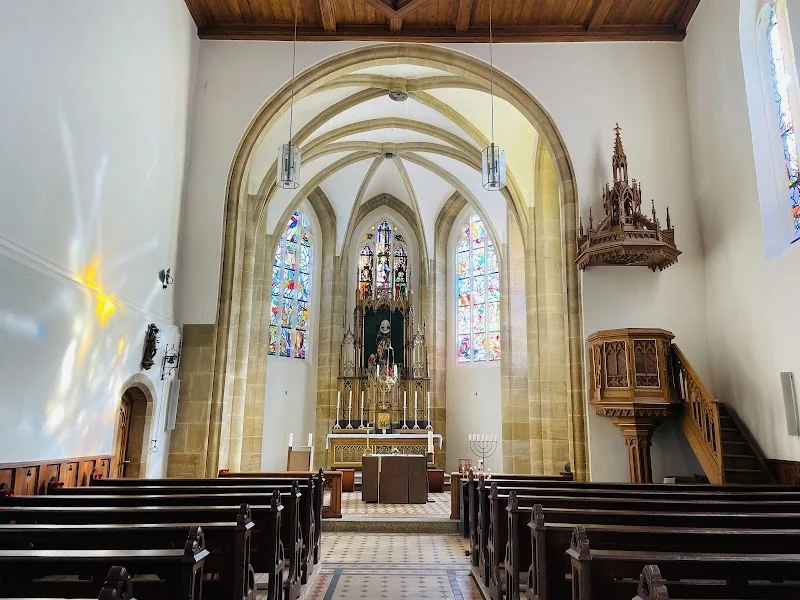
Among the most striking features of St. Elisabeth im Sand are the eight stained glass windows by Markus Lüpertz. The city of Bamberg describes them as a significant example of contemporary art in public space. Thematically, the windows reflect the patronage of the church: They connect scenes from the life of Saint Elisabeth with the seven works of mercy. These include feeding the hungry, sheltering the homeless, clothing the naked, visiting the sick, visiting the imprisoned, burying the dead, and giving alms. The eighth window is dedicated to the biblical verse from Mt 25:40. This creates a cohesive program that is not only art-historically interesting but can also be read spiritually and theologically. ([stadt.bamberg.de](https://www.stadt.bamberg.de/Unsere-Stadt/Kultur-und-Kunst-/L%C3%BCpertz-Fenster/?utm_source=openai))
Especially for visitors looking for photos or images of St. Elisabeth im Sand, these windows are a key reason for the appeal of the place. Light filters through the colored panes into the church space and changes the effect of the entire interior depending on the time of day. The city of Bamberg emphasizes that the windows are not merely illustrative decoration but a testimony of faith in secular times. It is also interesting that the public art impulse does not end inside: In front of the church, the sculpture Apoll by Markus Lüpertz is already present, creating a visible connection between the artist and the place. The church thus becomes a space where medieval structure and contemporary art do not contradict each other but instead reinforce one another. Therefore, those who visit St. Elisabeth im Sand experience not only a historical church but a consciously designed art location that attracts attention beyond Bamberg. ([stadt.bamberg.de](https://www.stadt.bamberg.de/Unsere-Stadt/Kultur-und-Kunst-/L%C3%BCpertz-Fenster/?utm_source=openai))
Opening Hours, Tours, and Accessible Access
The official pages make the visit to St. Elisabeth im Sand well-planned. The World Heritage Center of the city of Bamberg states the opening hours for the church space as Tuesday to Sunday, from 11:00 AM to 5:00 PM. Additionally, it is specified that the church space is open from April to October from Tuesday to Sunday and on public holidays between 11:00 AM and 5:00 PM. During the winter months, shortened hours apply from 11:00 AM to 3:00 PM. The portal is open daily from 8:00 AM to 6:00 PM. Exceptions apply for services, weddings, individual tours, and concert events. This is important for visitors because it allows for a short detour to the church to be easily combined with a stroll through the old town early in the day or in the afternoon. ([stadt.bamberg.de](https://www.stadt.bamberg.de/Unsere-Stadt/Kultur-und-Kunst-/L%C3%BCpertz-Fenster/%C3%96ffnungszeiten-und-F%C3%BChrungen/?utm_source=openai))
Regarding tours and access, the church also provides concrete information. The city of Bamberg refers to group tours such as “Power Plants of Light: Lüpertz Designs and Windows,” which even begin with original designs by the artist in the diocesan museum and then lead to the stained glass windows in St. Elisabeth. This makes it clear that the place can not only be visited individually but also experienced in a curated art and educational context. Furthermore, Bamberg Tourism describes St. Elisabeth as conditionally wheelchair accessible; access is step-free via a small ramp in front of the main entrance door. This is a significant practical advantage for a historical church building. Therefore, those looking for a church with cultural value, art reference, and accessible visiting format will find a remarkable offer in St. Elisabeth im Sand. ([stadt.bamberg.de](https://www.stadt.bamberg.de/Unsere-Stadt/Kultur-und-Kunst-/L%C3%BCpertz-Fenster/%C3%96ffnungszeiten-und-F%C3%BChrungen/?utm_source=openai))
Address, Old Town Location, and Nearby Attractions
The exact location of St. Elisabeth im Sand is very helpful for orientation in Bamberg: Obere Sandstraße 42, 96049 Bamberg. The tourism information clearly places the church in the old town and mentions Klein Venedig, the Bamberg Cathedral, Schlenkerla, and the New Residence as several well-known destinations in immediate proximity. This makes it clear that St. Elisabeth fits very well into a tour through the UNESCO-shaped cityscape. The old town of Bamberg is described by the city itself as a historically grown ensemble, whose medieval core, Gothic architecture, and bourgeois Baroque shape the cityscape. St. Elisabeth lies right in the middle of this context and is therefore a sensible stop not only for church enthusiasts but also for city visitors. ([visitbamberg.com](https://www.visitbamberg.com/poi/st-elisabeth/?utm_source=openai))
For visit planning, it is also useful that the city of Bamberg highlights St. Elisabeth im Sand as a publicly open cultural site and that the church opening is organized by the museums of the city of Bamberg in cooperation with the Museums Service GmbH. This shows that the place is integrated into urban cultural mediation and is not merely regarded as a static monument. Therefore, those who want to photograph the church will find not only a quiet interior but also a location that integrates into the flow of an old town walk. The combination of Sandstraße, historical neighboring buildings, and proximity to the most important sights of the city center creates many perspectives for exterior shots, city views, and detailed images. Especially because the church stands in such a dense historical environment, it acts like a resting center between busy paths, gastronomic addresses, and the typical sight lines of Bamberg's old town. ([stadt.bamberg.de](https://www.stadt.bamberg.de/Startseite/OB-Kirche-St-Elisabeth-wird-t%C3%A4glich-ge%C3%B6ffnet-.php?FID=3481.1684.1&ModID=7&NavID=2730.2&object=tx%2C3481.6&utm_source=openai))
Events, Photo Opportunities, and the Unique Visitor Experience
St. Elisabeth im Sand is not only a place for quiet visits but also appears in Bamberg's cultural event offerings. Bamberg Tourism lists the church in the area of Music & concerts, thus referring to its profile as a venue for musical events. At the same time, the city of Bamberg describes the church as a space visited by art and culture enthusiasts from near and far to see the vividly colorful windows in the heart of the old town. This light effect is crucial for the visitor experience: The Lüpertz windows give the space an intense presence that distinctly differs from classical church interiors and makes St. Elisabeth equally interesting for photos, art observation, and meditative visits. ([stadt.bamberg.de](https://www.stadt.bamberg.de/Startseite/OB-Kirche-St-Elisabeth-wird-t%C3%A4glich-ge%C3%B6ffnet-.php?FID=3481.1684.1&ModID=7&NavID=2730.2&object=tx%2C3481.6&utm_source=openai))
Another special aspect is the historical path of crucifixion, which, according to Bamberg Tourism, begins at the church as early as 1503 and leads visitors and pilgrims over the Michaelsberg to St. Getreu. This gives the place an additional spiritual and topographical dimension, connecting it with other stations of old Bamberg. Therefore, those looking for images or impressions of St. Elisabeth im Sand will find not just a single church but a hub between art, piety, city history, and path culture. The opening organization also emphasizes this role: The city of Bamberg stresses that the church space is open for visits and also takes tours and events into account. Thus, a place emerges where quiet devotion, cultural education, and interest in architecture naturally meet. ([en.bamberg.info](https://en.bamberg.info/poi/st_elisabeth-4633/))
Sources:
- visit Bamberg - St. Elisabeth
- Bamberg Tourism - St. Elisabeth
- City of Bamberg - St. Elisabeth im Sand / Opening Hours
- City of Bamberg - The Stained Glass Windows by Markus Lüpertz in St. Elisabeth im Sand
- City of Bamberg - Culture and Art / Art Guide St. Elisabeth im Sand
- City of Bamberg - Church St. Elisabeth is Open Daily
Mehr anzeigenWeniger anzeigen
St. Elisabeth im Sand | Photos & History
St. Elisabeth im Sand is a place where Bamberg's history, art, and old town atmosphere are condensed in a small space. The church is located at Obere Sandstraße 42 near Klein Venedig, the Bamberg Cathedral, and the New Residence, making it one of the sights that is hard to overlook during a stroll through the historic center. At the same time, it is not only a monument of the past but also a vibrant art location: The city of Bamberg and Bamberg Tourism present St. Elisabeth today as a place with an open church space, featuring striking stained glass windows by Markus Lüpertz and a visitation offer aimed at both locals and visitors from outside. Therefore, those looking for photos, images, or background information about St. Elisabeth im Sand will find not only a beautiful facade but a church with clear historical depth, cultural significance, and a special light effect in the interior. ([visitbamberg.com](https://www.visitbamberg.com/poi/st-elisabeth/?utm_source=openai))
Particularly interesting is the connection between medieval origins and modern artistic interpretation. The official tourism presentation traces the history of the Elisabeth Church back to the year 1328, while the current form of the church space and its aura were shaped by later renovations, reconsecration, and the Lüpertz windows. For visitors, this is exciting because here, not just a single monument can be seen, but a development over many centuries. This is precisely what creates the appeal for photos, for cultural-historical visits, and for people searching for quiet yet impressive places in Bamberg. The church is also regularly open, making the visit easy to plan and fitting well into a tour of the old town. ([visitbamberg.com](https://www.visitbamberg.com/poi/st-elisabeth/?utm_source=openai))
The History of St. Elisabeth im Sand: From Hospital to Church
The roots of St. Elisabeth im Sand date back to the year 1328. At that time, the citizen Konrad Eseler founded the second Bamberg citizens' hospital. The historical function was thus strongly socially shaped from the very beginning: From the Middle Ages to modern times, the space served as a religious place for patients, relatives, and nursing staff. This makes the church in Bamberg more than just a building. It is a testament to how closely care, faith, and city history were intertwined. The official tourism presentation emphasizes this origin and shows that St. Elisabeth did not emerge as an isolated church building but as part of a hospital complex in the Sand area, a place where help, care, and pastoral care were interconnected. ([visitbamberg.com](https://www.visitbamberg.com/poi/st-elisabeth/?utm_source=openai))
As history progressed, the use of the building changed multiple times. When the city merged the Elisabeth Hospital with the Bamberg Katharinen Hospital in 1738, a prison was housed in the vacated spaces in the Sand area. This phase shows how significantly the importance of the place shifted over the centuries. The construction history itself is also multifaceted: The choir still standing today dates back to around 1400, according to Bamberg Tourism, while the nave was built in 1493. The later secularization brought further profound changes, as St. Elisabeth was used as a prison and workhouse before the church was consecrated again in 1883. This sequence makes the place so impressive because it not only shows pious continuity but also breaks, repurposing, and renewal. Therefore, those interested in the history of St. Elisabeth im Sand will find a building that acts like a historical archive in the urban space. ([visitbamberg.com](https://www.visitbamberg.com/poi/st-elisabeth/?utm_source=openai))
Markus Lüpertz and the Stained Glass Windows: Art in the Light of the Church Space
Among the most striking features of St. Elisabeth im Sand are the eight stained glass windows by Markus Lüpertz. The city of Bamberg describes them as a significant example of contemporary art in public space. Thematically, the windows reflect the patronage of the church: They connect scenes from the life of Saint Elisabeth with the seven works of mercy. These include feeding the hungry, sheltering the homeless, clothing the naked, visiting the sick, visiting the imprisoned, burying the dead, and giving alms. The eighth window is dedicated to the biblical verse from Mt 25:40. This creates a cohesive program that is not only art-historically interesting but can also be read spiritually and theologically. ([stadt.bamberg.de](https://www.stadt.bamberg.de/Unsere-Stadt/Kultur-und-Kunst-/L%C3%BCpertz-Fenster/?utm_source=openai))
Especially for visitors looking for photos or images of St. Elisabeth im Sand, these windows are a key reason for the appeal of the place. Light filters through the colored panes into the church space and changes the effect of the entire interior depending on the time of day. The city of Bamberg emphasizes that the windows are not merely illustrative decoration but a testimony of faith in secular times. It is also interesting that the public art impulse does not end inside: In front of the church, the sculpture Apoll by Markus Lüpertz is already present, creating a visible connection between the artist and the place. The church thus becomes a space where medieval structure and contemporary art do not contradict each other but instead reinforce one another. Therefore, those who visit St. Elisabeth im Sand experience not only a historical church but a consciously designed art location that attracts attention beyond Bamberg. ([stadt.bamberg.de](https://www.stadt.bamberg.de/Unsere-Stadt/Kultur-und-Kunst-/L%C3%BCpertz-Fenster/?utm_source=openai))
Opening Hours, Tours, and Accessible Access
The official pages make the visit to St. Elisabeth im Sand well-planned. The World Heritage Center of the city of Bamberg states the opening hours for the church space as Tuesday to Sunday, from 11:00 AM to 5:00 PM. Additionally, it is specified that the church space is open from April to October from Tuesday to Sunday and on public holidays between 11:00 AM and 5:00 PM. During the winter months, shortened hours apply from 11:00 AM to 3:00 PM. The portal is open daily from 8:00 AM to 6:00 PM. Exceptions apply for services, weddings, individual tours, and concert events. This is important for visitors because it allows for a short detour to the church to be easily combined with a stroll through the old town early in the day or in the afternoon. ([stadt.bamberg.de](https://www.stadt.bamberg.de/Unsere-Stadt/Kultur-und-Kunst-/L%C3%BCpertz-Fenster/%C3%96ffnungszeiten-und-F%C3%BChrungen/?utm_source=openai))
Regarding tours and access, the church also provides concrete information. The city of Bamberg refers to group tours such as “Power Plants of Light: Lüpertz Designs and Windows,” which even begin with original designs by the artist in the diocesan museum and then lead to the stained glass windows in St. Elisabeth. This makes it clear that the place can not only be visited individually but also experienced in a curated art and educational context. Furthermore, Bamberg Tourism describes St. Elisabeth as conditionally wheelchair accessible; access is step-free via a small ramp in front of the main entrance door. This is a significant practical advantage for a historical church building. Therefore, those looking for a church with cultural value, art reference, and accessible visiting format will find a remarkable offer in St. Elisabeth im Sand. ([stadt.bamberg.de](https://www.stadt.bamberg.de/Unsere-Stadt/Kultur-und-Kunst-/L%C3%BCpertz-Fenster/%C3%96ffnungszeiten-und-F%C3%BChrungen/?utm_source=openai))
Address, Old Town Location, and Nearby Attractions
The exact location of St. Elisabeth im Sand is very helpful for orientation in Bamberg: Obere Sandstraße 42, 96049 Bamberg. The tourism information clearly places the church in the old town and mentions Klein Venedig, the Bamberg Cathedral, Schlenkerla, and the New Residence as several well-known destinations in immediate proximity. This makes it clear that St. Elisabeth fits very well into a tour through the UNESCO-shaped cityscape. The old town of Bamberg is described by the city itself as a historically grown ensemble, whose medieval core, Gothic architecture, and bourgeois Baroque shape the cityscape. St. Elisabeth lies right in the middle of this context and is therefore a sensible stop not only for church enthusiasts but also for city visitors. ([visitbamberg.com](https://www.visitbamberg.com/poi/st-elisabeth/?utm_source=openai))
For visit planning, it is also useful that the city of Bamberg highlights St. Elisabeth im Sand as a publicly open cultural site and that the church opening is organized by the museums of the city of Bamberg in cooperation with the Museums Service GmbH. This shows that the place is integrated into urban cultural mediation and is not merely regarded as a static monument. Therefore, those who want to photograph the church will find not only a quiet interior but also a location that integrates into the flow of an old town walk. The combination of Sandstraße, historical neighboring buildings, and proximity to the most important sights of the city center creates many perspectives for exterior shots, city views, and detailed images. Especially because the church stands in such a dense historical environment, it acts like a resting center between busy paths, gastronomic addresses, and the typical sight lines of Bamberg's old town. ([stadt.bamberg.de](https://www.stadt.bamberg.de/Startseite/OB-Kirche-St-Elisabeth-wird-t%C3%A4glich-ge%C3%B6ffnet-.php?FID=3481.1684.1&ModID=7&NavID=2730.2&object=tx%2C3481.6&utm_source=openai))
Events, Photo Opportunities, and the Unique Visitor Experience
St. Elisabeth im Sand is not only a place for quiet visits but also appears in Bamberg's cultural event offerings. Bamberg Tourism lists the church in the area of Music & concerts, thus referring to its profile as a venue for musical events. At the same time, the city of Bamberg describes the church as a space visited by art and culture enthusiasts from near and far to see the vividly colorful windows in the heart of the old town. This light effect is crucial for the visitor experience: The Lüpertz windows give the space an intense presence that distinctly differs from classical church interiors and makes St. Elisabeth equally interesting for photos, art observation, and meditative visits. ([stadt.bamberg.de](https://www.stadt.bamberg.de/Startseite/OB-Kirche-St-Elisabeth-wird-t%C3%A4glich-ge%C3%B6ffnet-.php?FID=3481.1684.1&ModID=7&NavID=2730.2&object=tx%2C3481.6&utm_source=openai))
Another special aspect is the historical path of crucifixion, which, according to Bamberg Tourism, begins at the church as early as 1503 and leads visitors and pilgrims over the Michaelsberg to St. Getreu. This gives the place an additional spiritual and topographical dimension, connecting it with other stations of old Bamberg. Therefore, those looking for images or impressions of St. Elisabeth im Sand will find not just a single church but a hub between art, piety, city history, and path culture. The opening organization also emphasizes this role: The city of Bamberg stresses that the church space is open for visits and also takes tours and events into account. Thus, a place emerges where quiet devotion, cultural education, and interest in architecture naturally meet. ([en.bamberg.info](https://en.bamberg.info/poi/st_elisabeth-4633/))
Sources:
- visit Bamberg - St. Elisabeth
- Bamberg Tourism - St. Elisabeth
- City of Bamberg - St. Elisabeth im Sand / Opening Hours
- City of Bamberg - The Stained Glass Windows by Markus Lüpertz in St. Elisabeth im Sand
- City of Bamberg - Culture and Art / Art Guide St. Elisabeth im Sand
- City of Bamberg - Church St. Elisabeth is Open Daily
St. Elisabeth im Sand | Photos & History
St. Elisabeth im Sand is a place where Bamberg's history, art, and old town atmosphere are condensed in a small space. The church is located at Obere Sandstraße 42 near Klein Venedig, the Bamberg Cathedral, and the New Residence, making it one of the sights that is hard to overlook during a stroll through the historic center. At the same time, it is not only a monument of the past but also a vibrant art location: The city of Bamberg and Bamberg Tourism present St. Elisabeth today as a place with an open church space, featuring striking stained glass windows by Markus Lüpertz and a visitation offer aimed at both locals and visitors from outside. Therefore, those looking for photos, images, or background information about St. Elisabeth im Sand will find not only a beautiful facade but a church with clear historical depth, cultural significance, and a special light effect in the interior. ([visitbamberg.com](https://www.visitbamberg.com/poi/st-elisabeth/?utm_source=openai))
Particularly interesting is the connection between medieval origins and modern artistic interpretation. The official tourism presentation traces the history of the Elisabeth Church back to the year 1328, while the current form of the church space and its aura were shaped by later renovations, reconsecration, and the Lüpertz windows. For visitors, this is exciting because here, not just a single monument can be seen, but a development over many centuries. This is precisely what creates the appeal for photos, for cultural-historical visits, and for people searching for quiet yet impressive places in Bamberg. The church is also regularly open, making the visit easy to plan and fitting well into a tour of the old town. ([visitbamberg.com](https://www.visitbamberg.com/poi/st-elisabeth/?utm_source=openai))
The History of St. Elisabeth im Sand: From Hospital to Church
The roots of St. Elisabeth im Sand date back to the year 1328. At that time, the citizen Konrad Eseler founded the second Bamberg citizens' hospital. The historical function was thus strongly socially shaped from the very beginning: From the Middle Ages to modern times, the space served as a religious place for patients, relatives, and nursing staff. This makes the church in Bamberg more than just a building. It is a testament to how closely care, faith, and city history were intertwined. The official tourism presentation emphasizes this origin and shows that St. Elisabeth did not emerge as an isolated church building but as part of a hospital complex in the Sand area, a place where help, care, and pastoral care were interconnected. ([visitbamberg.com](https://www.visitbamberg.com/poi/st-elisabeth/?utm_source=openai))
As history progressed, the use of the building changed multiple times. When the city merged the Elisabeth Hospital with the Bamberg Katharinen Hospital in 1738, a prison was housed in the vacated spaces in the Sand area. This phase shows how significantly the importance of the place shifted over the centuries. The construction history itself is also multifaceted: The choir still standing today dates back to around 1400, according to Bamberg Tourism, while the nave was built in 1493. The later secularization brought further profound changes, as St. Elisabeth was used as a prison and workhouse before the church was consecrated again in 1883. This sequence makes the place so impressive because it not only shows pious continuity but also breaks, repurposing, and renewal. Therefore, those interested in the history of St. Elisabeth im Sand will find a building that acts like a historical archive in the urban space. ([visitbamberg.com](https://www.visitbamberg.com/poi/st-elisabeth/?utm_source=openai))
Markus Lüpertz and the Stained Glass Windows: Art in the Light of the Church Space
Among the most striking features of St. Elisabeth im Sand are the eight stained glass windows by Markus Lüpertz. The city of Bamberg describes them as a significant example of contemporary art in public space. Thematically, the windows reflect the patronage of the church: They connect scenes from the life of Saint Elisabeth with the seven works of mercy. These include feeding the hungry, sheltering the homeless, clothing the naked, visiting the sick, visiting the imprisoned, burying the dead, and giving alms. The eighth window is dedicated to the biblical verse from Mt 25:40. This creates a cohesive program that is not only art-historically interesting but can also be read spiritually and theologically. ([stadt.bamberg.de](https://www.stadt.bamberg.de/Unsere-Stadt/Kultur-und-Kunst-/L%C3%BCpertz-Fenster/?utm_source=openai))
Especially for visitors looking for photos or images of St. Elisabeth im Sand, these windows are a key reason for the appeal of the place. Light filters through the colored panes into the church space and changes the effect of the entire interior depending on the time of day. The city of Bamberg emphasizes that the windows are not merely illustrative decoration but a testimony of faith in secular times. It is also interesting that the public art impulse does not end inside: In front of the church, the sculpture Apoll by Markus Lüpertz is already present, creating a visible connection between the artist and the place. The church thus becomes a space where medieval structure and contemporary art do not contradict each other but instead reinforce one another. Therefore, those who visit St. Elisabeth im Sand experience not only a historical church but a consciously designed art location that attracts attention beyond Bamberg. ([stadt.bamberg.de](https://www.stadt.bamberg.de/Unsere-Stadt/Kultur-und-Kunst-/L%C3%BCpertz-Fenster/?utm_source=openai))
Opening Hours, Tours, and Accessible Access
The official pages make the visit to St. Elisabeth im Sand well-planned. The World Heritage Center of the city of Bamberg states the opening hours for the church space as Tuesday to Sunday, from 11:00 AM to 5:00 PM. Additionally, it is specified that the church space is open from April to October from Tuesday to Sunday and on public holidays between 11:00 AM and 5:00 PM. During the winter months, shortened hours apply from 11:00 AM to 3:00 PM. The portal is open daily from 8:00 AM to 6:00 PM. Exceptions apply for services, weddings, individual tours, and concert events. This is important for visitors because it allows for a short detour to the church to be easily combined with a stroll through the old town early in the day or in the afternoon. ([stadt.bamberg.de](https://www.stadt.bamberg.de/Unsere-Stadt/Kultur-und-Kunst-/L%C3%BCpertz-Fenster/%C3%96ffnungszeiten-und-F%C3%BChrungen/?utm_source=openai))
Regarding tours and access, the church also provides concrete information. The city of Bamberg refers to group tours such as “Power Plants of Light: Lüpertz Designs and Windows,” which even begin with original designs by the artist in the diocesan museum and then lead to the stained glass windows in St. Elisabeth. This makes it clear that the place can not only be visited individually but also experienced in a curated art and educational context. Furthermore, Bamberg Tourism describes St. Elisabeth as conditionally wheelchair accessible; access is step-free via a small ramp in front of the main entrance door. This is a significant practical advantage for a historical church building. Therefore, those looking for a church with cultural value, art reference, and accessible visiting format will find a remarkable offer in St. Elisabeth im Sand. ([stadt.bamberg.de](https://www.stadt.bamberg.de/Unsere-Stadt/Kultur-und-Kunst-/L%C3%BCpertz-Fenster/%C3%96ffnungszeiten-und-F%C3%BChrungen/?utm_source=openai))
Address, Old Town Location, and Nearby Attractions
The exact location of St. Elisabeth im Sand is very helpful for orientation in Bamberg: Obere Sandstraße 42, 96049 Bamberg. The tourism information clearly places the church in the old town and mentions Klein Venedig, the Bamberg Cathedral, Schlenkerla, and the New Residence as several well-known destinations in immediate proximity. This makes it clear that St. Elisabeth fits very well into a tour through the UNESCO-shaped cityscape. The old town of Bamberg is described by the city itself as a historically grown ensemble, whose medieval core, Gothic architecture, and bourgeois Baroque shape the cityscape. St. Elisabeth lies right in the middle of this context and is therefore a sensible stop not only for church enthusiasts but also for city visitors. ([visitbamberg.com](https://www.visitbamberg.com/poi/st-elisabeth/?utm_source=openai))
For visit planning, it is also useful that the city of Bamberg highlights St. Elisabeth im Sand as a publicly open cultural site and that the church opening is organized by the museums of the city of Bamberg in cooperation with the Museums Service GmbH. This shows that the place is integrated into urban cultural mediation and is not merely regarded as a static monument. Therefore, those who want to photograph the church will find not only a quiet interior but also a location that integrates into the flow of an old town walk. The combination of Sandstraße, historical neighboring buildings, and proximity to the most important sights of the city center creates many perspectives for exterior shots, city views, and detailed images. Especially because the church stands in such a dense historical environment, it acts like a resting center between busy paths, gastronomic addresses, and the typical sight lines of Bamberg's old town. ([stadt.bamberg.de](https://www.stadt.bamberg.de/Startseite/OB-Kirche-St-Elisabeth-wird-t%C3%A4glich-ge%C3%B6ffnet-.php?FID=3481.1684.1&ModID=7&NavID=2730.2&object=tx%2C3481.6&utm_source=openai))
Events, Photo Opportunities, and the Unique Visitor Experience
St. Elisabeth im Sand is not only a place for quiet visits but also appears in Bamberg's cultural event offerings. Bamberg Tourism lists the church in the area of Music & concerts, thus referring to its profile as a venue for musical events. At the same time, the city of Bamberg describes the church as a space visited by art and culture enthusiasts from near and far to see the vividly colorful windows in the heart of the old town. This light effect is crucial for the visitor experience: The Lüpertz windows give the space an intense presence that distinctly differs from classical church interiors and makes St. Elisabeth equally interesting for photos, art observation, and meditative visits. ([stadt.bamberg.de](https://www.stadt.bamberg.de/Startseite/OB-Kirche-St-Elisabeth-wird-t%C3%A4glich-ge%C3%B6ffnet-.php?FID=3481.1684.1&ModID=7&NavID=2730.2&object=tx%2C3481.6&utm_source=openai))
Another special aspect is the historical path of crucifixion, which, according to Bamberg Tourism, begins at the church as early as 1503 and leads visitors and pilgrims over the Michaelsberg to St. Getreu. This gives the place an additional spiritual and topographical dimension, connecting it with other stations of old Bamberg. Therefore, those looking for images or impressions of St. Elisabeth im Sand will find not just a single church but a hub between art, piety, city history, and path culture. The opening organization also emphasizes this role: The city of Bamberg stresses that the church space is open for visits and also takes tours and events into account. Thus, a place emerges where quiet devotion, cultural education, and interest in architecture naturally meet. ([en.bamberg.info](https://en.bamberg.info/poi/st_elisabeth-4633/))
Sources:
- visit Bamberg - St. Elisabeth
- Bamberg Tourism - St. Elisabeth
- City of Bamberg - St. Elisabeth im Sand / Opening Hours
- City of Bamberg - The Stained Glass Windows by Markus Lüpertz in St. Elisabeth im Sand
- City of Bamberg - Culture and Art / Art Guide St. Elisabeth im Sand
- City of Bamberg - Church St. Elisabeth is Open Daily
Upcoming Events
No events found
Frequently Asked Questions
Reviews
BradinHK
14. January 2025
I enjoyed making a brief visit to St. Elisabeth, a small Roman Catholic chapel with a history that dates back to the first half of the 14th-century. What you see today is a rebuild from the late 19th-century and a fairly basic Neo-Gothic features. What I found most interesting about my visit were the eight contemporary stained glass windows by artist Markus Lüpertz (2021) that are fitted within the church. They represent scenes from the life of St. Elisabeth based on seven themes of mercy. Worth a brief stop if you enjoy art viewing in addition to visiting old churches.
Don Dude
24. May 2025
Pretty church kind of in a off-the-beaten path in Bamburg. Nice coloring and kind of older more modest church building. It was not open when I walked by, but the outside arch was worth seeing if you wandering that direction.
Kazi Rahim Ullah Rahi
27. July 2024
Beautiful small church in the heart of Bamberg.
František Zimmermann
4. November 2022
Eight stained glass windows by internationally acclaimed artist Markus Lüpertz depict scenes from the life of Saint Elizabeth in conjunction with the Seven Acts of Mercy from the Bible: give alms, visit prisoners, feed the hungry, visit the sick, clothe the naked, shelter the homeless, bury the dead. The eighth window is dedicated to the Bible, which says: "Whatever you did for one of the least of these my brothers, you did for me."
SACHIT VARMA
15. October 2020
Decent little catholic church close to the river.