
Bamberg
Dompl. 8, 96049 Bamberg, Deutschland
New Residence Bamberg | Opening Hours & Exhibition 2026
The New Residence Bamberg at Domplatz is much more than a beautiful Baroque palace: it is a central monument of the World Heritage City, a museum with extraordinarily rich furnishings, and a place where history, art, and garden art come together directly. In the historic rooms, splendor, power, and living culture meet over four centuries, while the rose garden in the courtyard provides a calm counterpoint with a wide view over the old town and to Michaelsberg. Therefore, those who visit the residence experience not only architecture but a fully staged ensemble of interiors, art collection, garden, and city panorama. This is precisely why the New Residence is particularly relevant for visitors interested in opening hours, current exhibitions, guided tours, tickets, and practical visitor information. ([residenz-bamberg.de](https://www.residenz-bamberg.de/englisch/residenz/index.htm))
Opening Hours, Tickets, and Current Exhibition 2026
For planning the visit, the current times in 2026 are particularly important. The New Residence Bamberg and the rose garden are open daily from October 4 to March from 10 am to 4 pm, and from April to October 3 daily from 9 am to 6 pm. The residence is closed only on January 1, Shrove Tuesday, and on December 24, 25, and 31. Tickets are only available at the museum ticket office on-site; an online ticket office is not mentioned on the official visitor information. The regular admission is 7 euros, reduced 6 euros, the rose garden is freely accessible, and there is a combination ticket with Schloss Seehof. Admission is free for children and young people up to 18 years. ([residenz-bamberg.de](https://www.residenz-bamberg.de/deutsch/tourist/oeffnung.htm))
Another attraction is the special exhibition Courtly Encounters. The Ludwig Collection as Guests in the New Residence Bamberg. It has been extended until June 21, 2026, and showcases ceramic masterpieces from the Ludwig collection in dialogue with the historical furnishings of the Prince-Bishop's Apartment. The exhibition is not designed as a standalone tour but can be viewed as part of a guided tour through the Prince-Bishop's Apartment; admission is included in the regular ticket price. This connection of museum space, historical furnishings, and contemporary exhibition concept is what makes the house appealing and explains why search queries for exhibition 2026, current exhibition, and Easter exhibition are so closely related. ([residenz-bamberg.de](https://www.residenz-bamberg.de/))
It is also important for visitors to note that due to renovation work, the Elector's Apartment and the Old German Gallery are currently not accessible. The remaining state rooms can be visited without restriction. Therefore, anyone planning a visit in 2026 will still receive a very complete experience of the residence despite individual construction sites, as the central areas such as the Emperor's Hall, Emperor's Apartment, Prince-Bishop's Apartment, and rose garden remain part of the tour. The official site also recommends checking current information before the visit, as guided tours, events, and individual accesses may change seasonally. ([residenz-bamberg.de](https://www.residenz-bamberg.de/))
History of the New Residence Bamberg
The history of the New Residence begins in the early 17th century. From 1603, several neighboring cathedral chapters were replaced by a Renaissance new building under Prince-Bishop Philipp von Gebsattel; from 1609, his successor Johann Gottfried von Aschhausen continued the expansion. However, construction work likely stalled due to the Thirty Years' War, leaving the complex unfinished for decades. This historical break explains why the residence in its current form shows different layers of construction and furnishings. At the same time, the political significance of the building is already evident here: it was not only a residence but also the power center of the city, visible on the Cathedral Hill and in close proximity to the cathedral and the Old Court. Thus, the residence still forms a core of the UNESCO World Heritage Old Town Bamberg. ([residenz-bamberg.de](https://www.residenz-bamberg.de/deutsch/residenz/geschichte.htm))
The decisive expansion was driven forward by Prince-Bishop and Elector Lothar Franz von Schönborn from 1693. In 1695, he concluded a contract with Johann Leonhard Dientzenhofer, whose planning already anticipated the basic form of the present residence. In 1696, the Elector's Apartment was created, followed by the Prince-Bishop's Apartment and the Emperor's Apartment from 1703; the pre-existing Emperor's Hall was decorated with wall and ceiling paintings from 1707 to 1709. This construction phase created the visible Baroque grandeur that characterizes the building complex to this day. Therefore, the New Residence is not only a beautiful palace but also an architectural document of political self-representation and Baroque representation at the highest level. ([residenz-bamberg.de](https://www.residenz-bamberg.de/deutsch/residenz/geschichte.htm))
After the secularization, the residence came into the possession of the Wittelsbach family in 1802. Various uses followed, including as a residence for several members of the House of Wittelsbach and later also as a residence for the Greek King Otto. In 1919, the Bavarian government moved out, and the residence was finally turned into a museum. Already in the 1920s, a museum-wide concept was created, which opened in 1932 in the three state apartments. Since 1965, the house has also housed the Bamberg State Library and is no longer a political center, but one of the most important cultural centers of the World Heritage City. This development from princely residence to museum and cultural site makes the New Residence a particularly multifaceted destination for culturally interested guests. ([residenz-bamberg.de](https://www.residenz-bamberg.de/englisch/residenz/history.htm))
Prince-Bishop's Apartment, Emperor's Hall, and State Gallery
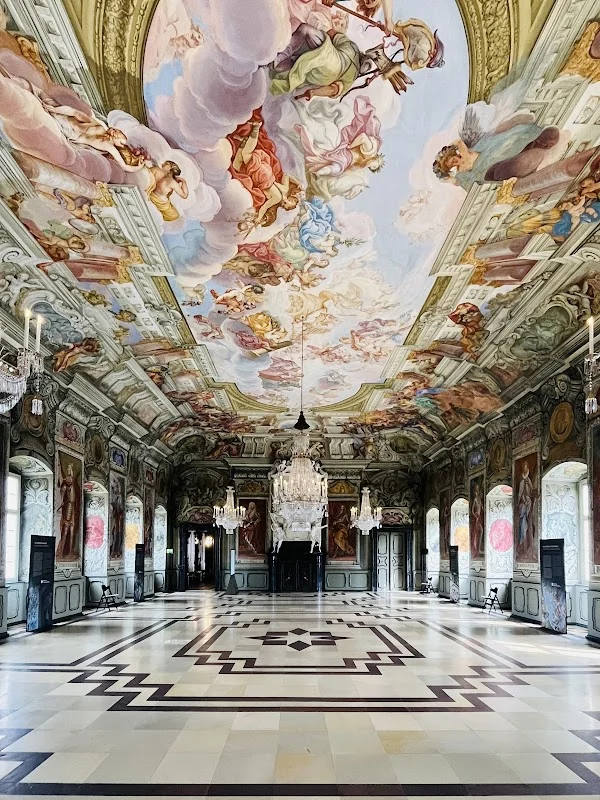
Upon entering the New Residence, visitors experience an extraordinarily dense sequence of state rooms. On the Cathedral Hill, masterpieces of furniture art, painting, sculpture, and textile art from more than four centuries can be seen. Particularly impressive is the Emperor's Hall, which is considered the highlight of Baroque splendor in Bamberg, as well as the State Gallery with its Old German and Baroque paintings from the collections of the Bavarian State Painting Collections. Selected works by the Rococo sculptor Ferdinand Tietz are also included. Today, nearly 50 rooms shape the museum experience, complemented by one of the richest historical furnishings within the palace administration. This makes the residence a house where not only rooms are shown but entire historical worlds of life. ([residenz-bamberg.de](https://www.residenz-bamberg.de/englisch/residenz/index.htm))
Particularly exciting is the Prince-Bishop's Apartment on the first floor. It was designed from 1703 as the final residence for Lothar Franz von Schönborn and later also served as a living area for other Bamberg Prince-Bishops. The rooms do not show a rigid stylistic purity but a deliberately contrasting ensemble that ranges from heavy late Baroque through Régence and Rococo to classicist and later furnishing elements. This variety is precisely what makes the tour appealing: visitors not only see representative halls but also how the taste, use, and self-understanding of the ruling families changed over the course of the 18th and 19th centuries. In today's museum visit, this is an important added value because architecture, furnishing, and staging interlock closely. ([residenz-bamberg.de](https://www.residenz-bamberg.de/deutsch/appartements/fuerstbisch.htm))
The Emperor's Hall and the Emperor's Apartment are also particularly important in the context of representation. The Emperor's Hall was created as a space for grand state and festive culture and is still suitable for events with a ceremonial character today. For visitors, this means: The residence is not just a museum in the classical sense, but a lively place where cultural use and historical substance come together. At the same time, the State Gallery explains why the search for New Residence Bamberg State Gallery so often leads to this house: here, pictorial collections, courtly living culture, and an exceptionally well-preserved ensemble combine to create one of the most impressive art locations in Franconia. ([residenz-bamberg.de](https://www.residenz-bamberg.de/englisch/residenz/index.htm))
Rose Garden of the New Residence Bamberg
The rose garden is one of the most popular arguments for a visit to the New Residence because it transforms the courtyard of the palace into a quiet, colorful counterpoint to the courtly architecture. Today, around 4500 roses in 50 different varieties grow in the beds framed by low boxwood hedges. The garden is freely accessible, and from the balustrade, there is a wide view over the old town to Michaelsberg with the former Benedictine monastery. Thus, the rose garden is not just a pretty additional offer but a reason for a visit in its own right, making the residence a rare mix of art, history, and garden culture. Especially for travelers looking for rose gardens, public gardens, or quiet viewpoints, it is a central plus. ([residenz-bamberg.de](https://residenz-bamberg.de/deutsch/garten/index.htm))
The history of the garden is as interesting as its current effect. After the incorporation of the Prince-Bishopric into the Bavarian Kingdom, the garden was redesigned into a private cabinet garden, later developing into an early rosarium. Even though it has been modified and replanted several times in the 20th century, it has remained uninterrupted as a rose garden. This continuity makes it a rare historical garden space that does not appear as a decorative appendage but as an organic continuation of the residence visit. Those interested in Baroque, garden architecture, and courtly representation receive a very vivid impression of how the residence and garden were conceived as a cohesive experience. ([residenz-bamberg.de](https://residenz-bamberg.de/deutsch/garten/index.htm))
Practically speaking, the rose garden is also particularly pleasant for a stay between two sightseeing steps. Admission is free, the paths are easily walkable, and according to the official accessibility information, the garden is reachable with wheelchair paths and usable without steep inclines. A café option in the garden area complements the stay and makes the rose garden a place where one does not just take a quick photo but also lingers. Especially in spring and around the Easter season, the garden often becomes a quiet favorite because the historical setting and open atmosphere connect particularly well then. For the search intention New Residence Bamberg Easter, it is therefore a natural part of the visit experience. ([residenz-bamberg.de](https://residenz-bamberg.de/deutsch/tourist/mobilitaet.htm))
Access, Parking, and Barrier-Free Visit
Access to the New Residence is relatively simple because the building is located directly at Domplatz. Those arriving by train can reach the residence from the station in about 20 minutes on foot. Additionally, it is conveniently accessible by public transport via the Domplatz stop. However, there are no dedicated visitor parking spaces for the residence; instead, the palace administration refers to the city parking guidance system and the parking garages in Bamberg. Tour buses are not allowed to drive onto Domplatz, and bus parking spaces are located on Pfeuferstraße, Mußstraße, and Margaretendamm. This makes the location central, but requires a short pre-planning for drivers. ([residenz-bamberg.de](https://www.residenz-bamberg.de/deutsch/tourist/anfahrt.htm))
For visitors with mobility restrictions, there are specific aids. Three public disabled parking spaces are located at Domplatz, about 120 meters from the entrance. The path to the entrance has slight inclines and is partly paved, partly designed as a wheelchair path. The entrance hall with ticket office and museum shop is accessible via a separate entrance in the courtyard; during opening hours, a Euro key is available for this. The 1st and 2nd floors, including the Emperor's Hall, are accessible by elevator. Thus, the main tour is manageable for many guests with restrictions, even if individual areas, such as the path surface in some places, are not completely even. ([residenz-bamberg.de](https://www.residenz-bamberg.de/deutsch/tourist/mobilitaet.htm))
Additionally, there are further practical tips in the house that facilitate the visit. Larger bags and bulky items are not allowed in the museum areas, but free lockers are available. Dogs and other animals are not allowed in the residence, and in the rose garden, they must be leashed. Photos and videos are only permitted for private purposes in the New Residence, in the rose garden, and in the outdoor area of the Old Court; photographing is prohibited during guided tours. Additionally, free Wi-Fi is available at Domplatz, in the residence, and in the rose garden. Therefore, anyone looking for details on tickets, accessibility, or orientation before the visit will find many useful information for a smooth stay on the official site. ([residenz-bamberg.de](https://www.residenz-bamberg.de/deutsch/tourist/index.htm))
Events 2026, Guided Tours, and Family Offers
The New Residence is not only a museum but also a place for events and guided tours. Regular guided tours take place in the Prince-Bishop's Apartment, while the other rooms can be visited without a guide. Groups of 15 or more and school classes should register in advance via email. Additionally, themed tours and activities for families are listed as a separate section on the official site. This is particularly important for visitors looking for New Residence Bamberg events 2026 or programs in the residence, as the offerings change seasonally and are continuously updated on the website. Thus, the residence does not remain static but continues to develop as a vibrant cultural site. ([residenz-bamberg.de](https://www.residenz-bamberg.de/deutsch/tourist/oeffnung.htm))
A good example of this interplay between museum and event location was the International Museum Day on May 17, 2026. On this day, admission was free, and visitors could experience the tour through the Emperor's Hall, Emperor's Apartment, and Baroque Gallery at their own pace. Additionally, there were short tours, a children's tour with a workshop, and a thematic tour on writing furniture of the Bamberg Prince-Bishops. Explorer sheets for children were also offered. This shows how the New Residence conveys historical content in a contemporary manner and appeals to families. For all those who spontaneously search for Easter exhibition, current exhibition, or family program, not only the exhibition itself is interesting but also the look at the current event calendar of the residence. ([residenz-bamberg.de](https://www.residenz-bamberg.de/))
Furthermore, the Emperor's Hall itself plays an important role as an event space. It is suitable for concerts and ceremonial events, offers seating for 300 people in rows, and can only be used outside of museum opening hours. The room size of 264 square meters makes it one of the most representative halls in the city. Therefore, anyone looking for a location for cultural formats, readings, or upscale festive events will find the New Residence to be an address with high historical radiance. This dual function as a museum and event venue explains why the residence is so present among cultural audiences as well as event planners and those interested in weddings or concerts. ([schloesser.bayern.de](https://www.schloesser.bayern.de/deutsch/raeume/objekte/bam_res.htm))
Sources:
- Bavarian Palace Administration - New Residence Bamberg
- Bavarian Palace Administration - History
- Bavarian Palace Administration - Opening Hours and Tours
- Bavarian Palace Administration - Admission Prices 2026
- Bavarian Palace Administration - Access
- Bavarian Palace Administration - Service for People with Disabilities
- Bavarian Palace Administration - Rose Garden
- Bavarian Palace Administration - Emperor's Hall
- Bavarian Palace Administration - The Bamberg Residence Today
- Bavarian Palace Administration - Prince-Bishop's Apartment
Mehr anzeigenWeniger anzeigen
New Residence Bamberg | Opening Hours & Exhibition 2026
The New Residence Bamberg at Domplatz is much more than a beautiful Baroque palace: it is a central monument of the World Heritage City, a museum with extraordinarily rich furnishings, and a place where history, art, and garden art come together directly. In the historic rooms, splendor, power, and living culture meet over four centuries, while the rose garden in the courtyard provides a calm counterpoint with a wide view over the old town and to Michaelsberg. Therefore, those who visit the residence experience not only architecture but a fully staged ensemble of interiors, art collection, garden, and city panorama. This is precisely why the New Residence is particularly relevant for visitors interested in opening hours, current exhibitions, guided tours, tickets, and practical visitor information. ([residenz-bamberg.de](https://www.residenz-bamberg.de/englisch/residenz/index.htm))
Opening Hours, Tickets, and Current Exhibition 2026
For planning the visit, the current times in 2026 are particularly important. The New Residence Bamberg and the rose garden are open daily from October 4 to March from 10 am to 4 pm, and from April to October 3 daily from 9 am to 6 pm. The residence is closed only on January 1, Shrove Tuesday, and on December 24, 25, and 31. Tickets are only available at the museum ticket office on-site; an online ticket office is not mentioned on the official visitor information. The regular admission is 7 euros, reduced 6 euros, the rose garden is freely accessible, and there is a combination ticket with Schloss Seehof. Admission is free for children and young people up to 18 years. ([residenz-bamberg.de](https://www.residenz-bamberg.de/deutsch/tourist/oeffnung.htm))
Another attraction is the special exhibition Courtly Encounters. The Ludwig Collection as Guests in the New Residence Bamberg. It has been extended until June 21, 2026, and showcases ceramic masterpieces from the Ludwig collection in dialogue with the historical furnishings of the Prince-Bishop's Apartment. The exhibition is not designed as a standalone tour but can be viewed as part of a guided tour through the Prince-Bishop's Apartment; admission is included in the regular ticket price. This connection of museum space, historical furnishings, and contemporary exhibition concept is what makes the house appealing and explains why search queries for exhibition 2026, current exhibition, and Easter exhibition are so closely related. ([residenz-bamberg.de](https://www.residenz-bamberg.de/))
It is also important for visitors to note that due to renovation work, the Elector's Apartment and the Old German Gallery are currently not accessible. The remaining state rooms can be visited without restriction. Therefore, anyone planning a visit in 2026 will still receive a very complete experience of the residence despite individual construction sites, as the central areas such as the Emperor's Hall, Emperor's Apartment, Prince-Bishop's Apartment, and rose garden remain part of the tour. The official site also recommends checking current information before the visit, as guided tours, events, and individual accesses may change seasonally. ([residenz-bamberg.de](https://www.residenz-bamberg.de/))
History of the New Residence Bamberg
The history of the New Residence begins in the early 17th century. From 1603, several neighboring cathedral chapters were replaced by a Renaissance new building under Prince-Bishop Philipp von Gebsattel; from 1609, his successor Johann Gottfried von Aschhausen continued the expansion. However, construction work likely stalled due to the Thirty Years' War, leaving the complex unfinished for decades. This historical break explains why the residence in its current form shows different layers of construction and furnishings. At the same time, the political significance of the building is already evident here: it was not only a residence but also the power center of the city, visible on the Cathedral Hill and in close proximity to the cathedral and the Old Court. Thus, the residence still forms a core of the UNESCO World Heritage Old Town Bamberg. ([residenz-bamberg.de](https://www.residenz-bamberg.de/deutsch/residenz/geschichte.htm))
The decisive expansion was driven forward by Prince-Bishop and Elector Lothar Franz von Schönborn from 1693. In 1695, he concluded a contract with Johann Leonhard Dientzenhofer, whose planning already anticipated the basic form of the present residence. In 1696, the Elector's Apartment was created, followed by the Prince-Bishop's Apartment and the Emperor's Apartment from 1703; the pre-existing Emperor's Hall was decorated with wall and ceiling paintings from 1707 to 1709. This construction phase created the visible Baroque grandeur that characterizes the building complex to this day. Therefore, the New Residence is not only a beautiful palace but also an architectural document of political self-representation and Baroque representation at the highest level. ([residenz-bamberg.de](https://www.residenz-bamberg.de/deutsch/residenz/geschichte.htm))
After the secularization, the residence came into the possession of the Wittelsbach family in 1802. Various uses followed, including as a residence for several members of the House of Wittelsbach and later also as a residence for the Greek King Otto. In 1919, the Bavarian government moved out, and the residence was finally turned into a museum. Already in the 1920s, a museum-wide concept was created, which opened in 1932 in the three state apartments. Since 1965, the house has also housed the Bamberg State Library and is no longer a political center, but one of the most important cultural centers of the World Heritage City. This development from princely residence to museum and cultural site makes the New Residence a particularly multifaceted destination for culturally interested guests. ([residenz-bamberg.de](https://www.residenz-bamberg.de/englisch/residenz/history.htm))
Prince-Bishop's Apartment, Emperor's Hall, and State Gallery
Upon entering the New Residence, visitors experience an extraordinarily dense sequence of state rooms. On the Cathedral Hill, masterpieces of furniture art, painting, sculpture, and textile art from more than four centuries can be seen. Particularly impressive is the Emperor's Hall, which is considered the highlight of Baroque splendor in Bamberg, as well as the State Gallery with its Old German and Baroque paintings from the collections of the Bavarian State Painting Collections. Selected works by the Rococo sculptor Ferdinand Tietz are also included. Today, nearly 50 rooms shape the museum experience, complemented by one of the richest historical furnishings within the palace administration. This makes the residence a house where not only rooms are shown but entire historical worlds of life. ([residenz-bamberg.de](https://www.residenz-bamberg.de/englisch/residenz/index.htm))
Particularly exciting is the Prince-Bishop's Apartment on the first floor. It was designed from 1703 as the final residence for Lothar Franz von Schönborn and later also served as a living area for other Bamberg Prince-Bishops. The rooms do not show a rigid stylistic purity but a deliberately contrasting ensemble that ranges from heavy late Baroque through Régence and Rococo to classicist and later furnishing elements. This variety is precisely what makes the tour appealing: visitors not only see representative halls but also how the taste, use, and self-understanding of the ruling families changed over the course of the 18th and 19th centuries. In today's museum visit, this is an important added value because architecture, furnishing, and staging interlock closely. ([residenz-bamberg.de](https://www.residenz-bamberg.de/deutsch/appartements/fuerstbisch.htm))
The Emperor's Hall and the Emperor's Apartment are also particularly important in the context of representation. The Emperor's Hall was created as a space for grand state and festive culture and is still suitable for events with a ceremonial character today. For visitors, this means: The residence is not just a museum in the classical sense, but a lively place where cultural use and historical substance come together. At the same time, the State Gallery explains why the search for New Residence Bamberg State Gallery so often leads to this house: here, pictorial collections, courtly living culture, and an exceptionally well-preserved ensemble combine to create one of the most impressive art locations in Franconia. ([residenz-bamberg.de](https://www.residenz-bamberg.de/englisch/residenz/index.htm))
Rose Garden of the New Residence Bamberg
The rose garden is one of the most popular arguments for a visit to the New Residence because it transforms the courtyard of the palace into a quiet, colorful counterpoint to the courtly architecture. Today, around 4500 roses in 50 different varieties grow in the beds framed by low boxwood hedges. The garden is freely accessible, and from the balustrade, there is a wide view over the old town to Michaelsberg with the former Benedictine monastery. Thus, the rose garden is not just a pretty additional offer but a reason for a visit in its own right, making the residence a rare mix of art, history, and garden culture. Especially for travelers looking for rose gardens, public gardens, or quiet viewpoints, it is a central plus. ([residenz-bamberg.de](https://residenz-bamberg.de/deutsch/garten/index.htm))
The history of the garden is as interesting as its current effect. After the incorporation of the Prince-Bishopric into the Bavarian Kingdom, the garden was redesigned into a private cabinet garden, later developing into an early rosarium. Even though it has been modified and replanted several times in the 20th century, it has remained uninterrupted as a rose garden. This continuity makes it a rare historical garden space that does not appear as a decorative appendage but as an organic continuation of the residence visit. Those interested in Baroque, garden architecture, and courtly representation receive a very vivid impression of how the residence and garden were conceived as a cohesive experience. ([residenz-bamberg.de](https://residenz-bamberg.de/deutsch/garten/index.htm))
Practically speaking, the rose garden is also particularly pleasant for a stay between two sightseeing steps. Admission is free, the paths are easily walkable, and according to the official accessibility information, the garden is reachable with wheelchair paths and usable without steep inclines. A café option in the garden area complements the stay and makes the rose garden a place where one does not just take a quick photo but also lingers. Especially in spring and around the Easter season, the garden often becomes a quiet favorite because the historical setting and open atmosphere connect particularly well then. For the search intention New Residence Bamberg Easter, it is therefore a natural part of the visit experience. ([residenz-bamberg.de](https://residenz-bamberg.de/deutsch/tourist/mobilitaet.htm))
Access, Parking, and Barrier-Free Visit
Access to the New Residence is relatively simple because the building is located directly at Domplatz. Those arriving by train can reach the residence from the station in about 20 minutes on foot. Additionally, it is conveniently accessible by public transport via the Domplatz stop. However, there are no dedicated visitor parking spaces for the residence; instead, the palace administration refers to the city parking guidance system and the parking garages in Bamberg. Tour buses are not allowed to drive onto Domplatz, and bus parking spaces are located on Pfeuferstraße, Mußstraße, and Margaretendamm. This makes the location central, but requires a short pre-planning for drivers. ([residenz-bamberg.de](https://www.residenz-bamberg.de/deutsch/tourist/anfahrt.htm))
For visitors with mobility restrictions, there are specific aids. Three public disabled parking spaces are located at Domplatz, about 120 meters from the entrance. The path to the entrance has slight inclines and is partly paved, partly designed as a wheelchair path. The entrance hall with ticket office and museum shop is accessible via a separate entrance in the courtyard; during opening hours, a Euro key is available for this. The 1st and 2nd floors, including the Emperor's Hall, are accessible by elevator. Thus, the main tour is manageable for many guests with restrictions, even if individual areas, such as the path surface in some places, are not completely even. ([residenz-bamberg.de](https://www.residenz-bamberg.de/deutsch/tourist/mobilitaet.htm))
Additionally, there are further practical tips in the house that facilitate the visit. Larger bags and bulky items are not allowed in the museum areas, but free lockers are available. Dogs and other animals are not allowed in the residence, and in the rose garden, they must be leashed. Photos and videos are only permitted for private purposes in the New Residence, in the rose garden, and in the outdoor area of the Old Court; photographing is prohibited during guided tours. Additionally, free Wi-Fi is available at Domplatz, in the residence, and in the rose garden. Therefore, anyone looking for details on tickets, accessibility, or orientation before the visit will find many useful information for a smooth stay on the official site. ([residenz-bamberg.de](https://www.residenz-bamberg.de/deutsch/tourist/index.htm))
Events 2026, Guided Tours, and Family Offers
The New Residence is not only a museum but also a place for events and guided tours. Regular guided tours take place in the Prince-Bishop's Apartment, while the other rooms can be visited without a guide. Groups of 15 or more and school classes should register in advance via email. Additionally, themed tours and activities for families are listed as a separate section on the official site. This is particularly important for visitors looking for New Residence Bamberg events 2026 or programs in the residence, as the offerings change seasonally and are continuously updated on the website. Thus, the residence does not remain static but continues to develop as a vibrant cultural site. ([residenz-bamberg.de](https://www.residenz-bamberg.de/deutsch/tourist/oeffnung.htm))
A good example of this interplay between museum and event location was the International Museum Day on May 17, 2026. On this day, admission was free, and visitors could experience the tour through the Emperor's Hall, Emperor's Apartment, and Baroque Gallery at their own pace. Additionally, there were short tours, a children's tour with a workshop, and a thematic tour on writing furniture of the Bamberg Prince-Bishops. Explorer sheets for children were also offered. This shows how the New Residence conveys historical content in a contemporary manner and appeals to families. For all those who spontaneously search for Easter exhibition, current exhibition, or family program, not only the exhibition itself is interesting but also the look at the current event calendar of the residence. ([residenz-bamberg.de](https://www.residenz-bamberg.de/))
Furthermore, the Emperor's Hall itself plays an important role as an event space. It is suitable for concerts and ceremonial events, offers seating for 300 people in rows, and can only be used outside of museum opening hours. The room size of 264 square meters makes it one of the most representative halls in the city. Therefore, anyone looking for a location for cultural formats, readings, or upscale festive events will find the New Residence to be an address with high historical radiance. This dual function as a museum and event venue explains why the residence is so present among cultural audiences as well as event planners and those interested in weddings or concerts. ([schloesser.bayern.de](https://www.schloesser.bayern.de/deutsch/raeume/objekte/bam_res.htm))
Sources:
- Bavarian Palace Administration - New Residence Bamberg
- Bavarian Palace Administration - History
- Bavarian Palace Administration - Opening Hours and Tours
- Bavarian Palace Administration - Admission Prices 2026
- Bavarian Palace Administration - Access
- Bavarian Palace Administration - Service for People with Disabilities
- Bavarian Palace Administration - Rose Garden
- Bavarian Palace Administration - Emperor's Hall
- Bavarian Palace Administration - The Bamberg Residence Today
- Bavarian Palace Administration - Prince-Bishop's Apartment
New Residence Bamberg | Opening Hours & Exhibition 2026
The New Residence Bamberg at Domplatz is much more than a beautiful Baroque palace: it is a central monument of the World Heritage City, a museum with extraordinarily rich furnishings, and a place where history, art, and garden art come together directly. In the historic rooms, splendor, power, and living culture meet over four centuries, while the rose garden in the courtyard provides a calm counterpoint with a wide view over the old town and to Michaelsberg. Therefore, those who visit the residence experience not only architecture but a fully staged ensemble of interiors, art collection, garden, and city panorama. This is precisely why the New Residence is particularly relevant for visitors interested in opening hours, current exhibitions, guided tours, tickets, and practical visitor information. ([residenz-bamberg.de](https://www.residenz-bamberg.de/englisch/residenz/index.htm))
Opening Hours, Tickets, and Current Exhibition 2026
For planning the visit, the current times in 2026 are particularly important. The New Residence Bamberg and the rose garden are open daily from October 4 to March from 10 am to 4 pm, and from April to October 3 daily from 9 am to 6 pm. The residence is closed only on January 1, Shrove Tuesday, and on December 24, 25, and 31. Tickets are only available at the museum ticket office on-site; an online ticket office is not mentioned on the official visitor information. The regular admission is 7 euros, reduced 6 euros, the rose garden is freely accessible, and there is a combination ticket with Schloss Seehof. Admission is free for children and young people up to 18 years. ([residenz-bamberg.de](https://www.residenz-bamberg.de/deutsch/tourist/oeffnung.htm))
Another attraction is the special exhibition Courtly Encounters. The Ludwig Collection as Guests in the New Residence Bamberg. It has been extended until June 21, 2026, and showcases ceramic masterpieces from the Ludwig collection in dialogue with the historical furnishings of the Prince-Bishop's Apartment. The exhibition is not designed as a standalone tour but can be viewed as part of a guided tour through the Prince-Bishop's Apartment; admission is included in the regular ticket price. This connection of museum space, historical furnishings, and contemporary exhibition concept is what makes the house appealing and explains why search queries for exhibition 2026, current exhibition, and Easter exhibition are so closely related. ([residenz-bamberg.de](https://www.residenz-bamberg.de/))
It is also important for visitors to note that due to renovation work, the Elector's Apartment and the Old German Gallery are currently not accessible. The remaining state rooms can be visited without restriction. Therefore, anyone planning a visit in 2026 will still receive a very complete experience of the residence despite individual construction sites, as the central areas such as the Emperor's Hall, Emperor's Apartment, Prince-Bishop's Apartment, and rose garden remain part of the tour. The official site also recommends checking current information before the visit, as guided tours, events, and individual accesses may change seasonally. ([residenz-bamberg.de](https://www.residenz-bamberg.de/))
History of the New Residence Bamberg
The history of the New Residence begins in the early 17th century. From 1603, several neighboring cathedral chapters were replaced by a Renaissance new building under Prince-Bishop Philipp von Gebsattel; from 1609, his successor Johann Gottfried von Aschhausen continued the expansion. However, construction work likely stalled due to the Thirty Years' War, leaving the complex unfinished for decades. This historical break explains why the residence in its current form shows different layers of construction and furnishings. At the same time, the political significance of the building is already evident here: it was not only a residence but also the power center of the city, visible on the Cathedral Hill and in close proximity to the cathedral and the Old Court. Thus, the residence still forms a core of the UNESCO World Heritage Old Town Bamberg. ([residenz-bamberg.de](https://www.residenz-bamberg.de/deutsch/residenz/geschichte.htm))
The decisive expansion was driven forward by Prince-Bishop and Elector Lothar Franz von Schönborn from 1693. In 1695, he concluded a contract with Johann Leonhard Dientzenhofer, whose planning already anticipated the basic form of the present residence. In 1696, the Elector's Apartment was created, followed by the Prince-Bishop's Apartment and the Emperor's Apartment from 1703; the pre-existing Emperor's Hall was decorated with wall and ceiling paintings from 1707 to 1709. This construction phase created the visible Baroque grandeur that characterizes the building complex to this day. Therefore, the New Residence is not only a beautiful palace but also an architectural document of political self-representation and Baroque representation at the highest level. ([residenz-bamberg.de](https://www.residenz-bamberg.de/deutsch/residenz/geschichte.htm))
After the secularization, the residence came into the possession of the Wittelsbach family in 1802. Various uses followed, including as a residence for several members of the House of Wittelsbach and later also as a residence for the Greek King Otto. In 1919, the Bavarian government moved out, and the residence was finally turned into a museum. Already in the 1920s, a museum-wide concept was created, which opened in 1932 in the three state apartments. Since 1965, the house has also housed the Bamberg State Library and is no longer a political center, but one of the most important cultural centers of the World Heritage City. This development from princely residence to museum and cultural site makes the New Residence a particularly multifaceted destination for culturally interested guests. ([residenz-bamberg.de](https://www.residenz-bamberg.de/englisch/residenz/history.htm))
Prince-Bishop's Apartment, Emperor's Hall, and State Gallery
Upon entering the New Residence, visitors experience an extraordinarily dense sequence of state rooms. On the Cathedral Hill, masterpieces of furniture art, painting, sculpture, and textile art from more than four centuries can be seen. Particularly impressive is the Emperor's Hall, which is considered the highlight of Baroque splendor in Bamberg, as well as the State Gallery with its Old German and Baroque paintings from the collections of the Bavarian State Painting Collections. Selected works by the Rococo sculptor Ferdinand Tietz are also included. Today, nearly 50 rooms shape the museum experience, complemented by one of the richest historical furnishings within the palace administration. This makes the residence a house where not only rooms are shown but entire historical worlds of life. ([residenz-bamberg.de](https://www.residenz-bamberg.de/englisch/residenz/index.htm))
Particularly exciting is the Prince-Bishop's Apartment on the first floor. It was designed from 1703 as the final residence for Lothar Franz von Schönborn and later also served as a living area for other Bamberg Prince-Bishops. The rooms do not show a rigid stylistic purity but a deliberately contrasting ensemble that ranges from heavy late Baroque through Régence and Rococo to classicist and later furnishing elements. This variety is precisely what makes the tour appealing: visitors not only see representative halls but also how the taste, use, and self-understanding of the ruling families changed over the course of the 18th and 19th centuries. In today's museum visit, this is an important added value because architecture, furnishing, and staging interlock closely. ([residenz-bamberg.de](https://www.residenz-bamberg.de/deutsch/appartements/fuerstbisch.htm))
The Emperor's Hall and the Emperor's Apartment are also particularly important in the context of representation. The Emperor's Hall was created as a space for grand state and festive culture and is still suitable for events with a ceremonial character today. For visitors, this means: The residence is not just a museum in the classical sense, but a lively place where cultural use and historical substance come together. At the same time, the State Gallery explains why the search for New Residence Bamberg State Gallery so often leads to this house: here, pictorial collections, courtly living culture, and an exceptionally well-preserved ensemble combine to create one of the most impressive art locations in Franconia. ([residenz-bamberg.de](https://www.residenz-bamberg.de/englisch/residenz/index.htm))
Rose Garden of the New Residence Bamberg
The rose garden is one of the most popular arguments for a visit to the New Residence because it transforms the courtyard of the palace into a quiet, colorful counterpoint to the courtly architecture. Today, around 4500 roses in 50 different varieties grow in the beds framed by low boxwood hedges. The garden is freely accessible, and from the balustrade, there is a wide view over the old town to Michaelsberg with the former Benedictine monastery. Thus, the rose garden is not just a pretty additional offer but a reason for a visit in its own right, making the residence a rare mix of art, history, and garden culture. Especially for travelers looking for rose gardens, public gardens, or quiet viewpoints, it is a central plus. ([residenz-bamberg.de](https://residenz-bamberg.de/deutsch/garten/index.htm))
The history of the garden is as interesting as its current effect. After the incorporation of the Prince-Bishopric into the Bavarian Kingdom, the garden was redesigned into a private cabinet garden, later developing into an early rosarium. Even though it has been modified and replanted several times in the 20th century, it has remained uninterrupted as a rose garden. This continuity makes it a rare historical garden space that does not appear as a decorative appendage but as an organic continuation of the residence visit. Those interested in Baroque, garden architecture, and courtly representation receive a very vivid impression of how the residence and garden were conceived as a cohesive experience. ([residenz-bamberg.de](https://residenz-bamberg.de/deutsch/garten/index.htm))
Practically speaking, the rose garden is also particularly pleasant for a stay between two sightseeing steps. Admission is free, the paths are easily walkable, and according to the official accessibility information, the garden is reachable with wheelchair paths and usable without steep inclines. A café option in the garden area complements the stay and makes the rose garden a place where one does not just take a quick photo but also lingers. Especially in spring and around the Easter season, the garden often becomes a quiet favorite because the historical setting and open atmosphere connect particularly well then. For the search intention New Residence Bamberg Easter, it is therefore a natural part of the visit experience. ([residenz-bamberg.de](https://residenz-bamberg.de/deutsch/tourist/mobilitaet.htm))
Access, Parking, and Barrier-Free Visit
Access to the New Residence is relatively simple because the building is located directly at Domplatz. Those arriving by train can reach the residence from the station in about 20 minutes on foot. Additionally, it is conveniently accessible by public transport via the Domplatz stop. However, there are no dedicated visitor parking spaces for the residence; instead, the palace administration refers to the city parking guidance system and the parking garages in Bamberg. Tour buses are not allowed to drive onto Domplatz, and bus parking spaces are located on Pfeuferstraße, Mußstraße, and Margaretendamm. This makes the location central, but requires a short pre-planning for drivers. ([residenz-bamberg.de](https://www.residenz-bamberg.de/deutsch/tourist/anfahrt.htm))
For visitors with mobility restrictions, there are specific aids. Three public disabled parking spaces are located at Domplatz, about 120 meters from the entrance. The path to the entrance has slight inclines and is partly paved, partly designed as a wheelchair path. The entrance hall with ticket office and museum shop is accessible via a separate entrance in the courtyard; during opening hours, a Euro key is available for this. The 1st and 2nd floors, including the Emperor's Hall, are accessible by elevator. Thus, the main tour is manageable for many guests with restrictions, even if individual areas, such as the path surface in some places, are not completely even. ([residenz-bamberg.de](https://www.residenz-bamberg.de/deutsch/tourist/mobilitaet.htm))
Additionally, there are further practical tips in the house that facilitate the visit. Larger bags and bulky items are not allowed in the museum areas, but free lockers are available. Dogs and other animals are not allowed in the residence, and in the rose garden, they must be leashed. Photos and videos are only permitted for private purposes in the New Residence, in the rose garden, and in the outdoor area of the Old Court; photographing is prohibited during guided tours. Additionally, free Wi-Fi is available at Domplatz, in the residence, and in the rose garden. Therefore, anyone looking for details on tickets, accessibility, or orientation before the visit will find many useful information for a smooth stay on the official site. ([residenz-bamberg.de](https://www.residenz-bamberg.de/deutsch/tourist/index.htm))
Events 2026, Guided Tours, and Family Offers
The New Residence is not only a museum but also a place for events and guided tours. Regular guided tours take place in the Prince-Bishop's Apartment, while the other rooms can be visited without a guide. Groups of 15 or more and school classes should register in advance via email. Additionally, themed tours and activities for families are listed as a separate section on the official site. This is particularly important for visitors looking for New Residence Bamberg events 2026 or programs in the residence, as the offerings change seasonally and are continuously updated on the website. Thus, the residence does not remain static but continues to develop as a vibrant cultural site. ([residenz-bamberg.de](https://www.residenz-bamberg.de/deutsch/tourist/oeffnung.htm))
A good example of this interplay between museum and event location was the International Museum Day on May 17, 2026. On this day, admission was free, and visitors could experience the tour through the Emperor's Hall, Emperor's Apartment, and Baroque Gallery at their own pace. Additionally, there were short tours, a children's tour with a workshop, and a thematic tour on writing furniture of the Bamberg Prince-Bishops. Explorer sheets for children were also offered. This shows how the New Residence conveys historical content in a contemporary manner and appeals to families. For all those who spontaneously search for Easter exhibition, current exhibition, or family program, not only the exhibition itself is interesting but also the look at the current event calendar of the residence. ([residenz-bamberg.de](https://www.residenz-bamberg.de/))
Furthermore, the Emperor's Hall itself plays an important role as an event space. It is suitable for concerts and ceremonial events, offers seating for 300 people in rows, and can only be used outside of museum opening hours. The room size of 264 square meters makes it one of the most representative halls in the city. Therefore, anyone looking for a location for cultural formats, readings, or upscale festive events will find the New Residence to be an address with high historical radiance. This dual function as a museum and event venue explains why the residence is so present among cultural audiences as well as event planners and those interested in weddings or concerts. ([schloesser.bayern.de](https://www.schloesser.bayern.de/deutsch/raeume/objekte/bam_res.htm))
Sources:
- Bavarian Palace Administration - New Residence Bamberg
- Bavarian Palace Administration - History
- Bavarian Palace Administration - Opening Hours and Tours
- Bavarian Palace Administration - Admission Prices 2026
- Bavarian Palace Administration - Access
- Bavarian Palace Administration - Service for People with Disabilities
- Bavarian Palace Administration - Rose Garden
- Bavarian Palace Administration - Emperor's Hall
- Bavarian Palace Administration - The Bamberg Residence Today
- Bavarian Palace Administration - Prince-Bishop's Apartment
Upcoming Events
No events found
Frequently Asked Questions
Reviews
Sumeet Dimri
8. October 2024
Neue Residenz Bamberg is a stunning palace that offers a glimpse into the opulent lifestyle of the prince-bishops who once called it home. The 6 Euro entry fee is well worth it to explore the ornately decorated rooms, beautiful gardens, and the captivating Imperial Hall. The architecture is impressive, and the guided tour provides a fascinating insight into the history of the palace and its inhabitants. Be sure to set aside a few hours to fully immerse yourself in this magnificent residence's grandeur and charm!
david antoun
26. January 2025
the new seat of the prince Bishop from 17th century with halls and rooms furnished also in the 18th century like the magnificent Imperial Hall. the visit is only possible with a guide but photos are allowed. amazing Tour
BradinHK
1. February 2025
Neue Residenz is the elegant palace building at Domplatz. It is a 40 room Baroque complex which houses the State Rooms and State Gallery along with a charming Rose Garden. Opening hours are 10am to 4pm daily and entry is €6 per adult. The Rose Garden can be accessed freely and affords lovely views of the lower section of the historic centre of Bamberg. Neue Residenz was constructed mostly in the 17th-century and is a fine representation of Austrian-Bohemian Baroque architecture. The State Rooms are highly decorative with outstanding ceiling frescos. The Imperial Hall fresco works by Melchior Steidl (1709) is a masterpiece, probably one of the finest of its kind in Franconia. The State Gallery is where you find European masterpieces mostly from the Baroque period. This makes for a nice art viewing experience as well. Easy to spend 45-60 minutes between the two, make sure to allow another 10-15 for the Rose Garden as part of your visit as well.
Animesh Kumar
8. September 2022
A beautiful and historic building again close to the old town. Is right next to the historic old court and Bamberg Cathedral. Although it looks really promising from outside we couldn’t manage time to visit inside. It has a beautiful garden with mostly roses in the inner yard. Next time we would be visiting inside too.
Alex Bransby
9. May 2022
Didn’t go inside, though the interior looks stunning. Just as pretty on the outside with its baroque architecture. Interesting shape too to admire in an L shape enclosing the Domplatz. Right by other sites such as the old court and the Dom. Absolute must visit when in town!