
Bamberg
Maximilianspl., 96047 Bamberg, Deutschland
Maximiliansplatz Bamberg | Parking & Events
The Maximiliansplatz in Bamberg, which the locals almost always refer to as Maxplatz, is much more than just a square in the old town. It is considered the largest and most significant square in the Bamberg city center and one of the clearest landmarks in the historic center. Those who arrive here find themselves in a space that connects city history, baroque architecture, and everyday city life. The square is located in the pedestrian zone, forming a natural meeting point between the Green Market and the alleys of the island city and is characterized by magnificent facades, the town hall ensemble, and the Maximiliansbrunnen. Precisely because historical architecture and modern usage stand so closely together here, the Maximiliansplatz does not feel like a museum-like place, but rather like a vibrant urban space that remains in constant motion. For visitors, it is therefore an ideal starting point for a stroll through the old town, for short breaks, for photos, and for a direct entry into Bamberg, which many travelers particularly appreciate in the UNESCO World Heritage city. ([visitbamberg.com](https://www.visitbamberg.com/en/poi/maxplatz/))
Why the Maximiliansplatz in Bamberg is the most important square in the city center
The Maxplatz is not just any open space between buildings in Bamberg, but an urban center with a clear function. The official city and tourism information describes it as the largest and most important square in the entire city center, and you can feel this role from the very first glance at the generous, open space. Unlike many smaller old town squares, the Maximiliansplatz is not narrow and hidden, but wide, bright, and representative. Its shape and size make it a place where one can quickly orient oneself, where people meet, and where the paths of the old town converge. Between the Green Market, St. Martin, and the adjacent alleys of the island city, a natural hub emerges that not only absorbs visitor flows but also distributes them. Anyone strolling through Bamberg will eventually pass by here, as the square functions like a hinge between different urban spaces. At the same time, its location in the pedestrian zone makes it particularly pleasant to experience: without through traffic, with plenty of space to stop, and with enough distance to let the architecture take effect. That the square is now used for markets, cultural events, and simply for daily city life is therefore not a coincidence, but a direct consequence of its urban significance. Especially in a city like Bamberg, whose center is dense, historical, and pedestrian-friendly, the Maximiliansplatz takes on the role of a stage where the city itself presents itself. ([visitbamberg.com](https://www.visitbamberg.com/en/poi/maxplatz/))
The impression on site is also crucial for the significance of the square. The Maximiliansplatz is not just a mere transit area, but a place where one can linger longer. The generous rectangular square layout creates distance, sight lines, and perspectives that are rarely found in this form in the narrow old town. As a result, the baroque facades, the town hall, and the fountain do not appear isolated, but as an ensemble. This spatial effect is one of the reasons why the square often serves as a meeting point and why it is perceived by many guests as one of the first addresses for a visit to Bamberg. Additionally, the local everyday language: that almost everyone in Bamberg talks about the Maxplatz shows how deeply this square is anchored in the urban self-understanding. Those seeking orientation in Bamberg encounter not only a geographical center here but also a social and cultural one. The Maximiliansplatz is thus a place to arrive, to wait, to look, and to move on. It is precisely in this mix of function and atmosphere that its special strength lies. ([visitbamberg.com](https://www.visitbamberg.com/en/poi/maxplatz/))
Town Hall, Maximiliansbrunnen, and Baroque Facades at Maxplatz
The architectural heart of the Maximiliansplatz is the town hall at Maxplatz, which shapes the center of the square and the north side of the ensemble. Its history dates back to the first half of the 18th century: the baroque building was constructed between 1732 and 1737 based on designs by Balthasar Neumann and under the supervision of Justus Heinrich Dientzenhofer. The complex was originally not a classic town hall but served as a clerical seminar for the Diocese of Bamberg until 1928. Only after lengthy renovations and a fundamental restoration was the building complex completed in 1943 as the town hall of the city of Bamberg. For later use, the expansion to rear-set sections was also important, adapting the ensemble to the requirements of the city administration. This construction history explains why the Maxplatz today is not only a beautiful square but also a place of institutional significance, where administration, city history, and representative architecture come together closely. The baroque facades on the sides of the square give the space its elegant effect, while the town hall, as a massive yet finely structured center, visibly conveys the historical weight of the place. ([visitbamberg.com](https://www.visitbamberg.com/poi/maxplatz/))
A second defining element is the Maximiliansbrunnen, which complements the square as a sculptural landmark. The fountain was created in 1880 by Ferdinand von Miller and features figures that are important for Bamberg and Franconian history: King Maximilian I Joseph, Heinrich II, Kunigunde, Otto of Bamberg, and Conrad III. In conjunction with the town hall, this creates a narrative axis that not only looks beautiful but also makes historical references visible. The fountain brings movement into the tranquil image of the square: water, sculpture, and open space ensure that the Maxplatz does not appear static as an urban space but rather lively. This is precisely where the special quality of the square's design lies. The Maximiliansplatz is not an isolated monument but an ensemble of architecture, art, and public space. For visitors, this combination is particularly appealing because they can experience multiple layers of Bamberg in just a few steps: the baroque administrative building, the representative fountain, the carefully proportioned edges of the square, and the dense old town backdrop surrounding it. Those who want to understand why the Maxplatz often appears as a showcase of the city center must see this interplay. It is the mix of baroque severity, symbolic imagery, and open urban space that makes the square unmistakable. ([bambergstadtfuehrung.de](https://bambergstadtfuehrung.de/en/poi/maximiliansplatz/))
Additionally, the square walls around the Maximiliansplatz further enhance the baroque effect. The official tourism description emphasizes the magnificent baroque buildings that line the sides of the square, making it clear: the square functions like a stage with architecture as a backdrop. The town hall is not only a place of administration but also a focal point and a landmark that holds the entire square together. Visitors intuitively read the ensemble as a historical center, even if they do not know the exact construction and usage histories. This is what good urban architecture is about: it is immediately experienceable without needing to know every detail. Therefore, those who visit the Maxplatz not only experience an attractive square but also one of the most prominent places in Bamberg, where the baroque design of the city is particularly concentrated and visible. ([visitbamberg.com](https://www.visitbamberg.com/en/poi/maxplatz/))
History of the Maxplatz: From Old St. Martin to Fair and Market Times
The current shape of the Maximiliansplatz did not emerge from nothing but from a profound urban transformation at the beginning of the 19th century. On the site previously stood the old St. Martin's Church, which is first mentioned in sources from 1250 and was demolished during the secularization and subsequent restructuring of the urban center. After the demolition, the area developed into an open square where the citizens of Bamberg held their autumn and spring fairs for many years. This transition from a church-dominated space to a public marketplace is central to the history of the Maxplatz. It shows how religious, economic, and urban functions have repeatedly shifted in Bamberg without the place losing its significance. Instead of the church, a square emerged that was designed from the very beginning for public use, trade, and encounters. This also explains why the Maxplatz continues to function so well as an event space today: the historical use has prepared the space for public life. The later naming of the square after King Maximilian I Joseph of Bavaria then added a new, representative layer to the place and anchored it more strongly in political and urban symbolism. ([visitbamberg.com](https://www.visitbamberg.com/poi/maxplatz/))
Particularly exciting is the layer of memory beneath the visible surface of the square. During the construction of the underground garage in the 1960s, the foundations of earlier predecessor buildings of Old St. Martin came to light on the Maxplatz. These remains were interpreted as traces of a smaller Romanesque church and an older chapel with a rectangular choir, dating back to the 9th to 11th centuries. This shows that the Maximiliansplatz not only has a baroque and modern history but also an early medieval one. For a contemporary visitor, this may not be immediately visible, but it is precisely this historical depth that makes the place so interesting. The square is therefore not simply a product of the 18th or 19th centuries but an urban space where several epochs overlap. City and tourism sources also emphasize this historical continuity by referring to the early St. Martin's Church, the redesign of the square, and the long tradition as a marketplace. The history of the Maxplatz is thus a story of change: from church to square, from cemetery and sacred space to fairground, from marketplace to cultural center of the city center. This transformation explains why the place still has such a strong presence today. ([visitbamberg.com](https://www.visitbamberg.com/poi/maxplatz/))
The historical development also includes the economic use of the surroundings. On the east side of the square once stood four breweries that were particularly frequented during fair times. Merchants and traders stayed there overnight, and even storage facilities were set up in the upper floors. This description shows how closely trade, gastronomy, and urban life have been interconnected at the Maxplatz from early on. The square was therefore never just representative but always also practically and economically relevant. This also contributes to the fact that the Maximiliansplatz is not an isolated monument but a place where city history naturally integrates into the everyday life of the city center. ([visitbamberg.com](https://www.visitbamberg.com/poi/ehemalige-braustaetten-am-maxplatz/))
Events, Markets, and the Maxplatz as the Stage of the City
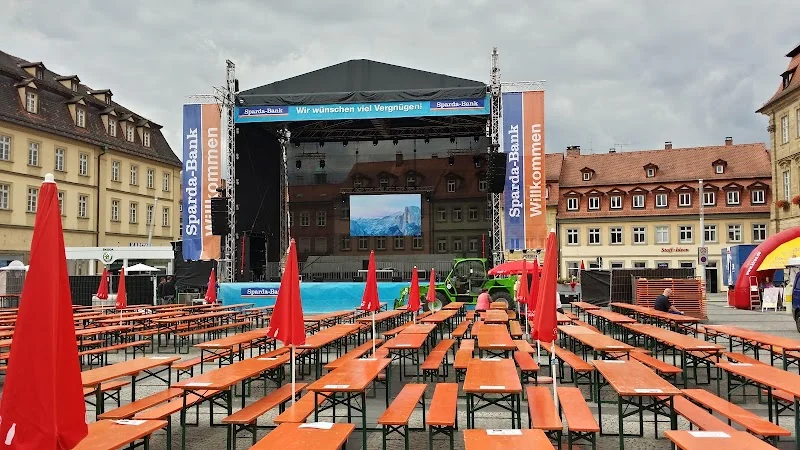
Those who visit the Maximiliansplatz today experience a place that not only preserves its historical significance but actively translates it into current city life. The official pages explicitly describe the square as a space for cultural events, events, and markets. Its size alone makes it predestined for such uses, as it can accommodate not only individual stalls or small actions but also larger crowds and recurring formats. Between May and September, events regularly take place on the Maxplatz, including the internationally renowned street and variety festival Bamberg zaubert. That such a representative old town square serves as a festival space for street art, magic, and spontaneous encounters fits very well with Bamberg: the city combines historical heritage with vibrant present without one displacing the other. The square thus does not become a backdrop but a stage. Those sitting or standing here do not feel that events are staged but that they fit into the natural openness of the square. This makes the Maxplatz one of the few places in the old town where culture is so immediately experienceable in public space. ([visitbamberg.com](https://www.visitbamberg.com/poi/maxplatz/))
The role of the Maximiliansplatz is particularly strong during the Advent and Christmas season. The tourism description emphasizes that the annual highlight is the Christmas market, which runs through the entire city center in the weeks leading up to Christmas. Especially during this time, the Maxplatz becomes a place for meeting, looking, and lingering. Pine branches, lights, market stalls, and the short distance to other old town areas ensure that the square is perceived not just as a passage but as part of a larger winter city experience. This is particularly important for search intentions around events: those searching for Maxplatz, program, or Christmas market want not just a date but a sense of how the place feels. On the Maxplatz, this sense is very concrete. The open space gives room to the market stalls, the baroque facades provide an elegant backdrop, and the proximity to other central places increases the frequency. Even in everyday life, the size of the square plays a role because it allows for spontaneous uses, such as city festivals, actions, or temporary cultural formats. The Maxplatz is thus a flexible event location that combines historical atmosphere and urban pragmatism. This mix makes it particularly attractive for visitors who want to not only see Bamberg but also experience it. ([visitbamberg.com](https://www.visitbamberg.com/poi/maxplatz/))
The high usability of the square can also be seen in its location. A square that is located directly in the city center, anchored in the pedestrian zone, and surrounded by important sights is particularly suitable for markets. Even when no event is taking place, the Maxplatz remains a place with an urban pulse: people meet, take short breaks, orient themselves, or move from one old town area to another. In SEO terms, the square thus covers several search intentions at once: events, program, market, Christmas market, and city center flair. This explains why the Maxplatz is constantly present in Bamberg not only for tourists but also for locals. ([visitbamberg.com](https://www.visitbamberg.com/en/poi/maxplatz/))
Getting to the Maxplatz: Pedestrian Zone, ZOB, and Short Distances to the Old Town
Getting to the Maximiliansplatz is easy if you understand how the Bamberg city center is structured. The square is located in the middle of the pedestrian zone and is therefore most pleasantly reached on foot. This is typical for an old town with a dense, historical structure: one does not drive up to the edge of the square but approaches the destination via the surrounding streets and pathways. The official address is Maximiliansplatz, 96047 Bamberg, and the tourism and city tour pages also mention the location in close proximity to St. Martin, the Gabelmann, and the Central Bus Station ZOB. This makes the square a very readable landmark in the urban space. Anyone walking around the city center will quickly find the Maxplatz because it forms an open space that contrasts sharply with the narrower old town alleys. This is not only helpful for outsiders but also for everyone who wants to discover Bamberg on foot. The proximity to the ZOB is particularly convenient for visitors arriving by public transport and wanting to reach the historic core in just a few minutes. ([visitbamberg.com](https://www.visitbamberg.com/en/poi/maxplatz/))
City overview information also shows that the area around the Maxplatz is well connected. An official accessibility and location overview mentions the ZOB at a distance of about 200 meters, and it also states that the location is accessible by almost all bus lines. Even if details may change over the years, the core message remains stable: the Maxplatz is a central, very accessible point in the city center. In practice, this means that visitors do not need to plan for a long time but can use the square as a natural fixed point. Those arriving by bus can orient themselves at the ZOB; those walking are already moving in the historic center; and those exploring the old town will almost automatically end up at the Maxplatz sooner or later. Precisely because the area is open and not dominated by through traffic, the square feels particularly relaxed for arrivals and meetings. The approach is thus less a question of complicated routes than a question of good orientation. The Maxplatz is in Bamberg exactly the place where one can easily arrange to meet and from which one can comfortably continue to explore the city on foot. ([stadt.bamberg.de](https://www.stadt.bamberg.de/media/custom/332_9543_1.PDF))
For the search intention of getting there and maps, it is also important that the square is surrounded by several clearly identifiable destinations. The Green Market, St. Martin, Gabelmann, and the island city are in direct proximity or within a very short walking distance. So, anyone using a map or wanting to orient themselves on site can take the Maxplatz as a logical hub. In a city like Bamberg, whose old town is consciously experienced on foot, this is a real advantage. The Maximiliansplatz is not hidden but embedded in a network of short paths. This makes it an attractive starting point for a tour of the old town. ([visitbamberg.com](https://www.visitbamberg.com/en/poi/maxplatz/))
Parking at Maximiliansplatz: Underground Garage, City Center Parking Garages, and Practical Orientation
The topic of parking is one of the most important practical questions regarding the Maximiliansplatz because the square is located in the middle of the historic city center. The city of Bamberg and the Bamberg municipal utilities organize the stationary traffic in the old town through a network of centrally located parking garages, underground garages, and parking spaces. The mobility pages explain that the city center has numerous parking options around the historic old town and that the municipal utilities operate a corresponding offer. For the area around the Maxplatz, it is particularly important that there is an underground garage beneath the square, which is referred to in official municipal utilities communications as the underground garage under the Maxplatz. This means that the Maxplatz is not only a place to visit but also a place where the parking issue is directly considered. Anyone wanting to take care of something in the city center or use the square as a starting point for a walk can therefore orient themselves to the immediate surroundings and does not have to park far outside. ([stadtwerke-bamberg.de](https://www.stadtwerke-bamberg.de/mobilitaet/parken.html?utm_source=openai))
Additionally, the municipal parking regulations around the Maxplatz are noteworthy. The city of Bamberg has expanded the parking area around the Maxplatz in parking zone 1 to a radius of 600 meters to better manage the particularly valuable parking space. This shows how strongly the city center is regulated in terms of parking and how important good planning remains in this area. For visitors, this means: not every free spot directly at the destination is automatically the best choice, but often the centrally located, clearly designated facilities are more sensible. The municipal utilities list, among others, the underground garage Zentrum Nord, the parking garage Zentrum Süd, and the underground garage concert and congress hall as central facilities in the city center. Even if these facilities are not directly on the square itself, they are practical alternatives for a visit to the Maxplatz if one wants to park the car conveniently and in an organized manner. The crucial point is that Bamberg consciously directs its old town towards short distances and well-coordinated parking offers. Therefore, those visiting the Maxplatz should think more about a short walk than about long searches right at the door. ([stadt.bamberg.de](https://www.stadt.bamberg.de/Schnellnavigation/Nachrichten/Stadt-Bamberg-ordnet-den-Parkraum.php?FID=3481.22551.1&ModID=7&NavID=3481.273.1&object=tx%2C3481.6.1&utm_source=openai))
For today's mobility, another practical aspect comes into play: the Bamberg municipal utilities also operate a public charging station at the Maxplatz. In their overview of the public charging network, the location Maxplatz opposite Fleischstraße 9 is listed with a maximum charging and parking duration of one hour. This is a very concrete advantage for electric vehicles and shows that the square is integrated into modern urban mobility. Therefore, anyone wanting to combine a short stop at the Maxplatz with a charging process will find an official option there. Overall, this results in a clear picture: the Maxplatz is located in the heart of the old town but is very well integrated in terms of parking and urban mobility. The mix of underground garage, inner-city parking garages, and charging points makes the location practically usable for day visits, errands, and old town routes. ([stadtwerke-bamberg.de](https://www.stadtwerke-bamberg.de/e-laden))
Around the Maxplatz: Green Market, St. Martin, and Other Attractions
The Maximiliansplatz is not only worth seeing itself but also an ideal starting point to explore the neighboring highlights of the Bamberg old town. The official pages mention the Green Market, the Gabelmann, St. Martin, and the Central Bus Station in direct proximity. This neighborhood makes the square so valuable: one stands in a place from which several typical Bamberg motifs can be reached in just a few steps. The Green Market brings the classic city center feeling, St. Martin points to the church-historical depth of the district, and the Gabelmann is also an important landmark as a well-known fountain. For visitors, this creates a compact city tour that can easily be done on foot. The Maxplatz serves as a connecting center from which one can continue in various directions. This spatial connection explains why the square is repeatedly portrayed in tourist descriptions as a natural meeting point between the old town areas. Those who want to experience Bamberg in a short time will find here a particularly dense concentration of history, everyday life, and photo motifs. ([visitbamberg.com](https://www.visitbamberg.com/en/poi/maxplatz/))
The historical surroundings also enhance this attractiveness. At the Maxplatz itself, the architecture and square design recall the baroque urban development, while the neighboring areas make the different layers of the city visible. In tourism sources, the square is explicitly described as a place characterized by baroque architecture, the town hall ensemble, and the Maximiliansbrunnen. In immediate proximity, other attractions complement this picture and make it clear why Bamberg as a World Heritage city is so easily experienced on foot. Especially because many things are close together, even short stays can be very intense. Those with little time can take the Maxplatz as a starting point, take a look at the facades and the fountain, and then head directly towards the Green Market or St. Martin. Those with more time can incorporate the square into a more detailed route through the city center. In both cases, the Maxplatz functions as a reliable fixed point. The combination of central location, architectural quality, and direct proximity to further attractions makes it one of the best places to get to know Bamberg in a compact space. ([visitbamberg.com](https://www.visitbamberg.com/en/poi/maxplatz/))
In summary, the Maximiliansplatz is so strong because it fulfills several search intentions simultaneously: those looking for events will find them; those wanting to park get practical orientation; those needing directions or a map find a clear focal point; and those seeking historical old town atmosphere experience it here in a particularly dense form. This is as important for an SEO text as it is for real visitors. The Maxplatz is not a side location but a core piece of the Bamberg city center, where one can quickly understand Bamberg. That is precisely why it is worthwhile to see the square not only as an address but as a place of experience. ([visitbamberg.com](https://www.visitbamberg.com/en/poi/maxplatz/))
Sources:
Mehr anzeigenWeniger anzeigen
Maximiliansplatz Bamberg | Parking & Events
The Maximiliansplatz in Bamberg, which the locals almost always refer to as Maxplatz, is much more than just a square in the old town. It is considered the largest and most significant square in the Bamberg city center and one of the clearest landmarks in the historic center. Those who arrive here find themselves in a space that connects city history, baroque architecture, and everyday city life. The square is located in the pedestrian zone, forming a natural meeting point between the Green Market and the alleys of the island city and is characterized by magnificent facades, the town hall ensemble, and the Maximiliansbrunnen. Precisely because historical architecture and modern usage stand so closely together here, the Maximiliansplatz does not feel like a museum-like place, but rather like a vibrant urban space that remains in constant motion. For visitors, it is therefore an ideal starting point for a stroll through the old town, for short breaks, for photos, and for a direct entry into Bamberg, which many travelers particularly appreciate in the UNESCO World Heritage city. ([visitbamberg.com](https://www.visitbamberg.com/en/poi/maxplatz/))
Why the Maximiliansplatz in Bamberg is the most important square in the city center
The Maxplatz is not just any open space between buildings in Bamberg, but an urban center with a clear function. The official city and tourism information describes it as the largest and most important square in the entire city center, and you can feel this role from the very first glance at the generous, open space. Unlike many smaller old town squares, the Maximiliansplatz is not narrow and hidden, but wide, bright, and representative. Its shape and size make it a place where one can quickly orient oneself, where people meet, and where the paths of the old town converge. Between the Green Market, St. Martin, and the adjacent alleys of the island city, a natural hub emerges that not only absorbs visitor flows but also distributes them. Anyone strolling through Bamberg will eventually pass by here, as the square functions like a hinge between different urban spaces. At the same time, its location in the pedestrian zone makes it particularly pleasant to experience: without through traffic, with plenty of space to stop, and with enough distance to let the architecture take effect. That the square is now used for markets, cultural events, and simply for daily city life is therefore not a coincidence, but a direct consequence of its urban significance. Especially in a city like Bamberg, whose center is dense, historical, and pedestrian-friendly, the Maximiliansplatz takes on the role of a stage where the city itself presents itself. ([visitbamberg.com](https://www.visitbamberg.com/en/poi/maxplatz/))
The impression on site is also crucial for the significance of the square. The Maximiliansplatz is not just a mere transit area, but a place where one can linger longer. The generous rectangular square layout creates distance, sight lines, and perspectives that are rarely found in this form in the narrow old town. As a result, the baroque facades, the town hall, and the fountain do not appear isolated, but as an ensemble. This spatial effect is one of the reasons why the square often serves as a meeting point and why it is perceived by many guests as one of the first addresses for a visit to Bamberg. Additionally, the local everyday language: that almost everyone in Bamberg talks about the Maxplatz shows how deeply this square is anchored in the urban self-understanding. Those seeking orientation in Bamberg encounter not only a geographical center here but also a social and cultural one. The Maximiliansplatz is thus a place to arrive, to wait, to look, and to move on. It is precisely in this mix of function and atmosphere that its special strength lies. ([visitbamberg.com](https://www.visitbamberg.com/en/poi/maxplatz/))
Town Hall, Maximiliansbrunnen, and Baroque Facades at Maxplatz
The architectural heart of the Maximiliansplatz is the town hall at Maxplatz, which shapes the center of the square and the north side of the ensemble. Its history dates back to the first half of the 18th century: the baroque building was constructed between 1732 and 1737 based on designs by Balthasar Neumann and under the supervision of Justus Heinrich Dientzenhofer. The complex was originally not a classic town hall but served as a clerical seminar for the Diocese of Bamberg until 1928. Only after lengthy renovations and a fundamental restoration was the building complex completed in 1943 as the town hall of the city of Bamberg. For later use, the expansion to rear-set sections was also important, adapting the ensemble to the requirements of the city administration. This construction history explains why the Maxplatz today is not only a beautiful square but also a place of institutional significance, where administration, city history, and representative architecture come together closely. The baroque facades on the sides of the square give the space its elegant effect, while the town hall, as a massive yet finely structured center, visibly conveys the historical weight of the place. ([visitbamberg.com](https://www.visitbamberg.com/poi/maxplatz/))
A second defining element is the Maximiliansbrunnen, which complements the square as a sculptural landmark. The fountain was created in 1880 by Ferdinand von Miller and features figures that are important for Bamberg and Franconian history: King Maximilian I Joseph, Heinrich II, Kunigunde, Otto of Bamberg, and Conrad III. In conjunction with the town hall, this creates a narrative axis that not only looks beautiful but also makes historical references visible. The fountain brings movement into the tranquil image of the square: water, sculpture, and open space ensure that the Maxplatz does not appear static as an urban space but rather lively. This is precisely where the special quality of the square's design lies. The Maximiliansplatz is not an isolated monument but an ensemble of architecture, art, and public space. For visitors, this combination is particularly appealing because they can experience multiple layers of Bamberg in just a few steps: the baroque administrative building, the representative fountain, the carefully proportioned edges of the square, and the dense old town backdrop surrounding it. Those who want to understand why the Maxplatz often appears as a showcase of the city center must see this interplay. It is the mix of baroque severity, symbolic imagery, and open urban space that makes the square unmistakable. ([bambergstadtfuehrung.de](https://bambergstadtfuehrung.de/en/poi/maximiliansplatz/))
Additionally, the square walls around the Maximiliansplatz further enhance the baroque effect. The official tourism description emphasizes the magnificent baroque buildings that line the sides of the square, making it clear: the square functions like a stage with architecture as a backdrop. The town hall is not only a place of administration but also a focal point and a landmark that holds the entire square together. Visitors intuitively read the ensemble as a historical center, even if they do not know the exact construction and usage histories. This is what good urban architecture is about: it is immediately experienceable without needing to know every detail. Therefore, those who visit the Maxplatz not only experience an attractive square but also one of the most prominent places in Bamberg, where the baroque design of the city is particularly concentrated and visible. ([visitbamberg.com](https://www.visitbamberg.com/en/poi/maxplatz/))
History of the Maxplatz: From Old St. Martin to Fair and Market Times
The current shape of the Maximiliansplatz did not emerge from nothing but from a profound urban transformation at the beginning of the 19th century. On the site previously stood the old St. Martin's Church, which is first mentioned in sources from 1250 and was demolished during the secularization and subsequent restructuring of the urban center. After the demolition, the area developed into an open square where the citizens of Bamberg held their autumn and spring fairs for many years. This transition from a church-dominated space to a public marketplace is central to the history of the Maxplatz. It shows how religious, economic, and urban functions have repeatedly shifted in Bamberg without the place losing its significance. Instead of the church, a square emerged that was designed from the very beginning for public use, trade, and encounters. This also explains why the Maxplatz continues to function so well as an event space today: the historical use has prepared the space for public life. The later naming of the square after King Maximilian I Joseph of Bavaria then added a new, representative layer to the place and anchored it more strongly in political and urban symbolism. ([visitbamberg.com](https://www.visitbamberg.com/poi/maxplatz/))
Particularly exciting is the layer of memory beneath the visible surface of the square. During the construction of the underground garage in the 1960s, the foundations of earlier predecessor buildings of Old St. Martin came to light on the Maxplatz. These remains were interpreted as traces of a smaller Romanesque church and an older chapel with a rectangular choir, dating back to the 9th to 11th centuries. This shows that the Maximiliansplatz not only has a baroque and modern history but also an early medieval one. For a contemporary visitor, this may not be immediately visible, but it is precisely this historical depth that makes the place so interesting. The square is therefore not simply a product of the 18th or 19th centuries but an urban space where several epochs overlap. City and tourism sources also emphasize this historical continuity by referring to the early St. Martin's Church, the redesign of the square, and the long tradition as a marketplace. The history of the Maxplatz is thus a story of change: from church to square, from cemetery and sacred space to fairground, from marketplace to cultural center of the city center. This transformation explains why the place still has such a strong presence today. ([visitbamberg.com](https://www.visitbamberg.com/poi/maxplatz/))
The historical development also includes the economic use of the surroundings. On the east side of the square once stood four breweries that were particularly frequented during fair times. Merchants and traders stayed there overnight, and even storage facilities were set up in the upper floors. This description shows how closely trade, gastronomy, and urban life have been interconnected at the Maxplatz from early on. The square was therefore never just representative but always also practically and economically relevant. This also contributes to the fact that the Maximiliansplatz is not an isolated monument but a place where city history naturally integrates into the everyday life of the city center. ([visitbamberg.com](https://www.visitbamberg.com/poi/ehemalige-braustaetten-am-maxplatz/))
Events, Markets, and the Maxplatz as the Stage of the City
Those who visit the Maximiliansplatz today experience a place that not only preserves its historical significance but actively translates it into current city life. The official pages explicitly describe the square as a space for cultural events, events, and markets. Its size alone makes it predestined for such uses, as it can accommodate not only individual stalls or small actions but also larger crowds and recurring formats. Between May and September, events regularly take place on the Maxplatz, including the internationally renowned street and variety festival Bamberg zaubert. That such a representative old town square serves as a festival space for street art, magic, and spontaneous encounters fits very well with Bamberg: the city combines historical heritage with vibrant present without one displacing the other. The square thus does not become a backdrop but a stage. Those sitting or standing here do not feel that events are staged but that they fit into the natural openness of the square. This makes the Maxplatz one of the few places in the old town where culture is so immediately experienceable in public space. ([visitbamberg.com](https://www.visitbamberg.com/poi/maxplatz/))
The role of the Maximiliansplatz is particularly strong during the Advent and Christmas season. The tourism description emphasizes that the annual highlight is the Christmas market, which runs through the entire city center in the weeks leading up to Christmas. Especially during this time, the Maxplatz becomes a place for meeting, looking, and lingering. Pine branches, lights, market stalls, and the short distance to other old town areas ensure that the square is perceived not just as a passage but as part of a larger winter city experience. This is particularly important for search intentions around events: those searching for Maxplatz, program, or Christmas market want not just a date but a sense of how the place feels. On the Maxplatz, this sense is very concrete. The open space gives room to the market stalls, the baroque facades provide an elegant backdrop, and the proximity to other central places increases the frequency. Even in everyday life, the size of the square plays a role because it allows for spontaneous uses, such as city festivals, actions, or temporary cultural formats. The Maxplatz is thus a flexible event location that combines historical atmosphere and urban pragmatism. This mix makes it particularly attractive for visitors who want to not only see Bamberg but also experience it. ([visitbamberg.com](https://www.visitbamberg.com/poi/maxplatz/))
The high usability of the square can also be seen in its location. A square that is located directly in the city center, anchored in the pedestrian zone, and surrounded by important sights is particularly suitable for markets. Even when no event is taking place, the Maxplatz remains a place with an urban pulse: people meet, take short breaks, orient themselves, or move from one old town area to another. In SEO terms, the square thus covers several search intentions at once: events, program, market, Christmas market, and city center flair. This explains why the Maxplatz is constantly present in Bamberg not only for tourists but also for locals. ([visitbamberg.com](https://www.visitbamberg.com/en/poi/maxplatz/))
Getting to the Maxplatz: Pedestrian Zone, ZOB, and Short Distances to the Old Town
Getting to the Maximiliansplatz is easy if you understand how the Bamberg city center is structured. The square is located in the middle of the pedestrian zone and is therefore most pleasantly reached on foot. This is typical for an old town with a dense, historical structure: one does not drive up to the edge of the square but approaches the destination via the surrounding streets and pathways. The official address is Maximiliansplatz, 96047 Bamberg, and the tourism and city tour pages also mention the location in close proximity to St. Martin, the Gabelmann, and the Central Bus Station ZOB. This makes the square a very readable landmark in the urban space. Anyone walking around the city center will quickly find the Maxplatz because it forms an open space that contrasts sharply with the narrower old town alleys. This is not only helpful for outsiders but also for everyone who wants to discover Bamberg on foot. The proximity to the ZOB is particularly convenient for visitors arriving by public transport and wanting to reach the historic core in just a few minutes. ([visitbamberg.com](https://www.visitbamberg.com/en/poi/maxplatz/))
City overview information also shows that the area around the Maxplatz is well connected. An official accessibility and location overview mentions the ZOB at a distance of about 200 meters, and it also states that the location is accessible by almost all bus lines. Even if details may change over the years, the core message remains stable: the Maxplatz is a central, very accessible point in the city center. In practice, this means that visitors do not need to plan for a long time but can use the square as a natural fixed point. Those arriving by bus can orient themselves at the ZOB; those walking are already moving in the historic center; and those exploring the old town will almost automatically end up at the Maxplatz sooner or later. Precisely because the area is open and not dominated by through traffic, the square feels particularly relaxed for arrivals and meetings. The approach is thus less a question of complicated routes than a question of good orientation. The Maxplatz is in Bamberg exactly the place where one can easily arrange to meet and from which one can comfortably continue to explore the city on foot. ([stadt.bamberg.de](https://www.stadt.bamberg.de/media/custom/332_9543_1.PDF))
For the search intention of getting there and maps, it is also important that the square is surrounded by several clearly identifiable destinations. The Green Market, St. Martin, Gabelmann, and the island city are in direct proximity or within a very short walking distance. So, anyone using a map or wanting to orient themselves on site can take the Maxplatz as a logical hub. In a city like Bamberg, whose old town is consciously experienced on foot, this is a real advantage. The Maximiliansplatz is not hidden but embedded in a network of short paths. This makes it an attractive starting point for a tour of the old town. ([visitbamberg.com](https://www.visitbamberg.com/en/poi/maxplatz/))
Parking at Maximiliansplatz: Underground Garage, City Center Parking Garages, and Practical Orientation
The topic of parking is one of the most important practical questions regarding the Maximiliansplatz because the square is located in the middle of the historic city center. The city of Bamberg and the Bamberg municipal utilities organize the stationary traffic in the old town through a network of centrally located parking garages, underground garages, and parking spaces. The mobility pages explain that the city center has numerous parking options around the historic old town and that the municipal utilities operate a corresponding offer. For the area around the Maxplatz, it is particularly important that there is an underground garage beneath the square, which is referred to in official municipal utilities communications as the underground garage under the Maxplatz. This means that the Maxplatz is not only a place to visit but also a place where the parking issue is directly considered. Anyone wanting to take care of something in the city center or use the square as a starting point for a walk can therefore orient themselves to the immediate surroundings and does not have to park far outside. ([stadtwerke-bamberg.de](https://www.stadtwerke-bamberg.de/mobilitaet/parken.html?utm_source=openai))
Additionally, the municipal parking regulations around the Maxplatz are noteworthy. The city of Bamberg has expanded the parking area around the Maxplatz in parking zone 1 to a radius of 600 meters to better manage the particularly valuable parking space. This shows how strongly the city center is regulated in terms of parking and how important good planning remains in this area. For visitors, this means: not every free spot directly at the destination is automatically the best choice, but often the centrally located, clearly designated facilities are more sensible. The municipal utilities list, among others, the underground garage Zentrum Nord, the parking garage Zentrum Süd, and the underground garage concert and congress hall as central facilities in the city center. Even if these facilities are not directly on the square itself, they are practical alternatives for a visit to the Maxplatz if one wants to park the car conveniently and in an organized manner. The crucial point is that Bamberg consciously directs its old town towards short distances and well-coordinated parking offers. Therefore, those visiting the Maxplatz should think more about a short walk than about long searches right at the door. ([stadt.bamberg.de](https://www.stadt.bamberg.de/Schnellnavigation/Nachrichten/Stadt-Bamberg-ordnet-den-Parkraum.php?FID=3481.22551.1&ModID=7&NavID=3481.273.1&object=tx%2C3481.6.1&utm_source=openai))
For today's mobility, another practical aspect comes into play: the Bamberg municipal utilities also operate a public charging station at the Maxplatz. In their overview of the public charging network, the location Maxplatz opposite Fleischstraße 9 is listed with a maximum charging and parking duration of one hour. This is a very concrete advantage for electric vehicles and shows that the square is integrated into modern urban mobility. Therefore, anyone wanting to combine a short stop at the Maxplatz with a charging process will find an official option there. Overall, this results in a clear picture: the Maxplatz is located in the heart of the old town but is very well integrated in terms of parking and urban mobility. The mix of underground garage, inner-city parking garages, and charging points makes the location practically usable for day visits, errands, and old town routes. ([stadtwerke-bamberg.de](https://www.stadtwerke-bamberg.de/e-laden))
Around the Maxplatz: Green Market, St. Martin, and Other Attractions
The Maximiliansplatz is not only worth seeing itself but also an ideal starting point to explore the neighboring highlights of the Bamberg old town. The official pages mention the Green Market, the Gabelmann, St. Martin, and the Central Bus Station in direct proximity. This neighborhood makes the square so valuable: one stands in a place from which several typical Bamberg motifs can be reached in just a few steps. The Green Market brings the classic city center feeling, St. Martin points to the church-historical depth of the district, and the Gabelmann is also an important landmark as a well-known fountain. For visitors, this creates a compact city tour that can easily be done on foot. The Maxplatz serves as a connecting center from which one can continue in various directions. This spatial connection explains why the square is repeatedly portrayed in tourist descriptions as a natural meeting point between the old town areas. Those who want to experience Bamberg in a short time will find here a particularly dense concentration of history, everyday life, and photo motifs. ([visitbamberg.com](https://www.visitbamberg.com/en/poi/maxplatz/))
The historical surroundings also enhance this attractiveness. At the Maxplatz itself, the architecture and square design recall the baroque urban development, while the neighboring areas make the different layers of the city visible. In tourism sources, the square is explicitly described as a place characterized by baroque architecture, the town hall ensemble, and the Maximiliansbrunnen. In immediate proximity, other attractions complement this picture and make it clear why Bamberg as a World Heritage city is so easily experienced on foot. Especially because many things are close together, even short stays can be very intense. Those with little time can take the Maxplatz as a starting point, take a look at the facades and the fountain, and then head directly towards the Green Market or St. Martin. Those with more time can incorporate the square into a more detailed route through the city center. In both cases, the Maxplatz functions as a reliable fixed point. The combination of central location, architectural quality, and direct proximity to further attractions makes it one of the best places to get to know Bamberg in a compact space. ([visitbamberg.com](https://www.visitbamberg.com/en/poi/maxplatz/))
In summary, the Maximiliansplatz is so strong because it fulfills several search intentions simultaneously: those looking for events will find them; those wanting to park get practical orientation; those needing directions or a map find a clear focal point; and those seeking historical old town atmosphere experience it here in a particularly dense form. This is as important for an SEO text as it is for real visitors. The Maxplatz is not a side location but a core piece of the Bamberg city center, where one can quickly understand Bamberg. That is precisely why it is worthwhile to see the square not only as an address but as a place of experience. ([visitbamberg.com](https://www.visitbamberg.com/en/poi/maxplatz/))
Sources:
Maximiliansplatz Bamberg | Parking & Events
The Maximiliansplatz in Bamberg, which the locals almost always refer to as Maxplatz, is much more than just a square in the old town. It is considered the largest and most significant square in the Bamberg city center and one of the clearest landmarks in the historic center. Those who arrive here find themselves in a space that connects city history, baroque architecture, and everyday city life. The square is located in the pedestrian zone, forming a natural meeting point between the Green Market and the alleys of the island city and is characterized by magnificent facades, the town hall ensemble, and the Maximiliansbrunnen. Precisely because historical architecture and modern usage stand so closely together here, the Maximiliansplatz does not feel like a museum-like place, but rather like a vibrant urban space that remains in constant motion. For visitors, it is therefore an ideal starting point for a stroll through the old town, for short breaks, for photos, and for a direct entry into Bamberg, which many travelers particularly appreciate in the UNESCO World Heritage city. ([visitbamberg.com](https://www.visitbamberg.com/en/poi/maxplatz/))
Why the Maximiliansplatz in Bamberg is the most important square in the city center
The Maxplatz is not just any open space between buildings in Bamberg, but an urban center with a clear function. The official city and tourism information describes it as the largest and most important square in the entire city center, and you can feel this role from the very first glance at the generous, open space. Unlike many smaller old town squares, the Maximiliansplatz is not narrow and hidden, but wide, bright, and representative. Its shape and size make it a place where one can quickly orient oneself, where people meet, and where the paths of the old town converge. Between the Green Market, St. Martin, and the adjacent alleys of the island city, a natural hub emerges that not only absorbs visitor flows but also distributes them. Anyone strolling through Bamberg will eventually pass by here, as the square functions like a hinge between different urban spaces. At the same time, its location in the pedestrian zone makes it particularly pleasant to experience: without through traffic, with plenty of space to stop, and with enough distance to let the architecture take effect. That the square is now used for markets, cultural events, and simply for daily city life is therefore not a coincidence, but a direct consequence of its urban significance. Especially in a city like Bamberg, whose center is dense, historical, and pedestrian-friendly, the Maximiliansplatz takes on the role of a stage where the city itself presents itself. ([visitbamberg.com](https://www.visitbamberg.com/en/poi/maxplatz/))
The impression on site is also crucial for the significance of the square. The Maximiliansplatz is not just a mere transit area, but a place where one can linger longer. The generous rectangular square layout creates distance, sight lines, and perspectives that are rarely found in this form in the narrow old town. As a result, the baroque facades, the town hall, and the fountain do not appear isolated, but as an ensemble. This spatial effect is one of the reasons why the square often serves as a meeting point and why it is perceived by many guests as one of the first addresses for a visit to Bamberg. Additionally, the local everyday language: that almost everyone in Bamberg talks about the Maxplatz shows how deeply this square is anchored in the urban self-understanding. Those seeking orientation in Bamberg encounter not only a geographical center here but also a social and cultural one. The Maximiliansplatz is thus a place to arrive, to wait, to look, and to move on. It is precisely in this mix of function and atmosphere that its special strength lies. ([visitbamberg.com](https://www.visitbamberg.com/en/poi/maxplatz/))
Town Hall, Maximiliansbrunnen, and Baroque Facades at Maxplatz
The architectural heart of the Maximiliansplatz is the town hall at Maxplatz, which shapes the center of the square and the north side of the ensemble. Its history dates back to the first half of the 18th century: the baroque building was constructed between 1732 and 1737 based on designs by Balthasar Neumann and under the supervision of Justus Heinrich Dientzenhofer. The complex was originally not a classic town hall but served as a clerical seminar for the Diocese of Bamberg until 1928. Only after lengthy renovations and a fundamental restoration was the building complex completed in 1943 as the town hall of the city of Bamberg. For later use, the expansion to rear-set sections was also important, adapting the ensemble to the requirements of the city administration. This construction history explains why the Maxplatz today is not only a beautiful square but also a place of institutional significance, where administration, city history, and representative architecture come together closely. The baroque facades on the sides of the square give the space its elegant effect, while the town hall, as a massive yet finely structured center, visibly conveys the historical weight of the place. ([visitbamberg.com](https://www.visitbamberg.com/poi/maxplatz/))
A second defining element is the Maximiliansbrunnen, which complements the square as a sculptural landmark. The fountain was created in 1880 by Ferdinand von Miller and features figures that are important for Bamberg and Franconian history: King Maximilian I Joseph, Heinrich II, Kunigunde, Otto of Bamberg, and Conrad III. In conjunction with the town hall, this creates a narrative axis that not only looks beautiful but also makes historical references visible. The fountain brings movement into the tranquil image of the square: water, sculpture, and open space ensure that the Maxplatz does not appear static as an urban space but rather lively. This is precisely where the special quality of the square's design lies. The Maximiliansplatz is not an isolated monument but an ensemble of architecture, art, and public space. For visitors, this combination is particularly appealing because they can experience multiple layers of Bamberg in just a few steps: the baroque administrative building, the representative fountain, the carefully proportioned edges of the square, and the dense old town backdrop surrounding it. Those who want to understand why the Maxplatz often appears as a showcase of the city center must see this interplay. It is the mix of baroque severity, symbolic imagery, and open urban space that makes the square unmistakable. ([bambergstadtfuehrung.de](https://bambergstadtfuehrung.de/en/poi/maximiliansplatz/))
Additionally, the square walls around the Maximiliansplatz further enhance the baroque effect. The official tourism description emphasizes the magnificent baroque buildings that line the sides of the square, making it clear: the square functions like a stage with architecture as a backdrop. The town hall is not only a place of administration but also a focal point and a landmark that holds the entire square together. Visitors intuitively read the ensemble as a historical center, even if they do not know the exact construction and usage histories. This is what good urban architecture is about: it is immediately experienceable without needing to know every detail. Therefore, those who visit the Maxplatz not only experience an attractive square but also one of the most prominent places in Bamberg, where the baroque design of the city is particularly concentrated and visible. ([visitbamberg.com](https://www.visitbamberg.com/en/poi/maxplatz/))
History of the Maxplatz: From Old St. Martin to Fair and Market Times
The current shape of the Maximiliansplatz did not emerge from nothing but from a profound urban transformation at the beginning of the 19th century. On the site previously stood the old St. Martin's Church, which is first mentioned in sources from 1250 and was demolished during the secularization and subsequent restructuring of the urban center. After the demolition, the area developed into an open square where the citizens of Bamberg held their autumn and spring fairs for many years. This transition from a church-dominated space to a public marketplace is central to the history of the Maxplatz. It shows how religious, economic, and urban functions have repeatedly shifted in Bamberg without the place losing its significance. Instead of the church, a square emerged that was designed from the very beginning for public use, trade, and encounters. This also explains why the Maxplatz continues to function so well as an event space today: the historical use has prepared the space for public life. The later naming of the square after King Maximilian I Joseph of Bavaria then added a new, representative layer to the place and anchored it more strongly in political and urban symbolism. ([visitbamberg.com](https://www.visitbamberg.com/poi/maxplatz/))
Particularly exciting is the layer of memory beneath the visible surface of the square. During the construction of the underground garage in the 1960s, the foundations of earlier predecessor buildings of Old St. Martin came to light on the Maxplatz. These remains were interpreted as traces of a smaller Romanesque church and an older chapel with a rectangular choir, dating back to the 9th to 11th centuries. This shows that the Maximiliansplatz not only has a baroque and modern history but also an early medieval one. For a contemporary visitor, this may not be immediately visible, but it is precisely this historical depth that makes the place so interesting. The square is therefore not simply a product of the 18th or 19th centuries but an urban space where several epochs overlap. City and tourism sources also emphasize this historical continuity by referring to the early St. Martin's Church, the redesign of the square, and the long tradition as a marketplace. The history of the Maxplatz is thus a story of change: from church to square, from cemetery and sacred space to fairground, from marketplace to cultural center of the city center. This transformation explains why the place still has such a strong presence today. ([visitbamberg.com](https://www.visitbamberg.com/poi/maxplatz/))
The historical development also includes the economic use of the surroundings. On the east side of the square once stood four breweries that were particularly frequented during fair times. Merchants and traders stayed there overnight, and even storage facilities were set up in the upper floors. This description shows how closely trade, gastronomy, and urban life have been interconnected at the Maxplatz from early on. The square was therefore never just representative but always also practically and economically relevant. This also contributes to the fact that the Maximiliansplatz is not an isolated monument but a place where city history naturally integrates into the everyday life of the city center. ([visitbamberg.com](https://www.visitbamberg.com/poi/ehemalige-braustaetten-am-maxplatz/))
Events, Markets, and the Maxplatz as the Stage of the City
Those who visit the Maximiliansplatz today experience a place that not only preserves its historical significance but actively translates it into current city life. The official pages explicitly describe the square as a space for cultural events, events, and markets. Its size alone makes it predestined for such uses, as it can accommodate not only individual stalls or small actions but also larger crowds and recurring formats. Between May and September, events regularly take place on the Maxplatz, including the internationally renowned street and variety festival Bamberg zaubert. That such a representative old town square serves as a festival space for street art, magic, and spontaneous encounters fits very well with Bamberg: the city combines historical heritage with vibrant present without one displacing the other. The square thus does not become a backdrop but a stage. Those sitting or standing here do not feel that events are staged but that they fit into the natural openness of the square. This makes the Maxplatz one of the few places in the old town where culture is so immediately experienceable in public space. ([visitbamberg.com](https://www.visitbamberg.com/poi/maxplatz/))
The role of the Maximiliansplatz is particularly strong during the Advent and Christmas season. The tourism description emphasizes that the annual highlight is the Christmas market, which runs through the entire city center in the weeks leading up to Christmas. Especially during this time, the Maxplatz becomes a place for meeting, looking, and lingering. Pine branches, lights, market stalls, and the short distance to other old town areas ensure that the square is perceived not just as a passage but as part of a larger winter city experience. This is particularly important for search intentions around events: those searching for Maxplatz, program, or Christmas market want not just a date but a sense of how the place feels. On the Maxplatz, this sense is very concrete. The open space gives room to the market stalls, the baroque facades provide an elegant backdrop, and the proximity to other central places increases the frequency. Even in everyday life, the size of the square plays a role because it allows for spontaneous uses, such as city festivals, actions, or temporary cultural formats. The Maxplatz is thus a flexible event location that combines historical atmosphere and urban pragmatism. This mix makes it particularly attractive for visitors who want to not only see Bamberg but also experience it. ([visitbamberg.com](https://www.visitbamberg.com/poi/maxplatz/))
The high usability of the square can also be seen in its location. A square that is located directly in the city center, anchored in the pedestrian zone, and surrounded by important sights is particularly suitable for markets. Even when no event is taking place, the Maxplatz remains a place with an urban pulse: people meet, take short breaks, orient themselves, or move from one old town area to another. In SEO terms, the square thus covers several search intentions at once: events, program, market, Christmas market, and city center flair. This explains why the Maxplatz is constantly present in Bamberg not only for tourists but also for locals. ([visitbamberg.com](https://www.visitbamberg.com/en/poi/maxplatz/))
Getting to the Maxplatz: Pedestrian Zone, ZOB, and Short Distances to the Old Town
Getting to the Maximiliansplatz is easy if you understand how the Bamberg city center is structured. The square is located in the middle of the pedestrian zone and is therefore most pleasantly reached on foot. This is typical for an old town with a dense, historical structure: one does not drive up to the edge of the square but approaches the destination via the surrounding streets and pathways. The official address is Maximiliansplatz, 96047 Bamberg, and the tourism and city tour pages also mention the location in close proximity to St. Martin, the Gabelmann, and the Central Bus Station ZOB. This makes the square a very readable landmark in the urban space. Anyone walking around the city center will quickly find the Maxplatz because it forms an open space that contrasts sharply with the narrower old town alleys. This is not only helpful for outsiders but also for everyone who wants to discover Bamberg on foot. The proximity to the ZOB is particularly convenient for visitors arriving by public transport and wanting to reach the historic core in just a few minutes. ([visitbamberg.com](https://www.visitbamberg.com/en/poi/maxplatz/))
City overview information also shows that the area around the Maxplatz is well connected. An official accessibility and location overview mentions the ZOB at a distance of about 200 meters, and it also states that the location is accessible by almost all bus lines. Even if details may change over the years, the core message remains stable: the Maxplatz is a central, very accessible point in the city center. In practice, this means that visitors do not need to plan for a long time but can use the square as a natural fixed point. Those arriving by bus can orient themselves at the ZOB; those walking are already moving in the historic center; and those exploring the old town will almost automatically end up at the Maxplatz sooner or later. Precisely because the area is open and not dominated by through traffic, the square feels particularly relaxed for arrivals and meetings. The approach is thus less a question of complicated routes than a question of good orientation. The Maxplatz is in Bamberg exactly the place where one can easily arrange to meet and from which one can comfortably continue to explore the city on foot. ([stadt.bamberg.de](https://www.stadt.bamberg.de/media/custom/332_9543_1.PDF))
For the search intention of getting there and maps, it is also important that the square is surrounded by several clearly identifiable destinations. The Green Market, St. Martin, Gabelmann, and the island city are in direct proximity or within a very short walking distance. So, anyone using a map or wanting to orient themselves on site can take the Maxplatz as a logical hub. In a city like Bamberg, whose old town is consciously experienced on foot, this is a real advantage. The Maximiliansplatz is not hidden but embedded in a network of short paths. This makes it an attractive starting point for a tour of the old town. ([visitbamberg.com](https://www.visitbamberg.com/en/poi/maxplatz/))
Parking at Maximiliansplatz: Underground Garage, City Center Parking Garages, and Practical Orientation
The topic of parking is one of the most important practical questions regarding the Maximiliansplatz because the square is located in the middle of the historic city center. The city of Bamberg and the Bamberg municipal utilities organize the stationary traffic in the old town through a network of centrally located parking garages, underground garages, and parking spaces. The mobility pages explain that the city center has numerous parking options around the historic old town and that the municipal utilities operate a corresponding offer. For the area around the Maxplatz, it is particularly important that there is an underground garage beneath the square, which is referred to in official municipal utilities communications as the underground garage under the Maxplatz. This means that the Maxplatz is not only a place to visit but also a place where the parking issue is directly considered. Anyone wanting to take care of something in the city center or use the square as a starting point for a walk can therefore orient themselves to the immediate surroundings and does not have to park far outside. ([stadtwerke-bamberg.de](https://www.stadtwerke-bamberg.de/mobilitaet/parken.html?utm_source=openai))
Additionally, the municipal parking regulations around the Maxplatz are noteworthy. The city of Bamberg has expanded the parking area around the Maxplatz in parking zone 1 to a radius of 600 meters to better manage the particularly valuable parking space. This shows how strongly the city center is regulated in terms of parking and how important good planning remains in this area. For visitors, this means: not every free spot directly at the destination is automatically the best choice, but often the centrally located, clearly designated facilities are more sensible. The municipal utilities list, among others, the underground garage Zentrum Nord, the parking garage Zentrum Süd, and the underground garage concert and congress hall as central facilities in the city center. Even if these facilities are not directly on the square itself, they are practical alternatives for a visit to the Maxplatz if one wants to park the car conveniently and in an organized manner. The crucial point is that Bamberg consciously directs its old town towards short distances and well-coordinated parking offers. Therefore, those visiting the Maxplatz should think more about a short walk than about long searches right at the door. ([stadt.bamberg.de](https://www.stadt.bamberg.de/Schnellnavigation/Nachrichten/Stadt-Bamberg-ordnet-den-Parkraum.php?FID=3481.22551.1&ModID=7&NavID=3481.273.1&object=tx%2C3481.6.1&utm_source=openai))
For today's mobility, another practical aspect comes into play: the Bamberg municipal utilities also operate a public charging station at the Maxplatz. In their overview of the public charging network, the location Maxplatz opposite Fleischstraße 9 is listed with a maximum charging and parking duration of one hour. This is a very concrete advantage for electric vehicles and shows that the square is integrated into modern urban mobility. Therefore, anyone wanting to combine a short stop at the Maxplatz with a charging process will find an official option there. Overall, this results in a clear picture: the Maxplatz is located in the heart of the old town but is very well integrated in terms of parking and urban mobility. The mix of underground garage, inner-city parking garages, and charging points makes the location practically usable for day visits, errands, and old town routes. ([stadtwerke-bamberg.de](https://www.stadtwerke-bamberg.de/e-laden))
Around the Maxplatz: Green Market, St. Martin, and Other Attractions
The Maximiliansplatz is not only worth seeing itself but also an ideal starting point to explore the neighboring highlights of the Bamberg old town. The official pages mention the Green Market, the Gabelmann, St. Martin, and the Central Bus Station in direct proximity. This neighborhood makes the square so valuable: one stands in a place from which several typical Bamberg motifs can be reached in just a few steps. The Green Market brings the classic city center feeling, St. Martin points to the church-historical depth of the district, and the Gabelmann is also an important landmark as a well-known fountain. For visitors, this creates a compact city tour that can easily be done on foot. The Maxplatz serves as a connecting center from which one can continue in various directions. This spatial connection explains why the square is repeatedly portrayed in tourist descriptions as a natural meeting point between the old town areas. Those who want to experience Bamberg in a short time will find here a particularly dense concentration of history, everyday life, and photo motifs. ([visitbamberg.com](https://www.visitbamberg.com/en/poi/maxplatz/))
The historical surroundings also enhance this attractiveness. At the Maxplatz itself, the architecture and square design recall the baroque urban development, while the neighboring areas make the different layers of the city visible. In tourism sources, the square is explicitly described as a place characterized by baroque architecture, the town hall ensemble, and the Maximiliansbrunnen. In immediate proximity, other attractions complement this picture and make it clear why Bamberg as a World Heritage city is so easily experienced on foot. Especially because many things are close together, even short stays can be very intense. Those with little time can take the Maxplatz as a starting point, take a look at the facades and the fountain, and then head directly towards the Green Market or St. Martin. Those with more time can incorporate the square into a more detailed route through the city center. In both cases, the Maxplatz functions as a reliable fixed point. The combination of central location, architectural quality, and direct proximity to further attractions makes it one of the best places to get to know Bamberg in a compact space. ([visitbamberg.com](https://www.visitbamberg.com/en/poi/maxplatz/))
In summary, the Maximiliansplatz is so strong because it fulfills several search intentions simultaneously: those looking for events will find them; those wanting to park get practical orientation; those needing directions or a map find a clear focal point; and those seeking historical old town atmosphere experience it here in a particularly dense form. This is as important for an SEO text as it is for real visitors. The Maxplatz is not a side location but a core piece of the Bamberg city center, where one can quickly understand Bamberg. That is precisely why it is worthwhile to see the square not only as an address but as a place of experience. ([visitbamberg.com](https://www.visitbamberg.com/en/poi/maxplatz/))
Sources:
Frequently Asked Questions
Reviews
No reviews found