
Bamberg
Untere Sandstraße 42, 96049 Bamberg, Deutschland
Kunstraum Kesselhaus | Photos & Exhibitions
The Kunstraum Kesselhaus in Bamberg is a place that clearly shows at first glance why it works so well for contemporary art. The former boiler house of the old hospital is located at Untere Sandstraße 42 at Leinritt, directly on the Regnitz and opposite the concert and congress hall. From a long-vacant functional building, a space for exhibitions, readings, lectures, concerts, and artistic experiments has been created. The official pages describe the house as flooded with light, architecturally exciting, and characterized by urban flair. Particularly striking are the approximately seven-meter-high rooms under the shed roof construction, which give the artworks plenty of air and the audience an open, concentrated atmosphere. Therefore, those searching for photos or images of the Kunstraum Kesselhaus are not just looking for a building, but a very specific mix of industrial charm, history, and contemporary art. This very mix is what makes the place appealing and explains why it is perceived in Bamberg far beyond a simple exhibition address. ([bamberg.info](https://www.bamberg.info/poi/kunstraum_kesselhaus-44157/))
Photos, Images, and the First Impression of Kunstraum Kesselhaus
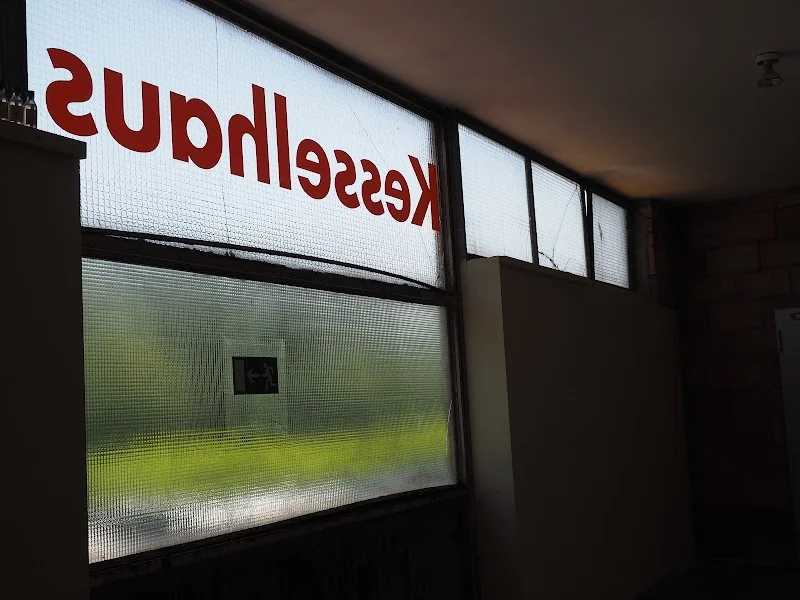
The first impression of the Kunstraum is primarily created through its architecture. The building dates back to the early 1960s and was originally used as a functional building of the old hospital, including heating, laundry, and pathology. This past is still visible in the house, but therein lies its strength: it is not a neutral white cube, but a space with patina, presence, and its own history. This is particularly interesting for images and photos because the surface of the building does not work against the art, but enters into a dialogue with it. The official descriptions emphasize this character: a historic industrial building that stood empty for many years and was then reactivated through the commitment of the Kunstraum JETZT! e.V. Therefore, anyone photographing the house is also capturing the traces of its use and repurposing. ([bamberg.info](https://www.bamberg.info/poi/kunstraum_kesselhaus-44157/))
Additionally, the spatial effect inside contributes significantly. The tourism site for Bamberg speaks of light-flooded rooms under the distinctive shed roof construction, while the association highlights the generous skylights and the interchangeable, hanging or movable partition walls. For the visual language, this means: hard industrial aesthetics meet plenty of daylight and flexible curatorial interventions. This creates spaces where sculptures, installations, or site-specific works are not only presented but also become physically tangible. This is precisely why the Kunstraum Kesselhaus frequently appears in search queries for photos, images, and impressions. The location does not provide a smooth backdrop, but a strong visual stance that allows art and architecture to work equally. ([bamberg.info](https://www.bamberg.info/poi/kunstraum_kesselhaus-44157/))
The location also strongly contributes to the visual impact. The Kesselhaus is located on the Regnitz, opposite the concert and congress hall, thus in an area that makes the transition between the old town, river, and cultural quarter visible. This environment makes the house interesting not only in content but also photographically, as exterior views, riverside, and entrance at Leinritt allow for different perspectives. The place is described on the official pages as ideally located and as a space with history and character. For visitors, this is often the moment when a simple cultural appointment becomes a very formative impression: one does not enter just any art place, but an urban space with industrial memory that has consciously opened up to contemporary art. ([kunstraum-jetzt.de](https://www.kunstraum-jetzt.de/?page_id=46))
When searching for images of Kunstraum Kesselhaus, one should therefore not only think of classic exhibition views. Details such as the roof construction, the high room edges, the wide sightlines, and the contrasts between raw substance and precisely placed art are also interesting. The association itself states that the walls can withstand drill holes and that the stable floor can also bear heavy loads. This openness is crucial for the visual language of the house: art can appear larger, louder, and more physical here than in many other spaces. For SEO and user searches, this is important because terms like photos, images, interior view, or architecture always refer to the special materiality of the house. This is precisely where the visual identity of the Kesselhaus lies. ([kunstraum-jetzt.de](https://www.kunstraum-jetzt.de/?page_id=24))
Opening Hours, Exhibitions, and Current Program
The Kunstraum Kesselhaus is not a daily open exhibition space but a program space that is only accessible during ongoing exhibitions. The regular times are stated on the official page as Friday and public holidays from 3 PM to 6 PM and Saturday and Sunday from 11 AM to 6 PM, with times varying depending on the exhibition. This is important for planning visits, as one should not schedule the appointment spontaneously like any other museum. The current opening hours should be checked on the homepage or on the organizer's page. This logic makes the place curatorially flexible and at the same time demanding: the visit is oriented to the exhibition rhythm, not vice versa. ([kunstraum-jetzt.de](https://www.kunstraum-jetzt.de/?page_id=1564))
The program is developed in close collaboration with the participating associations. The Kunstraum JETZT! e.V. explicitly names the BBK Oberfranken, the Kunstverein Bamberg, and the ArchitekturTreff Bamberg as central partners. Thus, the Kesselhaus is not just a space but a shared platform for different artistic and architectural perspectives. The official page also emphasizes that the audience experiences not only exhibitions but also readings, lectures, dance, short films, and concerts. This mix is particularly relevant for search intentions around programs, events, and current exhibitions because the place is not reduced to a single genre. Those who visit it usually receive a culturally broad but clearly contemporary profile. ([kunstraum-jetzt.de](https://www.kunstraum-jetzt.de/?page_id=46))
As an example for the exhibition year 2026, the website mentions the show Dierk Berthel – unfinished spaces, volume II. It ran from March 14, 2026, to April 26, 2026, and was described as an artistic exploration of sculpture as an intervention in space. The works presented engage with material, form, and environment and range from monumental, powerful sculptures to lighter, playful creations. For the Kunstraum Kesselhaus, this is a typical program example: it is not just about showing finished objects, but about spatial experience. Especially in a house with high ceilings, daylight, and industrial structure, such works unfold their full effect. ([kunstraum-jetzt.de](https://www.kunstraum-jetzt.de/?page_id=1589))
It is also important to consider the question of admission and accessibility. For art exhibitions, no admission is usually charged; for music, performance, and similar events, the respective organizer decides on pricing. This makes the Kunstraum Kesselhaus not only culturally attractive but also accessible. Those specifically looking for tickets, programs, or exhibitions should therefore distinguish between exhibitions and special events. The place is not a mass event house with a fixed permanent calendar but a flexible space where contemporary art and occasional cultural formats are continuously re-organized. This dynamism is part of its profile and explains why the program often appears particularly diverse. ([kunstraum-jetzt.de](https://www.kunstraum-jetzt.de/?page_id=1564))
Directions, Entrance, and Parking at Untere Sandstraße
The official address of the Kunstraum is Untere Sandstraße 42, 96047 Bamberg; the entrance is located at Leinritt. This information is crucial for any travel planning because the place is not simply located on a main road with a large forecourt but in a historically grown part of the city with its own pathways. Therefore, those coming for the first time should consciously plan the entrance at Am Leinritt. This makes orientation easier, especially if one only knows the building or project name. For SEO search queries like directions to Kunstraum Kesselhaus, this clear address structure is particularly helpful. ([kunstraum-jetzt.de](https://www.kunstraum-jetzt.de/?page_id=116))
The location on the Regnitz and opposite the concert and congress hall makes the site urbanistically attractive but also practically interesting. The Kunstraum itself does not mention its own parking facility, but the immediate surroundings belong to a well-developed cultural quarter. Based on the official location information, the underground garage of the concert and congress hall at Mußstraße 5 is a nearby public parking option in the area. The parking facility has 354 spaces and is open 24 hours a day. Since the Kunstraum is located opposite the congress hall, this is a logical orientation for many visitors. This is a location inference based on the official information, not an explicit parking recommendation from the Kunstraum itself. ([kunstraum-jetzt.de](https://www.kunstraum-jetzt.de/?page_id=46))
For visitors coming from the city area or who already know Bamberg, the location is easy to place: Sand area, Regnitz bank, concert and congress hall, Leinritt, Untere Sandstraße. This combination usually makes the way to the Kesselhaus simpler than the address might initially suggest. At the same time, one should note that the house is only open during exhibitions and that the visit should therefore be scheduled accordingly. The journey is particularly worthwhile if one combines the exhibition visit with a walk along the river or with another cultural appointment in the neighborhood. This way, the journey becomes part of the overall experience. ([kunstraum-jetzt.de](https://www.kunstraum-jetzt.de/?page_id=46))
It is also sensible to consider the context of the house for the search intention of parking. The Kesselhaus is not located in an isolated industrial area but in an urban cultural space with different road users, pedestrian paths, and venues. Those who wish to travel comfortably should therefore check in advance whether an exhibition is currently running, whether a special format is taking place, and how the general occupancy in the quarter is developing. The official sources describe the place as ideally located and easily accessible; it can be inferred that both orientation on foot and the use of the existing public parking infrastructure are the most practical ways. This is especially helpful during openings, tours, or evening events. ([kunstraum-jetzt.de](https://www.kunstraum-jetzt.de/?page_id=46))
History, Initiative, and Development Since 2009
The history of the Kunstraum Kesselhaus is closely linked to the desire to provide Bamberg with a permanent place for contemporary visual art. The association describes that the cultural city of Bamberg has lacked such an exhibition space for decades and that various protagonists of art became aware of the Kesselhaus of the former hospital. In 2009, the three chairpersons of ArchitekturTreff, BBK, and Kunstverein founded the Kesselhaus initiative. From the beginning, the aim was to transform an empty, neglected building into a center for contemporary art. That this transformation did not happen by chance but arose from long-term commitment shapes the self-understanding of the place to this day. ([kunstraum-jetzt.de](https://www.kunstraum-jetzt.de/?page_id=24))
The first structural and organizational steps were laborious yet decisive. According to the association's history, work was done to clean up, debris was removed, funding applications were submitted, sponsors were won, and the technical infrastructure was improved. This included, among other things, new electrical wiring, an emergency exit door, and securing the floor openings of the former boilers. The space was deliberately kept in its industrial character; no fresh paint was intended to cover the historical impression. This decision is still noticeable today because the place does not rely on perfect smoothness but on authenticity and usability. For the art, this is an advantage, as it does not have to fight against the materiality of the space. ([kunstraum-jetzt.de](https://www.kunstraum-jetzt.de/?page_id=24))
In June 2011, the Kesselhaus was opened as a Kunstraum. The association's chronicle names the first actions as the research group F and an exhibition organized by the Kunstverein; in September 2011, ARTUR 14 followed as a showcase of Upper Franconian artists. The house quickly gained regional and national attention. In autumn 2013, it was initially closed again due to structural deficiencies, after which the support association Kunstraum JETZT! e.V. was founded. This phase shows how strongly the place is supported by civic engagement. The reopening in July 2015 marked not only a structural but also a cultural return. ([kunstraum-jetzt.de](https://www.kunstraum-jetzt.de/?page_id=24))
The further development was characterized by sustainable security. In 2022, a feasibility study was commissioned by the city of Bamberg and successfully completed. In 2025, the association was able to negotiate an indefinite lease with the city of Bamberg, which forms the basis for planning-secure and sustainable work. In 2026, an office space for the association's and operational work was additionally established. For an art space, this is not a minor matter but a prerequisite for ensuring that programs can not only function in the short term but can also be planned in the long term. Today, the Kunstraum Kesselhaus stands not only for a beautiful idea but for an institutionally stable structure that has developed over years. ([kunstraum-jetzt.de](https://www.kunstraum-jetzt.de/?page_id=46))
What Makes Kunstraum Kesselhaus Special for Bamberg
What is special about Kunstraum Kesselhaus is the combination of location, architecture, and cultural mission. The association describes the place as a space with history and character, where discourse, experimentation, and encounters become possible. At the same time, the Kesselhaus fills a gap in a city with a strong theater, music, and museum profile: the gap of a space dedicated to contemporary art exhibitions. This profile makes the house particularly interesting for visitors seeking more than just a classic sight. It is not about museum distance but about immediate cultural presence. ([kunstraum-jetzt.de](https://www.kunstraum-jetzt.de/?page_id=46))
Particularly convincing is the openness of the space to different artistic formats. The official information mentions not only exhibitions but also readings, lectures, dance, short films, and concerts. This means: the Kesselhaus is not fixed to a single discipline but consciously works at the intersections. This complexity is also important for the perception of the city because Bamberg thus has a place where current themes and artistic positions can be tested. The collaboration between BBK Oberfranken, Kunstverein Bamberg, and ArchitekturTreff Bamberg ensures that different perspectives come together and that the program does not appear monotonous. ([kunstraum-jetzt.de](https://www.kunstraum-jetzt.de/?page_id=46))
The figures mentioned by the association underline this significance. Over 75 exhibitions and events are said to have reached around 60,000 visitors, supported by volunteers, sponsors, and association members. Additionally, the association is supported by nearly 200 members. Such values show that the Kunstraum Kesselhaus does not just exist as a project but as a living community effort. In a time when cultural places often face pressure, this is a strong signal. For Bamberg, this means: contemporary art has not only a temporary pop-up space but a local structure that has developed and been supported over the years. ([kunstraum-jetzt.de](https://www.kunstraum-jetzt.de/?page_id=46))
Cultural education is also explicitly part of the concept. The association states that the space is also there for art education for children, teenagers, and adults. This is an important point because the place thus has an impact beyond mere exhibition into the city. Those working with school classes, families, or art-interested groups will find here not a rigid framework but a space designed for mediation. The combination of historical architecture, contemporary art, and education-oriented work makes the Kunstraum Kesselhaus a rare location in the best sense: locally anchored, open to experiments, and simultaneously clear in its cultural mission. ([kunstraum-jetzt.de](https://www.kunstraum-jetzt.de/?page_id=46))
Visitor Tips, Accessibility, and Practical Information
Those wishing to visit the Kunstraum Kesselhaus should pay attention to the special opening logic of the house. Unlike a classic museum, the place does not have continuous daily opening hours but is tied to the duration of exhibitions. This is worthwhile because the visit is usually associated with a specific curatorial concept. At the same time, it means that one should check the current exhibition in advance to avoid standing in front of a closed door. For search terms like opening hours, program, or exhibition, this information is central. The house is a destination for conscious cultural appointments, not for random spontaneous visits. ([kunstraum-jetzt.de](https://www.kunstraum-jetzt.de/?page_id=1564))
Another practical point is admission. For art exhibitions, no admission is usually charged. This makes the visit particularly attractive for those who want to experience contemporary art without high admission barriers. For special formats like concerts, music evenings, or performances, the respective organizer may set their own prices. Therefore, it is advisable to pay attention to the specific format in advance. The Kesselhaus is particularly interesting because of this mix of open exhibition culture and flexible special events: the perception of the place always also depends on what is currently being shown or performed. This keeps the space content-wise lively and changes with each new presentation. ([kunstraum-jetzt.de](https://www.kunstraum-jetzt.de/?page_id=1564))
Regarding barrier-free use, the official site states that the Kunstraum Kesselhaus is accessible upon request. Therefore, those needing assistance should contact in advance. Guided tours can also be requested via the provided email address of the art association or the BBK. This is a useful hint for groups, school classes, or culture-interested visitors who want to explore the space not just superficially but in depth. The combination of appointment coordination, guided tours, and individual accessibility fits well with a place that strongly focuses on personal encounters and mediation. ([kunstraum-jetzt.de](https://www.kunstraum-jetzt.de/?page_id=1564))
Finally, a look at the self-understanding of the house: the association understands the Kunstraum as a kind of charity in Bamberg, thus as civic engagement for contemporary art. Membership and support are actively promoted, even with a low monthly fee. This shows that the place is not only conceived as a cultural address but as a community project. Therefore, those looking for photos, wanting to attend a program, or discovering a special art space in Bamberg will find here far more than just a beautiful backdrop. The Kesselhaus is a lived cultural place that is equally supported by engagement, history, and contemporary art. ([kunstraum-jetzt.de](https://www.kunstraum-jetzt.de/?page_id=1564))
Sources:
- Kunstraum JETZT! – Space for Art ([kunstraum-jetzt.de](https://www.kunstraum-jetzt.de/?page_id=46))
- Kunstraum JETZT! – Opening Hours ([kunstraum-jetzt.de](https://www.kunstraum-jetzt.de/?page_id=1564))
- Kunstraum JETZT! – Contact and Location Map ([kunstraum-jetzt.de](https://www.kunstraum-jetzt.de/?page_id=116))
- Kunstraum JETZT! – History ([kunstraum-jetzt.de](https://www.kunstraum-jetzt.de/?page_id=24))
- Bamberg Tourism – Kunstraum Kesselhaus ([bamberg.info](https://www.bamberg.info/poi/kunstraum_kesselhaus-44157/))
- Kunstraum JETZT! – Exhibitions 2026 ([kunstraum-jetzt.de](https://www.kunstraum-jetzt.de/?page_id=1589))
- Bamberg Congress + Event – Parking Options at the Concert and Congress Hall ([bamberg-ce.de](https://www.bamberg-ce.de/faqs/?utm_source=openai))
Mehr anzeigenWeniger anzeigen
Kunstraum Kesselhaus | Photos & Exhibitions
The Kunstraum Kesselhaus in Bamberg is a place that clearly shows at first glance why it works so well for contemporary art. The former boiler house of the old hospital is located at Untere Sandstraße 42 at Leinritt, directly on the Regnitz and opposite the concert and congress hall. From a long-vacant functional building, a space for exhibitions, readings, lectures, concerts, and artistic experiments has been created. The official pages describe the house as flooded with light, architecturally exciting, and characterized by urban flair. Particularly striking are the approximately seven-meter-high rooms under the shed roof construction, which give the artworks plenty of air and the audience an open, concentrated atmosphere. Therefore, those searching for photos or images of the Kunstraum Kesselhaus are not just looking for a building, but a very specific mix of industrial charm, history, and contemporary art. This very mix is what makes the place appealing and explains why it is perceived in Bamberg far beyond a simple exhibition address. ([bamberg.info](https://www.bamberg.info/poi/kunstraum_kesselhaus-44157/))
Photos, Images, and the First Impression of Kunstraum Kesselhaus
The first impression of the Kunstraum is primarily created through its architecture. The building dates back to the early 1960s and was originally used as a functional building of the old hospital, including heating, laundry, and pathology. This past is still visible in the house, but therein lies its strength: it is not a neutral white cube, but a space with patina, presence, and its own history. This is particularly interesting for images and photos because the surface of the building does not work against the art, but enters into a dialogue with it. The official descriptions emphasize this character: a historic industrial building that stood empty for many years and was then reactivated through the commitment of the Kunstraum JETZT! e.V. Therefore, anyone photographing the house is also capturing the traces of its use and repurposing. ([bamberg.info](https://www.bamberg.info/poi/kunstraum_kesselhaus-44157/))
Additionally, the spatial effect inside contributes significantly. The tourism site for Bamberg speaks of light-flooded rooms under the distinctive shed roof construction, while the association highlights the generous skylights and the interchangeable, hanging or movable partition walls. For the visual language, this means: hard industrial aesthetics meet plenty of daylight and flexible curatorial interventions. This creates spaces where sculptures, installations, or site-specific works are not only presented but also become physically tangible. This is precisely why the Kunstraum Kesselhaus frequently appears in search queries for photos, images, and impressions. The location does not provide a smooth backdrop, but a strong visual stance that allows art and architecture to work equally. ([bamberg.info](https://www.bamberg.info/poi/kunstraum_kesselhaus-44157/))
The location also strongly contributes to the visual impact. The Kesselhaus is located on the Regnitz, opposite the concert and congress hall, thus in an area that makes the transition between the old town, river, and cultural quarter visible. This environment makes the house interesting not only in content but also photographically, as exterior views, riverside, and entrance at Leinritt allow for different perspectives. The place is described on the official pages as ideally located and as a space with history and character. For visitors, this is often the moment when a simple cultural appointment becomes a very formative impression: one does not enter just any art place, but an urban space with industrial memory that has consciously opened up to contemporary art. ([kunstraum-jetzt.de](https://www.kunstraum-jetzt.de/?page_id=46))
When searching for images of Kunstraum Kesselhaus, one should therefore not only think of classic exhibition views. Details such as the roof construction, the high room edges, the wide sightlines, and the contrasts between raw substance and precisely placed art are also interesting. The association itself states that the walls can withstand drill holes and that the stable floor can also bear heavy loads. This openness is crucial for the visual language of the house: art can appear larger, louder, and more physical here than in many other spaces. For SEO and user searches, this is important because terms like photos, images, interior view, or architecture always refer to the special materiality of the house. This is precisely where the visual identity of the Kesselhaus lies. ([kunstraum-jetzt.de](https://www.kunstraum-jetzt.de/?page_id=24))
Opening Hours, Exhibitions, and Current Program
The Kunstraum Kesselhaus is not a daily open exhibition space but a program space that is only accessible during ongoing exhibitions. The regular times are stated on the official page as Friday and public holidays from 3 PM to 6 PM and Saturday and Sunday from 11 AM to 6 PM, with times varying depending on the exhibition. This is important for planning visits, as one should not schedule the appointment spontaneously like any other museum. The current opening hours should be checked on the homepage or on the organizer's page. This logic makes the place curatorially flexible and at the same time demanding: the visit is oriented to the exhibition rhythm, not vice versa. ([kunstraum-jetzt.de](https://www.kunstraum-jetzt.de/?page_id=1564))
The program is developed in close collaboration with the participating associations. The Kunstraum JETZT! e.V. explicitly names the BBK Oberfranken, the Kunstverein Bamberg, and the ArchitekturTreff Bamberg as central partners. Thus, the Kesselhaus is not just a space but a shared platform for different artistic and architectural perspectives. The official page also emphasizes that the audience experiences not only exhibitions but also readings, lectures, dance, short films, and concerts. This mix is particularly relevant for search intentions around programs, events, and current exhibitions because the place is not reduced to a single genre. Those who visit it usually receive a culturally broad but clearly contemporary profile. ([kunstraum-jetzt.de](https://www.kunstraum-jetzt.de/?page_id=46))
As an example for the exhibition year 2026, the website mentions the show Dierk Berthel – unfinished spaces, volume II. It ran from March 14, 2026, to April 26, 2026, and was described as an artistic exploration of sculpture as an intervention in space. The works presented engage with material, form, and environment and range from monumental, powerful sculptures to lighter, playful creations. For the Kunstraum Kesselhaus, this is a typical program example: it is not just about showing finished objects, but about spatial experience. Especially in a house with high ceilings, daylight, and industrial structure, such works unfold their full effect. ([kunstraum-jetzt.de](https://www.kunstraum-jetzt.de/?page_id=1589))
It is also important to consider the question of admission and accessibility. For art exhibitions, no admission is usually charged; for music, performance, and similar events, the respective organizer decides on pricing. This makes the Kunstraum Kesselhaus not only culturally attractive but also accessible. Those specifically looking for tickets, programs, or exhibitions should therefore distinguish between exhibitions and special events. The place is not a mass event house with a fixed permanent calendar but a flexible space where contemporary art and occasional cultural formats are continuously re-organized. This dynamism is part of its profile and explains why the program often appears particularly diverse. ([kunstraum-jetzt.de](https://www.kunstraum-jetzt.de/?page_id=1564))
Directions, Entrance, and Parking at Untere Sandstraße
The official address of the Kunstraum is Untere Sandstraße 42, 96047 Bamberg; the entrance is located at Leinritt. This information is crucial for any travel planning because the place is not simply located on a main road with a large forecourt but in a historically grown part of the city with its own pathways. Therefore, those coming for the first time should consciously plan the entrance at Am Leinritt. This makes orientation easier, especially if one only knows the building or project name. For SEO search queries like directions to Kunstraum Kesselhaus, this clear address structure is particularly helpful. ([kunstraum-jetzt.de](https://www.kunstraum-jetzt.de/?page_id=116))
The location on the Regnitz and opposite the concert and congress hall makes the site urbanistically attractive but also practically interesting. The Kunstraum itself does not mention its own parking facility, but the immediate surroundings belong to a well-developed cultural quarter. Based on the official location information, the underground garage of the concert and congress hall at Mußstraße 5 is a nearby public parking option in the area. The parking facility has 354 spaces and is open 24 hours a day. Since the Kunstraum is located opposite the congress hall, this is a logical orientation for many visitors. This is a location inference based on the official information, not an explicit parking recommendation from the Kunstraum itself. ([kunstraum-jetzt.de](https://www.kunstraum-jetzt.de/?page_id=46))
For visitors coming from the city area or who already know Bamberg, the location is easy to place: Sand area, Regnitz bank, concert and congress hall, Leinritt, Untere Sandstraße. This combination usually makes the way to the Kesselhaus simpler than the address might initially suggest. At the same time, one should note that the house is only open during exhibitions and that the visit should therefore be scheduled accordingly. The journey is particularly worthwhile if one combines the exhibition visit with a walk along the river or with another cultural appointment in the neighborhood. This way, the journey becomes part of the overall experience. ([kunstraum-jetzt.de](https://www.kunstraum-jetzt.de/?page_id=46))
It is also sensible to consider the context of the house for the search intention of parking. The Kesselhaus is not located in an isolated industrial area but in an urban cultural space with different road users, pedestrian paths, and venues. Those who wish to travel comfortably should therefore check in advance whether an exhibition is currently running, whether a special format is taking place, and how the general occupancy in the quarter is developing. The official sources describe the place as ideally located and easily accessible; it can be inferred that both orientation on foot and the use of the existing public parking infrastructure are the most practical ways. This is especially helpful during openings, tours, or evening events. ([kunstraum-jetzt.de](https://www.kunstraum-jetzt.de/?page_id=46))
History, Initiative, and Development Since 2009
The history of the Kunstraum Kesselhaus is closely linked to the desire to provide Bamberg with a permanent place for contemporary visual art. The association describes that the cultural city of Bamberg has lacked such an exhibition space for decades and that various protagonists of art became aware of the Kesselhaus of the former hospital. In 2009, the three chairpersons of ArchitekturTreff, BBK, and Kunstverein founded the Kesselhaus initiative. From the beginning, the aim was to transform an empty, neglected building into a center for contemporary art. That this transformation did not happen by chance but arose from long-term commitment shapes the self-understanding of the place to this day. ([kunstraum-jetzt.de](https://www.kunstraum-jetzt.de/?page_id=24))
The first structural and organizational steps were laborious yet decisive. According to the association's history, work was done to clean up, debris was removed, funding applications were submitted, sponsors were won, and the technical infrastructure was improved. This included, among other things, new electrical wiring, an emergency exit door, and securing the floor openings of the former boilers. The space was deliberately kept in its industrial character; no fresh paint was intended to cover the historical impression. This decision is still noticeable today because the place does not rely on perfect smoothness but on authenticity and usability. For the art, this is an advantage, as it does not have to fight against the materiality of the space. ([kunstraum-jetzt.de](https://www.kunstraum-jetzt.de/?page_id=24))
In June 2011, the Kesselhaus was opened as a Kunstraum. The association's chronicle names the first actions as the research group F and an exhibition organized by the Kunstverein; in September 2011, ARTUR 14 followed as a showcase of Upper Franconian artists. The house quickly gained regional and national attention. In autumn 2013, it was initially closed again due to structural deficiencies, after which the support association Kunstraum JETZT! e.V. was founded. This phase shows how strongly the place is supported by civic engagement. The reopening in July 2015 marked not only a structural but also a cultural return. ([kunstraum-jetzt.de](https://www.kunstraum-jetzt.de/?page_id=24))
The further development was characterized by sustainable security. In 2022, a feasibility study was commissioned by the city of Bamberg and successfully completed. In 2025, the association was able to negotiate an indefinite lease with the city of Bamberg, which forms the basis for planning-secure and sustainable work. In 2026, an office space for the association's and operational work was additionally established. For an art space, this is not a minor matter but a prerequisite for ensuring that programs can not only function in the short term but can also be planned in the long term. Today, the Kunstraum Kesselhaus stands not only for a beautiful idea but for an institutionally stable structure that has developed over years. ([kunstraum-jetzt.de](https://www.kunstraum-jetzt.de/?page_id=46))
What Makes Kunstraum Kesselhaus Special for Bamberg
What is special about Kunstraum Kesselhaus is the combination of location, architecture, and cultural mission. The association describes the place as a space with history and character, where discourse, experimentation, and encounters become possible. At the same time, the Kesselhaus fills a gap in a city with a strong theater, music, and museum profile: the gap of a space dedicated to contemporary art exhibitions. This profile makes the house particularly interesting for visitors seeking more than just a classic sight. It is not about museum distance but about immediate cultural presence. ([kunstraum-jetzt.de](https://www.kunstraum-jetzt.de/?page_id=46))
Particularly convincing is the openness of the space to different artistic formats. The official information mentions not only exhibitions but also readings, lectures, dance, short films, and concerts. This means: the Kesselhaus is not fixed to a single discipline but consciously works at the intersections. This complexity is also important for the perception of the city because Bamberg thus has a place where current themes and artistic positions can be tested. The collaboration between BBK Oberfranken, Kunstverein Bamberg, and ArchitekturTreff Bamberg ensures that different perspectives come together and that the program does not appear monotonous. ([kunstraum-jetzt.de](https://www.kunstraum-jetzt.de/?page_id=46))
The figures mentioned by the association underline this significance. Over 75 exhibitions and events are said to have reached around 60,000 visitors, supported by volunteers, sponsors, and association members. Additionally, the association is supported by nearly 200 members. Such values show that the Kunstraum Kesselhaus does not just exist as a project but as a living community effort. In a time when cultural places often face pressure, this is a strong signal. For Bamberg, this means: contemporary art has not only a temporary pop-up space but a local structure that has developed and been supported over the years. ([kunstraum-jetzt.de](https://www.kunstraum-jetzt.de/?page_id=46))
Cultural education is also explicitly part of the concept. The association states that the space is also there for art education for children, teenagers, and adults. This is an important point because the place thus has an impact beyond mere exhibition into the city. Those working with school classes, families, or art-interested groups will find here not a rigid framework but a space designed for mediation. The combination of historical architecture, contemporary art, and education-oriented work makes the Kunstraum Kesselhaus a rare location in the best sense: locally anchored, open to experiments, and simultaneously clear in its cultural mission. ([kunstraum-jetzt.de](https://www.kunstraum-jetzt.de/?page_id=46))
Visitor Tips, Accessibility, and Practical Information
Those wishing to visit the Kunstraum Kesselhaus should pay attention to the special opening logic of the house. Unlike a classic museum, the place does not have continuous daily opening hours but is tied to the duration of exhibitions. This is worthwhile because the visit is usually associated with a specific curatorial concept. At the same time, it means that one should check the current exhibition in advance to avoid standing in front of a closed door. For search terms like opening hours, program, or exhibition, this information is central. The house is a destination for conscious cultural appointments, not for random spontaneous visits. ([kunstraum-jetzt.de](https://www.kunstraum-jetzt.de/?page_id=1564))
Another practical point is admission. For art exhibitions, no admission is usually charged. This makes the visit particularly attractive for those who want to experience contemporary art without high admission barriers. For special formats like concerts, music evenings, or performances, the respective organizer may set their own prices. Therefore, it is advisable to pay attention to the specific format in advance. The Kesselhaus is particularly interesting because of this mix of open exhibition culture and flexible special events: the perception of the place always also depends on what is currently being shown or performed. This keeps the space content-wise lively and changes with each new presentation. ([kunstraum-jetzt.de](https://www.kunstraum-jetzt.de/?page_id=1564))
Regarding barrier-free use, the official site states that the Kunstraum Kesselhaus is accessible upon request. Therefore, those needing assistance should contact in advance. Guided tours can also be requested via the provided email address of the art association or the BBK. This is a useful hint for groups, school classes, or culture-interested visitors who want to explore the space not just superficially but in depth. The combination of appointment coordination, guided tours, and individual accessibility fits well with a place that strongly focuses on personal encounters and mediation. ([kunstraum-jetzt.de](https://www.kunstraum-jetzt.de/?page_id=1564))
Finally, a look at the self-understanding of the house: the association understands the Kunstraum as a kind of charity in Bamberg, thus as civic engagement for contemporary art. Membership and support are actively promoted, even with a low monthly fee. This shows that the place is not only conceived as a cultural address but as a community project. Therefore, those looking for photos, wanting to attend a program, or discovering a special art space in Bamberg will find here far more than just a beautiful backdrop. The Kesselhaus is a lived cultural place that is equally supported by engagement, history, and contemporary art. ([kunstraum-jetzt.de](https://www.kunstraum-jetzt.de/?page_id=1564))
Sources:
- Kunstraum JETZT! – Space for Art ([kunstraum-jetzt.de](https://www.kunstraum-jetzt.de/?page_id=46))
- Kunstraum JETZT! – Opening Hours ([kunstraum-jetzt.de](https://www.kunstraum-jetzt.de/?page_id=1564))
- Kunstraum JETZT! – Contact and Location Map ([kunstraum-jetzt.de](https://www.kunstraum-jetzt.de/?page_id=116))
- Kunstraum JETZT! – History ([kunstraum-jetzt.de](https://www.kunstraum-jetzt.de/?page_id=24))
- Bamberg Tourism – Kunstraum Kesselhaus ([bamberg.info](https://www.bamberg.info/poi/kunstraum_kesselhaus-44157/))
- Kunstraum JETZT! – Exhibitions 2026 ([kunstraum-jetzt.de](https://www.kunstraum-jetzt.de/?page_id=1589))
- Bamberg Congress + Event – Parking Options at the Concert and Congress Hall ([bamberg-ce.de](https://www.bamberg-ce.de/faqs/?utm_source=openai))
Kunstraum Kesselhaus | Photos & Exhibitions
The Kunstraum Kesselhaus in Bamberg is a place that clearly shows at first glance why it works so well for contemporary art. The former boiler house of the old hospital is located at Untere Sandstraße 42 at Leinritt, directly on the Regnitz and opposite the concert and congress hall. From a long-vacant functional building, a space for exhibitions, readings, lectures, concerts, and artistic experiments has been created. The official pages describe the house as flooded with light, architecturally exciting, and characterized by urban flair. Particularly striking are the approximately seven-meter-high rooms under the shed roof construction, which give the artworks plenty of air and the audience an open, concentrated atmosphere. Therefore, those searching for photos or images of the Kunstraum Kesselhaus are not just looking for a building, but a very specific mix of industrial charm, history, and contemporary art. This very mix is what makes the place appealing and explains why it is perceived in Bamberg far beyond a simple exhibition address. ([bamberg.info](https://www.bamberg.info/poi/kunstraum_kesselhaus-44157/))
Photos, Images, and the First Impression of Kunstraum Kesselhaus
The first impression of the Kunstraum is primarily created through its architecture. The building dates back to the early 1960s and was originally used as a functional building of the old hospital, including heating, laundry, and pathology. This past is still visible in the house, but therein lies its strength: it is not a neutral white cube, but a space with patina, presence, and its own history. This is particularly interesting for images and photos because the surface of the building does not work against the art, but enters into a dialogue with it. The official descriptions emphasize this character: a historic industrial building that stood empty for many years and was then reactivated through the commitment of the Kunstraum JETZT! e.V. Therefore, anyone photographing the house is also capturing the traces of its use and repurposing. ([bamberg.info](https://www.bamberg.info/poi/kunstraum_kesselhaus-44157/))
Additionally, the spatial effect inside contributes significantly. The tourism site for Bamberg speaks of light-flooded rooms under the distinctive shed roof construction, while the association highlights the generous skylights and the interchangeable, hanging or movable partition walls. For the visual language, this means: hard industrial aesthetics meet plenty of daylight and flexible curatorial interventions. This creates spaces where sculptures, installations, or site-specific works are not only presented but also become physically tangible. This is precisely why the Kunstraum Kesselhaus frequently appears in search queries for photos, images, and impressions. The location does not provide a smooth backdrop, but a strong visual stance that allows art and architecture to work equally. ([bamberg.info](https://www.bamberg.info/poi/kunstraum_kesselhaus-44157/))
The location also strongly contributes to the visual impact. The Kesselhaus is located on the Regnitz, opposite the concert and congress hall, thus in an area that makes the transition between the old town, river, and cultural quarter visible. This environment makes the house interesting not only in content but also photographically, as exterior views, riverside, and entrance at Leinritt allow for different perspectives. The place is described on the official pages as ideally located and as a space with history and character. For visitors, this is often the moment when a simple cultural appointment becomes a very formative impression: one does not enter just any art place, but an urban space with industrial memory that has consciously opened up to contemporary art. ([kunstraum-jetzt.de](https://www.kunstraum-jetzt.de/?page_id=46))
When searching for images of Kunstraum Kesselhaus, one should therefore not only think of classic exhibition views. Details such as the roof construction, the high room edges, the wide sightlines, and the contrasts between raw substance and precisely placed art are also interesting. The association itself states that the walls can withstand drill holes and that the stable floor can also bear heavy loads. This openness is crucial for the visual language of the house: art can appear larger, louder, and more physical here than in many other spaces. For SEO and user searches, this is important because terms like photos, images, interior view, or architecture always refer to the special materiality of the house. This is precisely where the visual identity of the Kesselhaus lies. ([kunstraum-jetzt.de](https://www.kunstraum-jetzt.de/?page_id=24))
Opening Hours, Exhibitions, and Current Program
The Kunstraum Kesselhaus is not a daily open exhibition space but a program space that is only accessible during ongoing exhibitions. The regular times are stated on the official page as Friday and public holidays from 3 PM to 6 PM and Saturday and Sunday from 11 AM to 6 PM, with times varying depending on the exhibition. This is important for planning visits, as one should not schedule the appointment spontaneously like any other museum. The current opening hours should be checked on the homepage or on the organizer's page. This logic makes the place curatorially flexible and at the same time demanding: the visit is oriented to the exhibition rhythm, not vice versa. ([kunstraum-jetzt.de](https://www.kunstraum-jetzt.de/?page_id=1564))
The program is developed in close collaboration with the participating associations. The Kunstraum JETZT! e.V. explicitly names the BBK Oberfranken, the Kunstverein Bamberg, and the ArchitekturTreff Bamberg as central partners. Thus, the Kesselhaus is not just a space but a shared platform for different artistic and architectural perspectives. The official page also emphasizes that the audience experiences not only exhibitions but also readings, lectures, dance, short films, and concerts. This mix is particularly relevant for search intentions around programs, events, and current exhibitions because the place is not reduced to a single genre. Those who visit it usually receive a culturally broad but clearly contemporary profile. ([kunstraum-jetzt.de](https://www.kunstraum-jetzt.de/?page_id=46))
As an example for the exhibition year 2026, the website mentions the show Dierk Berthel – unfinished spaces, volume II. It ran from March 14, 2026, to April 26, 2026, and was described as an artistic exploration of sculpture as an intervention in space. The works presented engage with material, form, and environment and range from monumental, powerful sculptures to lighter, playful creations. For the Kunstraum Kesselhaus, this is a typical program example: it is not just about showing finished objects, but about spatial experience. Especially in a house with high ceilings, daylight, and industrial structure, such works unfold their full effect. ([kunstraum-jetzt.de](https://www.kunstraum-jetzt.de/?page_id=1589))
It is also important to consider the question of admission and accessibility. For art exhibitions, no admission is usually charged; for music, performance, and similar events, the respective organizer decides on pricing. This makes the Kunstraum Kesselhaus not only culturally attractive but also accessible. Those specifically looking for tickets, programs, or exhibitions should therefore distinguish between exhibitions and special events. The place is not a mass event house with a fixed permanent calendar but a flexible space where contemporary art and occasional cultural formats are continuously re-organized. This dynamism is part of its profile and explains why the program often appears particularly diverse. ([kunstraum-jetzt.de](https://www.kunstraum-jetzt.de/?page_id=1564))
Directions, Entrance, and Parking at Untere Sandstraße
The official address of the Kunstraum is Untere Sandstraße 42, 96047 Bamberg; the entrance is located at Leinritt. This information is crucial for any travel planning because the place is not simply located on a main road with a large forecourt but in a historically grown part of the city with its own pathways. Therefore, those coming for the first time should consciously plan the entrance at Am Leinritt. This makes orientation easier, especially if one only knows the building or project name. For SEO search queries like directions to Kunstraum Kesselhaus, this clear address structure is particularly helpful. ([kunstraum-jetzt.de](https://www.kunstraum-jetzt.de/?page_id=116))
The location on the Regnitz and opposite the concert and congress hall makes the site urbanistically attractive but also practically interesting. The Kunstraum itself does not mention its own parking facility, but the immediate surroundings belong to a well-developed cultural quarter. Based on the official location information, the underground garage of the concert and congress hall at Mußstraße 5 is a nearby public parking option in the area. The parking facility has 354 spaces and is open 24 hours a day. Since the Kunstraum is located opposite the congress hall, this is a logical orientation for many visitors. This is a location inference based on the official information, not an explicit parking recommendation from the Kunstraum itself. ([kunstraum-jetzt.de](https://www.kunstraum-jetzt.de/?page_id=46))
For visitors coming from the city area or who already know Bamberg, the location is easy to place: Sand area, Regnitz bank, concert and congress hall, Leinritt, Untere Sandstraße. This combination usually makes the way to the Kesselhaus simpler than the address might initially suggest. At the same time, one should note that the house is only open during exhibitions and that the visit should therefore be scheduled accordingly. The journey is particularly worthwhile if one combines the exhibition visit with a walk along the river or with another cultural appointment in the neighborhood. This way, the journey becomes part of the overall experience. ([kunstraum-jetzt.de](https://www.kunstraum-jetzt.de/?page_id=46))
It is also sensible to consider the context of the house for the search intention of parking. The Kesselhaus is not located in an isolated industrial area but in an urban cultural space with different road users, pedestrian paths, and venues. Those who wish to travel comfortably should therefore check in advance whether an exhibition is currently running, whether a special format is taking place, and how the general occupancy in the quarter is developing. The official sources describe the place as ideally located and easily accessible; it can be inferred that both orientation on foot and the use of the existing public parking infrastructure are the most practical ways. This is especially helpful during openings, tours, or evening events. ([kunstraum-jetzt.de](https://www.kunstraum-jetzt.de/?page_id=46))
History, Initiative, and Development Since 2009
The history of the Kunstraum Kesselhaus is closely linked to the desire to provide Bamberg with a permanent place for contemporary visual art. The association describes that the cultural city of Bamberg has lacked such an exhibition space for decades and that various protagonists of art became aware of the Kesselhaus of the former hospital. In 2009, the three chairpersons of ArchitekturTreff, BBK, and Kunstverein founded the Kesselhaus initiative. From the beginning, the aim was to transform an empty, neglected building into a center for contemporary art. That this transformation did not happen by chance but arose from long-term commitment shapes the self-understanding of the place to this day. ([kunstraum-jetzt.de](https://www.kunstraum-jetzt.de/?page_id=24))
The first structural and organizational steps were laborious yet decisive. According to the association's history, work was done to clean up, debris was removed, funding applications were submitted, sponsors were won, and the technical infrastructure was improved. This included, among other things, new electrical wiring, an emergency exit door, and securing the floor openings of the former boilers. The space was deliberately kept in its industrial character; no fresh paint was intended to cover the historical impression. This decision is still noticeable today because the place does not rely on perfect smoothness but on authenticity and usability. For the art, this is an advantage, as it does not have to fight against the materiality of the space. ([kunstraum-jetzt.de](https://www.kunstraum-jetzt.de/?page_id=24))
In June 2011, the Kesselhaus was opened as a Kunstraum. The association's chronicle names the first actions as the research group F and an exhibition organized by the Kunstverein; in September 2011, ARTUR 14 followed as a showcase of Upper Franconian artists. The house quickly gained regional and national attention. In autumn 2013, it was initially closed again due to structural deficiencies, after which the support association Kunstraum JETZT! e.V. was founded. This phase shows how strongly the place is supported by civic engagement. The reopening in July 2015 marked not only a structural but also a cultural return. ([kunstraum-jetzt.de](https://www.kunstraum-jetzt.de/?page_id=24))
The further development was characterized by sustainable security. In 2022, a feasibility study was commissioned by the city of Bamberg and successfully completed. In 2025, the association was able to negotiate an indefinite lease with the city of Bamberg, which forms the basis for planning-secure and sustainable work. In 2026, an office space for the association's and operational work was additionally established. For an art space, this is not a minor matter but a prerequisite for ensuring that programs can not only function in the short term but can also be planned in the long term. Today, the Kunstraum Kesselhaus stands not only for a beautiful idea but for an institutionally stable structure that has developed over years. ([kunstraum-jetzt.de](https://www.kunstraum-jetzt.de/?page_id=46))
What Makes Kunstraum Kesselhaus Special for Bamberg
What is special about Kunstraum Kesselhaus is the combination of location, architecture, and cultural mission. The association describes the place as a space with history and character, where discourse, experimentation, and encounters become possible. At the same time, the Kesselhaus fills a gap in a city with a strong theater, music, and museum profile: the gap of a space dedicated to contemporary art exhibitions. This profile makes the house particularly interesting for visitors seeking more than just a classic sight. It is not about museum distance but about immediate cultural presence. ([kunstraum-jetzt.de](https://www.kunstraum-jetzt.de/?page_id=46))
Particularly convincing is the openness of the space to different artistic formats. The official information mentions not only exhibitions but also readings, lectures, dance, short films, and concerts. This means: the Kesselhaus is not fixed to a single discipline but consciously works at the intersections. This complexity is also important for the perception of the city because Bamberg thus has a place where current themes and artistic positions can be tested. The collaboration between BBK Oberfranken, Kunstverein Bamberg, and ArchitekturTreff Bamberg ensures that different perspectives come together and that the program does not appear monotonous. ([kunstraum-jetzt.de](https://www.kunstraum-jetzt.de/?page_id=46))
The figures mentioned by the association underline this significance. Over 75 exhibitions and events are said to have reached around 60,000 visitors, supported by volunteers, sponsors, and association members. Additionally, the association is supported by nearly 200 members. Such values show that the Kunstraum Kesselhaus does not just exist as a project but as a living community effort. In a time when cultural places often face pressure, this is a strong signal. For Bamberg, this means: contemporary art has not only a temporary pop-up space but a local structure that has developed and been supported over the years. ([kunstraum-jetzt.de](https://www.kunstraum-jetzt.de/?page_id=46))
Cultural education is also explicitly part of the concept. The association states that the space is also there for art education for children, teenagers, and adults. This is an important point because the place thus has an impact beyond mere exhibition into the city. Those working with school classes, families, or art-interested groups will find here not a rigid framework but a space designed for mediation. The combination of historical architecture, contemporary art, and education-oriented work makes the Kunstraum Kesselhaus a rare location in the best sense: locally anchored, open to experiments, and simultaneously clear in its cultural mission. ([kunstraum-jetzt.de](https://www.kunstraum-jetzt.de/?page_id=46))
Visitor Tips, Accessibility, and Practical Information
Those wishing to visit the Kunstraum Kesselhaus should pay attention to the special opening logic of the house. Unlike a classic museum, the place does not have continuous daily opening hours but is tied to the duration of exhibitions. This is worthwhile because the visit is usually associated with a specific curatorial concept. At the same time, it means that one should check the current exhibition in advance to avoid standing in front of a closed door. For search terms like opening hours, program, or exhibition, this information is central. The house is a destination for conscious cultural appointments, not for random spontaneous visits. ([kunstraum-jetzt.de](https://www.kunstraum-jetzt.de/?page_id=1564))
Another practical point is admission. For art exhibitions, no admission is usually charged. This makes the visit particularly attractive for those who want to experience contemporary art without high admission barriers. For special formats like concerts, music evenings, or performances, the respective organizer may set their own prices. Therefore, it is advisable to pay attention to the specific format in advance. The Kesselhaus is particularly interesting because of this mix of open exhibition culture and flexible special events: the perception of the place always also depends on what is currently being shown or performed. This keeps the space content-wise lively and changes with each new presentation. ([kunstraum-jetzt.de](https://www.kunstraum-jetzt.de/?page_id=1564))
Regarding barrier-free use, the official site states that the Kunstraum Kesselhaus is accessible upon request. Therefore, those needing assistance should contact in advance. Guided tours can also be requested via the provided email address of the art association or the BBK. This is a useful hint for groups, school classes, or culture-interested visitors who want to explore the space not just superficially but in depth. The combination of appointment coordination, guided tours, and individual accessibility fits well with a place that strongly focuses on personal encounters and mediation. ([kunstraum-jetzt.de](https://www.kunstraum-jetzt.de/?page_id=1564))
Finally, a look at the self-understanding of the house: the association understands the Kunstraum as a kind of charity in Bamberg, thus as civic engagement for contemporary art. Membership and support are actively promoted, even with a low monthly fee. This shows that the place is not only conceived as a cultural address but as a community project. Therefore, those looking for photos, wanting to attend a program, or discovering a special art space in Bamberg will find here far more than just a beautiful backdrop. The Kesselhaus is a lived cultural place that is equally supported by engagement, history, and contemporary art. ([kunstraum-jetzt.de](https://www.kunstraum-jetzt.de/?page_id=1564))
Sources:
- Kunstraum JETZT! – Space for Art ([kunstraum-jetzt.de](https://www.kunstraum-jetzt.de/?page_id=46))
- Kunstraum JETZT! – Opening Hours ([kunstraum-jetzt.de](https://www.kunstraum-jetzt.de/?page_id=1564))
- Kunstraum JETZT! – Contact and Location Map ([kunstraum-jetzt.de](https://www.kunstraum-jetzt.de/?page_id=116))
- Kunstraum JETZT! – History ([kunstraum-jetzt.de](https://www.kunstraum-jetzt.de/?page_id=24))
- Bamberg Tourism – Kunstraum Kesselhaus ([bamberg.info](https://www.bamberg.info/poi/kunstraum_kesselhaus-44157/))
- Kunstraum JETZT! – Exhibitions 2026 ([kunstraum-jetzt.de](https://www.kunstraum-jetzt.de/?page_id=1589))
- Bamberg Congress + Event – Parking Options at the Concert and Congress Hall ([bamberg-ce.de](https://www.bamberg-ce.de/faqs/?utm_source=openai))
Upcoming Events
No events found
Frequently Asked Questions
Reviews
대찌동 (대찌동)
29. July 2025
Currently an exhibition is going on, but I had a hard time finding the exhibits, which was disappointing! It's not open on weekdays, only on weekends. There's no entrance fee, but you can voluntarily pay one! The beautiful nature coexisting here is at least a bit comforting.
gui h.
3. April 2024
Great little spot for modern art... A must-see... The next exhibition is coming and I'm giving it another thumbs up!
Puri Juri
9. July 2023
Very nice, friendly people, free entry.
Sabine Z
7. April 2024
Great location for art exhibitions near the old town.
Rochus Münzel
14. March 2019
*Space-Art-Space* Impressive history and atmosphere, thank you for an interesting "insight" into a piece of Bamberg culture beyond symphonists and the World Heritage Center!