
Bamberg
Michelsberg 10, 96049 Bamberg, Deutschland
Monastery Complex St. Michael | Opening Hours & Photos
The Monastery Complex St. Michael on the Michaelsberg is one of the most impressive places in Bamberg, as history, landscape, faith, and city views come together in a small space. High above the old town lies the former Benedictine complex on one of the seven hills of the city, featuring a church, terraced gardens, a vineyard, a viewing terrace, and the information center as today's visitor points. This very mix makes the complex so sought after: Those looking for photos, opening hours, location, or reviews will find not just a single monument here, but a whole ensemble that has shaped the cityscape for centuries. Following its reopening in 2026, the Monastery Complex has come back into focus and presents itself as a place where baroque architecture, spiritual history, and a wide-open view over Bamberg combine to create a harmonious overall picture. For visitors, St. Michael is thus less a quick photo stop and more a destination for a mindful walk that takes time and is worth it for that reason. ([buergerspitalstiftung.de](https://www.buergerspitalstiftung.de/klosteranlage-michaelsberg/allgemeines))
Opening Hours and Visit to the Monastery Complex St. Michael
The most common inquiries are about the current opening hours, and this is where a closer look is worthwhile. The Monastery Church St. Michael is currently open from Friday to Sunday and on public holidays from 11:00 AM to 4:00 PM. The information center on the Michaelsberg welcomes guests from Friday to Sunday and on public holidays from 11:30 AM to 4:30 PM. The garden areas, the monastery courtyard, and the viewing terrace are accessible all day outside of winter, so a visit does not have to be limited to just the church. This combination of fixed opening hours for the interior and freely accessible outdoor areas is important for planning, as one can easily combine the tour with a walk through the terraced gardens or a view over Bamberg. Those who want to experience St. Michael in peace should plan their visit for a morning or early afternoon, as the complex appears particularly open and calm at that time. The official visitor information also emphasizes that work on monument preservation continues in the church and throughout the area, even though the church has been publicly accessible again since April 2026. The information center provides a good complement, as it explains the condition of the complex, the history of the hill, and the restoration in an understandable way and facilitates access with models, photos, and exhibits. Thus, the complex is not only a destination for the classic church visit but also for anyone interested in restoration, world heritage, and city history. Knowing the times allows for a more relaxed visit, avoiding disappointments and making better use of the available areas. ([buergerspitalstiftung.de](https://www.buergerspitalstiftung.de/klosteranlage-michaelsberg/allgemeines))
Photos, Views, and Terraced Gardens on the Michaelsberg
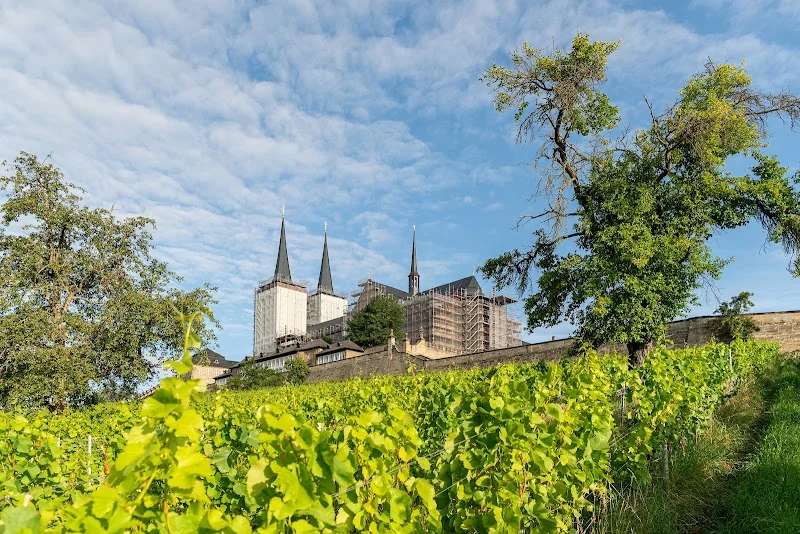
Many people consciously seek out the Monastery Complex St. Michael with the addition of photos, and that is easily understandable. The complex offers several motifs at once: the baroque west facade with its towers, the grand staircase at the church, the terraced gardens on the hill, the vineyard, and the wide view over the city. Particularly striking is the terrace behind the church, from which a panoramic view over Bamberg opens up. Those looking for a quiet perspective for shots will find not only classic postcard motifs here but also details such as garden paths, pavilions, fountains, and the interplay between architecture and vegetation. The terraced gardens themselves are among the great advantages of the place. They impress with baroque garden architecture and old fruit varieties and are open all day outside of winter. The Benedictine Path leads through the former baroque gardens and connects the visit with a walk that is excellent for pictures and for navigating through the complex. The vineyard, re-established in 2012, is also a strong motif as it picks up the historical wine-growing tradition of the Michaelsberg. The information center adds to the photo points with insights into the interior view of the church, the famous ceiling painting, and the history of the area, so that one not only takes beautiful motifs but also understands their context. For photos, St. Michael is therefore particularly interesting because here not just a single viewpoint counts, but an entire landscape of sight axes, height levels, and historical elements emerges. This very complexity makes the complex equally attractive for travelers, city explorers, and architecture enthusiasts. ([en.bamberg.info](https://en.bamberg.info/poi/kloster_st_michael-4637/))
History of the Monastery Complex St. Michael in Bamberg
The history of St. Michael dates back deep into the beginnings of Bamberg. At the suggestion of Emperor Henry II, the former Benedictine monastery was founded in 1015, and as early as 1021, the first church was consecrated. In the early 12th century, the complex gained significant importance under Bishop Otto I before an earthquake in 1117 caused great destruction. Subsequently, Otto had a monumental Romanesque new building constructed. Another turning point occurred in 1610 when a fire damaged the church, and the reconstruction of the complex gave it its current appearance. This reconstruction particularly shaped the baroque effect that visitors see today. In the 17th and 18th centuries, the complex received its grand closed form; the monastery church, abbey wings, convent buildings, forecourt facilities, and gardens were combined during this time into an ensemble that was significantly shaped by the Dientzenhofer brothers. The church itself is particularly known today for its baroque facade with grand staircase, the tomb of Saint Otto, the neo-Gothic ribbed vault, and the heavenly garden on the ceiling. The ceiling painting, featuring over 570 detailed flower and herb motifs, is among the most famous works of art in the city. Until the secularization in 1803, the Benedictines determined life on the Michaelsberg; afterwards, monastic life as a religious community came to an end. For more recent history, it is also important to note that in 2012, a high risk of collapse of the church was identified, leading to a general renovation that lasted until April 25, 2026. The reopening in April 2026 thus marks not only a festive moment but also the result of a long phase of securing, restoring, and scientific support. Therefore, those who visit St. Michael do not see a static monument but a place whose history consists of reconstruction, loss, care, and renewed opening. It is precisely these layers that make the complex so identity-forming for Bamberg. ([bamberg.info](https://www.bamberg.info/poi/ehemalige_klosteranlage_st_mic-4637/))
Access, Parking, and Practical Information
The practical access is another central search term, as the Monastery Complex is located on a hill and not directly at the edge of a parking lot like an inner-city museum. Officially, St. Michael is accessible on foot via the Panorama Path, via Aufseßstraße and the Benedictine Path, or via Maienbrunnen. Those arriving by public transport can use the city bus line 910 from the ZOB to the Klinikum Michelsberg stop on weekdays. Especially for special occasions, the official information explicitly recommends arriving by bus or on foot, as there are no regular parking spaces available within the complex. For normal visits, according to visitor information, parking in the complex is only possible in the evening and on weekends for visiting the restaurants. For major events, this is communicated even more clearly: For the Bürgerfest 2026, it was explicitly pointed out that there are no parking options in the Monastery Complex and that additional buses run regularly between ZOB and Michelsberg. Bicycle parking spaces are located on the north side. Those who also value accessibility should know that the complex is not fully accessible, and access to the vineyard or individual areas is organized via the designated paths and entrances. The visitor map of the foundation helps with orientation, as it makes the relevant accesses, stations, and paths visible. For relaxed planning, this means: better to determine the route in advance, plan enough time for the ascent, and understand the hill not as a destination but as part of the experience. This fits perfectly with the location on the Michaelsberg, as the way up is part of the character of the visit. ([buergerspitalstiftung.de](https://www.buergerspitalstiftung.de/klosteranlage-michaelsberg/allgemeines))
Reviews of the Monastery Complex St. Michael
The provided location data indicates a rating of 4.4 out of 5 stars for the Monastery Complex St. Michael based on 963 reviews. This is a solid value for a sight that is both a monument, church grounds, garden complex, and viewpoint. Especially at a place with so many levels of use, visitors rarely expect only a single aspect, but rather a complete picture of atmosphere, historical depth, and practical accessibility. The official information clearly shows why the complex is often perceived positively in reviews: The view behind the church is panoramic, the terraced gardens appear independent and tranquil, the information center makes the restoration and history understandable, and the reopened church offers a very rare interior experience with the heavenly garden, tomb, and vault. Those looking for photos will find strong motifs; those needing opening hours will get clear time slots; those seeking history will receive a 1000-year narrative with many turning points. This combination typically ensures that reviews of such places depend not only on the architecture but also on the mood of the walk, the quality of the view, and the impression of whether one experiences a place as well-maintained and accessible. For families, cultural travelers, pilgrims, city walkers, and photo enthusiasts, St. Michael is therefore a location with broad appeal. The current reopening in 2026, the guided tours, and the events on the Michaelsberg reinforce the impression of a lively cultural site, not just a historical venue. Therefore, when reading reviews, one should pay attention to recurring themes: location, panorama, garden architecture, sacred art, and the special effect of the hill. That is where the true charm of this sight lies. ([en.bamberg.info](https://en.bamberg.info/poi/information_centre_on_michaels-33840/))
Guided Tours, Concerts, and Events on the Michaelsberg
The Monastery Complex St. Michael is today not only a monument to look at but also a place for guided tours, concerts, exhibitions, and special events. The information center explicitly sees itself as a starting point for walks, tours, and access to the gardens, and the tourism site also refers to ongoing guided tour offers. For the period from May to October, for example, guided tours are announced on Fridays and Saturdays from 3:00 PM to 4:00 PM. In addition, the official event page lists current cultural formats such as theater, concerts, and thematic walks. Already as part of the reopening in 2026, there was a Bürgerfest with free guided tours, lectures on the general renovation, herb and tree tours in the gardens, an exhibition in the north pavilion, and musical contributions on the east plateau. The combination of church, cross garden, vineyard, and visitor infrastructure was also utilized for this weekend. Additional events include the wine garden serving, cultural concerts in the church, and formats like the herb tour, which focuses on the terraced gardens and orchards. This shows that St. Michael can be perceived again in 2026 as a lively event venue without losing its historical depth. This is particularly attractive for travelers, as a visit can be variably planned: Those seeking quiet impressions come outside of events; those wishing for additional impressions combine the walk with a guided tour or a concert. The former monastery complex itself thus becomes an open cultural space where world heritage, monument preservation, and regional use come together. So, for those looking for an excursion destination that combines photos, history, views, and current programs, the Michaelsberg offers exactly this mix. ([en.bamberg.info](https://en.bamberg.info/poi/information_centre_on_michaels-33840/))
Sources:
- Bürgerspitalstiftung Bamberg - General Information ([buergerspitalstiftung.de](https://www.buergerspitalstiftung.de/klosteranlage-michaelsberg/allgemeines))
- Bamberg Tourism - Former Monastery Complex St. Michael ([bamberg.info](https://www.bamberg.info/poi/ehemalige_klosteranlage_st_mic-4637/))
- Bamberg Tourism - Monastery Church St. Michael ([en.bamberg.info](https://en.bamberg.info/poi/monastery_church_st_michael-47321/))
- Bamberg Tourism - Information Centre on Michaelsberg Hill ([en.bamberg.info](https://en.bamberg.info/poi/information_centre_on_michaels-33840/))
- Bürgerspitalstiftung Bamberg - Overview Plan for Visitors ([buergerspitalstiftung.de](https://www.buergerspitalstiftung.de/fileadmin/mediamanager/002_downloads/Uebersichtsplan.pdf))
- Bürgerspitalstiftung Bamberg - Bürgerfest at Michaelsberg ([buergerspitalstiftung.de](https://www.buergerspitalstiftung.de/klosteranlage-michaelsberg/aktuelles/detail/buergerfest-am-michaelsberg-bamberg-feiert-st-michael))
- Bürgerspitalstiftung Bamberg - Opening Service St. Michael ([buergerspitalstiftung.de](https://www.buergerspitalstiftung.de/klosteranlage-michaelsberg/veranstaltungen/detail/eroeffnungsgottesdienst?utm_source=openai))
Mehr anzeigenWeniger anzeigen
Monastery Complex St. Michael | Opening Hours & Photos
The Monastery Complex St. Michael on the Michaelsberg is one of the most impressive places in Bamberg, as history, landscape, faith, and city views come together in a small space. High above the old town lies the former Benedictine complex on one of the seven hills of the city, featuring a church, terraced gardens, a vineyard, a viewing terrace, and the information center as today's visitor points. This very mix makes the complex so sought after: Those looking for photos, opening hours, location, or reviews will find not just a single monument here, but a whole ensemble that has shaped the cityscape for centuries. Following its reopening in 2026, the Monastery Complex has come back into focus and presents itself as a place where baroque architecture, spiritual history, and a wide-open view over Bamberg combine to create a harmonious overall picture. For visitors, St. Michael is thus less a quick photo stop and more a destination for a mindful walk that takes time and is worth it for that reason. ([buergerspitalstiftung.de](https://www.buergerspitalstiftung.de/klosteranlage-michaelsberg/allgemeines))
Opening Hours and Visit to the Monastery Complex St. Michael
The most common inquiries are about the current opening hours, and this is where a closer look is worthwhile. The Monastery Church St. Michael is currently open from Friday to Sunday and on public holidays from 11:00 AM to 4:00 PM. The information center on the Michaelsberg welcomes guests from Friday to Sunday and on public holidays from 11:30 AM to 4:30 PM. The garden areas, the monastery courtyard, and the viewing terrace are accessible all day outside of winter, so a visit does not have to be limited to just the church. This combination of fixed opening hours for the interior and freely accessible outdoor areas is important for planning, as one can easily combine the tour with a walk through the terraced gardens or a view over Bamberg. Those who want to experience St. Michael in peace should plan their visit for a morning or early afternoon, as the complex appears particularly open and calm at that time. The official visitor information also emphasizes that work on monument preservation continues in the church and throughout the area, even though the church has been publicly accessible again since April 2026. The information center provides a good complement, as it explains the condition of the complex, the history of the hill, and the restoration in an understandable way and facilitates access with models, photos, and exhibits. Thus, the complex is not only a destination for the classic church visit but also for anyone interested in restoration, world heritage, and city history. Knowing the times allows for a more relaxed visit, avoiding disappointments and making better use of the available areas. ([buergerspitalstiftung.de](https://www.buergerspitalstiftung.de/klosteranlage-michaelsberg/allgemeines))
Photos, Views, and Terraced Gardens on the Michaelsberg
Many people consciously seek out the Monastery Complex St. Michael with the addition of photos, and that is easily understandable. The complex offers several motifs at once: the baroque west facade with its towers, the grand staircase at the church, the terraced gardens on the hill, the vineyard, and the wide view over the city. Particularly striking is the terrace behind the church, from which a panoramic view over Bamberg opens up. Those looking for a quiet perspective for shots will find not only classic postcard motifs here but also details such as garden paths, pavilions, fountains, and the interplay between architecture and vegetation. The terraced gardens themselves are among the great advantages of the place. They impress with baroque garden architecture and old fruit varieties and are open all day outside of winter. The Benedictine Path leads through the former baroque gardens and connects the visit with a walk that is excellent for pictures and for navigating through the complex. The vineyard, re-established in 2012, is also a strong motif as it picks up the historical wine-growing tradition of the Michaelsberg. The information center adds to the photo points with insights into the interior view of the church, the famous ceiling painting, and the history of the area, so that one not only takes beautiful motifs but also understands their context. For photos, St. Michael is therefore particularly interesting because here not just a single viewpoint counts, but an entire landscape of sight axes, height levels, and historical elements emerges. This very complexity makes the complex equally attractive for travelers, city explorers, and architecture enthusiasts. ([en.bamberg.info](https://en.bamberg.info/poi/kloster_st_michael-4637/))
History of the Monastery Complex St. Michael in Bamberg
The history of St. Michael dates back deep into the beginnings of Bamberg. At the suggestion of Emperor Henry II, the former Benedictine monastery was founded in 1015, and as early as 1021, the first church was consecrated. In the early 12th century, the complex gained significant importance under Bishop Otto I before an earthquake in 1117 caused great destruction. Subsequently, Otto had a monumental Romanesque new building constructed. Another turning point occurred in 1610 when a fire damaged the church, and the reconstruction of the complex gave it its current appearance. This reconstruction particularly shaped the baroque effect that visitors see today. In the 17th and 18th centuries, the complex received its grand closed form; the monastery church, abbey wings, convent buildings, forecourt facilities, and gardens were combined during this time into an ensemble that was significantly shaped by the Dientzenhofer brothers. The church itself is particularly known today for its baroque facade with grand staircase, the tomb of Saint Otto, the neo-Gothic ribbed vault, and the heavenly garden on the ceiling. The ceiling painting, featuring over 570 detailed flower and herb motifs, is among the most famous works of art in the city. Until the secularization in 1803, the Benedictines determined life on the Michaelsberg; afterwards, monastic life as a religious community came to an end. For more recent history, it is also important to note that in 2012, a high risk of collapse of the church was identified, leading to a general renovation that lasted until April 25, 2026. The reopening in April 2026 thus marks not only a festive moment but also the result of a long phase of securing, restoring, and scientific support. Therefore, those who visit St. Michael do not see a static monument but a place whose history consists of reconstruction, loss, care, and renewed opening. It is precisely these layers that make the complex so identity-forming for Bamberg. ([bamberg.info](https://www.bamberg.info/poi/ehemalige_klosteranlage_st_mic-4637/))
Access, Parking, and Practical Information
The practical access is another central search term, as the Monastery Complex is located on a hill and not directly at the edge of a parking lot like an inner-city museum. Officially, St. Michael is accessible on foot via the Panorama Path, via Aufseßstraße and the Benedictine Path, or via Maienbrunnen. Those arriving by public transport can use the city bus line 910 from the ZOB to the Klinikum Michelsberg stop on weekdays. Especially for special occasions, the official information explicitly recommends arriving by bus or on foot, as there are no regular parking spaces available within the complex. For normal visits, according to visitor information, parking in the complex is only possible in the evening and on weekends for visiting the restaurants. For major events, this is communicated even more clearly: For the Bürgerfest 2026, it was explicitly pointed out that there are no parking options in the Monastery Complex and that additional buses run regularly between ZOB and Michelsberg. Bicycle parking spaces are located on the north side. Those who also value accessibility should know that the complex is not fully accessible, and access to the vineyard or individual areas is organized via the designated paths and entrances. The visitor map of the foundation helps with orientation, as it makes the relevant accesses, stations, and paths visible. For relaxed planning, this means: better to determine the route in advance, plan enough time for the ascent, and understand the hill not as a destination but as part of the experience. This fits perfectly with the location on the Michaelsberg, as the way up is part of the character of the visit. ([buergerspitalstiftung.de](https://www.buergerspitalstiftung.de/klosteranlage-michaelsberg/allgemeines))
Reviews of the Monastery Complex St. Michael
The provided location data indicates a rating of 4.4 out of 5 stars for the Monastery Complex St. Michael based on 963 reviews. This is a solid value for a sight that is both a monument, church grounds, garden complex, and viewpoint. Especially at a place with so many levels of use, visitors rarely expect only a single aspect, but rather a complete picture of atmosphere, historical depth, and practical accessibility. The official information clearly shows why the complex is often perceived positively in reviews: The view behind the church is panoramic, the terraced gardens appear independent and tranquil, the information center makes the restoration and history understandable, and the reopened church offers a very rare interior experience with the heavenly garden, tomb, and vault. Those looking for photos will find strong motifs; those needing opening hours will get clear time slots; those seeking history will receive a 1000-year narrative with many turning points. This combination typically ensures that reviews of such places depend not only on the architecture but also on the mood of the walk, the quality of the view, and the impression of whether one experiences a place as well-maintained and accessible. For families, cultural travelers, pilgrims, city walkers, and photo enthusiasts, St. Michael is therefore a location with broad appeal. The current reopening in 2026, the guided tours, and the events on the Michaelsberg reinforce the impression of a lively cultural site, not just a historical venue. Therefore, when reading reviews, one should pay attention to recurring themes: location, panorama, garden architecture, sacred art, and the special effect of the hill. That is where the true charm of this sight lies. ([en.bamberg.info](https://en.bamberg.info/poi/information_centre_on_michaels-33840/))
Guided Tours, Concerts, and Events on the Michaelsberg
The Monastery Complex St. Michael is today not only a monument to look at but also a place for guided tours, concerts, exhibitions, and special events. The information center explicitly sees itself as a starting point for walks, tours, and access to the gardens, and the tourism site also refers to ongoing guided tour offers. For the period from May to October, for example, guided tours are announced on Fridays and Saturdays from 3:00 PM to 4:00 PM. In addition, the official event page lists current cultural formats such as theater, concerts, and thematic walks. Already as part of the reopening in 2026, there was a Bürgerfest with free guided tours, lectures on the general renovation, herb and tree tours in the gardens, an exhibition in the north pavilion, and musical contributions on the east plateau. The combination of church, cross garden, vineyard, and visitor infrastructure was also utilized for this weekend. Additional events include the wine garden serving, cultural concerts in the church, and formats like the herb tour, which focuses on the terraced gardens and orchards. This shows that St. Michael can be perceived again in 2026 as a lively event venue without losing its historical depth. This is particularly attractive for travelers, as a visit can be variably planned: Those seeking quiet impressions come outside of events; those wishing for additional impressions combine the walk with a guided tour or a concert. The former monastery complex itself thus becomes an open cultural space where world heritage, monument preservation, and regional use come together. So, for those looking for an excursion destination that combines photos, history, views, and current programs, the Michaelsberg offers exactly this mix. ([en.bamberg.info](https://en.bamberg.info/poi/information_centre_on_michaels-33840/))
Sources:
- Bürgerspitalstiftung Bamberg - General Information ([buergerspitalstiftung.de](https://www.buergerspitalstiftung.de/klosteranlage-michaelsberg/allgemeines))
- Bamberg Tourism - Former Monastery Complex St. Michael ([bamberg.info](https://www.bamberg.info/poi/ehemalige_klosteranlage_st_mic-4637/))
- Bamberg Tourism - Monastery Church St. Michael ([en.bamberg.info](https://en.bamberg.info/poi/monastery_church_st_michael-47321/))
- Bamberg Tourism - Information Centre on Michaelsberg Hill ([en.bamberg.info](https://en.bamberg.info/poi/information_centre_on_michaels-33840/))
- Bürgerspitalstiftung Bamberg - Overview Plan for Visitors ([buergerspitalstiftung.de](https://www.buergerspitalstiftung.de/fileadmin/mediamanager/002_downloads/Uebersichtsplan.pdf))
- Bürgerspitalstiftung Bamberg - Bürgerfest at Michaelsberg ([buergerspitalstiftung.de](https://www.buergerspitalstiftung.de/klosteranlage-michaelsberg/aktuelles/detail/buergerfest-am-michaelsberg-bamberg-feiert-st-michael))
- Bürgerspitalstiftung Bamberg - Opening Service St. Michael ([buergerspitalstiftung.de](https://www.buergerspitalstiftung.de/klosteranlage-michaelsberg/veranstaltungen/detail/eroeffnungsgottesdienst?utm_source=openai))
Monastery Complex St. Michael | Opening Hours & Photos
The Monastery Complex St. Michael on the Michaelsberg is one of the most impressive places in Bamberg, as history, landscape, faith, and city views come together in a small space. High above the old town lies the former Benedictine complex on one of the seven hills of the city, featuring a church, terraced gardens, a vineyard, a viewing terrace, and the information center as today's visitor points. This very mix makes the complex so sought after: Those looking for photos, opening hours, location, or reviews will find not just a single monument here, but a whole ensemble that has shaped the cityscape for centuries. Following its reopening in 2026, the Monastery Complex has come back into focus and presents itself as a place where baroque architecture, spiritual history, and a wide-open view over Bamberg combine to create a harmonious overall picture. For visitors, St. Michael is thus less a quick photo stop and more a destination for a mindful walk that takes time and is worth it for that reason. ([buergerspitalstiftung.de](https://www.buergerspitalstiftung.de/klosteranlage-michaelsberg/allgemeines))
Opening Hours and Visit to the Monastery Complex St. Michael
The most common inquiries are about the current opening hours, and this is where a closer look is worthwhile. The Monastery Church St. Michael is currently open from Friday to Sunday and on public holidays from 11:00 AM to 4:00 PM. The information center on the Michaelsberg welcomes guests from Friday to Sunday and on public holidays from 11:30 AM to 4:30 PM. The garden areas, the monastery courtyard, and the viewing terrace are accessible all day outside of winter, so a visit does not have to be limited to just the church. This combination of fixed opening hours for the interior and freely accessible outdoor areas is important for planning, as one can easily combine the tour with a walk through the terraced gardens or a view over Bamberg. Those who want to experience St. Michael in peace should plan their visit for a morning or early afternoon, as the complex appears particularly open and calm at that time. The official visitor information also emphasizes that work on monument preservation continues in the church and throughout the area, even though the church has been publicly accessible again since April 2026. The information center provides a good complement, as it explains the condition of the complex, the history of the hill, and the restoration in an understandable way and facilitates access with models, photos, and exhibits. Thus, the complex is not only a destination for the classic church visit but also for anyone interested in restoration, world heritage, and city history. Knowing the times allows for a more relaxed visit, avoiding disappointments and making better use of the available areas. ([buergerspitalstiftung.de](https://www.buergerspitalstiftung.de/klosteranlage-michaelsberg/allgemeines))
Photos, Views, and Terraced Gardens on the Michaelsberg
Many people consciously seek out the Monastery Complex St. Michael with the addition of photos, and that is easily understandable. The complex offers several motifs at once: the baroque west facade with its towers, the grand staircase at the church, the terraced gardens on the hill, the vineyard, and the wide view over the city. Particularly striking is the terrace behind the church, from which a panoramic view over Bamberg opens up. Those looking for a quiet perspective for shots will find not only classic postcard motifs here but also details such as garden paths, pavilions, fountains, and the interplay between architecture and vegetation. The terraced gardens themselves are among the great advantages of the place. They impress with baroque garden architecture and old fruit varieties and are open all day outside of winter. The Benedictine Path leads through the former baroque gardens and connects the visit with a walk that is excellent for pictures and for navigating through the complex. The vineyard, re-established in 2012, is also a strong motif as it picks up the historical wine-growing tradition of the Michaelsberg. The information center adds to the photo points with insights into the interior view of the church, the famous ceiling painting, and the history of the area, so that one not only takes beautiful motifs but also understands their context. For photos, St. Michael is therefore particularly interesting because here not just a single viewpoint counts, but an entire landscape of sight axes, height levels, and historical elements emerges. This very complexity makes the complex equally attractive for travelers, city explorers, and architecture enthusiasts. ([en.bamberg.info](https://en.bamberg.info/poi/kloster_st_michael-4637/))
History of the Monastery Complex St. Michael in Bamberg
The history of St. Michael dates back deep into the beginnings of Bamberg. At the suggestion of Emperor Henry II, the former Benedictine monastery was founded in 1015, and as early as 1021, the first church was consecrated. In the early 12th century, the complex gained significant importance under Bishop Otto I before an earthquake in 1117 caused great destruction. Subsequently, Otto had a monumental Romanesque new building constructed. Another turning point occurred in 1610 when a fire damaged the church, and the reconstruction of the complex gave it its current appearance. This reconstruction particularly shaped the baroque effect that visitors see today. In the 17th and 18th centuries, the complex received its grand closed form; the monastery church, abbey wings, convent buildings, forecourt facilities, and gardens were combined during this time into an ensemble that was significantly shaped by the Dientzenhofer brothers. The church itself is particularly known today for its baroque facade with grand staircase, the tomb of Saint Otto, the neo-Gothic ribbed vault, and the heavenly garden on the ceiling. The ceiling painting, featuring over 570 detailed flower and herb motifs, is among the most famous works of art in the city. Until the secularization in 1803, the Benedictines determined life on the Michaelsberg; afterwards, monastic life as a religious community came to an end. For more recent history, it is also important to note that in 2012, a high risk of collapse of the church was identified, leading to a general renovation that lasted until April 25, 2026. The reopening in April 2026 thus marks not only a festive moment but also the result of a long phase of securing, restoring, and scientific support. Therefore, those who visit St. Michael do not see a static monument but a place whose history consists of reconstruction, loss, care, and renewed opening. It is precisely these layers that make the complex so identity-forming for Bamberg. ([bamberg.info](https://www.bamberg.info/poi/ehemalige_klosteranlage_st_mic-4637/))
Access, Parking, and Practical Information
The practical access is another central search term, as the Monastery Complex is located on a hill and not directly at the edge of a parking lot like an inner-city museum. Officially, St. Michael is accessible on foot via the Panorama Path, via Aufseßstraße and the Benedictine Path, or via Maienbrunnen. Those arriving by public transport can use the city bus line 910 from the ZOB to the Klinikum Michelsberg stop on weekdays. Especially for special occasions, the official information explicitly recommends arriving by bus or on foot, as there are no regular parking spaces available within the complex. For normal visits, according to visitor information, parking in the complex is only possible in the evening and on weekends for visiting the restaurants. For major events, this is communicated even more clearly: For the Bürgerfest 2026, it was explicitly pointed out that there are no parking options in the Monastery Complex and that additional buses run regularly between ZOB and Michelsberg. Bicycle parking spaces are located on the north side. Those who also value accessibility should know that the complex is not fully accessible, and access to the vineyard or individual areas is organized via the designated paths and entrances. The visitor map of the foundation helps with orientation, as it makes the relevant accesses, stations, and paths visible. For relaxed planning, this means: better to determine the route in advance, plan enough time for the ascent, and understand the hill not as a destination but as part of the experience. This fits perfectly with the location on the Michaelsberg, as the way up is part of the character of the visit. ([buergerspitalstiftung.de](https://www.buergerspitalstiftung.de/klosteranlage-michaelsberg/allgemeines))
Reviews of the Monastery Complex St. Michael
The provided location data indicates a rating of 4.4 out of 5 stars for the Monastery Complex St. Michael based on 963 reviews. This is a solid value for a sight that is both a monument, church grounds, garden complex, and viewpoint. Especially at a place with so many levels of use, visitors rarely expect only a single aspect, but rather a complete picture of atmosphere, historical depth, and practical accessibility. The official information clearly shows why the complex is often perceived positively in reviews: The view behind the church is panoramic, the terraced gardens appear independent and tranquil, the information center makes the restoration and history understandable, and the reopened church offers a very rare interior experience with the heavenly garden, tomb, and vault. Those looking for photos will find strong motifs; those needing opening hours will get clear time slots; those seeking history will receive a 1000-year narrative with many turning points. This combination typically ensures that reviews of such places depend not only on the architecture but also on the mood of the walk, the quality of the view, and the impression of whether one experiences a place as well-maintained and accessible. For families, cultural travelers, pilgrims, city walkers, and photo enthusiasts, St. Michael is therefore a location with broad appeal. The current reopening in 2026, the guided tours, and the events on the Michaelsberg reinforce the impression of a lively cultural site, not just a historical venue. Therefore, when reading reviews, one should pay attention to recurring themes: location, panorama, garden architecture, sacred art, and the special effect of the hill. That is where the true charm of this sight lies. ([en.bamberg.info](https://en.bamberg.info/poi/information_centre_on_michaels-33840/))
Guided Tours, Concerts, and Events on the Michaelsberg
The Monastery Complex St. Michael is today not only a monument to look at but also a place for guided tours, concerts, exhibitions, and special events. The information center explicitly sees itself as a starting point for walks, tours, and access to the gardens, and the tourism site also refers to ongoing guided tour offers. For the period from May to October, for example, guided tours are announced on Fridays and Saturdays from 3:00 PM to 4:00 PM. In addition, the official event page lists current cultural formats such as theater, concerts, and thematic walks. Already as part of the reopening in 2026, there was a Bürgerfest with free guided tours, lectures on the general renovation, herb and tree tours in the gardens, an exhibition in the north pavilion, and musical contributions on the east plateau. The combination of church, cross garden, vineyard, and visitor infrastructure was also utilized for this weekend. Additional events include the wine garden serving, cultural concerts in the church, and formats like the herb tour, which focuses on the terraced gardens and orchards. This shows that St. Michael can be perceived again in 2026 as a lively event venue without losing its historical depth. This is particularly attractive for travelers, as a visit can be variably planned: Those seeking quiet impressions come outside of events; those wishing for additional impressions combine the walk with a guided tour or a concert. The former monastery complex itself thus becomes an open cultural space where world heritage, monument preservation, and regional use come together. So, for those looking for an excursion destination that combines photos, history, views, and current programs, the Michaelsberg offers exactly this mix. ([en.bamberg.info](https://en.bamberg.info/poi/information_centre_on_michaels-33840/))
Sources:
- Bürgerspitalstiftung Bamberg - General Information ([buergerspitalstiftung.de](https://www.buergerspitalstiftung.de/klosteranlage-michaelsberg/allgemeines))
- Bamberg Tourism - Former Monastery Complex St. Michael ([bamberg.info](https://www.bamberg.info/poi/ehemalige_klosteranlage_st_mic-4637/))
- Bamberg Tourism - Monastery Church St. Michael ([en.bamberg.info](https://en.bamberg.info/poi/monastery_church_st_michael-47321/))
- Bamberg Tourism - Information Centre on Michaelsberg Hill ([en.bamberg.info](https://en.bamberg.info/poi/information_centre_on_michaels-33840/))
- Bürgerspitalstiftung Bamberg - Overview Plan for Visitors ([buergerspitalstiftung.de](https://www.buergerspitalstiftung.de/fileadmin/mediamanager/002_downloads/Uebersichtsplan.pdf))
- Bürgerspitalstiftung Bamberg - Bürgerfest at Michaelsberg ([buergerspitalstiftung.de](https://www.buergerspitalstiftung.de/klosteranlage-michaelsberg/aktuelles/detail/buergerfest-am-michaelsberg-bamberg-feiert-st-michael))
- Bürgerspitalstiftung Bamberg - Opening Service St. Michael ([buergerspitalstiftung.de](https://www.buergerspitalstiftung.de/klosteranlage-michaelsberg/veranstaltungen/detail/eroeffnungsgottesdienst?utm_source=openai))
Upcoming Events
No events found
Frequently Asked Questions
Reviews
Nguyen Lam Vuong
8. May 2026
Very nice place for walking and sightseeing. Although the monastery is under construction, it is still great walking around and seeing the entire city from up on the hill.
Johannes Krause
12. April 2026
The complex is currently undergoing extensive renovations, so visitors cannot tour the monastery’s interior, nor is much visible from the outside. However, part of the adjacent small park is open to the public.
Mike Z
17. October 2025
Monastery is under construction for a few years at this point, so not much to see besides beautiful view of the town underneath, also a nice hike / walk to and from the place, however rose garden in New Bishop’s residence affords comparable view in gorgeous historic setting around. Hence, monastery visit could be skipped if timing is tight.
slaivory
7. March 2024
As of February 2024, it was being remodeled. But tourists can walk inside the church watching the view. Scenery of the downtown is quite nice. It is around more than 20 minutes from downtown. Because it is a small town, it's not burdensome. But it is still totally up to you whether to visit here or not.
Debbie Hodge
22. October 2023
We enjoyed our hike up to this lovely monastery. The views are amazing and the gardens around it are worth the trip to the top. The renovations prevented us from going into the buildings.