
Bamberg
Karmelitenpl. 1, 96049 Bamberg, Deutschland
Carmelite Church St. Mary and St. Theodore | History & Baroque
The Carmelite Church St. Mary and St. Theodore at Karmelitenplatz 1 is one of the most impressive monastery sites in Bamberg and is located in the historic urban area, which is part of the UNESCO World Heritage Site of Bamberg's Old Town. Today, those searching for the Carmelite Church are often looking not just for a church, but a whole ensemble of history, monastic tradition, baroque architecture, and quiet presence. This is precisely what makes this place appealing: The complex is not a smoothly polished museum temple, but a grown monastery complex that has changed over centuries while still preserving its identity. Behind the baroque façade lies a much older core, and despite the current renovation, the place remains a spiritual and architectural reference point. The church itself is closed until the end of 2026, but the cloister can be visited on selected days; thus, the Carmelite Church today serves as a monument, spiritual site, and living part of Bamberg's urban landscape. ([de.wikipedia.org](https://de.wikipedia.org/wiki/Karmelitenkloster_Bamberg))
History of the Carmelite Church St. Mary and St. Theodore
The history of the site begins significantly earlier than the current Carmelite presence. The official tourism presentation places the establishment of the church in the course of the 12th century as part of a Cistercian convent; on the pages of the Carmelites themselves, the complex is described as an abbey founded in 1157, initially shaped by Cistercian nuns and dissolved in 1554. After that, the church stood empty for a time until the Carmelites came to St. Theodore at Kaulberg in 1589 through a swap agreement. This was a significant turning point for Bamberg: From a decommissioned women's monastery complex, a new monastic seat emerged, which later significantly influenced the religious and architectural character of the hill. The location at Kaulberg is therefore not a random address, but the result of a historical transition between different monastic and usage phases. ([visitbamberg.com](https://www.visitbamberg.com/poi/karmelitenkirche-st-theodor/))
In the 17th century, the phase began that continues to shape the appearance to this day. In 1658, the renovation of the old church began; during this process, the liturgical orientation was changed and the access was relocated to the present entrance side. The former main portal was bricked up and remains preserved as the oldest church portal in Bamberg. Between 1692 and 1707, during a construction phase with significant involvement from Leonhard Dientzenhofer, the church received its baroque form and was finally consecrated. This transformation was not merely a beautification program, but a profound redefinition of space: The building acquired a new façade effect, new sight axes, and a new internal order. With the secularization of 1801/03, monastic life initially came to an end, and the church and monastery were temporarily put to very secular purposes. Only in 1902 could the Carmelites reacquire the complex; the solemn introduction took place in 1903. These breaks explain why the Carmelite Church continues to radiate so much historical tension today. ([karmeliten.de](https://karmeliten.de/orte/bamberg/))
Baroque Facade and Romanesque Core
Architecturally, the Carmelite Church thrives on the contrast between visible baroque splendor and hidden Romanesque elements. The most striking impression is made on the east façade, which functioned as the new show side after the baroque redesign. At the same time, Romanesque elements of the older church are still preserved in the substructure and on individual building components. Particularly important is the Lion Portal on the west side, which is considered a visible relic of the early construction phase and is among the oldest church portals in Bamberg. This finding makes the church particularly interesting for architecture enthusiasts: One does not only see one style, but several layers of time at once. The baroque form is therefore not an overlay without memory, but a staging that consciously overlays and simultaneously preserves the older substance. The building thus vividly narrates how monastic architecture has adapted to new liturgical and representative ideas. ([de.wikipedia.org](https://de.wikipedia.org/wiki/Karmelitenkloster_Bamberg))
The iconography of the façade is also deliberately chosen. Above the main entrance stands Mary with Child and Scapular, leaning on the Mariahilf image; in the niches appear Carmelite saints, and the prophet Elijah was chosen as the gable finial, who is a special role model for the order. This iconography is not merely decoration, but a visual summary of the order's identity. Additionally, the interior design was newly formed after the reoccupation in the 20th century: Much was newly baroque, and some older pieces could be reacquired. There is also an organ with 38 registers on three manuals and pedals in the church, and a four-part chime of cast steel bells from 1921 hangs in the tower. Thus, the Carmelite Church is experienced not only as a building but also as an acoustic space. For inquiries about photos, this is important: The place thrives on view, light, color, relief, and sound equally. ([de.wikipedia.org](https://de.wikipedia.org/wiki/Karmelitenkloster_Bamberg))
The Carmelite Cloister and the Monastery Complex Today
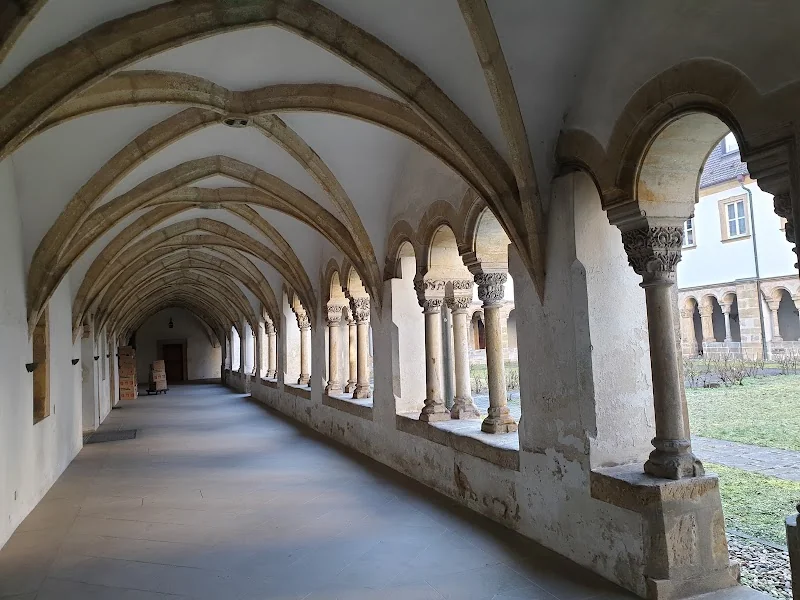
Those wishing to visit the Carmelite Church today primarily experience the cloister as the heart of the ensemble. Bamberg Tourism describes it as a magnificent late Romanesque cloister from the 13th century, hidden behind the baroque entrance façade. This transition from outside to inside is characteristic: In front of the façade, the complex appears as a baroque monastery building, while inside it opens up to an older, quieter world with Romanesque character. Since 2025, a permanent exhibition in the cloister informs about the history and architecture of the monastery buildings, which further enhances the site for guests. The cloister is publicly accessible from Thursday to Saturday from 10 am to 5 pm, while the church itself remains closed due to renovation until the end of 2026. Thus, the cloister is currently the most important real access to the complex and at the same time the area where the historical depth can be experienced most directly. ([bamberg.info](https://www.bamberg.info/poi/karmelitenkloster-4639/))
The current situation of the complex is characterized by both upheaval and continuity. A large part of the former monastery was converted into a residential complex called Kloster Karree between 2020 and 2025, with the work carried out in close coordination with monument preservation and the city. The remaining Carmelites continue to use the double house Am Knöcklein 7–9 as a monastery; the provincial administration is located at Am Knöcklein 11–13. Additionally, the church, crypt, and St. Peter's Chapel remain the property of the order. It is important to note: The monastery has not disappeared but has been transformed into a new form. This also explains why the complex appears so multifaceted today. It is not only a monument but also a continuously used monastic site, residence, pilgrimage site, and cultural site. Therefore, when visiting the Carmelite cloister, one does not see a preserved relic, but a living ensemble that continues to write its history into the present. ([de.wikipedia.org](https://de.wikipedia.org/wiki/Karmelitenkloster_Bamberg))
Services, Confession Ministry, and Spiritual Significance
Despite renovations, the Carmelite Church remains a spiritual place. The official order website emphasizes that confession ministry is a significant focus and that the church undoubtedly belongs to the monastery and pilgrimage churches that are particularly valued for confession and spiritual guidance in the Catholic space. The Carmelites in Bamberg provide specific service times on Sundays and weekdays; during the renovation, services are held in the former monastery shop. Thus, the spiritual practice is not interrupted but temporarily relocated to a smaller, provisional space. This is important for the perception of the Carmelite Church because the place is not only thought of touristically but primarily religiously. Its appeal arises not only from the architecture but also from the lived monastic life that continues there. ([karmeliten.de](https://karmeliten.de/orte/bamberg/))
Also part of its spiritual significance is the remembrance of Frater Alois Ehrlich, whose grave in the Carmelite Church is still revered as a place of silent intercessory prayer. Such places make it clear that monastery complexes in Bamberg are not just historical backdrops but biographical, liturgical, and communal spaces. Additionally, the cloister is regularly used for music, creating a remarkable connection between contemplation and culture. This mixture is characteristic of the Carmelite Church: The place is quiet but not empty; rich in tradition but not museum-like; open to visitors but still shaped by prayer in its inner core. Therefore, those viewing the site as seekers or visitors should not only see it as a photo motif but as a functioning religious space. This is where its special value lies within the urban fabric of Bamberg. ([karmeliten.de](https://karmeliten.de/orte/bamberg/))
Directions, Parking, and Location in Bamberg's World Heritage
The central location of the Carmelite Church is an advantage for access, but also a small planning challenge. The address Karmelitenplatz 1 in 96049 Bamberg is located in a historic area with narrow streets, many sights, and high pedestrian traffic. For this reason, it is worthwhile to use the official parking recommendations from the city and tourism offerings. The BAMBERG tourism site explicitly recommends Park & Ride to get directly to the city center without searching for parking. Those wishing to park closer to the Old Town will find a practical option in the City-Altstadt underground garage: It is open 24 hours a day, offers 344 parking spaces, and is only two minutes from the city center according to tourism information. For a visit to the Carmelite Church, the Upper Parish, or the Cathedral, this is often the most pleasant solution. ([en.bamberg.info](https://en.bamberg.info/poi/city-altstadt_car_park-4977/))
The immediate surroundings also speak for a combined visit. The Carmelite Church is located near the Upper Parish, the Bamberg Cathedral, and other sites in the Bergstadt that shape Bamberg's historical face. This means for visitors: A detour to the Carmelite Church can easily be incorporated into a walk around the Domberg and the adjacent slopes. Those searching for 'Karmelitenplatz 1 Bamberg', 'Karmelitenkloster Bamberg', or 'parking Bamberg Old Town' will encounter an area where several important stations of the World Heritage are concentrated. The location within this densely woven Old Town area makes the site so strong: It is not an isolated individual object, but part of a much larger historical landscape where church, monastery, street, and sight axis interact. ([visitbamberg.com](https://www.visitbamberg.com/poi/karmelitenkirche-st-theodor/))
Photos, Impressions, and Visiting Tips for Bamberg
For inquiries about photos, it is especially worthwhile to look at the strongest motifs of the complex. The first motif is the baroque façade with its clear iconographic order, the second is the late Romanesque cloister with its calm, older form language. This contrast is not only beautiful but tells the construction history directly in the image. Since the church remains closed at present, the exterior view and cloister are the most reliable areas for a visit and for good shots. It is precisely there that the differences between baroque staging, Romanesque depth, and monastic tranquility can be best captured. This is central to the perception of the Carmelite Church because the place does not act through monumentality but through layering. Therefore, those interested in 'Carmelite Church St. Mary and St. Theodore photos' are actually looking for this interplay of surface, portal, arcade, and courtyard. ([bamberg.info](https://www.bamberg.info/poi/karmelitenkloster-4639/))
A second tip concerns the cultural use of the cloister. The Bamberg Sunday concerts 'Classics in the Cloister' take place on selected Sundays from May to September, directly connecting music with architecture. Musicians from the Bamberg Symphony or the Bamberg String Quartet shape the format, which is described by the tourism site as a moderated chamber concert. This way, the cloister is not only viewed but also acoustically experienced. For visitors, this results in a rare combination: historical silence during the day, cultural density during concert dates, and a clearly readable monument site that does not fade into the background despite renovations. Therefore, when visiting Bamberg, one should not only plan the Carmelite Church as a stopover but as a focal point with sufficient time, because it is precisely the quiet perception that makes the difference here. ([bamberg.info](https://www.bamberg.info/veranstaltungen/sonntagskonzerte_klassik_im_kr-418973/?utm_source=openai))
In summary, the Carmelite Church St. Mary and St. Theodore is one of those places where Bamberg condenses its unique mix of history, spirituality, and urban landscape in a small space. The way there leads through the World Heritage, the view meets baroque façade and Romanesque cloister, and the present shows itself in renovation, pastoral care, and concert life. This is why the complex remains exciting for people looking for practical things like opening hours, parking, or photos: Behind these search intentions lies a place that is much older, much quieter, and at the same time much livelier than a first glance might suggest. ([de.wikipedia.org](https://de.wikipedia.org/wiki/Karmelitenkloster_Bamberg))
Sources:
- Carmelites Bamberg - Official Website ([karmeliten.de](https://karmeliten.de/orte/bamberg/))
- BAMBERG Tourism - Carmelite Monastery ([bamberg.info](https://www.bamberg.info/poi/karmelitenkloster-4639/))
- visit Bamberg - Carmelite Church St. Theodore ([visitbamberg.com](https://www.visitbamberg.com/poi/karmelitenkirche-st-theodor/))
- BAMBERG Tourism - Classics in the Cloister ([bamberg.info](https://www.bamberg.info/veranstaltungen/sonntagskonzerte_klassik_im_kr-418973/?utm_source=openai))
- BAMBERG Tourism - Parking and RV Parking Spaces ([bamberg.info](https://www.bamberg.info/parkplaetze/))
Mehr anzeigenWeniger anzeigen
Carmelite Church St. Mary and St. Theodore | History & Baroque
The Carmelite Church St. Mary and St. Theodore at Karmelitenplatz 1 is one of the most impressive monastery sites in Bamberg and is located in the historic urban area, which is part of the UNESCO World Heritage Site of Bamberg's Old Town. Today, those searching for the Carmelite Church are often looking not just for a church, but a whole ensemble of history, monastic tradition, baroque architecture, and quiet presence. This is precisely what makes this place appealing: The complex is not a smoothly polished museum temple, but a grown monastery complex that has changed over centuries while still preserving its identity. Behind the baroque façade lies a much older core, and despite the current renovation, the place remains a spiritual and architectural reference point. The church itself is closed until the end of 2026, but the cloister can be visited on selected days; thus, the Carmelite Church today serves as a monument, spiritual site, and living part of Bamberg's urban landscape. ([de.wikipedia.org](https://de.wikipedia.org/wiki/Karmelitenkloster_Bamberg))
History of the Carmelite Church St. Mary and St. Theodore
The history of the site begins significantly earlier than the current Carmelite presence. The official tourism presentation places the establishment of the church in the course of the 12th century as part of a Cistercian convent; on the pages of the Carmelites themselves, the complex is described as an abbey founded in 1157, initially shaped by Cistercian nuns and dissolved in 1554. After that, the church stood empty for a time until the Carmelites came to St. Theodore at Kaulberg in 1589 through a swap agreement. This was a significant turning point for Bamberg: From a decommissioned women's monastery complex, a new monastic seat emerged, which later significantly influenced the religious and architectural character of the hill. The location at Kaulberg is therefore not a random address, but the result of a historical transition between different monastic and usage phases. ([visitbamberg.com](https://www.visitbamberg.com/poi/karmelitenkirche-st-theodor/))
In the 17th century, the phase began that continues to shape the appearance to this day. In 1658, the renovation of the old church began; during this process, the liturgical orientation was changed and the access was relocated to the present entrance side. The former main portal was bricked up and remains preserved as the oldest church portal in Bamberg. Between 1692 and 1707, during a construction phase with significant involvement from Leonhard Dientzenhofer, the church received its baroque form and was finally consecrated. This transformation was not merely a beautification program, but a profound redefinition of space: The building acquired a new façade effect, new sight axes, and a new internal order. With the secularization of 1801/03, monastic life initially came to an end, and the church and monastery were temporarily put to very secular purposes. Only in 1902 could the Carmelites reacquire the complex; the solemn introduction took place in 1903. These breaks explain why the Carmelite Church continues to radiate so much historical tension today. ([karmeliten.de](https://karmeliten.de/orte/bamberg/))
Baroque Facade and Romanesque Core
Architecturally, the Carmelite Church thrives on the contrast between visible baroque splendor and hidden Romanesque elements. The most striking impression is made on the east façade, which functioned as the new show side after the baroque redesign. At the same time, Romanesque elements of the older church are still preserved in the substructure and on individual building components. Particularly important is the Lion Portal on the west side, which is considered a visible relic of the early construction phase and is among the oldest church portals in Bamberg. This finding makes the church particularly interesting for architecture enthusiasts: One does not only see one style, but several layers of time at once. The baroque form is therefore not an overlay without memory, but a staging that consciously overlays and simultaneously preserves the older substance. The building thus vividly narrates how monastic architecture has adapted to new liturgical and representative ideas. ([de.wikipedia.org](https://de.wikipedia.org/wiki/Karmelitenkloster_Bamberg))
The iconography of the façade is also deliberately chosen. Above the main entrance stands Mary with Child and Scapular, leaning on the Mariahilf image; in the niches appear Carmelite saints, and the prophet Elijah was chosen as the gable finial, who is a special role model for the order. This iconography is not merely decoration, but a visual summary of the order's identity. Additionally, the interior design was newly formed after the reoccupation in the 20th century: Much was newly baroque, and some older pieces could be reacquired. There is also an organ with 38 registers on three manuals and pedals in the church, and a four-part chime of cast steel bells from 1921 hangs in the tower. Thus, the Carmelite Church is experienced not only as a building but also as an acoustic space. For inquiries about photos, this is important: The place thrives on view, light, color, relief, and sound equally. ([de.wikipedia.org](https://de.wikipedia.org/wiki/Karmelitenkloster_Bamberg))
The Carmelite Cloister and the Monastery Complex Today
Those wishing to visit the Carmelite Church today primarily experience the cloister as the heart of the ensemble. Bamberg Tourism describes it as a magnificent late Romanesque cloister from the 13th century, hidden behind the baroque entrance façade. This transition from outside to inside is characteristic: In front of the façade, the complex appears as a baroque monastery building, while inside it opens up to an older, quieter world with Romanesque character. Since 2025, a permanent exhibition in the cloister informs about the history and architecture of the monastery buildings, which further enhances the site for guests. The cloister is publicly accessible from Thursday to Saturday from 10 am to 5 pm, while the church itself remains closed due to renovation until the end of 2026. Thus, the cloister is currently the most important real access to the complex and at the same time the area where the historical depth can be experienced most directly. ([bamberg.info](https://www.bamberg.info/poi/karmelitenkloster-4639/))
The current situation of the complex is characterized by both upheaval and continuity. A large part of the former monastery was converted into a residential complex called Kloster Karree between 2020 and 2025, with the work carried out in close coordination with monument preservation and the city. The remaining Carmelites continue to use the double house Am Knöcklein 7–9 as a monastery; the provincial administration is located at Am Knöcklein 11–13. Additionally, the church, crypt, and St. Peter's Chapel remain the property of the order. It is important to note: The monastery has not disappeared but has been transformed into a new form. This also explains why the complex appears so multifaceted today. It is not only a monument but also a continuously used monastic site, residence, pilgrimage site, and cultural site. Therefore, when visiting the Carmelite cloister, one does not see a preserved relic, but a living ensemble that continues to write its history into the present. ([de.wikipedia.org](https://de.wikipedia.org/wiki/Karmelitenkloster_Bamberg))
Services, Confession Ministry, and Spiritual Significance
Despite renovations, the Carmelite Church remains a spiritual place. The official order website emphasizes that confession ministry is a significant focus and that the church undoubtedly belongs to the monastery and pilgrimage churches that are particularly valued for confession and spiritual guidance in the Catholic space. The Carmelites in Bamberg provide specific service times on Sundays and weekdays; during the renovation, services are held in the former monastery shop. Thus, the spiritual practice is not interrupted but temporarily relocated to a smaller, provisional space. This is important for the perception of the Carmelite Church because the place is not only thought of touristically but primarily religiously. Its appeal arises not only from the architecture but also from the lived monastic life that continues there. ([karmeliten.de](https://karmeliten.de/orte/bamberg/))
Also part of its spiritual significance is the remembrance of Frater Alois Ehrlich, whose grave in the Carmelite Church is still revered as a place of silent intercessory prayer. Such places make it clear that monastery complexes in Bamberg are not just historical backdrops but biographical, liturgical, and communal spaces. Additionally, the cloister is regularly used for music, creating a remarkable connection between contemplation and culture. This mixture is characteristic of the Carmelite Church: The place is quiet but not empty; rich in tradition but not museum-like; open to visitors but still shaped by prayer in its inner core. Therefore, those viewing the site as seekers or visitors should not only see it as a photo motif but as a functioning religious space. This is where its special value lies within the urban fabric of Bamberg. ([karmeliten.de](https://karmeliten.de/orte/bamberg/))
Directions, Parking, and Location in Bamberg's World Heritage
The central location of the Carmelite Church is an advantage for access, but also a small planning challenge. The address Karmelitenplatz 1 in 96049 Bamberg is located in a historic area with narrow streets, many sights, and high pedestrian traffic. For this reason, it is worthwhile to use the official parking recommendations from the city and tourism offerings. The BAMBERG tourism site explicitly recommends Park & Ride to get directly to the city center without searching for parking. Those wishing to park closer to the Old Town will find a practical option in the City-Altstadt underground garage: It is open 24 hours a day, offers 344 parking spaces, and is only two minutes from the city center according to tourism information. For a visit to the Carmelite Church, the Upper Parish, or the Cathedral, this is often the most pleasant solution. ([en.bamberg.info](https://en.bamberg.info/poi/city-altstadt_car_park-4977/))
The immediate surroundings also speak for a combined visit. The Carmelite Church is located near the Upper Parish, the Bamberg Cathedral, and other sites in the Bergstadt that shape Bamberg's historical face. This means for visitors: A detour to the Carmelite Church can easily be incorporated into a walk around the Domberg and the adjacent slopes. Those searching for 'Karmelitenplatz 1 Bamberg', 'Karmelitenkloster Bamberg', or 'parking Bamberg Old Town' will encounter an area where several important stations of the World Heritage are concentrated. The location within this densely woven Old Town area makes the site so strong: It is not an isolated individual object, but part of a much larger historical landscape where church, monastery, street, and sight axis interact. ([visitbamberg.com](https://www.visitbamberg.com/poi/karmelitenkirche-st-theodor/))
Photos, Impressions, and Visiting Tips for Bamberg
For inquiries about photos, it is especially worthwhile to look at the strongest motifs of the complex. The first motif is the baroque façade with its clear iconographic order, the second is the late Romanesque cloister with its calm, older form language. This contrast is not only beautiful but tells the construction history directly in the image. Since the church remains closed at present, the exterior view and cloister are the most reliable areas for a visit and for good shots. It is precisely there that the differences between baroque staging, Romanesque depth, and monastic tranquility can be best captured. This is central to the perception of the Carmelite Church because the place does not act through monumentality but through layering. Therefore, those interested in 'Carmelite Church St. Mary and St. Theodore photos' are actually looking for this interplay of surface, portal, arcade, and courtyard. ([bamberg.info](https://www.bamberg.info/poi/karmelitenkloster-4639/))
A second tip concerns the cultural use of the cloister. The Bamberg Sunday concerts 'Classics in the Cloister' take place on selected Sundays from May to September, directly connecting music with architecture. Musicians from the Bamberg Symphony or the Bamberg String Quartet shape the format, which is described by the tourism site as a moderated chamber concert. This way, the cloister is not only viewed but also acoustically experienced. For visitors, this results in a rare combination: historical silence during the day, cultural density during concert dates, and a clearly readable monument site that does not fade into the background despite renovations. Therefore, when visiting Bamberg, one should not only plan the Carmelite Church as a stopover but as a focal point with sufficient time, because it is precisely the quiet perception that makes the difference here. ([bamberg.info](https://www.bamberg.info/veranstaltungen/sonntagskonzerte_klassik_im_kr-418973/?utm_source=openai))
In summary, the Carmelite Church St. Mary and St. Theodore is one of those places where Bamberg condenses its unique mix of history, spirituality, and urban landscape in a small space. The way there leads through the World Heritage, the view meets baroque façade and Romanesque cloister, and the present shows itself in renovation, pastoral care, and concert life. This is why the complex remains exciting for people looking for practical things like opening hours, parking, or photos: Behind these search intentions lies a place that is much older, much quieter, and at the same time much livelier than a first glance might suggest. ([de.wikipedia.org](https://de.wikipedia.org/wiki/Karmelitenkloster_Bamberg))
Sources:
- Carmelites Bamberg - Official Website ([karmeliten.de](https://karmeliten.de/orte/bamberg/))
- BAMBERG Tourism - Carmelite Monastery ([bamberg.info](https://www.bamberg.info/poi/karmelitenkloster-4639/))
- visit Bamberg - Carmelite Church St. Theodore ([visitbamberg.com](https://www.visitbamberg.com/poi/karmelitenkirche-st-theodor/))
- BAMBERG Tourism - Classics in the Cloister ([bamberg.info](https://www.bamberg.info/veranstaltungen/sonntagskonzerte_klassik_im_kr-418973/?utm_source=openai))
- BAMBERG Tourism - Parking and RV Parking Spaces ([bamberg.info](https://www.bamberg.info/parkplaetze/))
Carmelite Church St. Mary and St. Theodore | History & Baroque
The Carmelite Church St. Mary and St. Theodore at Karmelitenplatz 1 is one of the most impressive monastery sites in Bamberg and is located in the historic urban area, which is part of the UNESCO World Heritage Site of Bamberg's Old Town. Today, those searching for the Carmelite Church are often looking not just for a church, but a whole ensemble of history, monastic tradition, baroque architecture, and quiet presence. This is precisely what makes this place appealing: The complex is not a smoothly polished museum temple, but a grown monastery complex that has changed over centuries while still preserving its identity. Behind the baroque façade lies a much older core, and despite the current renovation, the place remains a spiritual and architectural reference point. The church itself is closed until the end of 2026, but the cloister can be visited on selected days; thus, the Carmelite Church today serves as a monument, spiritual site, and living part of Bamberg's urban landscape. ([de.wikipedia.org](https://de.wikipedia.org/wiki/Karmelitenkloster_Bamberg))
History of the Carmelite Church St. Mary and St. Theodore
The history of the site begins significantly earlier than the current Carmelite presence. The official tourism presentation places the establishment of the church in the course of the 12th century as part of a Cistercian convent; on the pages of the Carmelites themselves, the complex is described as an abbey founded in 1157, initially shaped by Cistercian nuns and dissolved in 1554. After that, the church stood empty for a time until the Carmelites came to St. Theodore at Kaulberg in 1589 through a swap agreement. This was a significant turning point for Bamberg: From a decommissioned women's monastery complex, a new monastic seat emerged, which later significantly influenced the religious and architectural character of the hill. The location at Kaulberg is therefore not a random address, but the result of a historical transition between different monastic and usage phases. ([visitbamberg.com](https://www.visitbamberg.com/poi/karmelitenkirche-st-theodor/))
In the 17th century, the phase began that continues to shape the appearance to this day. In 1658, the renovation of the old church began; during this process, the liturgical orientation was changed and the access was relocated to the present entrance side. The former main portal was bricked up and remains preserved as the oldest church portal in Bamberg. Between 1692 and 1707, during a construction phase with significant involvement from Leonhard Dientzenhofer, the church received its baroque form and was finally consecrated. This transformation was not merely a beautification program, but a profound redefinition of space: The building acquired a new façade effect, new sight axes, and a new internal order. With the secularization of 1801/03, monastic life initially came to an end, and the church and monastery were temporarily put to very secular purposes. Only in 1902 could the Carmelites reacquire the complex; the solemn introduction took place in 1903. These breaks explain why the Carmelite Church continues to radiate so much historical tension today. ([karmeliten.de](https://karmeliten.de/orte/bamberg/))
Baroque Facade and Romanesque Core
Architecturally, the Carmelite Church thrives on the contrast between visible baroque splendor and hidden Romanesque elements. The most striking impression is made on the east façade, which functioned as the new show side after the baroque redesign. At the same time, Romanesque elements of the older church are still preserved in the substructure and on individual building components. Particularly important is the Lion Portal on the west side, which is considered a visible relic of the early construction phase and is among the oldest church portals in Bamberg. This finding makes the church particularly interesting for architecture enthusiasts: One does not only see one style, but several layers of time at once. The baroque form is therefore not an overlay without memory, but a staging that consciously overlays and simultaneously preserves the older substance. The building thus vividly narrates how monastic architecture has adapted to new liturgical and representative ideas. ([de.wikipedia.org](https://de.wikipedia.org/wiki/Karmelitenkloster_Bamberg))
The iconography of the façade is also deliberately chosen. Above the main entrance stands Mary with Child and Scapular, leaning on the Mariahilf image; in the niches appear Carmelite saints, and the prophet Elijah was chosen as the gable finial, who is a special role model for the order. This iconography is not merely decoration, but a visual summary of the order's identity. Additionally, the interior design was newly formed after the reoccupation in the 20th century: Much was newly baroque, and some older pieces could be reacquired. There is also an organ with 38 registers on three manuals and pedals in the church, and a four-part chime of cast steel bells from 1921 hangs in the tower. Thus, the Carmelite Church is experienced not only as a building but also as an acoustic space. For inquiries about photos, this is important: The place thrives on view, light, color, relief, and sound equally. ([de.wikipedia.org](https://de.wikipedia.org/wiki/Karmelitenkloster_Bamberg))
The Carmelite Cloister and the Monastery Complex Today
Those wishing to visit the Carmelite Church today primarily experience the cloister as the heart of the ensemble. Bamberg Tourism describes it as a magnificent late Romanesque cloister from the 13th century, hidden behind the baroque entrance façade. This transition from outside to inside is characteristic: In front of the façade, the complex appears as a baroque monastery building, while inside it opens up to an older, quieter world with Romanesque character. Since 2025, a permanent exhibition in the cloister informs about the history and architecture of the monastery buildings, which further enhances the site for guests. The cloister is publicly accessible from Thursday to Saturday from 10 am to 5 pm, while the church itself remains closed due to renovation until the end of 2026. Thus, the cloister is currently the most important real access to the complex and at the same time the area where the historical depth can be experienced most directly. ([bamberg.info](https://www.bamberg.info/poi/karmelitenkloster-4639/))
The current situation of the complex is characterized by both upheaval and continuity. A large part of the former monastery was converted into a residential complex called Kloster Karree between 2020 and 2025, with the work carried out in close coordination with monument preservation and the city. The remaining Carmelites continue to use the double house Am Knöcklein 7–9 as a monastery; the provincial administration is located at Am Knöcklein 11–13. Additionally, the church, crypt, and St. Peter's Chapel remain the property of the order. It is important to note: The monastery has not disappeared but has been transformed into a new form. This also explains why the complex appears so multifaceted today. It is not only a monument but also a continuously used monastic site, residence, pilgrimage site, and cultural site. Therefore, when visiting the Carmelite cloister, one does not see a preserved relic, but a living ensemble that continues to write its history into the present. ([de.wikipedia.org](https://de.wikipedia.org/wiki/Karmelitenkloster_Bamberg))
Services, Confession Ministry, and Spiritual Significance
Despite renovations, the Carmelite Church remains a spiritual place. The official order website emphasizes that confession ministry is a significant focus and that the church undoubtedly belongs to the monastery and pilgrimage churches that are particularly valued for confession and spiritual guidance in the Catholic space. The Carmelites in Bamberg provide specific service times on Sundays and weekdays; during the renovation, services are held in the former monastery shop. Thus, the spiritual practice is not interrupted but temporarily relocated to a smaller, provisional space. This is important for the perception of the Carmelite Church because the place is not only thought of touristically but primarily religiously. Its appeal arises not only from the architecture but also from the lived monastic life that continues there. ([karmeliten.de](https://karmeliten.de/orte/bamberg/))
Also part of its spiritual significance is the remembrance of Frater Alois Ehrlich, whose grave in the Carmelite Church is still revered as a place of silent intercessory prayer. Such places make it clear that monastery complexes in Bamberg are not just historical backdrops but biographical, liturgical, and communal spaces. Additionally, the cloister is regularly used for music, creating a remarkable connection between contemplation and culture. This mixture is characteristic of the Carmelite Church: The place is quiet but not empty; rich in tradition but not museum-like; open to visitors but still shaped by prayer in its inner core. Therefore, those viewing the site as seekers or visitors should not only see it as a photo motif but as a functioning religious space. This is where its special value lies within the urban fabric of Bamberg. ([karmeliten.de](https://karmeliten.de/orte/bamberg/))
Directions, Parking, and Location in Bamberg's World Heritage
The central location of the Carmelite Church is an advantage for access, but also a small planning challenge. The address Karmelitenplatz 1 in 96049 Bamberg is located in a historic area with narrow streets, many sights, and high pedestrian traffic. For this reason, it is worthwhile to use the official parking recommendations from the city and tourism offerings. The BAMBERG tourism site explicitly recommends Park & Ride to get directly to the city center without searching for parking. Those wishing to park closer to the Old Town will find a practical option in the City-Altstadt underground garage: It is open 24 hours a day, offers 344 parking spaces, and is only two minutes from the city center according to tourism information. For a visit to the Carmelite Church, the Upper Parish, or the Cathedral, this is often the most pleasant solution. ([en.bamberg.info](https://en.bamberg.info/poi/city-altstadt_car_park-4977/))
The immediate surroundings also speak for a combined visit. The Carmelite Church is located near the Upper Parish, the Bamberg Cathedral, and other sites in the Bergstadt that shape Bamberg's historical face. This means for visitors: A detour to the Carmelite Church can easily be incorporated into a walk around the Domberg and the adjacent slopes. Those searching for 'Karmelitenplatz 1 Bamberg', 'Karmelitenkloster Bamberg', or 'parking Bamberg Old Town' will encounter an area where several important stations of the World Heritage are concentrated. The location within this densely woven Old Town area makes the site so strong: It is not an isolated individual object, but part of a much larger historical landscape where church, monastery, street, and sight axis interact. ([visitbamberg.com](https://www.visitbamberg.com/poi/karmelitenkirche-st-theodor/))
Photos, Impressions, and Visiting Tips for Bamberg
For inquiries about photos, it is especially worthwhile to look at the strongest motifs of the complex. The first motif is the baroque façade with its clear iconographic order, the second is the late Romanesque cloister with its calm, older form language. This contrast is not only beautiful but tells the construction history directly in the image. Since the church remains closed at present, the exterior view and cloister are the most reliable areas for a visit and for good shots. It is precisely there that the differences between baroque staging, Romanesque depth, and monastic tranquility can be best captured. This is central to the perception of the Carmelite Church because the place does not act through monumentality but through layering. Therefore, those interested in 'Carmelite Church St. Mary and St. Theodore photos' are actually looking for this interplay of surface, portal, arcade, and courtyard. ([bamberg.info](https://www.bamberg.info/poi/karmelitenkloster-4639/))
A second tip concerns the cultural use of the cloister. The Bamberg Sunday concerts 'Classics in the Cloister' take place on selected Sundays from May to September, directly connecting music with architecture. Musicians from the Bamberg Symphony or the Bamberg String Quartet shape the format, which is described by the tourism site as a moderated chamber concert. This way, the cloister is not only viewed but also acoustically experienced. For visitors, this results in a rare combination: historical silence during the day, cultural density during concert dates, and a clearly readable monument site that does not fade into the background despite renovations. Therefore, when visiting Bamberg, one should not only plan the Carmelite Church as a stopover but as a focal point with sufficient time, because it is precisely the quiet perception that makes the difference here. ([bamberg.info](https://www.bamberg.info/veranstaltungen/sonntagskonzerte_klassik_im_kr-418973/?utm_source=openai))
In summary, the Carmelite Church St. Mary and St. Theodore is one of those places where Bamberg condenses its unique mix of history, spirituality, and urban landscape in a small space. The way there leads through the World Heritage, the view meets baroque façade and Romanesque cloister, and the present shows itself in renovation, pastoral care, and concert life. This is why the complex remains exciting for people looking for practical things like opening hours, parking, or photos: Behind these search intentions lies a place that is much older, much quieter, and at the same time much livelier than a first glance might suggest. ([de.wikipedia.org](https://de.wikipedia.org/wiki/Karmelitenkloster_Bamberg))
Sources:
- Carmelites Bamberg - Official Website ([karmeliten.de](https://karmeliten.de/orte/bamberg/))
- BAMBERG Tourism - Carmelite Monastery ([bamberg.info](https://www.bamberg.info/poi/karmelitenkloster-4639/))
- visit Bamberg - Carmelite Church St. Theodore ([visitbamberg.com](https://www.visitbamberg.com/poi/karmelitenkirche-st-theodor/))
- BAMBERG Tourism - Classics in the Cloister ([bamberg.info](https://www.bamberg.info/veranstaltungen/sonntagskonzerte_klassik_im_kr-418973/?utm_source=openai))
- BAMBERG Tourism - Parking and RV Parking Spaces ([bamberg.info](https://www.bamberg.info/parkplaetze/))
Frequently Asked Questions
Reviews
No reviews found