
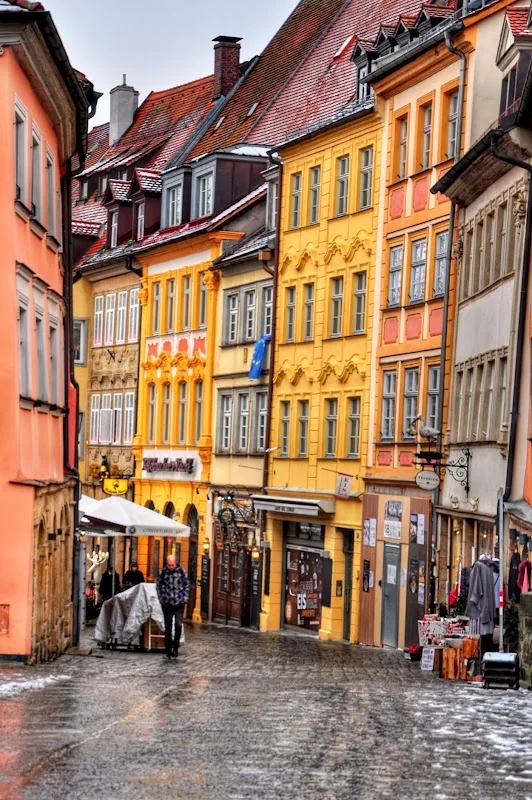
Bamberg
Dompl., 96049 Bamberg, Deutschland
Historic Old Town Bamberg | Photos & Reviews
The Historic Old Town of Bamberg is not a place to just tick off quickly, but a developed urban landscape with extraordinary depth. Since 1993, the ensemble has been on the UNESCO World Heritage List because it combines an early medieval urban structure with excellently preserved medieval and baroque architecture. Particularly fascinating is the close connection between spiritual history, civic urban development, and urban gardening. Bamberg was already elevated to the bishopric by Emperor Henry II in 1007 and was meant to remind of a "second Rome" in its significance. To this day, one can feel this historical layering while walking through the hill town, over the island town, and through the gardener's town. The old town is not a rigid backdrop but a vibrant urban landscape with short distances, strong sight lines, and many details that only reveal themselves upon closer inspection. This is precisely what creates the special charm of this place: Those who visit Bamberg experience not only beautiful facades but a coherent cultural monument that is still integrated into the everyday life of the city. ([whc.unesco.org](https://whc.unesco.org/en/list/624/?utm_source=openai))
Why the Old Town of Bamberg is UNESCO World Heritage
UNESCO recognizes Bamberg as an outstanding example of a Central European city with an early medieval layout and an impressive density of sacred and secular buildings. The World Heritage site covers around 142 hectares and is protected by an additional buffer zone of 444 hectares. It is particularly important that the historical urban structure with its three core areas has remained readable to this day. The medieval street axes, the functions of the individual districts, and the architectural development from the Middle Ages through the Baroque period to modern times can still be traced in the urban landscape. UNESCO also points out that Bamberg's architecture radiated strongly to Northern Germany and Hungary from the 12th century onwards. Thus, the old town is not only locally significant but part of a larger European cultural history. For visitors, this means: A walk through Bamberg is always also a walk through building and urban history, where many epochs overlap and complement each other in a small space. ([whc.unesco.org](https://whc.unesco.org/en/list/624/?utm_source=openai))
As important as the historical substance is the way Bamberg deals with its heritage. Since the 1950s, the city has been continuously restored, not through radical upheavals but through many small, carefully coordinated measures. UNESCO describes this approach as a special preservation strategy that has contributed to the high authenticity of the urban landscape. The protection system for the World Heritage is anchored in state and federal law; the city of Bamberg is responsible for the management of the site through the Bamberg World Heritage Center. This combination of protection, care, and everyday use makes the place so interesting: The old town remains inhabited, is visited, photographed, traversed, and managed without losing its historical identity. It is precisely this balance between vibrant present and protected past that is a key reason why Bamberg is considered one of the most impressive historical cities in Germany. ([whc.unesco.org](https://whc.unesco.org/en/list/624/?utm_source=openai))
Hill Town, Island Town, and Gardener's Town at a Glance
To truly understand the Historic Old Town of Bamberg, one should not see it as a single block but as an interplay of three historical settlement areas. The hill town is located on the hills and has formed the spiritual center since the founding of the diocese. Here, the ecclesiastical power and memorial sites are concentrated, foremost the Cathedral Hill with the Imperial Cathedral, along with monasteries, courtyards, and representative facilities. The island town lies between the two arms of the Regnitz River and traditionally stands for trade, craftsmanship, and civic life. Finally, the gardener's town preserves the centuries-old tradition of urban gardening. This tripartite division is not just a historical detail but the key to the World Heritage Bamberg. It is precisely in this functional diversity that the extraordinary quality of the city lies: religious center, economic hub, and productive garden city complement each other in a small space. This creates an urban landscape that does not appear to have grown randomly but possesses a historical order that can still be read today. ([whc.unesco.org](https://whc.unesco.org/en/list/624/?utm_source=openai))
The hill town is particularly closely connected to the topography of Bamberg. The city is often described as built on seven hills, similar to Rome, and it is precisely this hilly landscape that shapes the perception to this day. On the Cathedral Hill are the Imperial Cathedral and the Old Court, in close proximity the New Residence and other notable buildings. The character of the hill town is defined by narrow alleys, baroque facades, and wide views. The island town, in turn, is the image of the densely built urban center: Here, bridges, squares, residential houses, and public buildings come together. The Old Town Hall, which stands on an artificial island in the Regnitz, is the most famous landmark of this area. The charm of the island town lies in the fact that the historical structures become particularly evident in everyday life, as traffic, river, trade, and pedestrian zones overlap. ([bamberg.info](https://www.bamberg.info/bergstadt/?utm_source=openai))
The gardener's town is perhaps the most surprising part of the World Heritage. Since the Middle Ages, vegetable gardening has been practiced in the heart of Bamberg, and the medieval structures of the home gardens are still visibly preserved today. The city describes these areas as unique in Germany because there are hardly any other inner-city cultivation areas of this kind. In the past, Bamberg's gardeners exported their products far beyond the city limits, especially sets of onions, seeds, and licorice. This tradition has shaped the urban landscape and is now not only part of the UNESCO World Heritage but also part of the intangible cultural heritage. A marked circular path, an observation platform, and the Gardener's and Hacker Museum make the district particularly accessible. Those who are out and about here see not only historical houses but also a still vibrant form of urban agriculture. ([bamberg.info](https://www.bamberg.info/gaertnerstadt/?utm_source=openai))
Historic Buildings and Attractions You Shouldn't Miss
Among the most prominent buildings of the Historic Old Town Bamberg is the Imperial Cathedral on Cathedral Hill. Together with the Old Court and the New Residence, it represents the spiritual and representative dimension of the city. In close proximity, there are other significant places such as the Diocesan Museum, the Cathedral Square, and the historical paths of Cathedral Hill. The density of buildings is remarkable: Sacred architecture, courtly representation, and urban viewpoints alternate over a short distance. It is precisely this spatial proximity that gives the World Heritage its special character. The hill town is not simply a collection of individual monuments but a cohesive historical ensemble in which the power and cultural history of Bamberg can be read. Those who walk through these areas experience the city not linearly but as a succession of levels, terraces, courtyards, and sight lines. This makes the visit both compact and intense. ([bamberg.info](https://www.bamberg.info/bergstadt/?utm_source=openai))
In the island town, the Old Town Hall dominates, which was built on an artificial island in the river and is considered one of the most famous photographic motifs of Bamberg due to its frescoes and unusual location. The official tourism site describes it as a curiosity, whose history of origin is as remarkable as the painted facade. In addition, there are the civic streets, small squares, bridges, and the proximity to Little Venice, that row of fishermen's houses along the river that shapes the romantic image of the city. Together, these elements form a city center that appears both historical, densely built, and atmospherically open. The interplay of water, stone, and narrow alleys creates strong contrasts and makes the island town an ideal starting point for a city walk. Especially because many of the most important sights are within walking distance of each other, the historical core can be very well discovered on foot. ([bamberg.info](https://www.bamberg.info/poi/altes_rathaus-4656/?utm_source=openai))
The gardener's town expands the image of the old town with its own level. Here, the typical gardener's houses and the historically grown arrangement of the areas are still visible, allowing for an immediate experience of the connection between living, working, and producing. The circular path through the gardener's town is particularly recommended, which, according to the official description, is about 5.2 kilometers long and connects several important points. These include the Gardener's and Hacker Museum complex, various nurseries, the Church of St. Gangolf, the figure of Saint Sebastian, and other places that make the history of urban gardening tangible. Visitors here experience not only a monument but a cultural practice that still shapes urban life today. Therefore, those who photograph Bamberg should not only look for the well-known facades but also for the quieter motifs of the gardener's town, in which the special identity of the city is revealed very finely. ([bamberg.info](https://www.bamberg.info/gaertnerstadt/?utm_source=openai))
Access and Parking in the Old Town of Bamberg
Getting to the Historic Old Town Bamberg is well planned thanks to the official traffic and tourism information. By car, Bamberg can be reached via the A73 Nuremberg–Bamberg–Coburg and the A70 Schweinfurt–Bayreuth. The city refers to a parking guidance system that leads to parking options in the city center on the access roads. This is particularly helpful for visiting the old town, as the historical streets are narrow, but the availability of inner-city parking spaces is still present. The city of Bamberg lists over 1,500 parking spaces in parking garages and underground garages for the core city. Additionally, it recommends Park & Ride options, especially from Monday to Saturday. This is often the most pleasant solution for visitors, as it reduces the search for parking and old town traffic while allowing for an uncomplicated entry into the city center. ([en.bamberg.info](https://en.bamberg.info/anreise/?utm_source=openai))
There is also clear signage for tour buses. The official city information explains that the routes lead from the central stop for tour buses in Mußstraße to the bus parking lot on Lichtenhaidestraße. This also organizes group visits to the World Heritage site in a structured manner. Those who are walking benefit from the fact that Bamberg is very compact in the inner-city area, and many sights are close to each other. The tourism site also highlights that one can quickly move from one point to another in the old town. There are signposted bike paths and corresponding signage for bicycles. So, if you want to explore the old town not by car but rather in a relaxed and sustainable way, there are several good options. It is precisely the interplay of the parking guidance system, P+R, bus signage, and short distances that makes orientation in a historically sensitive city center surprisingly easy. ([stadt.bamberg.de](https://www.stadt.bamberg.de/B%C3%BCrgerservice/%C3%84mter-A-Z/Stadtplanungsamt_/verkehrsplanung/Verkehrsplanung/Parken-in-Bamberg/index.php?La=1&NavID=1829.328&kat=&kuo=2&object=tx%2C2730.2246.1&sub=0&utm_source=openai))
The location of the most important destinations also helps with planning. The World Heritage Visitor Center is located at Untere Mühlbrücke 5, right in the historical core, and is easily accessible by bus at Schranne. The official tourism and city pages make it clear that visitors can quickly reach the central places even without detailed local knowledge. Those arriving by car should rather use the managed parking options and parking garages than search for a space in the historical alleys. This is particularly sensible for a city with strong monument protection, as it helps to better preserve the historical character of the streets. Overall, the old town is thus very accessible: One parks outside the tightest core or uses Park & Ride, and the rest of the way becomes a comfortable walk through a unique World Heritage site. ([stadt.bamberg.de](https://www.stadt.bamberg.de/?object=tx%7C2730.1068.1&utm_source=openai))
World Heritage Visitor Center and Guided Tours on Site
The World Heritage Visitor Center is a central entry point for all who want to not only see the Historic Old Town Bamberg but also understand it. The official description calls it a reading aid for the World Heritage because it explains the peculiarities of the old town in the international UNESCO context. With around 220 square meters of exhibition space, the center conveys the most important connections of urban development, architecture, and the idea of protection. The exhibition works with models, digital applications, film stations, and a vivid representation of the historical city. Particularly valuable is that the center does not present individual objects like a classic museum but sharpens the view of the entire ensemble. Those who have little time get a compact overview here. Those who then continue through the city recognize much with different eyes. The effect is thus twofold: orientation before the tour and deepening during the visit. ([welterbe.bamberg.de](https://welterbe.bamberg.de/de/projekte/das-besuchszentrum?utm_source=openai))
Practically, the visitor center is also well integrated. Admission is free, the exhibition is barrier-free, and the opening hours are clearly regulated depending on the season. From April to October, the center is open from 10 AM to 6 PM, and from November to March from 11 AM to 4 PM. The official tourism site points out that public transport connections are available via Schranne, and parking options are nearby. In addition, Bamberg offers guided tours and special tours, such as the format "Fascination World Heritage," where one is guided to the most important sights in about two hours. Such offers are particularly useful when visiting the old town for the first time or wanting to better understand the connections between the individual districts. Especially in a city with so many historical layers, a good introduction is worthwhile, as it turns beautiful individual images into a coherent overall picture. ([stadt.bamberg.de](https://www.stadt.bamberg.de/B%C3%BCrgerservice/%C3%84mter/Bauordnungsamt/Denkmalpflege/index.php?FID=2730.255.1&ModID=9&NavID=1829.161&object=tx%2C3481.1&utm_source=openai))
Photos, Walks, and Special Perspectives in the Historic Old Town
The Historic Old Town Bamberg is particularly grateful for photos because very different motifs connect in a small space. Cathedral Hill offers wide sight lines and monumental architecture, the island town provides classic city views with the Old Town Hall and the river arms, and the gardener's town shows a quieter, more everyday side of the World Heritage. It is precisely this change of perspectives that makes the walk so appealing. Those who photograph the place should not only capture the well-known landmarks but also the transitions between the areas: bridges, stairs, narrow alleys, terraces, and small squares. In Bamberg, the effect often does not arise from a single building but from the spatial relationship between several elements. Particularly impressive is that many of the most important places are only a few minutes apart, allowing for very different photographic moods to be experienced in a short time. ([en.bamberg.info](https://en.bamberg.info/?utm_source=openai))
The character of the city itself also contributes to the special atmosphere. On the hills of the hill town, along the waterways of the island town, and in the gardener-influenced districts, Bamberg shows how closely landscape and city can be connected. The official tourism information describes the old town as a place where historical architecture, urban history, and cultural offerings lie closely together. You can feel this while walking: The paths are short, but the impressions are diverse. Those who have enough time should take the visit slowly, stop frequently, and consciously perceive the sight lines between Cathedral Hill, the Town Hall, and the gardener's town. Then it becomes understandable why Bamberg is not only a beautiful city but also an extraordinarily readable cultural heritage. The combination of UNESCO status, vibrant use, and historical diversity makes the old town a place where one likes to linger longer than planned. ([bamberg.info](https://www.bamberg.info/weltkulturerbe/?utm_source=openai))
Sources:
Mehr anzeigenWeniger anzeigen
Historic Old Town Bamberg | Photos & Reviews
The Historic Old Town of Bamberg is not a place to just tick off quickly, but a developed urban landscape with extraordinary depth. Since 1993, the ensemble has been on the UNESCO World Heritage List because it combines an early medieval urban structure with excellently preserved medieval and baroque architecture. Particularly fascinating is the close connection between spiritual history, civic urban development, and urban gardening. Bamberg was already elevated to the bishopric by Emperor Henry II in 1007 and was meant to remind of a "second Rome" in its significance. To this day, one can feel this historical layering while walking through the hill town, over the island town, and through the gardener's town. The old town is not a rigid backdrop but a vibrant urban landscape with short distances, strong sight lines, and many details that only reveal themselves upon closer inspection. This is precisely what creates the special charm of this place: Those who visit Bamberg experience not only beautiful facades but a coherent cultural monument that is still integrated into the everyday life of the city. ([whc.unesco.org](https://whc.unesco.org/en/list/624/?utm_source=openai))
Why the Old Town of Bamberg is UNESCO World Heritage
UNESCO recognizes Bamberg as an outstanding example of a Central European city with an early medieval layout and an impressive density of sacred and secular buildings. The World Heritage site covers around 142 hectares and is protected by an additional buffer zone of 444 hectares. It is particularly important that the historical urban structure with its three core areas has remained readable to this day. The medieval street axes, the functions of the individual districts, and the architectural development from the Middle Ages through the Baroque period to modern times can still be traced in the urban landscape. UNESCO also points out that Bamberg's architecture radiated strongly to Northern Germany and Hungary from the 12th century onwards. Thus, the old town is not only locally significant but part of a larger European cultural history. For visitors, this means: A walk through Bamberg is always also a walk through building and urban history, where many epochs overlap and complement each other in a small space. ([whc.unesco.org](https://whc.unesco.org/en/list/624/?utm_source=openai))
As important as the historical substance is the way Bamberg deals with its heritage. Since the 1950s, the city has been continuously restored, not through radical upheavals but through many small, carefully coordinated measures. UNESCO describes this approach as a special preservation strategy that has contributed to the high authenticity of the urban landscape. The protection system for the World Heritage is anchored in state and federal law; the city of Bamberg is responsible for the management of the site through the Bamberg World Heritage Center. This combination of protection, care, and everyday use makes the place so interesting: The old town remains inhabited, is visited, photographed, traversed, and managed without losing its historical identity. It is precisely this balance between vibrant present and protected past that is a key reason why Bamberg is considered one of the most impressive historical cities in Germany. ([whc.unesco.org](https://whc.unesco.org/en/list/624/?utm_source=openai))
Hill Town, Island Town, and Gardener's Town at a Glance
To truly understand the Historic Old Town of Bamberg, one should not see it as a single block but as an interplay of three historical settlement areas. The hill town is located on the hills and has formed the spiritual center since the founding of the diocese. Here, the ecclesiastical power and memorial sites are concentrated, foremost the Cathedral Hill with the Imperial Cathedral, along with monasteries, courtyards, and representative facilities. The island town lies between the two arms of the Regnitz River and traditionally stands for trade, craftsmanship, and civic life. Finally, the gardener's town preserves the centuries-old tradition of urban gardening. This tripartite division is not just a historical detail but the key to the World Heritage Bamberg. It is precisely in this functional diversity that the extraordinary quality of the city lies: religious center, economic hub, and productive garden city complement each other in a small space. This creates an urban landscape that does not appear to have grown randomly but possesses a historical order that can still be read today. ([whc.unesco.org](https://whc.unesco.org/en/list/624/?utm_source=openai))
The hill town is particularly closely connected to the topography of Bamberg. The city is often described as built on seven hills, similar to Rome, and it is precisely this hilly landscape that shapes the perception to this day. On the Cathedral Hill are the Imperial Cathedral and the Old Court, in close proximity the New Residence and other notable buildings. The character of the hill town is defined by narrow alleys, baroque facades, and wide views. The island town, in turn, is the image of the densely built urban center: Here, bridges, squares, residential houses, and public buildings come together. The Old Town Hall, which stands on an artificial island in the Regnitz, is the most famous landmark of this area. The charm of the island town lies in the fact that the historical structures become particularly evident in everyday life, as traffic, river, trade, and pedestrian zones overlap. ([bamberg.info](https://www.bamberg.info/bergstadt/?utm_source=openai))
The gardener's town is perhaps the most surprising part of the World Heritage. Since the Middle Ages, vegetable gardening has been practiced in the heart of Bamberg, and the medieval structures of the home gardens are still visibly preserved today. The city describes these areas as unique in Germany because there are hardly any other inner-city cultivation areas of this kind. In the past, Bamberg's gardeners exported their products far beyond the city limits, especially sets of onions, seeds, and licorice. This tradition has shaped the urban landscape and is now not only part of the UNESCO World Heritage but also part of the intangible cultural heritage. A marked circular path, an observation platform, and the Gardener's and Hacker Museum make the district particularly accessible. Those who are out and about here see not only historical houses but also a still vibrant form of urban agriculture. ([bamberg.info](https://www.bamberg.info/gaertnerstadt/?utm_source=openai))
Historic Buildings and Attractions You Shouldn't Miss
Among the most prominent buildings of the Historic Old Town Bamberg is the Imperial Cathedral on Cathedral Hill. Together with the Old Court and the New Residence, it represents the spiritual and representative dimension of the city. In close proximity, there are other significant places such as the Diocesan Museum, the Cathedral Square, and the historical paths of Cathedral Hill. The density of buildings is remarkable: Sacred architecture, courtly representation, and urban viewpoints alternate over a short distance. It is precisely this spatial proximity that gives the World Heritage its special character. The hill town is not simply a collection of individual monuments but a cohesive historical ensemble in which the power and cultural history of Bamberg can be read. Those who walk through these areas experience the city not linearly but as a succession of levels, terraces, courtyards, and sight lines. This makes the visit both compact and intense. ([bamberg.info](https://www.bamberg.info/bergstadt/?utm_source=openai))
In the island town, the Old Town Hall dominates, which was built on an artificial island in the river and is considered one of the most famous photographic motifs of Bamberg due to its frescoes and unusual location. The official tourism site describes it as a curiosity, whose history of origin is as remarkable as the painted facade. In addition, there are the civic streets, small squares, bridges, and the proximity to Little Venice, that row of fishermen's houses along the river that shapes the romantic image of the city. Together, these elements form a city center that appears both historical, densely built, and atmospherically open. The interplay of water, stone, and narrow alleys creates strong contrasts and makes the island town an ideal starting point for a city walk. Especially because many of the most important sights are within walking distance of each other, the historical core can be very well discovered on foot. ([bamberg.info](https://www.bamberg.info/poi/altes_rathaus-4656/?utm_source=openai))
The gardener's town expands the image of the old town with its own level. Here, the typical gardener's houses and the historically grown arrangement of the areas are still visible, allowing for an immediate experience of the connection between living, working, and producing. The circular path through the gardener's town is particularly recommended, which, according to the official description, is about 5.2 kilometers long and connects several important points. These include the Gardener's and Hacker Museum complex, various nurseries, the Church of St. Gangolf, the figure of Saint Sebastian, and other places that make the history of urban gardening tangible. Visitors here experience not only a monument but a cultural practice that still shapes urban life today. Therefore, those who photograph Bamberg should not only look for the well-known facades but also for the quieter motifs of the gardener's town, in which the special identity of the city is revealed very finely. ([bamberg.info](https://www.bamberg.info/gaertnerstadt/?utm_source=openai))
Access and Parking in the Old Town of Bamberg
Getting to the Historic Old Town Bamberg is well planned thanks to the official traffic and tourism information. By car, Bamberg can be reached via the A73 Nuremberg–Bamberg–Coburg and the A70 Schweinfurt–Bayreuth. The city refers to a parking guidance system that leads to parking options in the city center on the access roads. This is particularly helpful for visiting the old town, as the historical streets are narrow, but the availability of inner-city parking spaces is still present. The city of Bamberg lists over 1,500 parking spaces in parking garages and underground garages for the core city. Additionally, it recommends Park & Ride options, especially from Monday to Saturday. This is often the most pleasant solution for visitors, as it reduces the search for parking and old town traffic while allowing for an uncomplicated entry into the city center. ([en.bamberg.info](https://en.bamberg.info/anreise/?utm_source=openai))
There is also clear signage for tour buses. The official city information explains that the routes lead from the central stop for tour buses in Mußstraße to the bus parking lot on Lichtenhaidestraße. This also organizes group visits to the World Heritage site in a structured manner. Those who are walking benefit from the fact that Bamberg is very compact in the inner-city area, and many sights are close to each other. The tourism site also highlights that one can quickly move from one point to another in the old town. There are signposted bike paths and corresponding signage for bicycles. So, if you want to explore the old town not by car but rather in a relaxed and sustainable way, there are several good options. It is precisely the interplay of the parking guidance system, P+R, bus signage, and short distances that makes orientation in a historically sensitive city center surprisingly easy. ([stadt.bamberg.de](https://www.stadt.bamberg.de/B%C3%BCrgerservice/%C3%84mter-A-Z/Stadtplanungsamt_/verkehrsplanung/Verkehrsplanung/Parken-in-Bamberg/index.php?La=1&NavID=1829.328&kat=&kuo=2&object=tx%2C2730.2246.1&sub=0&utm_source=openai))
The location of the most important destinations also helps with planning. The World Heritage Visitor Center is located at Untere Mühlbrücke 5, right in the historical core, and is easily accessible by bus at Schranne. The official tourism and city pages make it clear that visitors can quickly reach the central places even without detailed local knowledge. Those arriving by car should rather use the managed parking options and parking garages than search for a space in the historical alleys. This is particularly sensible for a city with strong monument protection, as it helps to better preserve the historical character of the streets. Overall, the old town is thus very accessible: One parks outside the tightest core or uses Park & Ride, and the rest of the way becomes a comfortable walk through a unique World Heritage site. ([stadt.bamberg.de](https://www.stadt.bamberg.de/?object=tx%7C2730.1068.1&utm_source=openai))
World Heritage Visitor Center and Guided Tours on Site
The World Heritage Visitor Center is a central entry point for all who want to not only see the Historic Old Town Bamberg but also understand it. The official description calls it a reading aid for the World Heritage because it explains the peculiarities of the old town in the international UNESCO context. With around 220 square meters of exhibition space, the center conveys the most important connections of urban development, architecture, and the idea of protection. The exhibition works with models, digital applications, film stations, and a vivid representation of the historical city. Particularly valuable is that the center does not present individual objects like a classic museum but sharpens the view of the entire ensemble. Those who have little time get a compact overview here. Those who then continue through the city recognize much with different eyes. The effect is thus twofold: orientation before the tour and deepening during the visit. ([welterbe.bamberg.de](https://welterbe.bamberg.de/de/projekte/das-besuchszentrum?utm_source=openai))
Practically, the visitor center is also well integrated. Admission is free, the exhibition is barrier-free, and the opening hours are clearly regulated depending on the season. From April to October, the center is open from 10 AM to 6 PM, and from November to March from 11 AM to 4 PM. The official tourism site points out that public transport connections are available via Schranne, and parking options are nearby. In addition, Bamberg offers guided tours and special tours, such as the format "Fascination World Heritage," where one is guided to the most important sights in about two hours. Such offers are particularly useful when visiting the old town for the first time or wanting to better understand the connections between the individual districts. Especially in a city with so many historical layers, a good introduction is worthwhile, as it turns beautiful individual images into a coherent overall picture. ([stadt.bamberg.de](https://www.stadt.bamberg.de/B%C3%BCrgerservice/%C3%84mter/Bauordnungsamt/Denkmalpflege/index.php?FID=2730.255.1&ModID=9&NavID=1829.161&object=tx%2C3481.1&utm_source=openai))
Photos, Walks, and Special Perspectives in the Historic Old Town
The Historic Old Town Bamberg is particularly grateful for photos because very different motifs connect in a small space. Cathedral Hill offers wide sight lines and monumental architecture, the island town provides classic city views with the Old Town Hall and the river arms, and the gardener's town shows a quieter, more everyday side of the World Heritage. It is precisely this change of perspectives that makes the walk so appealing. Those who photograph the place should not only capture the well-known landmarks but also the transitions between the areas: bridges, stairs, narrow alleys, terraces, and small squares. In Bamberg, the effect often does not arise from a single building but from the spatial relationship between several elements. Particularly impressive is that many of the most important places are only a few minutes apart, allowing for very different photographic moods to be experienced in a short time. ([en.bamberg.info](https://en.bamberg.info/?utm_source=openai))
The character of the city itself also contributes to the special atmosphere. On the hills of the hill town, along the waterways of the island town, and in the gardener-influenced districts, Bamberg shows how closely landscape and city can be connected. The official tourism information describes the old town as a place where historical architecture, urban history, and cultural offerings lie closely together. You can feel this while walking: The paths are short, but the impressions are diverse. Those who have enough time should take the visit slowly, stop frequently, and consciously perceive the sight lines between Cathedral Hill, the Town Hall, and the gardener's town. Then it becomes understandable why Bamberg is not only a beautiful city but also an extraordinarily readable cultural heritage. The combination of UNESCO status, vibrant use, and historical diversity makes the old town a place where one likes to linger longer than planned. ([bamberg.info](https://www.bamberg.info/weltkulturerbe/?utm_source=openai))
Sources:
Historic Old Town Bamberg | Photos & Reviews
The Historic Old Town of Bamberg is not a place to just tick off quickly, but a developed urban landscape with extraordinary depth. Since 1993, the ensemble has been on the UNESCO World Heritage List because it combines an early medieval urban structure with excellently preserved medieval and baroque architecture. Particularly fascinating is the close connection between spiritual history, civic urban development, and urban gardening. Bamberg was already elevated to the bishopric by Emperor Henry II in 1007 and was meant to remind of a "second Rome" in its significance. To this day, one can feel this historical layering while walking through the hill town, over the island town, and through the gardener's town. The old town is not a rigid backdrop but a vibrant urban landscape with short distances, strong sight lines, and many details that only reveal themselves upon closer inspection. This is precisely what creates the special charm of this place: Those who visit Bamberg experience not only beautiful facades but a coherent cultural monument that is still integrated into the everyday life of the city. ([whc.unesco.org](https://whc.unesco.org/en/list/624/?utm_source=openai))
Why the Old Town of Bamberg is UNESCO World Heritage
UNESCO recognizes Bamberg as an outstanding example of a Central European city with an early medieval layout and an impressive density of sacred and secular buildings. The World Heritage site covers around 142 hectares and is protected by an additional buffer zone of 444 hectares. It is particularly important that the historical urban structure with its three core areas has remained readable to this day. The medieval street axes, the functions of the individual districts, and the architectural development from the Middle Ages through the Baroque period to modern times can still be traced in the urban landscape. UNESCO also points out that Bamberg's architecture radiated strongly to Northern Germany and Hungary from the 12th century onwards. Thus, the old town is not only locally significant but part of a larger European cultural history. For visitors, this means: A walk through Bamberg is always also a walk through building and urban history, where many epochs overlap and complement each other in a small space. ([whc.unesco.org](https://whc.unesco.org/en/list/624/?utm_source=openai))
As important as the historical substance is the way Bamberg deals with its heritage. Since the 1950s, the city has been continuously restored, not through radical upheavals but through many small, carefully coordinated measures. UNESCO describes this approach as a special preservation strategy that has contributed to the high authenticity of the urban landscape. The protection system for the World Heritage is anchored in state and federal law; the city of Bamberg is responsible for the management of the site through the Bamberg World Heritage Center. This combination of protection, care, and everyday use makes the place so interesting: The old town remains inhabited, is visited, photographed, traversed, and managed without losing its historical identity. It is precisely this balance between vibrant present and protected past that is a key reason why Bamberg is considered one of the most impressive historical cities in Germany. ([whc.unesco.org](https://whc.unesco.org/en/list/624/?utm_source=openai))
Hill Town, Island Town, and Gardener's Town at a Glance
To truly understand the Historic Old Town of Bamberg, one should not see it as a single block but as an interplay of three historical settlement areas. The hill town is located on the hills and has formed the spiritual center since the founding of the diocese. Here, the ecclesiastical power and memorial sites are concentrated, foremost the Cathedral Hill with the Imperial Cathedral, along with monasteries, courtyards, and representative facilities. The island town lies between the two arms of the Regnitz River and traditionally stands for trade, craftsmanship, and civic life. Finally, the gardener's town preserves the centuries-old tradition of urban gardening. This tripartite division is not just a historical detail but the key to the World Heritage Bamberg. It is precisely in this functional diversity that the extraordinary quality of the city lies: religious center, economic hub, and productive garden city complement each other in a small space. This creates an urban landscape that does not appear to have grown randomly but possesses a historical order that can still be read today. ([whc.unesco.org](https://whc.unesco.org/en/list/624/?utm_source=openai))
The hill town is particularly closely connected to the topography of Bamberg. The city is often described as built on seven hills, similar to Rome, and it is precisely this hilly landscape that shapes the perception to this day. On the Cathedral Hill are the Imperial Cathedral and the Old Court, in close proximity the New Residence and other notable buildings. The character of the hill town is defined by narrow alleys, baroque facades, and wide views. The island town, in turn, is the image of the densely built urban center: Here, bridges, squares, residential houses, and public buildings come together. The Old Town Hall, which stands on an artificial island in the Regnitz, is the most famous landmark of this area. The charm of the island town lies in the fact that the historical structures become particularly evident in everyday life, as traffic, river, trade, and pedestrian zones overlap. ([bamberg.info](https://www.bamberg.info/bergstadt/?utm_source=openai))
The gardener's town is perhaps the most surprising part of the World Heritage. Since the Middle Ages, vegetable gardening has been practiced in the heart of Bamberg, and the medieval structures of the home gardens are still visibly preserved today. The city describes these areas as unique in Germany because there are hardly any other inner-city cultivation areas of this kind. In the past, Bamberg's gardeners exported their products far beyond the city limits, especially sets of onions, seeds, and licorice. This tradition has shaped the urban landscape and is now not only part of the UNESCO World Heritage but also part of the intangible cultural heritage. A marked circular path, an observation platform, and the Gardener's and Hacker Museum make the district particularly accessible. Those who are out and about here see not only historical houses but also a still vibrant form of urban agriculture. ([bamberg.info](https://www.bamberg.info/gaertnerstadt/?utm_source=openai))
Historic Buildings and Attractions You Shouldn't Miss
Among the most prominent buildings of the Historic Old Town Bamberg is the Imperial Cathedral on Cathedral Hill. Together with the Old Court and the New Residence, it represents the spiritual and representative dimension of the city. In close proximity, there are other significant places such as the Diocesan Museum, the Cathedral Square, and the historical paths of Cathedral Hill. The density of buildings is remarkable: Sacred architecture, courtly representation, and urban viewpoints alternate over a short distance. It is precisely this spatial proximity that gives the World Heritage its special character. The hill town is not simply a collection of individual monuments but a cohesive historical ensemble in which the power and cultural history of Bamberg can be read. Those who walk through these areas experience the city not linearly but as a succession of levels, terraces, courtyards, and sight lines. This makes the visit both compact and intense. ([bamberg.info](https://www.bamberg.info/bergstadt/?utm_source=openai))
In the island town, the Old Town Hall dominates, which was built on an artificial island in the river and is considered one of the most famous photographic motifs of Bamberg due to its frescoes and unusual location. The official tourism site describes it as a curiosity, whose history of origin is as remarkable as the painted facade. In addition, there are the civic streets, small squares, bridges, and the proximity to Little Venice, that row of fishermen's houses along the river that shapes the romantic image of the city. Together, these elements form a city center that appears both historical, densely built, and atmospherically open. The interplay of water, stone, and narrow alleys creates strong contrasts and makes the island town an ideal starting point for a city walk. Especially because many of the most important sights are within walking distance of each other, the historical core can be very well discovered on foot. ([bamberg.info](https://www.bamberg.info/poi/altes_rathaus-4656/?utm_source=openai))
The gardener's town expands the image of the old town with its own level. Here, the typical gardener's houses and the historically grown arrangement of the areas are still visible, allowing for an immediate experience of the connection between living, working, and producing. The circular path through the gardener's town is particularly recommended, which, according to the official description, is about 5.2 kilometers long and connects several important points. These include the Gardener's and Hacker Museum complex, various nurseries, the Church of St. Gangolf, the figure of Saint Sebastian, and other places that make the history of urban gardening tangible. Visitors here experience not only a monument but a cultural practice that still shapes urban life today. Therefore, those who photograph Bamberg should not only look for the well-known facades but also for the quieter motifs of the gardener's town, in which the special identity of the city is revealed very finely. ([bamberg.info](https://www.bamberg.info/gaertnerstadt/?utm_source=openai))
Access and Parking in the Old Town of Bamberg
Getting to the Historic Old Town Bamberg is well planned thanks to the official traffic and tourism information. By car, Bamberg can be reached via the A73 Nuremberg–Bamberg–Coburg and the A70 Schweinfurt–Bayreuth. The city refers to a parking guidance system that leads to parking options in the city center on the access roads. This is particularly helpful for visiting the old town, as the historical streets are narrow, but the availability of inner-city parking spaces is still present. The city of Bamberg lists over 1,500 parking spaces in parking garages and underground garages for the core city. Additionally, it recommends Park & Ride options, especially from Monday to Saturday. This is often the most pleasant solution for visitors, as it reduces the search for parking and old town traffic while allowing for an uncomplicated entry into the city center. ([en.bamberg.info](https://en.bamberg.info/anreise/?utm_source=openai))
There is also clear signage for tour buses. The official city information explains that the routes lead from the central stop for tour buses in Mußstraße to the bus parking lot on Lichtenhaidestraße. This also organizes group visits to the World Heritage site in a structured manner. Those who are walking benefit from the fact that Bamberg is very compact in the inner-city area, and many sights are close to each other. The tourism site also highlights that one can quickly move from one point to another in the old town. There are signposted bike paths and corresponding signage for bicycles. So, if you want to explore the old town not by car but rather in a relaxed and sustainable way, there are several good options. It is precisely the interplay of the parking guidance system, P+R, bus signage, and short distances that makes orientation in a historically sensitive city center surprisingly easy. ([stadt.bamberg.de](https://www.stadt.bamberg.de/B%C3%BCrgerservice/%C3%84mter-A-Z/Stadtplanungsamt_/verkehrsplanung/Verkehrsplanung/Parken-in-Bamberg/index.php?La=1&NavID=1829.328&kat=&kuo=2&object=tx%2C2730.2246.1&sub=0&utm_source=openai))
The location of the most important destinations also helps with planning. The World Heritage Visitor Center is located at Untere Mühlbrücke 5, right in the historical core, and is easily accessible by bus at Schranne. The official tourism and city pages make it clear that visitors can quickly reach the central places even without detailed local knowledge. Those arriving by car should rather use the managed parking options and parking garages than search for a space in the historical alleys. This is particularly sensible for a city with strong monument protection, as it helps to better preserve the historical character of the streets. Overall, the old town is thus very accessible: One parks outside the tightest core or uses Park & Ride, and the rest of the way becomes a comfortable walk through a unique World Heritage site. ([stadt.bamberg.de](https://www.stadt.bamberg.de/?object=tx%7C2730.1068.1&utm_source=openai))
World Heritage Visitor Center and Guided Tours on Site
The World Heritage Visitor Center is a central entry point for all who want to not only see the Historic Old Town Bamberg but also understand it. The official description calls it a reading aid for the World Heritage because it explains the peculiarities of the old town in the international UNESCO context. With around 220 square meters of exhibition space, the center conveys the most important connections of urban development, architecture, and the idea of protection. The exhibition works with models, digital applications, film stations, and a vivid representation of the historical city. Particularly valuable is that the center does not present individual objects like a classic museum but sharpens the view of the entire ensemble. Those who have little time get a compact overview here. Those who then continue through the city recognize much with different eyes. The effect is thus twofold: orientation before the tour and deepening during the visit. ([welterbe.bamberg.de](https://welterbe.bamberg.de/de/projekte/das-besuchszentrum?utm_source=openai))
Practically, the visitor center is also well integrated. Admission is free, the exhibition is barrier-free, and the opening hours are clearly regulated depending on the season. From April to October, the center is open from 10 AM to 6 PM, and from November to March from 11 AM to 4 PM. The official tourism site points out that public transport connections are available via Schranne, and parking options are nearby. In addition, Bamberg offers guided tours and special tours, such as the format "Fascination World Heritage," where one is guided to the most important sights in about two hours. Such offers are particularly useful when visiting the old town for the first time or wanting to better understand the connections between the individual districts. Especially in a city with so many historical layers, a good introduction is worthwhile, as it turns beautiful individual images into a coherent overall picture. ([stadt.bamberg.de](https://www.stadt.bamberg.de/B%C3%BCrgerservice/%C3%84mter/Bauordnungsamt/Denkmalpflege/index.php?FID=2730.255.1&ModID=9&NavID=1829.161&object=tx%2C3481.1&utm_source=openai))
Photos, Walks, and Special Perspectives in the Historic Old Town
The Historic Old Town Bamberg is particularly grateful for photos because very different motifs connect in a small space. Cathedral Hill offers wide sight lines and monumental architecture, the island town provides classic city views with the Old Town Hall and the river arms, and the gardener's town shows a quieter, more everyday side of the World Heritage. It is precisely this change of perspectives that makes the walk so appealing. Those who photograph the place should not only capture the well-known landmarks but also the transitions between the areas: bridges, stairs, narrow alleys, terraces, and small squares. In Bamberg, the effect often does not arise from a single building but from the spatial relationship between several elements. Particularly impressive is that many of the most important places are only a few minutes apart, allowing for very different photographic moods to be experienced in a short time. ([en.bamberg.info](https://en.bamberg.info/?utm_source=openai))
The character of the city itself also contributes to the special atmosphere. On the hills of the hill town, along the waterways of the island town, and in the gardener-influenced districts, Bamberg shows how closely landscape and city can be connected. The official tourism information describes the old town as a place where historical architecture, urban history, and cultural offerings lie closely together. You can feel this while walking: The paths are short, but the impressions are diverse. Those who have enough time should take the visit slowly, stop frequently, and consciously perceive the sight lines between Cathedral Hill, the Town Hall, and the gardener's town. Then it becomes understandable why Bamberg is not only a beautiful city but also an extraordinarily readable cultural heritage. The combination of UNESCO status, vibrant use, and historical diversity makes the old town a place where one likes to linger longer than planned. ([bamberg.info](https://www.bamberg.info/weltkulturerbe/?utm_source=openai))
Sources:

Frequently Asked Questions
Reviews
No reviews found