
Scheßlitz
Gügel 1, 96110 Scheßlitz, Deutschland
Gügel Church St. Pankratius | Opening Hours & History
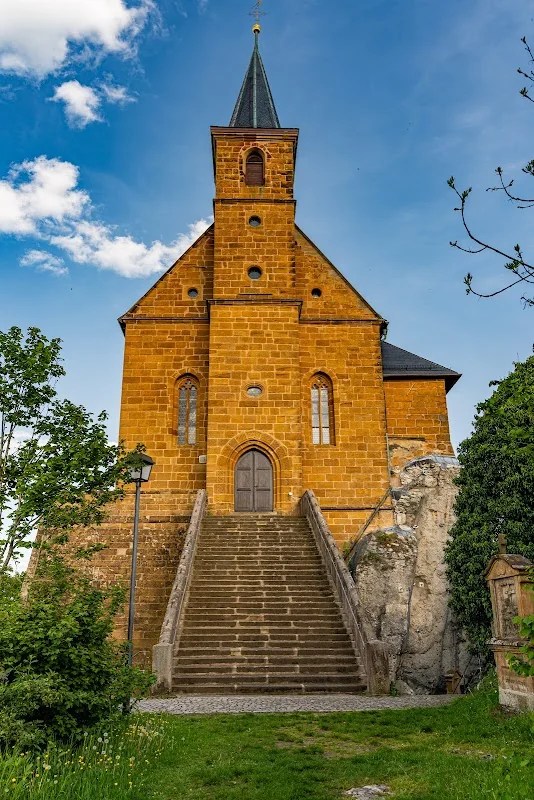
The Gügel Church St. Pankratius near Scheßlitz is much more than a quiet spot on the map. It stands prominently on a ridge of the Franconian Jura, overlooking the Bamberg region, and combines scenic drama with an unusually rich architectural history. From below, the rock often appears almost like a natural pedestal for the church; upon arrival at the top, a place opens up that offers much to pilgrims, walkers, and culture enthusiasts alike. Those who visit the Gügel experience a sacred place with baroque furnishings, a long history as a castle site, and a strong connection to the local church life. This interplay of views, history, and devotion makes the Gügel Church one of the most impressive destinations in the Scheßlitz area. ([pfarrei-schesslitz.de](https://pfarrei-schesslitz.de/kirchen/guegelkirche))
Opening Hours, Visits, and Services
For many visitors, the question of visiting is the first practical point. According to the parish, the Gügel Church is generally open for prayer and visits on Sundays and public holidays from 10 AM to 4 PM during the summer; it is also accessible during services. Thus, the location is suitable for both a short detour and a quiet stay with a conscious focus on architecture and landscape. The contact person is the Catholic Parish Office St. Kilian Scheßlitz; the contact details are provided on the official page. Those planning a wedding, a guided tour, or a special church event should coordinate the date in advance with the parish office, as the church is used not as a continuously regular museum space, but as a living sacred place. ([pfarrei-schesslitz.de](https://pfarrei-schesslitz.de/kirchen/guegelkirche))
The official description also makes it clear that the Gügel Church is not just intended for one-time visits. Various liturgical days play a role on the grounds and throughout the church year, including the feast day of the patron Pankratius on May 12, as well as other special feast days such as St. James the Elder, the Assumption of Mary, the Feast of the Guardian Angels, church consecration, and Christ the King feast. This mix of regular opening hours, services, and feast days explains why the church remains interesting for both pilgrims and culture-interested visitors: it is not an isolated monument, but a place with ongoing religious use and a clearly recognizable community connection. Those seeking peace will find it here, as well as people who come specifically for a service, a church visit, or a special holiday. ([pfarrei-schesslitz.de](https://pfarrei-schesslitz.de/kirchen/guegelkirche))
History from Castle Rock to Pilgrimage Church
The history of the site begins well before the current church building. According to the official account, a castle originally stood at this location, which was mentioned in a document from the Bamberg bishop in 1274. In 1390, the castle came into the possession of the Bamberg bishops through purchase, and subsequently, several predecessor buildings were constructed before the visible church was built between 1610 and 1618. The architect is named as G. Bonalino. This sequence already shows how closely the Gügel is connected to the regional history of power and piety: from a fortified site, it gradually became a spiritual center, whose location on the rock still shapes its appearance today. The name itself is also intriguing, as BR suggests that it is probably derived from the Middle High German word 'Gugel' for hood or monk's cowl and may refer to the shape of the rock. ([pfarrei-schesslitz.de](https://pfarrei-schesslitz.de/kirchen/guegelkirche))
The historical significance includes not only the building itself but also the furnishings. According to the architect's plans, the high altar was made; the high altar painting comes from the Bamberg court painter Wolfgang Fugkehr and depicts the Assumption of Mary. The sculptor Michael Kern created fourteen alabaster figures in 1611, which are still considered a special treasure of the church today. Later, additional layers were added: in 1834, a pulpit and gallery from the Bamberg Cathedral were installed, in 1891 a Lourdes grotto was created under the choir, and between 1984 and 1994, the church was extensively renovated. As a result, the Gügel Church is not a static memorial site, but a building that reflects several centuries of regional sacred history. ([pfarrei-schesslitz.de](https://pfarrei-schesslitz.de/kirchen/guegelkirche))
Access and Parking at the Gügel
The address Gügel 1, 96110 Scheßlitz leads directly to the church and makes access for visitors straightforward. According to BR, guests can park their cars at the Gügel Church before visiting or starting their hike. The city of Scheßlitz also names the Gügel parking lot as the starting point for a partial route, indicating that the location is well-suited not only for a short visit but also for longer excursions. Especially for a destination on a rock, this combination is important: those arriving by car need clear orientation; those walking need a distinct starting point. Both are provided at the Gügel, and that is why the visit can be planned very flexibly. ([br.de](https://www.br.de/br-fernsehen/sendungen/wir-in-bayern/ratgeber/wandern-guegelkirche-giechburg-schesslitz-oberfranken-burg-nina-schlesener-100.html))
It is also practical that the Gügel Church is located in a touristically well-integrated environment. The official hiking brochure from Scheßlitz connects the Gügel with Giechburg and other attractions, so the visit does not have to be limited to the interior of the church. Those with only a few minutes can drive straight up and take a look at the church and the view; those with more time can plan the trip as part of a larger day trip. Thus, a simple destination becomes a multifaceted place: accessible, easy to find, and yet situated in such a way that the journey upwards is already part of the experience. For many visitors, this transition from the valley to the rock is the moment when the character of the Gügel truly becomes palpable. ([schesslitz.de](https://www.schesslitz.de/fileadmin/Stadt_Sche%C3%9Flitz/Freizeit_und_Kultur/Freizeit_und_Sport/Wanderwege/Schesslitz_aktiv_erleben_Broschuere.pdf))
Hike to the Gügel Church and Giechburg
The Gügel Church is excellently suited as a starting or ending point for a short hike. BR describes a circular tour of just under four kilometers, about one and a half hours of walking time, and around 150 meters of elevation gain, which begins at the church, leads over the historic Stations of the Cross to Giechburg, and then returns. The route is thus manageable but varied: forest passages, open meadows, and clear sightlines alternate, and the hike gradually reveals the landscape. Even those who do not wish to walk the entire route benefit from the good location, as even the few meters around the church offer impressive views over the Bamberg region and the Franconian Switzerland. This proximity of sacred space and nature experience makes the place so popular. ([br.de](https://www.br.de/br-fernsehen/sendungen/wir-in-bayern/ratgeber/wandern-guegelkirche-giechburg-schesslitz-oberfranken-burg-nina-schlesener-100.html))
The city of Scheßlitz additionally offers a longer route, where the Gügel, Giechburg, and the Jewish cemetery come together over a distance of 9.8 kilometers. This makes it clear that the Gügel is not just a single photo stop, but part of a whole cultural landscape with paths, points of remembrance, and viewpoints. The BR description also highlights the historic Stations of the Cross, which accompany the ascent to the church and add a spiritual dimension to the hike. Those seeking a combination of movement, history, and landscape will therefore find an ideal setting here. The path is not a strenuous extreme ascent, but a manageable tour where the effort of the ascent pays off immediately in peace, openness, and perspective. ([br.de](https://www.br.de/br-fernsehen/sendungen/wir-in-bayern/ratgeber/wandern-guegelkirche-giechburg-schesslitz-oberfranken-burg-nina-schlesener-100.html))
Artworks, Fourteen Holy Helpers, and Baroque Furnishings
The Gügel Church is particularly noteworthy in art history due to its rich furnishings. It is described as a Fourteen Holy Helpers church, and the fourteen alabaster figures crafted by Michael Kern in 1611 are among its most important features. Additionally, there are two richly decorated side altars, numerous other figures, and the organ, which is said to have been built around 1618 by an unknown master. Such elements show that it is not just a simple pilgrimage chapel, but a complex that has grown over time, where visual art, altars, organ, and architecture merge. The pulpit and gallery taken from the Bamberg Cathedral in 1834 also contribute to the special effect of the interior and refer to connections within the ecclesiastical art landscape of the region. ([pfarrei-schesslitz.de](https://pfarrei-schesslitz.de/kirchen/guegelkirche))
Especially impressive is the contrast between the exterior and interior effect. From a distance, the church often appears smaller and almost chapel-like, but upon reaching the rock, the entire building unfolds with its size and prominent location. The official site emphasizes that the church is built on rock and is already visible from afar; BR also highlights the view that opens up from there over the Bamberg region and the Franconian Switzerland. This tension between external restraint and internal fullness shapes the character of the Gügel Church. Those searching for photos quickly understand why the place appears so photogenic: church, rock, and horizon create a rarely clear composition in which architecture and landscape reinforce each other. ([pfarrei-schesslitz.de](https://pfarrei-schesslitz.de/kirchen/guegelkirche))
Feast Days, Pilgrimage, and Special Occasions
The Gügel Church is dedicated to Saint Pankratius, whose feast day is on May 12. The official site also mentions St. James the Elder, the Assumption of Mary, the Feast of the Guardian Angels, church consecration, and Christ the King feast as special days at the Gügel. This shows that the church calendar here does not remain abstract, but is connected with concrete traditions and dates. For visitors specifically seeking a special atmosphere, such days are often particularly interesting, as liturgy, community, and local history then overlap particularly clearly. Therefore, those looking for a religiously shaped excursion destination will find at the Gügel not just a building, but a living calendar full of recurring occasions. ([pfarrei-schesslitz.de](https://pfarrei-schesslitz.de/kirchen/guegelkirche))
The Bamberg district also describes the Gügel Chapel as an ideal place for weddings, pilgrimages, and family celebrations. This makes the church interesting not only for those coming primarily for tourist reasons but also for those seeking a special setting for a personal occasion. In the connection of sacred space, view, and history lies a value that does not need to be measured in numbers: the Gügel is not a loud event location, but a quiet, characterful space with great charisma. That is why pilgrims, couples, families, and day visitors fit together well here. Those visiting the site experience a church that not only preserves the past but also continues to attract people for prayer, celebration, and reflection today. ([landkreis-bamberg.de](https://www.landkreis-bamberg.de/Erleben/Tourismus-und-Freizeit/Sehenswertes-/Kirchen-und-Kl%C3%B6ster/Wallfahrtskirche-G%C3%BCgelkapelle-Sche%C3%9Flitz.php?La=1&NavID=2892.350&object=tx%2C2892.1483.1&utm_source=openai))
Sources:
Show moreShow less
Gügel Church St. Pankratius | Opening Hours & History
The Gügel Church St. Pankratius near Scheßlitz is much more than a quiet spot on the map. It stands prominently on a ridge of the Franconian Jura, overlooking the Bamberg region, and combines scenic drama with an unusually rich architectural history. From below, the rock often appears almost like a natural pedestal for the church; upon arrival at the top, a place opens up that offers much to pilgrims, walkers, and culture enthusiasts alike. Those who visit the Gügel experience a sacred place with baroque furnishings, a long history as a castle site, and a strong connection to the local church life. This interplay of views, history, and devotion makes the Gügel Church one of the most impressive destinations in the Scheßlitz area. ([pfarrei-schesslitz.de](https://pfarrei-schesslitz.de/kirchen/guegelkirche))
Opening Hours, Visits, and Services
For many visitors, the question of visiting is the first practical point. According to the parish, the Gügel Church is generally open for prayer and visits on Sundays and public holidays from 10 AM to 4 PM during the summer; it is also accessible during services. Thus, the location is suitable for both a short detour and a quiet stay with a conscious focus on architecture and landscape. The contact person is the Catholic Parish Office St. Kilian Scheßlitz; the contact details are provided on the official page. Those planning a wedding, a guided tour, or a special church event should coordinate the date in advance with the parish office, as the church is used not as a continuously regular museum space, but as a living sacred place. ([pfarrei-schesslitz.de](https://pfarrei-schesslitz.de/kirchen/guegelkirche))
The official description also makes it clear that the Gügel Church is not just intended for one-time visits. Various liturgical days play a role on the grounds and throughout the church year, including the feast day of the patron Pankratius on May 12, as well as other special feast days such as St. James the Elder, the Assumption of Mary, the Feast of the Guardian Angels, church consecration, and Christ the King feast. This mix of regular opening hours, services, and feast days explains why the church remains interesting for both pilgrims and culture-interested visitors: it is not an isolated monument, but a place with ongoing religious use and a clearly recognizable community connection. Those seeking peace will find it here, as well as people who come specifically for a service, a church visit, or a special holiday. ([pfarrei-schesslitz.de](https://pfarrei-schesslitz.de/kirchen/guegelkirche))
History from Castle Rock to Pilgrimage Church
The history of the site begins well before the current church building. According to the official account, a castle originally stood at this location, which was mentioned in a document from the Bamberg bishop in 1274. In 1390, the castle came into the possession of the Bamberg bishops through purchase, and subsequently, several predecessor buildings were constructed before the visible church was built between 1610 and 1618. The architect is named as G. Bonalino. This sequence already shows how closely the Gügel is connected to the regional history of power and piety: from a fortified site, it gradually became a spiritual center, whose location on the rock still shapes its appearance today. The name itself is also intriguing, as BR suggests that it is probably derived from the Middle High German word 'Gugel' for hood or monk's cowl and may refer to the shape of the rock. ([pfarrei-schesslitz.de](https://pfarrei-schesslitz.de/kirchen/guegelkirche))
The historical significance includes not only the building itself but also the furnishings. According to the architect's plans, the high altar was made; the high altar painting comes from the Bamberg court painter Wolfgang Fugkehr and depicts the Assumption of Mary. The sculptor Michael Kern created fourteen alabaster figures in 1611, which are still considered a special treasure of the church today. Later, additional layers were added: in 1834, a pulpit and gallery from the Bamberg Cathedral were installed, in 1891 a Lourdes grotto was created under the choir, and between 1984 and 1994, the church was extensively renovated. As a result, the Gügel Church is not a static memorial site, but a building that reflects several centuries of regional sacred history. ([pfarrei-schesslitz.de](https://pfarrei-schesslitz.de/kirchen/guegelkirche))
Access and Parking at the Gügel
The address Gügel 1, 96110 Scheßlitz leads directly to the church and makes access for visitors straightforward. According to BR, guests can park their cars at the Gügel Church before visiting or starting their hike. The city of Scheßlitz also names the Gügel parking lot as the starting point for a partial route, indicating that the location is well-suited not only for a short visit but also for longer excursions. Especially for a destination on a rock, this combination is important: those arriving by car need clear orientation; those walking need a distinct starting point. Both are provided at the Gügel, and that is why the visit can be planned very flexibly. ([br.de](https://www.br.de/br-fernsehen/sendungen/wir-in-bayern/ratgeber/wandern-guegelkirche-giechburg-schesslitz-oberfranken-burg-nina-schlesener-100.html))
It is also practical that the Gügel Church is located in a touristically well-integrated environment. The official hiking brochure from Scheßlitz connects the Gügel with Giechburg and other attractions, so the visit does not have to be limited to the interior of the church. Those with only a few minutes can drive straight up and take a look at the church and the view; those with more time can plan the trip as part of a larger day trip. Thus, a simple destination becomes a multifaceted place: accessible, easy to find, and yet situated in such a way that the journey upwards is already part of the experience. For many visitors, this transition from the valley to the rock is the moment when the character of the Gügel truly becomes palpable. ([schesslitz.de](https://www.schesslitz.de/fileadmin/Stadt_Sche%C3%9Flitz/Freizeit_und_Kultur/Freizeit_und_Sport/Wanderwege/Schesslitz_aktiv_erleben_Broschuere.pdf))
Hike to the Gügel Church and Giechburg
The Gügel Church is excellently suited as a starting or ending point for a short hike. BR describes a circular tour of just under four kilometers, about one and a half hours of walking time, and around 150 meters of elevation gain, which begins at the church, leads over the historic Stations of the Cross to Giechburg, and then returns. The route is thus manageable but varied: forest passages, open meadows, and clear sightlines alternate, and the hike gradually reveals the landscape. Even those who do not wish to walk the entire route benefit from the good location, as even the few meters around the church offer impressive views over the Bamberg region and the Franconian Switzerland. This proximity of sacred space and nature experience makes the place so popular. ([br.de](https://www.br.de/br-fernsehen/sendungen/wir-in-bayern/ratgeber/wandern-guegelkirche-giechburg-schesslitz-oberfranken-burg-nina-schlesener-100.html))
The city of Scheßlitz additionally offers a longer route, where the Gügel, Giechburg, and the Jewish cemetery come together over a distance of 9.8 kilometers. This makes it clear that the Gügel is not just a single photo stop, but part of a whole cultural landscape with paths, points of remembrance, and viewpoints. The BR description also highlights the historic Stations of the Cross, which accompany the ascent to the church and add a spiritual dimension to the hike. Those seeking a combination of movement, history, and landscape will therefore find an ideal setting here. The path is not a strenuous extreme ascent, but a manageable tour where the effort of the ascent pays off immediately in peace, openness, and perspective. ([br.de](https://www.br.de/br-fernsehen/sendungen/wir-in-bayern/ratgeber/wandern-guegelkirche-giechburg-schesslitz-oberfranken-burg-nina-schlesener-100.html))
Artworks, Fourteen Holy Helpers, and Baroque Furnishings
The Gügel Church is particularly noteworthy in art history due to its rich furnishings. It is described as a Fourteen Holy Helpers church, and the fourteen alabaster figures crafted by Michael Kern in 1611 are among its most important features. Additionally, there are two richly decorated side altars, numerous other figures, and the organ, which is said to have been built around 1618 by an unknown master. Such elements show that it is not just a simple pilgrimage chapel, but a complex that has grown over time, where visual art, altars, organ, and architecture merge. The pulpit and gallery taken from the Bamberg Cathedral in 1834 also contribute to the special effect of the interior and refer to connections within the ecclesiastical art landscape of the region. ([pfarrei-schesslitz.de](https://pfarrei-schesslitz.de/kirchen/guegelkirche))
Especially impressive is the contrast between the exterior and interior effect. From a distance, the church often appears smaller and almost chapel-like, but upon reaching the rock, the entire building unfolds with its size and prominent location. The official site emphasizes that the church is built on rock and is already visible from afar; BR also highlights the view that opens up from there over the Bamberg region and the Franconian Switzerland. This tension between external restraint and internal fullness shapes the character of the Gügel Church. Those searching for photos quickly understand why the place appears so photogenic: church, rock, and horizon create a rarely clear composition in which architecture and landscape reinforce each other. ([pfarrei-schesslitz.de](https://pfarrei-schesslitz.de/kirchen/guegelkirche))
Feast Days, Pilgrimage, and Special Occasions
The Gügel Church is dedicated to Saint Pankratius, whose feast day is on May 12. The official site also mentions St. James the Elder, the Assumption of Mary, the Feast of the Guardian Angels, church consecration, and Christ the King feast as special days at the Gügel. This shows that the church calendar here does not remain abstract, but is connected with concrete traditions and dates. For visitors specifically seeking a special atmosphere, such days are often particularly interesting, as liturgy, community, and local history then overlap particularly clearly. Therefore, those looking for a religiously shaped excursion destination will find at the Gügel not just a building, but a living calendar full of recurring occasions. ([pfarrei-schesslitz.de](https://pfarrei-schesslitz.de/kirchen/guegelkirche))
The Bamberg district also describes the Gügel Chapel as an ideal place for weddings, pilgrimages, and family celebrations. This makes the church interesting not only for those coming primarily for tourist reasons but also for those seeking a special setting for a personal occasion. In the connection of sacred space, view, and history lies a value that does not need to be measured in numbers: the Gügel is not a loud event location, but a quiet, characterful space with great charisma. That is why pilgrims, couples, families, and day visitors fit together well here. Those visiting the site experience a church that not only preserves the past but also continues to attract people for prayer, celebration, and reflection today. ([landkreis-bamberg.de](https://www.landkreis-bamberg.de/Erleben/Tourismus-und-Freizeit/Sehenswertes-/Kirchen-und-Kl%C3%B6ster/Wallfahrtskirche-G%C3%BCgelkapelle-Sche%C3%9Flitz.php?La=1&NavID=2892.350&object=tx%2C2892.1483.1&utm_source=openai))
Sources:
Gügel Church St. Pankratius | Opening Hours & History
The Gügel Church St. Pankratius near Scheßlitz is much more than a quiet spot on the map. It stands prominently on a ridge of the Franconian Jura, overlooking the Bamberg region, and combines scenic drama with an unusually rich architectural history. From below, the rock often appears almost like a natural pedestal for the church; upon arrival at the top, a place opens up that offers much to pilgrims, walkers, and culture enthusiasts alike. Those who visit the Gügel experience a sacred place with baroque furnishings, a long history as a castle site, and a strong connection to the local church life. This interplay of views, history, and devotion makes the Gügel Church one of the most impressive destinations in the Scheßlitz area. ([pfarrei-schesslitz.de](https://pfarrei-schesslitz.de/kirchen/guegelkirche))
Opening Hours, Visits, and Services
For many visitors, the question of visiting is the first practical point. According to the parish, the Gügel Church is generally open for prayer and visits on Sundays and public holidays from 10 AM to 4 PM during the summer; it is also accessible during services. Thus, the location is suitable for both a short detour and a quiet stay with a conscious focus on architecture and landscape. The contact person is the Catholic Parish Office St. Kilian Scheßlitz; the contact details are provided on the official page. Those planning a wedding, a guided tour, or a special church event should coordinate the date in advance with the parish office, as the church is used not as a continuously regular museum space, but as a living sacred place. ([pfarrei-schesslitz.de](https://pfarrei-schesslitz.de/kirchen/guegelkirche))
The official description also makes it clear that the Gügel Church is not just intended for one-time visits. Various liturgical days play a role on the grounds and throughout the church year, including the feast day of the patron Pankratius on May 12, as well as other special feast days such as St. James the Elder, the Assumption of Mary, the Feast of the Guardian Angels, church consecration, and Christ the King feast. This mix of regular opening hours, services, and feast days explains why the church remains interesting for both pilgrims and culture-interested visitors: it is not an isolated monument, but a place with ongoing religious use and a clearly recognizable community connection. Those seeking peace will find it here, as well as people who come specifically for a service, a church visit, or a special holiday. ([pfarrei-schesslitz.de](https://pfarrei-schesslitz.de/kirchen/guegelkirche))
History from Castle Rock to Pilgrimage Church
The history of the site begins well before the current church building. According to the official account, a castle originally stood at this location, which was mentioned in a document from the Bamberg bishop in 1274. In 1390, the castle came into the possession of the Bamberg bishops through purchase, and subsequently, several predecessor buildings were constructed before the visible church was built between 1610 and 1618. The architect is named as G. Bonalino. This sequence already shows how closely the Gügel is connected to the regional history of power and piety: from a fortified site, it gradually became a spiritual center, whose location on the rock still shapes its appearance today. The name itself is also intriguing, as BR suggests that it is probably derived from the Middle High German word 'Gugel' for hood or monk's cowl and may refer to the shape of the rock. ([pfarrei-schesslitz.de](https://pfarrei-schesslitz.de/kirchen/guegelkirche))
The historical significance includes not only the building itself but also the furnishings. According to the architect's plans, the high altar was made; the high altar painting comes from the Bamberg court painter Wolfgang Fugkehr and depicts the Assumption of Mary. The sculptor Michael Kern created fourteen alabaster figures in 1611, which are still considered a special treasure of the church today. Later, additional layers were added: in 1834, a pulpit and gallery from the Bamberg Cathedral were installed, in 1891 a Lourdes grotto was created under the choir, and between 1984 and 1994, the church was extensively renovated. As a result, the Gügel Church is not a static memorial site, but a building that reflects several centuries of regional sacred history. ([pfarrei-schesslitz.de](https://pfarrei-schesslitz.de/kirchen/guegelkirche))
Access and Parking at the Gügel
The address Gügel 1, 96110 Scheßlitz leads directly to the church and makes access for visitors straightforward. According to BR, guests can park their cars at the Gügel Church before visiting or starting their hike. The city of Scheßlitz also names the Gügel parking lot as the starting point for a partial route, indicating that the location is well-suited not only for a short visit but also for longer excursions. Especially for a destination on a rock, this combination is important: those arriving by car need clear orientation; those walking need a distinct starting point. Both are provided at the Gügel, and that is why the visit can be planned very flexibly. ([br.de](https://www.br.de/br-fernsehen/sendungen/wir-in-bayern/ratgeber/wandern-guegelkirche-giechburg-schesslitz-oberfranken-burg-nina-schlesener-100.html))
It is also practical that the Gügel Church is located in a touristically well-integrated environment. The official hiking brochure from Scheßlitz connects the Gügel with Giechburg and other attractions, so the visit does not have to be limited to the interior of the church. Those with only a few minutes can drive straight up and take a look at the church and the view; those with more time can plan the trip as part of a larger day trip. Thus, a simple destination becomes a multifaceted place: accessible, easy to find, and yet situated in such a way that the journey upwards is already part of the experience. For many visitors, this transition from the valley to the rock is the moment when the character of the Gügel truly becomes palpable. ([schesslitz.de](https://www.schesslitz.de/fileadmin/Stadt_Sche%C3%9Flitz/Freizeit_und_Kultur/Freizeit_und_Sport/Wanderwege/Schesslitz_aktiv_erleben_Broschuere.pdf))
Hike to the Gügel Church and Giechburg
The Gügel Church is excellently suited as a starting or ending point for a short hike. BR describes a circular tour of just under four kilometers, about one and a half hours of walking time, and around 150 meters of elevation gain, which begins at the church, leads over the historic Stations of the Cross to Giechburg, and then returns. The route is thus manageable but varied: forest passages, open meadows, and clear sightlines alternate, and the hike gradually reveals the landscape. Even those who do not wish to walk the entire route benefit from the good location, as even the few meters around the church offer impressive views over the Bamberg region and the Franconian Switzerland. This proximity of sacred space and nature experience makes the place so popular. ([br.de](https://www.br.de/br-fernsehen/sendungen/wir-in-bayern/ratgeber/wandern-guegelkirche-giechburg-schesslitz-oberfranken-burg-nina-schlesener-100.html))
The city of Scheßlitz additionally offers a longer route, where the Gügel, Giechburg, and the Jewish cemetery come together over a distance of 9.8 kilometers. This makes it clear that the Gügel is not just a single photo stop, but part of a whole cultural landscape with paths, points of remembrance, and viewpoints. The BR description also highlights the historic Stations of the Cross, which accompany the ascent to the church and add a spiritual dimension to the hike. Those seeking a combination of movement, history, and landscape will therefore find an ideal setting here. The path is not a strenuous extreme ascent, but a manageable tour where the effort of the ascent pays off immediately in peace, openness, and perspective. ([br.de](https://www.br.de/br-fernsehen/sendungen/wir-in-bayern/ratgeber/wandern-guegelkirche-giechburg-schesslitz-oberfranken-burg-nina-schlesener-100.html))
Artworks, Fourteen Holy Helpers, and Baroque Furnishings
The Gügel Church is particularly noteworthy in art history due to its rich furnishings. It is described as a Fourteen Holy Helpers church, and the fourteen alabaster figures crafted by Michael Kern in 1611 are among its most important features. Additionally, there are two richly decorated side altars, numerous other figures, and the organ, which is said to have been built around 1618 by an unknown master. Such elements show that it is not just a simple pilgrimage chapel, but a complex that has grown over time, where visual art, altars, organ, and architecture merge. The pulpit and gallery taken from the Bamberg Cathedral in 1834 also contribute to the special effect of the interior and refer to connections within the ecclesiastical art landscape of the region. ([pfarrei-schesslitz.de](https://pfarrei-schesslitz.de/kirchen/guegelkirche))
Especially impressive is the contrast between the exterior and interior effect. From a distance, the church often appears smaller and almost chapel-like, but upon reaching the rock, the entire building unfolds with its size and prominent location. The official site emphasizes that the church is built on rock and is already visible from afar; BR also highlights the view that opens up from there over the Bamberg region and the Franconian Switzerland. This tension between external restraint and internal fullness shapes the character of the Gügel Church. Those searching for photos quickly understand why the place appears so photogenic: church, rock, and horizon create a rarely clear composition in which architecture and landscape reinforce each other. ([pfarrei-schesslitz.de](https://pfarrei-schesslitz.de/kirchen/guegelkirche))
Feast Days, Pilgrimage, and Special Occasions
The Gügel Church is dedicated to Saint Pankratius, whose feast day is on May 12. The official site also mentions St. James the Elder, the Assumption of Mary, the Feast of the Guardian Angels, church consecration, and Christ the King feast as special days at the Gügel. This shows that the church calendar here does not remain abstract, but is connected with concrete traditions and dates. For visitors specifically seeking a special atmosphere, such days are often particularly interesting, as liturgy, community, and local history then overlap particularly clearly. Therefore, those looking for a religiously shaped excursion destination will find at the Gügel not just a building, but a living calendar full of recurring occasions. ([pfarrei-schesslitz.de](https://pfarrei-schesslitz.de/kirchen/guegelkirche))
The Bamberg district also describes the Gügel Chapel as an ideal place for weddings, pilgrimages, and family celebrations. This makes the church interesting not only for those coming primarily for tourist reasons but also for those seeking a special setting for a personal occasion. In the connection of sacred space, view, and history lies a value that does not need to be measured in numbers: the Gügel is not a loud event location, but a quiet, characterful space with great charisma. That is why pilgrims, couples, families, and day visitors fit together well here. Those visiting the site experience a church that not only preserves the past but also continues to attract people for prayer, celebration, and reflection today. ([landkreis-bamberg.de](https://www.landkreis-bamberg.de/Erleben/Tourismus-und-Freizeit/Sehenswertes-/Kirchen-und-Kl%C3%B6ster/Wallfahrtskirche-G%C3%BCgelkapelle-Sche%C3%9Flitz.php?La=1&NavID=2892.350&object=tx%2C2892.1483.1&utm_source=openai))
Sources:
Frequently Asked Questions
Reviews
No reviews found