
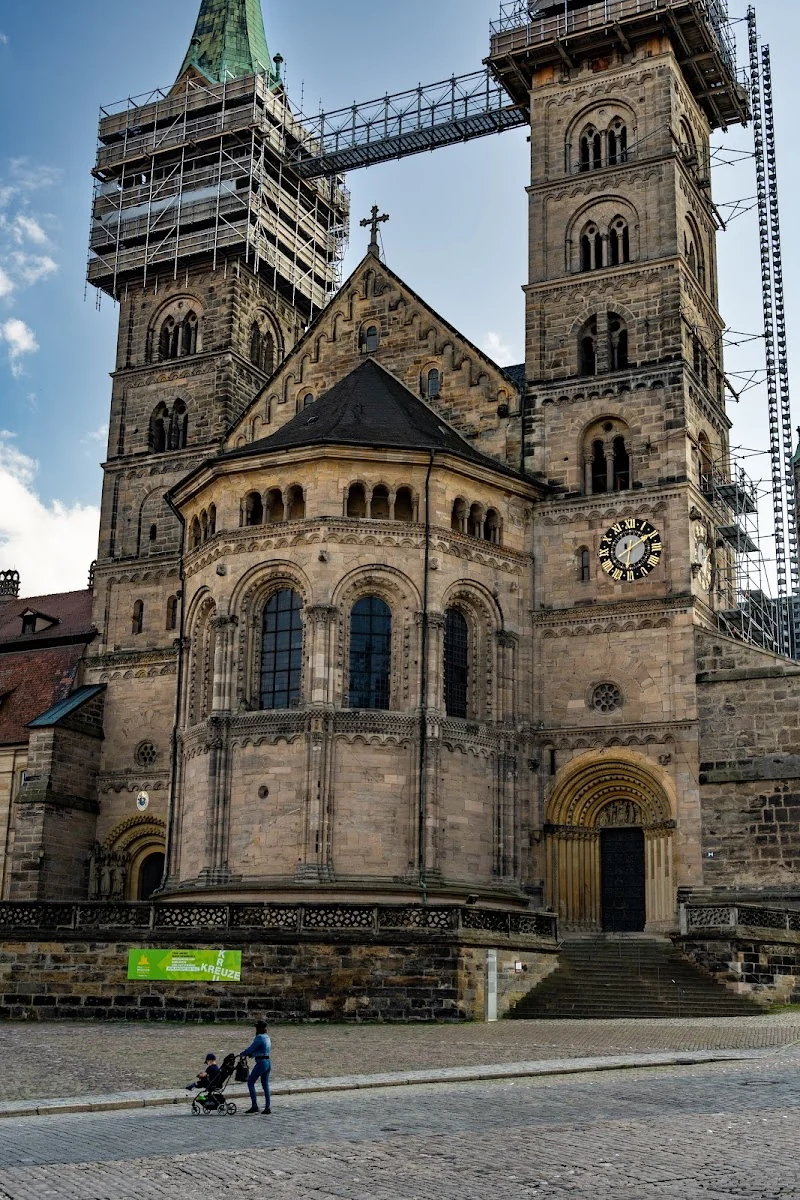
Dompl. 2, Bamberg
Dompl. 2, 96049 Bamberg, Germany
Archdiocese of Bamberg | Job Offers & Contact
The Archdiocese of Bamberg is the central Catholic administrative and pastoral structure in Bamberg. On the official homepage, visitors are directly guided to church membership, the ordinariate, parish searches across Bavaria, and sacraments; the site also refers to news, jobs, the diocesan magazine, and the most important areas of focus of the institution. This makes the location at Domplatz 2 a digital and organizational hub for believers, employees, volunteers, and interested parties. ([erzbistum-bamberg.de](https://erzbistum-bamberg.de/))
The central contact address is Domplatz 2, 96049 Bamberg; there are also specialized offices in neighboring buildings such as Domplatz 4, Jakobsplatz 5, Jakobsplatz 8, and Jakobsplatz 9. Those looking for contacts, pastoral services, church tax, personnel development, or family pastoral care will find in the Archdiocese of Bamberg not only an administrative address but also a vast service network with clear responsibilities. ([seelsorge.erzbistum-bamberg.de](https://seelsorge.erzbistum-bamberg.de/))
Church Membership, Sacraments, and Parish Search
When users search for the highly requested topics of church membership, sacraments, or parish search, the Archdiocese of Bamberg fits this information need very well. The official website highlights these three topics directly on the homepage and formulates them as clear entry points for people who wish to be readmitted to the Catholic Church, who are planning a baptism or a church wedding, or who are unsure which parish they belong to. The structure is deliberately user-friendly: instead of searching for a long time, the site leads directly to the most important concerns. This transforms a classic diocesan website into a service portal that brings together questions of faith and everyday issues. ([erzbistum-bamberg.de](https://erzbistum-bamberg.de/))
Particularly relevant is that the Archdiocese not only offers general information but also aligns the service logic with specific life situations. Those wishing to check church re-entry will find a clear entry point through the church membership section. Those preparing for sacraments such as baptism or marriage receive thematic orientation through the sacraments section. And those wanting to know which parish is responsible can quickly orient themselves through the parish search across Bavaria. This navigation is important for a church institution because it reduces the distance between the institution and visitors and facilitates the search for the right contact person. ([erzbistum-bamberg.de](https://erzbistum-bamberg.de/))
Moreover, the website offers a wide range of additional levels in the area of local church. Among other things, there are parishes from A to Z, service times, deaneries, Catholic missions, training opportunities, laypeople & volunteers, as well as further pages on diocesan development. This variety shows that the Archdiocese of Bamberg stands not only for the central seat at Domplatz but also for a widely organized church network in the city and region. For SEO, this interplay of search intent and real page structure is crucial: those searching for a parish, sacrament, or church membership expect not abstract church debates but direct, reliable, and understandable guidance. ([seelsorge.erzbistum-bamberg.de](https://seelsorge.erzbistum-bamberg.de/))
The user guidance on the homepage also supports this expectation. In addition to the direct entry points to church membership, ordinariate, parish search, and sacraments, the site refers to the topic area What interests you?, which visibly organizes the needs of the target groups. It quickly becomes clear: The Archdiocese of Bamberg sees itself not only as an administration but as the first point of contact for various life and faith questions. This structure is relevant for search engines as well as for actual visitors because it forms topic clusters that are thematically related and precisely cover search intent. ([erzbistum-bamberg.de](https://erzbistum-bamberg.de/))
Ordinariate and Contacts at Domplatz
The center of administration is the Archiepiscopal Ordinariate Bamberg at Domplatz 2. On the official contact page, the most important contact details are transparently listed: postal address, phone, fax, and the general email address. This is important for users because church administrative paths often have many sub-areas, and a central contact point makes it easier to get started. The ordinariate is thus not only a formal seat but the address where inquiries are bundled, forwarded, and processed. Especially in the context of contact and location searches, this clarity is a strong trust factor. ([erzbistum.erzbistum-bamberg.de](https://erzbistum.erzbistum-bamberg.de/bistum-allgemein/bischoefe/lebens--und-regierungszeiten/index.html))
At the same time, the official website shows that various specialized offices are distributed in the immediate vicinity of Domplatz and the old town. For example, the office for secular law is located at Domplatz 4, the Archiepiscopal Officium and Metropolitan Court at Jakobsplatz 5, the church tax office at Jakobsplatz 8, and the main department for pastoral care as well as the area of marriage and family at Jakobsplatz 9. This spatial distribution is typical for a large church administrative center where different competencies work at several closely located sites. Therefore, those making their way should not only look for a single house number but also pay attention to the respective specialized area. ([rechtsabteilung.erzbistum-bamberg.de](https://rechtsabteilung.erzbistum-bamberg.de/kontakt?utm_source=openai))
For individual services, there are also specific indications regarding opening hours. The church tax office of the Archdiocese of Bamberg states on its official page that it is open Monday to Thursday from 08:30 to 11:45 and from 14:00 to 15:30, and on Friday from 08:30 to 11:45. Such information is particularly valuable for visitors because it provides planning security and shows that the Archdiocese not only offers digital contacts but also communicates structured analog service times. In an SEO strategy, such practical details are a real advantage as they make the site more relevant for specific usage questions. ([erzbistum.erzbistum-bamberg.de](https://erzbistum.erzbistum-bamberg.de/finanzkammer/haushalt/haushalt-2006/?utm_source=openai))
Additionally, there is the image of an organization that is organized across many sub-areas. On the official pages, alongside the ordinariate, there are also references to the legal department, pastoral care, personnel development, family pastoral care, educational offerings, media, and press office. This means: The search term contact is not reduced to a single phone number here but stands for a whole structure of competence centers. That is why the combination of location, contact person, ordinariate, and Domplatz is so important for the visibility of the site. ([erzbistum-bamberg.de](https://erzbistum-bamberg.de/))
Job Offers and Employer Profile
The keyword analysis shows that job offers generate particularly strong interest. This is plausible for the Archdiocese of Bamberg, as the official career page explicitly presents the archdiocese as an employer and trainer. It points out that there are over a thousand Catholic church services and institutions, counseling centers, and self-help groups, schools, and training facilities within the Archdiocese of Bamberg. This results in an enormous variety of professional fields ranging from administration and education to counseling, pastoral care, and communication. ([personalentwicklung.erzbistum-bamberg.de](https://personalentwicklung.erzbistum-bamberg.de/stellenangebote/wir-bieten/index.html))
The career page also emphasizes that this variety offers different opportunities for development. Especially in an environment where church organizations rely on a broad network of full-time and volunteer staff, the combination of flexibility, self-motivation, and collaboration is presented as a strength. At the same time, the data protection page points out that job offers are managed under a separate portal and that applications go through the BITE applicant manager tool. Additionally, it is noted that applications can also be submitted by email or post, depending on the position. This is important for users because it lowers the entry barriers and makes the application process transparent. ([personalentwicklung.erzbistum-bamberg.de](https://personalentwicklung.erzbistum-bamberg.de/stellenangebote/wir-bieten/index.html))
The homepage itself also visibly integrates the topic of jobs. A direct link to jobs is displayed in the lower page area, positioning this area not as a marginal topic but as a fixed pillar of the website. For search engines, this is a clear signal that the Archdiocese of Bamberg not only offers religious and historical content but also wants to be perceived as a modern employer. This is particularly relevant for search queries such as job offers, employer profile, or working in the Archdiocese of Bamberg, as these intentions aim not only at open positions but also at a comprehensive picture of culture, tasks, meaning, and development. ([erzbistum-bamberg.de](https://erzbistum-bamberg.de/))
The formulation of a future-oriented employer and trainer is noteworthy because it emphasizes the development perspective. Despite budget consolidation and church upheavals, the Archdiocese wants to focus on quality, collaboration, and professional perspectives. For SEO content, this means: Those searching for job offers at the Archdiocese of Bamberg should not only find a list of open positions but also a comprehensible picture of how the organization works, what values it emphasizes, and what fields of work it offers. This connection between information and employer branding is particularly valuable here. ([personalentwicklung.erzbistum-bamberg.de](https://personalentwicklung.erzbistum-bamberg.de/stellenangebote/wir-bieten/index.html))
History of the Archdiocese of Bamberg since 1007
The history of the Archdiocese of Bamberg is one of the strongest and identity-forming themes in the entire search landscape. The official diocesan history explains that the Diocese of Bamberg was founded in 1007 at the initiative of King Henry II at the Imperial Synod in Frankfurt. Henry pursued both church-political and missionary goals: he wanted to evangelize the Slavs along the Upper Main from Bamberg and simultaneously create a political counterweight to the margraves of Schweinfurt. The same account also mentions that Würzburg and Eichstätt had to cede land to the newly founded diocese. These facts make it clear how closely the founding, imperial politics, and church organization were interconnected. ([erzbistum-erzbistum-bamberg.de](https://erzbistum-erzbistum-bamberg.de/bistum-allgemein/bistumsgr--ndung))
The historical development quickly continued. Eberhard I is named as the first bishop of Bamberg, who held office from 1007 to 1040. The diocesan history also mentions the consecration of the first cathedral in 1012 and the founding of the Michael's Monastery in 1015. For the new diocesan area, the expansion in 1016 to include areas along the Pegnitz, including the parishes of Fürth and Hersbruck, was also important. Already in 1020, Pope Benedict VIII consecrated St. Stephen in Bamberg. These early dates show that Bamberg not only became a church administrative seat but quickly grew into a significant spiritual center. ([erzbistum-erzbistum-bamberg.de](https://erzbistum-erzbistum-bamberg.de/bistum-allgemein/bistumsgr--ndung))
Particularly noteworthy is the role of the cathedral chapter. According to the official diocesan foundation, it was established with the Diocese of Bamberg and chose Saint George as its patron. Later, at the Fourth Lateran Council in 1215, the chapter gained the exclusive right to elect bishops and claimed co-government of the prince-bishopric and the diocese. This development is historically significant because it shows how strongly Bamberg was institutionally structured in the Middle Ages. For a content strategy, this historical foundation is valuable because it creates depth, authority, and a genuine unique selling proposition compared to purely functional administrative pages. ([erzbistum-erzbistum-bamberg.de](https://erzbistum-erzbistum-bamberg.de/bistum-allgemein/bistumsgr--ndung))
The official overview of the bishops complements this picture with a long historical continuity. It states that the Archdiocese of Bamberg has had a total of 79 bishops since 1007. The periods are divided into several epochs, from 1007 to 1237, from 1242 to 1344, from 1353 to 1487, from 1501 to 1653, from 1672 to 1875, and from 1890 to 2002. This division makes the centuries-long development visible and shows that the Archdiocese has a coherent historical line. Those searching for the history of the diocese of Bamberg expect exactly such reliable key dates. ([erzbistum-erzbistum-bamberg.de](https://erzbistum-erzbistum-bamberg.de/bistum-allgemein/bischoefe/lebens--und-regierungszeiten/index.html))
A remarkable historical detail is the Bamberg bishop Suidger, who became Pope Clement II. The official bishop portrait page describes that he was enthroned in Rome on Christmas Day 1046, took the name Clement II, and also retained the leadership of his diocese during his pontificate. Particularly impressive is the note that his grave in the choir of the cathedral is the only preserved papal grave north of the Alps. For the external perception of the Archdiocese, this historical detail is of great value because it highlights Bamberg as a place of exceptional ecclesiastical significance. ([erzbistum-erzbistum-bamberg.de](https://erzbistum-erzbistum-bamberg.de/bistum-allgemein/bischoefe/bischofsportraits/bischof-suidger---papst-clemens-ii-?utm_source=openai))
The official diocesan history in detail also lists the most important milestones with clear years and makes it clear how consistently the tradition is maintained. 1007, 1012, 1015, and 1016 are not abstract dates but building blocks of a founding history that continues to shape the identity of the Archdiocese today. Therefore, understanding the location at Domplatz means not only understanding a current administration but also a historically grown center with roots in the Ottonian imperial church. This depth should be visible in every high-quality SEO description. ([erzbistum-erzbistum-bamberg.de](https://erzbistum-erzbistum-bamberg.de/bistum-allgemein/bistumsgr--ndung))
Pastoral Care, Education, and Current Information
The Archdiocese of Bamberg presents itself on its pages not only as an administrative organization but as a broadly established network for pastoral care, faith, education, and media. The pastoral care page lists a very large number of offerings, including employee pastoral care, disability pastoral care, women's pastoral care, prison pastoral care, university pastoral care, internet pastoral care, hospital pastoral care, men's pastoral care, emergency pastoral care, police pastoral care, senior pastoral care, student pastoral care, telephone pastoral care, and bereavement pastoral care. Additionally, it refers to family pastoral care, living faith, sacraments, pilgrimages, pilgrimage sites, retreats, and spiritual impulses. For search queries related to pastoral or spiritual care, this is an extremely strong signal. ([seelsorge.erzbistum-bamberg.de](https://seelsorge.erzbistum-bamberg.de/))
Also in the areas of counseling and education, the range is broad. The website refers to an overview of counseling centers, community counseling and organizational development, bullying counseling, unemployment counseling, youth counseling, prevention of sexual violence, contact in cases of suspected abuse, equality office, women's commission, counseling center for ideological questions, employee representation, moderation, as well as supervision and coaching. Additionally, there are educational offerings such as daycare centers, diocesan libraries, educational houses, school & religious education, personnel development, adult education, training opportunities, and liturgical training. This shows that education and counseling are by no means secondary roles for the Archdiocese but are an integral part of its institutional identity. ([erzbistum-bamberg.de](https://erzbistum-bamberg.de/))
Particularly interesting is also the media and communication side. The official content refers to television editorial, radio editorial, online editorial, press office, publications, social media, strategic communication, and press releases. Additionally, there are media in the Archdiocese such as Heinrichsblatt and other church channels. The diocesan magazine Leben is also prominently advertised on the homepage. For content planning and SEO, this means that the Archdiocese of Bamberg not only communicates about internal administration but also actively works on public visibility. Especially for location and brand inquiries, this is a strong quality feature. ([erzbistum-bamberg.de](https://erzbistum-bamberg.de/))
On the information page, topics such as budget and church tax, environmental management, working world, and mission development and peace are bundled. It also mentions the Archdiocese of Bamberg's membership in the Blühpakt Bayern. This mix of finance, sustainability, working world, and global church responsibility shows how modern the range of topics has become. Those who understand the Archdiocese only as a historical institution are missing the point; the website makes it clear that environmental issues, social responsibility, and administrative processes also play a role here. ([information.erzbistum-bamberg.de](https://information.erzbistum-bamberg.de/index.html?utm_source=openai))
Equally important is the large number of thematic accesses for families, youth, women, men, seniors, and people with disabilities. The homepage directly links corresponding offerings, allowing users to quickly reach the appropriate area. This is crucial for search intent: many people are not looking for the general Archdiocese but for very concrete help, formats, or contacts. With its broad thematic structure, the Archdiocese of Bamberg can serve exactly these diverse intentions and thus remains relevant for both SEO and user value. ([erzbistum-bamberg.de](https://erzbistum-bamberg.de/))
Practical Information for Visitors
Those wishing to visit or contact the Archdiocese of Bamberg should first orient themselves at the central address: Archiepiscopal Ordinariate Bamberg, Domplatz 2, 96049 Bamberg. Additionally, the official contact page lists the general phone number (09 51) 5 02 - 0, the fax number (09 51) 5 02 - 15 89, and the email address info@erzbistum-bamberg.de. This data is consistently provided on several official subpages and thus forms the most reliable contact basis for general inquiries. ([seelsorge.erzbistum-bamberg.de](https://seelsorge.erzbistum-bamberg.de/))
For specific concerns, it is advisable to go directly through the respective specialized page. The church tax office has its own contact and opening hours, the legal department is located at Domplatz 4, the Officium at Jakobsplatz 5, and pastoral care and the area of marriage and family are at Jakobsplatz 9. This division shows that a visit should always be planned thematically. For example, someone with a question about church tax or family pastoral care will not automatically end up at the general ordinariate but will benefit from the clear assignment of departments. This is particularly helpful in practice. ([erzbistum-bamberg.de](https://erzbistum-bamberg.de/finanzkammer/haushalt/haushalt-2006/?utm_source=openai))
For digital orientation, the homepage is also strongly structured. It offers a map of the Archdiocese, various thematic entry points, references to parishes, services, youth, education, media, and the diocesan magazine Leben. The site is thus not only a business card but a navigation center for very different visitor groups. Therefore, those searching for contact, history, pastoral care, jobs, or church offerings in Bamberg will find a clear, serious, and broadly developed entry point on the official website. ([erzbistum-bamberg.de](https://erzbistum-bamberg.de/))
The historical dimension is also relevant for visitors because it imbues the location at Domplatz with significance. The Archdiocese of Bamberg is not just any administrative location but an institution that has existed since 1007, has produced 79 bishops, and is still perceived as a spiritual, cultural, and organizational center today. This combination of history and current function is a decisive reason why the location regularly receives high attention in search behavior. ([erzbistum-erzbistum-bamberg.de](https://erzbistum-erzbistum-bamberg.de/bistum-allgemein/bistumsgr--ndung))
Those who want to use the official information world of the Archdiocese of Bamberg sensibly should therefore orient themselves around the core terms: contact, ordinariate, pastoral care, parish search, sacraments, job offers, and history. These terms are not randomly chosen but reflect the real structure of the website. They also form the best basis for accurately covering search intentions and organizing content in a way that is comprehensible for users as well as for search engines. ([erzbistum-bamberg.de](https://erzbistum-bamberg.de/))
Sources:
Mehr anzeigenWeniger anzeigen
Archdiocese of Bamberg | Job Offers & Contact
The Archdiocese of Bamberg is the central Catholic administrative and pastoral structure in Bamberg. On the official homepage, visitors are directly guided to church membership, the ordinariate, parish searches across Bavaria, and sacraments; the site also refers to news, jobs, the diocesan magazine, and the most important areas of focus of the institution. This makes the location at Domplatz 2 a digital and organizational hub for believers, employees, volunteers, and interested parties. ([erzbistum-bamberg.de](https://erzbistum-bamberg.de/))
The central contact address is Domplatz 2, 96049 Bamberg; there are also specialized offices in neighboring buildings such as Domplatz 4, Jakobsplatz 5, Jakobsplatz 8, and Jakobsplatz 9. Those looking for contacts, pastoral services, church tax, personnel development, or family pastoral care will find in the Archdiocese of Bamberg not only an administrative address but also a vast service network with clear responsibilities. ([seelsorge.erzbistum-bamberg.de](https://seelsorge.erzbistum-bamberg.de/))
Church Membership, Sacraments, and Parish Search
When users search for the highly requested topics of church membership, sacraments, or parish search, the Archdiocese of Bamberg fits this information need very well. The official website highlights these three topics directly on the homepage and formulates them as clear entry points for people who wish to be readmitted to the Catholic Church, who are planning a baptism or a church wedding, or who are unsure which parish they belong to. The structure is deliberately user-friendly: instead of searching for a long time, the site leads directly to the most important concerns. This transforms a classic diocesan website into a service portal that brings together questions of faith and everyday issues. ([erzbistum-bamberg.de](https://erzbistum-bamberg.de/))
Particularly relevant is that the Archdiocese not only offers general information but also aligns the service logic with specific life situations. Those wishing to check church re-entry will find a clear entry point through the church membership section. Those preparing for sacraments such as baptism or marriage receive thematic orientation through the sacraments section. And those wanting to know which parish is responsible can quickly orient themselves through the parish search across Bavaria. This navigation is important for a church institution because it reduces the distance between the institution and visitors and facilitates the search for the right contact person. ([erzbistum-bamberg.de](https://erzbistum-bamberg.de/))
Moreover, the website offers a wide range of additional levels in the area of local church. Among other things, there are parishes from A to Z, service times, deaneries, Catholic missions, training opportunities, laypeople & volunteers, as well as further pages on diocesan development. This variety shows that the Archdiocese of Bamberg stands not only for the central seat at Domplatz but also for a widely organized church network in the city and region. For SEO, this interplay of search intent and real page structure is crucial: those searching for a parish, sacrament, or church membership expect not abstract church debates but direct, reliable, and understandable guidance. ([seelsorge.erzbistum-bamberg.de](https://seelsorge.erzbistum-bamberg.de/))
The user guidance on the homepage also supports this expectation. In addition to the direct entry points to church membership, ordinariate, parish search, and sacraments, the site refers to the topic area What interests you?, which visibly organizes the needs of the target groups. It quickly becomes clear: The Archdiocese of Bamberg sees itself not only as an administration but as the first point of contact for various life and faith questions. This structure is relevant for search engines as well as for actual visitors because it forms topic clusters that are thematically related and precisely cover search intent. ([erzbistum-bamberg.de](https://erzbistum-bamberg.de/))
Ordinariate and Contacts at Domplatz
The center of administration is the Archiepiscopal Ordinariate Bamberg at Domplatz 2. On the official contact page, the most important contact details are transparently listed: postal address, phone, fax, and the general email address. This is important for users because church administrative paths often have many sub-areas, and a central contact point makes it easier to get started. The ordinariate is thus not only a formal seat but the address where inquiries are bundled, forwarded, and processed. Especially in the context of contact and location searches, this clarity is a strong trust factor. ([erzbistum.erzbistum-bamberg.de](https://erzbistum.erzbistum-bamberg.de/bistum-allgemein/bischoefe/lebens--und-regierungszeiten/index.html))
At the same time, the official website shows that various specialized offices are distributed in the immediate vicinity of Domplatz and the old town. For example, the office for secular law is located at Domplatz 4, the Archiepiscopal Officium and Metropolitan Court at Jakobsplatz 5, the church tax office at Jakobsplatz 8, and the main department for pastoral care as well as the area of marriage and family at Jakobsplatz 9. This spatial distribution is typical for a large church administrative center where different competencies work at several closely located sites. Therefore, those making their way should not only look for a single house number but also pay attention to the respective specialized area. ([rechtsabteilung.erzbistum-bamberg.de](https://rechtsabteilung.erzbistum-bamberg.de/kontakt?utm_source=openai))
For individual services, there are also specific indications regarding opening hours. The church tax office of the Archdiocese of Bamberg states on its official page that it is open Monday to Thursday from 08:30 to 11:45 and from 14:00 to 15:30, and on Friday from 08:30 to 11:45. Such information is particularly valuable for visitors because it provides planning security and shows that the Archdiocese not only offers digital contacts but also communicates structured analog service times. In an SEO strategy, such practical details are a real advantage as they make the site more relevant for specific usage questions. ([erzbistum.erzbistum-bamberg.de](https://erzbistum.erzbistum-bamberg.de/finanzkammer/haushalt/haushalt-2006/?utm_source=openai))
Additionally, there is the image of an organization that is organized across many sub-areas. On the official pages, alongside the ordinariate, there are also references to the legal department, pastoral care, personnel development, family pastoral care, educational offerings, media, and press office. This means: The search term contact is not reduced to a single phone number here but stands for a whole structure of competence centers. That is why the combination of location, contact person, ordinariate, and Domplatz is so important for the visibility of the site. ([erzbistum-bamberg.de](https://erzbistum-bamberg.de/))
Job Offers and Employer Profile
The keyword analysis shows that job offers generate particularly strong interest. This is plausible for the Archdiocese of Bamberg, as the official career page explicitly presents the archdiocese as an employer and trainer. It points out that there are over a thousand Catholic church services and institutions, counseling centers, and self-help groups, schools, and training facilities within the Archdiocese of Bamberg. This results in an enormous variety of professional fields ranging from administration and education to counseling, pastoral care, and communication. ([personalentwicklung.erzbistum-bamberg.de](https://personalentwicklung.erzbistum-bamberg.de/stellenangebote/wir-bieten/index.html))
The career page also emphasizes that this variety offers different opportunities for development. Especially in an environment where church organizations rely on a broad network of full-time and volunteer staff, the combination of flexibility, self-motivation, and collaboration is presented as a strength. At the same time, the data protection page points out that job offers are managed under a separate portal and that applications go through the BITE applicant manager tool. Additionally, it is noted that applications can also be submitted by email or post, depending on the position. This is important for users because it lowers the entry barriers and makes the application process transparent. ([personalentwicklung.erzbistum-bamberg.de](https://personalentwicklung.erzbistum-bamberg.de/stellenangebote/wir-bieten/index.html))
The homepage itself also visibly integrates the topic of jobs. A direct link to jobs is displayed in the lower page area, positioning this area not as a marginal topic but as a fixed pillar of the website. For search engines, this is a clear signal that the Archdiocese of Bamberg not only offers religious and historical content but also wants to be perceived as a modern employer. This is particularly relevant for search queries such as job offers, employer profile, or working in the Archdiocese of Bamberg, as these intentions aim not only at open positions but also at a comprehensive picture of culture, tasks, meaning, and development. ([erzbistum-bamberg.de](https://erzbistum-bamberg.de/))
The formulation of a future-oriented employer and trainer is noteworthy because it emphasizes the development perspective. Despite budget consolidation and church upheavals, the Archdiocese wants to focus on quality, collaboration, and professional perspectives. For SEO content, this means: Those searching for job offers at the Archdiocese of Bamberg should not only find a list of open positions but also a comprehensible picture of how the organization works, what values it emphasizes, and what fields of work it offers. This connection between information and employer branding is particularly valuable here. ([personalentwicklung.erzbistum-bamberg.de](https://personalentwicklung.erzbistum-bamberg.de/stellenangebote/wir-bieten/index.html))
History of the Archdiocese of Bamberg since 1007
The history of the Archdiocese of Bamberg is one of the strongest and identity-forming themes in the entire search landscape. The official diocesan history explains that the Diocese of Bamberg was founded in 1007 at the initiative of King Henry II at the Imperial Synod in Frankfurt. Henry pursued both church-political and missionary goals: he wanted to evangelize the Slavs along the Upper Main from Bamberg and simultaneously create a political counterweight to the margraves of Schweinfurt. The same account also mentions that Würzburg and Eichstätt had to cede land to the newly founded diocese. These facts make it clear how closely the founding, imperial politics, and church organization were interconnected. ([erzbistum-erzbistum-bamberg.de](https://erzbistum-erzbistum-bamberg.de/bistum-allgemein/bistumsgr--ndung))
The historical development quickly continued. Eberhard I is named as the first bishop of Bamberg, who held office from 1007 to 1040. The diocesan history also mentions the consecration of the first cathedral in 1012 and the founding of the Michael's Monastery in 1015. For the new diocesan area, the expansion in 1016 to include areas along the Pegnitz, including the parishes of Fürth and Hersbruck, was also important. Already in 1020, Pope Benedict VIII consecrated St. Stephen in Bamberg. These early dates show that Bamberg not only became a church administrative seat but quickly grew into a significant spiritual center. ([erzbistum-erzbistum-bamberg.de](https://erzbistum-erzbistum-bamberg.de/bistum-allgemein/bistumsgr--ndung))
Particularly noteworthy is the role of the cathedral chapter. According to the official diocesan foundation, it was established with the Diocese of Bamberg and chose Saint George as its patron. Later, at the Fourth Lateran Council in 1215, the chapter gained the exclusive right to elect bishops and claimed co-government of the prince-bishopric and the diocese. This development is historically significant because it shows how strongly Bamberg was institutionally structured in the Middle Ages. For a content strategy, this historical foundation is valuable because it creates depth, authority, and a genuine unique selling proposition compared to purely functional administrative pages. ([erzbistum-erzbistum-bamberg.de](https://erzbistum-erzbistum-bamberg.de/bistum-allgemein/bistumsgr--ndung))
The official overview of the bishops complements this picture with a long historical continuity. It states that the Archdiocese of Bamberg has had a total of 79 bishops since 1007. The periods are divided into several epochs, from 1007 to 1237, from 1242 to 1344, from 1353 to 1487, from 1501 to 1653, from 1672 to 1875, and from 1890 to 2002. This division makes the centuries-long development visible and shows that the Archdiocese has a coherent historical line. Those searching for the history of the diocese of Bamberg expect exactly such reliable key dates. ([erzbistum-erzbistum-bamberg.de](https://erzbistum-erzbistum-bamberg.de/bistum-allgemein/bischoefe/lebens--und-regierungszeiten/index.html))
A remarkable historical detail is the Bamberg bishop Suidger, who became Pope Clement II. The official bishop portrait page describes that he was enthroned in Rome on Christmas Day 1046, took the name Clement II, and also retained the leadership of his diocese during his pontificate. Particularly impressive is the note that his grave in the choir of the cathedral is the only preserved papal grave north of the Alps. For the external perception of the Archdiocese, this historical detail is of great value because it highlights Bamberg as a place of exceptional ecclesiastical significance. ([erzbistum-erzbistum-bamberg.de](https://erzbistum-erzbistum-bamberg.de/bistum-allgemein/bischoefe/bischofsportraits/bischof-suidger---papst-clemens-ii-?utm_source=openai))
The official diocesan history in detail also lists the most important milestones with clear years and makes it clear how consistently the tradition is maintained. 1007, 1012, 1015, and 1016 are not abstract dates but building blocks of a founding history that continues to shape the identity of the Archdiocese today. Therefore, understanding the location at Domplatz means not only understanding a current administration but also a historically grown center with roots in the Ottonian imperial church. This depth should be visible in every high-quality SEO description. ([erzbistum-erzbistum-bamberg.de](https://erzbistum-erzbistum-bamberg.de/bistum-allgemein/bistumsgr--ndung))
Pastoral Care, Education, and Current Information
The Archdiocese of Bamberg presents itself on its pages not only as an administrative organization but as a broadly established network for pastoral care, faith, education, and media. The pastoral care page lists a very large number of offerings, including employee pastoral care, disability pastoral care, women's pastoral care, prison pastoral care, university pastoral care, internet pastoral care, hospital pastoral care, men's pastoral care, emergency pastoral care, police pastoral care, senior pastoral care, student pastoral care, telephone pastoral care, and bereavement pastoral care. Additionally, it refers to family pastoral care, living faith, sacraments, pilgrimages, pilgrimage sites, retreats, and spiritual impulses. For search queries related to pastoral or spiritual care, this is an extremely strong signal. ([seelsorge.erzbistum-bamberg.de](https://seelsorge.erzbistum-bamberg.de/))
Also in the areas of counseling and education, the range is broad. The website refers to an overview of counseling centers, community counseling and organizational development, bullying counseling, unemployment counseling, youth counseling, prevention of sexual violence, contact in cases of suspected abuse, equality office, women's commission, counseling center for ideological questions, employee representation, moderation, as well as supervision and coaching. Additionally, there are educational offerings such as daycare centers, diocesan libraries, educational houses, school & religious education, personnel development, adult education, training opportunities, and liturgical training. This shows that education and counseling are by no means secondary roles for the Archdiocese but are an integral part of its institutional identity. ([erzbistum-bamberg.de](https://erzbistum-bamberg.de/))
Particularly interesting is also the media and communication side. The official content refers to television editorial, radio editorial, online editorial, press office, publications, social media, strategic communication, and press releases. Additionally, there are media in the Archdiocese such as Heinrichsblatt and other church channels. The diocesan magazine Leben is also prominently advertised on the homepage. For content planning and SEO, this means that the Archdiocese of Bamberg not only communicates about internal administration but also actively works on public visibility. Especially for location and brand inquiries, this is a strong quality feature. ([erzbistum-bamberg.de](https://erzbistum-bamberg.de/))
On the information page, topics such as budget and church tax, environmental management, working world, and mission development and peace are bundled. It also mentions the Archdiocese of Bamberg's membership in the Blühpakt Bayern. This mix of finance, sustainability, working world, and global church responsibility shows how modern the range of topics has become. Those who understand the Archdiocese only as a historical institution are missing the point; the website makes it clear that environmental issues, social responsibility, and administrative processes also play a role here. ([information.erzbistum-bamberg.de](https://information.erzbistum-bamberg.de/index.html?utm_source=openai))
Equally important is the large number of thematic accesses for families, youth, women, men, seniors, and people with disabilities. The homepage directly links corresponding offerings, allowing users to quickly reach the appropriate area. This is crucial for search intent: many people are not looking for the general Archdiocese but for very concrete help, formats, or contacts. With its broad thematic structure, the Archdiocese of Bamberg can serve exactly these diverse intentions and thus remains relevant for both SEO and user value. ([erzbistum-bamberg.de](https://erzbistum-bamberg.de/))
Practical Information for Visitors
Those wishing to visit or contact the Archdiocese of Bamberg should first orient themselves at the central address: Archiepiscopal Ordinariate Bamberg, Domplatz 2, 96049 Bamberg. Additionally, the official contact page lists the general phone number (09 51) 5 02 - 0, the fax number (09 51) 5 02 - 15 89, and the email address info@erzbistum-bamberg.de. This data is consistently provided on several official subpages and thus forms the most reliable contact basis for general inquiries. ([seelsorge.erzbistum-bamberg.de](https://seelsorge.erzbistum-bamberg.de/))
For specific concerns, it is advisable to go directly through the respective specialized page. The church tax office has its own contact and opening hours, the legal department is located at Domplatz 4, the Officium at Jakobsplatz 5, and pastoral care and the area of marriage and family are at Jakobsplatz 9. This division shows that a visit should always be planned thematically. For example, someone with a question about church tax or family pastoral care will not automatically end up at the general ordinariate but will benefit from the clear assignment of departments. This is particularly helpful in practice. ([erzbistum-bamberg.de](https://erzbistum-bamberg.de/finanzkammer/haushalt/haushalt-2006/?utm_source=openai))
For digital orientation, the homepage is also strongly structured. It offers a map of the Archdiocese, various thematic entry points, references to parishes, services, youth, education, media, and the diocesan magazine Leben. The site is thus not only a business card but a navigation center for very different visitor groups. Therefore, those searching for contact, history, pastoral care, jobs, or church offerings in Bamberg will find a clear, serious, and broadly developed entry point on the official website. ([erzbistum-bamberg.de](https://erzbistum-bamberg.de/))
The historical dimension is also relevant for visitors because it imbues the location at Domplatz with significance. The Archdiocese of Bamberg is not just any administrative location but an institution that has existed since 1007, has produced 79 bishops, and is still perceived as a spiritual, cultural, and organizational center today. This combination of history and current function is a decisive reason why the location regularly receives high attention in search behavior. ([erzbistum-erzbistum-bamberg.de](https://erzbistum-erzbistum-bamberg.de/bistum-allgemein/bistumsgr--ndung))
Those who want to use the official information world of the Archdiocese of Bamberg sensibly should therefore orient themselves around the core terms: contact, ordinariate, pastoral care, parish search, sacraments, job offers, and history. These terms are not randomly chosen but reflect the real structure of the website. They also form the best basis for accurately covering search intentions and organizing content in a way that is comprehensible for users as well as for search engines. ([erzbistum-bamberg.de](https://erzbistum-bamberg.de/))
Sources:
Archdiocese of Bamberg | Job Offers & Contact
The Archdiocese of Bamberg is the central Catholic administrative and pastoral structure in Bamberg. On the official homepage, visitors are directly guided to church membership, the ordinariate, parish searches across Bavaria, and sacraments; the site also refers to news, jobs, the diocesan magazine, and the most important areas of focus of the institution. This makes the location at Domplatz 2 a digital and organizational hub for believers, employees, volunteers, and interested parties. ([erzbistum-bamberg.de](https://erzbistum-bamberg.de/))
The central contact address is Domplatz 2, 96049 Bamberg; there are also specialized offices in neighboring buildings such as Domplatz 4, Jakobsplatz 5, Jakobsplatz 8, and Jakobsplatz 9. Those looking for contacts, pastoral services, church tax, personnel development, or family pastoral care will find in the Archdiocese of Bamberg not only an administrative address but also a vast service network with clear responsibilities. ([seelsorge.erzbistum-bamberg.de](https://seelsorge.erzbistum-bamberg.de/))
Church Membership, Sacraments, and Parish Search
When users search for the highly requested topics of church membership, sacraments, or parish search, the Archdiocese of Bamberg fits this information need very well. The official website highlights these three topics directly on the homepage and formulates them as clear entry points for people who wish to be readmitted to the Catholic Church, who are planning a baptism or a church wedding, or who are unsure which parish they belong to. The structure is deliberately user-friendly: instead of searching for a long time, the site leads directly to the most important concerns. This transforms a classic diocesan website into a service portal that brings together questions of faith and everyday issues. ([erzbistum-bamberg.de](https://erzbistum-bamberg.de/))
Particularly relevant is that the Archdiocese not only offers general information but also aligns the service logic with specific life situations. Those wishing to check church re-entry will find a clear entry point through the church membership section. Those preparing for sacraments such as baptism or marriage receive thematic orientation through the sacraments section. And those wanting to know which parish is responsible can quickly orient themselves through the parish search across Bavaria. This navigation is important for a church institution because it reduces the distance between the institution and visitors and facilitates the search for the right contact person. ([erzbistum-bamberg.de](https://erzbistum-bamberg.de/))
Moreover, the website offers a wide range of additional levels in the area of local church. Among other things, there are parishes from A to Z, service times, deaneries, Catholic missions, training opportunities, laypeople & volunteers, as well as further pages on diocesan development. This variety shows that the Archdiocese of Bamberg stands not only for the central seat at Domplatz but also for a widely organized church network in the city and region. For SEO, this interplay of search intent and real page structure is crucial: those searching for a parish, sacrament, or church membership expect not abstract church debates but direct, reliable, and understandable guidance. ([seelsorge.erzbistum-bamberg.de](https://seelsorge.erzbistum-bamberg.de/))
The user guidance on the homepage also supports this expectation. In addition to the direct entry points to church membership, ordinariate, parish search, and sacraments, the site refers to the topic area What interests you?, which visibly organizes the needs of the target groups. It quickly becomes clear: The Archdiocese of Bamberg sees itself not only as an administration but as the first point of contact for various life and faith questions. This structure is relevant for search engines as well as for actual visitors because it forms topic clusters that are thematically related and precisely cover search intent. ([erzbistum-bamberg.de](https://erzbistum-bamberg.de/))
Ordinariate and Contacts at Domplatz
The center of administration is the Archiepiscopal Ordinariate Bamberg at Domplatz 2. On the official contact page, the most important contact details are transparently listed: postal address, phone, fax, and the general email address. This is important for users because church administrative paths often have many sub-areas, and a central contact point makes it easier to get started. The ordinariate is thus not only a formal seat but the address where inquiries are bundled, forwarded, and processed. Especially in the context of contact and location searches, this clarity is a strong trust factor. ([erzbistum.erzbistum-bamberg.de](https://erzbistum.erzbistum-bamberg.de/bistum-allgemein/bischoefe/lebens--und-regierungszeiten/index.html))
At the same time, the official website shows that various specialized offices are distributed in the immediate vicinity of Domplatz and the old town. For example, the office for secular law is located at Domplatz 4, the Archiepiscopal Officium and Metropolitan Court at Jakobsplatz 5, the church tax office at Jakobsplatz 8, and the main department for pastoral care as well as the area of marriage and family at Jakobsplatz 9. This spatial distribution is typical for a large church administrative center where different competencies work at several closely located sites. Therefore, those making their way should not only look for a single house number but also pay attention to the respective specialized area. ([rechtsabteilung.erzbistum-bamberg.de](https://rechtsabteilung.erzbistum-bamberg.de/kontakt?utm_source=openai))
For individual services, there are also specific indications regarding opening hours. The church tax office of the Archdiocese of Bamberg states on its official page that it is open Monday to Thursday from 08:30 to 11:45 and from 14:00 to 15:30, and on Friday from 08:30 to 11:45. Such information is particularly valuable for visitors because it provides planning security and shows that the Archdiocese not only offers digital contacts but also communicates structured analog service times. In an SEO strategy, such practical details are a real advantage as they make the site more relevant for specific usage questions. ([erzbistum.erzbistum-bamberg.de](https://erzbistum.erzbistum-bamberg.de/finanzkammer/haushalt/haushalt-2006/?utm_source=openai))
Additionally, there is the image of an organization that is organized across many sub-areas. On the official pages, alongside the ordinariate, there are also references to the legal department, pastoral care, personnel development, family pastoral care, educational offerings, media, and press office. This means: The search term contact is not reduced to a single phone number here but stands for a whole structure of competence centers. That is why the combination of location, contact person, ordinariate, and Domplatz is so important for the visibility of the site. ([erzbistum-bamberg.de](https://erzbistum-bamberg.de/))
Job Offers and Employer Profile
The keyword analysis shows that job offers generate particularly strong interest. This is plausible for the Archdiocese of Bamberg, as the official career page explicitly presents the archdiocese as an employer and trainer. It points out that there are over a thousand Catholic church services and institutions, counseling centers, and self-help groups, schools, and training facilities within the Archdiocese of Bamberg. This results in an enormous variety of professional fields ranging from administration and education to counseling, pastoral care, and communication. ([personalentwicklung.erzbistum-bamberg.de](https://personalentwicklung.erzbistum-bamberg.de/stellenangebote/wir-bieten/index.html))
The career page also emphasizes that this variety offers different opportunities for development. Especially in an environment where church organizations rely on a broad network of full-time and volunteer staff, the combination of flexibility, self-motivation, and collaboration is presented as a strength. At the same time, the data protection page points out that job offers are managed under a separate portal and that applications go through the BITE applicant manager tool. Additionally, it is noted that applications can also be submitted by email or post, depending on the position. This is important for users because it lowers the entry barriers and makes the application process transparent. ([personalentwicklung.erzbistum-bamberg.de](https://personalentwicklung.erzbistum-bamberg.de/stellenangebote/wir-bieten/index.html))
The homepage itself also visibly integrates the topic of jobs. A direct link to jobs is displayed in the lower page area, positioning this area not as a marginal topic but as a fixed pillar of the website. For search engines, this is a clear signal that the Archdiocese of Bamberg not only offers religious and historical content but also wants to be perceived as a modern employer. This is particularly relevant for search queries such as job offers, employer profile, or working in the Archdiocese of Bamberg, as these intentions aim not only at open positions but also at a comprehensive picture of culture, tasks, meaning, and development. ([erzbistum-bamberg.de](https://erzbistum-bamberg.de/))
The formulation of a future-oriented employer and trainer is noteworthy because it emphasizes the development perspective. Despite budget consolidation and church upheavals, the Archdiocese wants to focus on quality, collaboration, and professional perspectives. For SEO content, this means: Those searching for job offers at the Archdiocese of Bamberg should not only find a list of open positions but also a comprehensible picture of how the organization works, what values it emphasizes, and what fields of work it offers. This connection between information and employer branding is particularly valuable here. ([personalentwicklung.erzbistum-bamberg.de](https://personalentwicklung.erzbistum-bamberg.de/stellenangebote/wir-bieten/index.html))
History of the Archdiocese of Bamberg since 1007
The history of the Archdiocese of Bamberg is one of the strongest and identity-forming themes in the entire search landscape. The official diocesan history explains that the Diocese of Bamberg was founded in 1007 at the initiative of King Henry II at the Imperial Synod in Frankfurt. Henry pursued both church-political and missionary goals: he wanted to evangelize the Slavs along the Upper Main from Bamberg and simultaneously create a political counterweight to the margraves of Schweinfurt. The same account also mentions that Würzburg and Eichstätt had to cede land to the newly founded diocese. These facts make it clear how closely the founding, imperial politics, and church organization were interconnected. ([erzbistum-erzbistum-bamberg.de](https://erzbistum-erzbistum-bamberg.de/bistum-allgemein/bistumsgr--ndung))
The historical development quickly continued. Eberhard I is named as the first bishop of Bamberg, who held office from 1007 to 1040. The diocesan history also mentions the consecration of the first cathedral in 1012 and the founding of the Michael's Monastery in 1015. For the new diocesan area, the expansion in 1016 to include areas along the Pegnitz, including the parishes of Fürth and Hersbruck, was also important. Already in 1020, Pope Benedict VIII consecrated St. Stephen in Bamberg. These early dates show that Bamberg not only became a church administrative seat but quickly grew into a significant spiritual center. ([erzbistum-erzbistum-bamberg.de](https://erzbistum-erzbistum-bamberg.de/bistum-allgemein/bistumsgr--ndung))
Particularly noteworthy is the role of the cathedral chapter. According to the official diocesan foundation, it was established with the Diocese of Bamberg and chose Saint George as its patron. Later, at the Fourth Lateran Council in 1215, the chapter gained the exclusive right to elect bishops and claimed co-government of the prince-bishopric and the diocese. This development is historically significant because it shows how strongly Bamberg was institutionally structured in the Middle Ages. For a content strategy, this historical foundation is valuable because it creates depth, authority, and a genuine unique selling proposition compared to purely functional administrative pages. ([erzbistum-erzbistum-bamberg.de](https://erzbistum-erzbistum-bamberg.de/bistum-allgemein/bistumsgr--ndung))
The official overview of the bishops complements this picture with a long historical continuity. It states that the Archdiocese of Bamberg has had a total of 79 bishops since 1007. The periods are divided into several epochs, from 1007 to 1237, from 1242 to 1344, from 1353 to 1487, from 1501 to 1653, from 1672 to 1875, and from 1890 to 2002. This division makes the centuries-long development visible and shows that the Archdiocese has a coherent historical line. Those searching for the history of the diocese of Bamberg expect exactly such reliable key dates. ([erzbistum-erzbistum-bamberg.de](https://erzbistum-erzbistum-bamberg.de/bistum-allgemein/bischoefe/lebens--und-regierungszeiten/index.html))
A remarkable historical detail is the Bamberg bishop Suidger, who became Pope Clement II. The official bishop portrait page describes that he was enthroned in Rome on Christmas Day 1046, took the name Clement II, and also retained the leadership of his diocese during his pontificate. Particularly impressive is the note that his grave in the choir of the cathedral is the only preserved papal grave north of the Alps. For the external perception of the Archdiocese, this historical detail is of great value because it highlights Bamberg as a place of exceptional ecclesiastical significance. ([erzbistum-erzbistum-bamberg.de](https://erzbistum-erzbistum-bamberg.de/bistum-allgemein/bischoefe/bischofsportraits/bischof-suidger---papst-clemens-ii-?utm_source=openai))
The official diocesan history in detail also lists the most important milestones with clear years and makes it clear how consistently the tradition is maintained. 1007, 1012, 1015, and 1016 are not abstract dates but building blocks of a founding history that continues to shape the identity of the Archdiocese today. Therefore, understanding the location at Domplatz means not only understanding a current administration but also a historically grown center with roots in the Ottonian imperial church. This depth should be visible in every high-quality SEO description. ([erzbistum-erzbistum-bamberg.de](https://erzbistum-erzbistum-bamberg.de/bistum-allgemein/bistumsgr--ndung))
Pastoral Care, Education, and Current Information
The Archdiocese of Bamberg presents itself on its pages not only as an administrative organization but as a broadly established network for pastoral care, faith, education, and media. The pastoral care page lists a very large number of offerings, including employee pastoral care, disability pastoral care, women's pastoral care, prison pastoral care, university pastoral care, internet pastoral care, hospital pastoral care, men's pastoral care, emergency pastoral care, police pastoral care, senior pastoral care, student pastoral care, telephone pastoral care, and bereavement pastoral care. Additionally, it refers to family pastoral care, living faith, sacraments, pilgrimages, pilgrimage sites, retreats, and spiritual impulses. For search queries related to pastoral or spiritual care, this is an extremely strong signal. ([seelsorge.erzbistum-bamberg.de](https://seelsorge.erzbistum-bamberg.de/))
Also in the areas of counseling and education, the range is broad. The website refers to an overview of counseling centers, community counseling and organizational development, bullying counseling, unemployment counseling, youth counseling, prevention of sexual violence, contact in cases of suspected abuse, equality office, women's commission, counseling center for ideological questions, employee representation, moderation, as well as supervision and coaching. Additionally, there are educational offerings such as daycare centers, diocesan libraries, educational houses, school & religious education, personnel development, adult education, training opportunities, and liturgical training. This shows that education and counseling are by no means secondary roles for the Archdiocese but are an integral part of its institutional identity. ([erzbistum-bamberg.de](https://erzbistum-bamberg.de/))
Particularly interesting is also the media and communication side. The official content refers to television editorial, radio editorial, online editorial, press office, publications, social media, strategic communication, and press releases. Additionally, there are media in the Archdiocese such as Heinrichsblatt and other church channels. The diocesan magazine Leben is also prominently advertised on the homepage. For content planning and SEO, this means that the Archdiocese of Bamberg not only communicates about internal administration but also actively works on public visibility. Especially for location and brand inquiries, this is a strong quality feature. ([erzbistum-bamberg.de](https://erzbistum-bamberg.de/))
On the information page, topics such as budget and church tax, environmental management, working world, and mission development and peace are bundled. It also mentions the Archdiocese of Bamberg's membership in the Blühpakt Bayern. This mix of finance, sustainability, working world, and global church responsibility shows how modern the range of topics has become. Those who understand the Archdiocese only as a historical institution are missing the point; the website makes it clear that environmental issues, social responsibility, and administrative processes also play a role here. ([information.erzbistum-bamberg.de](https://information.erzbistum-bamberg.de/index.html?utm_source=openai))
Equally important is the large number of thematic accesses for families, youth, women, men, seniors, and people with disabilities. The homepage directly links corresponding offerings, allowing users to quickly reach the appropriate area. This is crucial for search intent: many people are not looking for the general Archdiocese but for very concrete help, formats, or contacts. With its broad thematic structure, the Archdiocese of Bamberg can serve exactly these diverse intentions and thus remains relevant for both SEO and user value. ([erzbistum-bamberg.de](https://erzbistum-bamberg.de/))
Practical Information for Visitors
Those wishing to visit or contact the Archdiocese of Bamberg should first orient themselves at the central address: Archiepiscopal Ordinariate Bamberg, Domplatz 2, 96049 Bamberg. Additionally, the official contact page lists the general phone number (09 51) 5 02 - 0, the fax number (09 51) 5 02 - 15 89, and the email address info@erzbistum-bamberg.de. This data is consistently provided on several official subpages and thus forms the most reliable contact basis for general inquiries. ([seelsorge.erzbistum-bamberg.de](https://seelsorge.erzbistum-bamberg.de/))
For specific concerns, it is advisable to go directly through the respective specialized page. The church tax office has its own contact and opening hours, the legal department is located at Domplatz 4, the Officium at Jakobsplatz 5, and pastoral care and the area of marriage and family are at Jakobsplatz 9. This division shows that a visit should always be planned thematically. For example, someone with a question about church tax or family pastoral care will not automatically end up at the general ordinariate but will benefit from the clear assignment of departments. This is particularly helpful in practice. ([erzbistum-bamberg.de](https://erzbistum-bamberg.de/finanzkammer/haushalt/haushalt-2006/?utm_source=openai))
For digital orientation, the homepage is also strongly structured. It offers a map of the Archdiocese, various thematic entry points, references to parishes, services, youth, education, media, and the diocesan magazine Leben. The site is thus not only a business card but a navigation center for very different visitor groups. Therefore, those searching for contact, history, pastoral care, jobs, or church offerings in Bamberg will find a clear, serious, and broadly developed entry point on the official website. ([erzbistum-bamberg.de](https://erzbistum-bamberg.de/))
The historical dimension is also relevant for visitors because it imbues the location at Domplatz with significance. The Archdiocese of Bamberg is not just any administrative location but an institution that has existed since 1007, has produced 79 bishops, and is still perceived as a spiritual, cultural, and organizational center today. This combination of history and current function is a decisive reason why the location regularly receives high attention in search behavior. ([erzbistum-erzbistum-bamberg.de](https://erzbistum-erzbistum-bamberg.de/bistum-allgemein/bistumsgr--ndung))
Those who want to use the official information world of the Archdiocese of Bamberg sensibly should therefore orient themselves around the core terms: contact, ordinariate, pastoral care, parish search, sacraments, job offers, and history. These terms are not randomly chosen but reflect the real structure of the website. They also form the best basis for accurately covering search intentions and organizing content in a way that is comprehensible for users as well as for search engines. ([erzbistum-bamberg.de](https://erzbistum-bamberg.de/))
Sources:
Upcoming Events
No events found
Frequently Asked Questions
Reviews
Sivin Lawrance
3. March 2025
Wonderful
Alexander B.
16. July 2025
Archbishop Herwig Gössl would be better off addressing the dark corners of his own misogynistic organization before publicly judging an upstanding constitutional judge. An institution that systematically oppresses women, obstructs awareness of sexualized violence, and is morally bankrupt has no say in matters of human dignity—it is part of the problem. Those who have protected perpetrators for decades should refrain from commenting on matters of decency and ethics. Brosius-Gersdorf deserves recognition, not inquisitorial rhetoric from the pulpit.
Fabian Klaus
8. September 2024
I contacted the Archdiocese of Bamberg regarding my application for a church teaching license. All inquiries were answered very quickly. Where problems arose, solutions were offered.
Julia Julchen
15. May 2025
Disastrous presentations in elementary schools by MFM. It's unbelievable that so many parents don't question it. This kind of thing shouldn't be supported.
T B
8. August 2025
The diocese is doing good work, but the bishop himself is not worthy of his office.