
Bamberg
Kunigundendamm 14, 96050 Bamberg, Deutschland
Redeemer Church Bamberg | Services & Events
The Redeemer Church Bamberg is much more than just a church landmark on Kunigundendamm. It is a place for services, music, encounters, exhibitions, and quiet reflection, embedded in the history of the right Regnitz riverbank area and simultaneously open to the present. Visitors to the church experience a striking central building with a strong architectural signature, a 55-meter high tower, an interior with around 700 seats, and a community life that extends far beyond the classic Sunday service. The church was consecrated in 1934, heavily damaged in 1945, and rebuilt by 1950; today, its open accessibility, church music, and special location by the Main-Danube Canal shape the profile of the house. As a cycling church and a spiritual stop for people on the go, it has a firm place in everyday life in Bamberg. ([erloeserkirche-bamberg.de](https://www.erloeserkirche-bamberg.de/erloeserkirche))
Services on Sundays at the Redeemer Church
Those looking for the Sunday services of the Redeemer Church Bamberg will find a clear and reliable offering. The community typically celebrates two services in the church on Sundays: the early service at 8:30 AM and the main service at 10:00 AM. The early service is particularly quiet and contemplative, while the 10 AM service is often accompanied by baptisms, creating a lively community atmosphere that can last into the late morning. The community describes this rhythm as a service from early on into the afternoon, highlighting the significance of the Redeemer Church as a spiritual center in eastern Bamberg. The 10 AM service is also recorded and later offered as an audio track for download, aligning with the desire for digital participation and an open, accessible church. ([erloeserkirche-bamberg.de](https://www.erloeserkirche-bamberg.de/gottesdienste-an-sonntagen))
The church's opening hours also reflect this open understanding. The contact page states that the church is open daily until dusk; on the cycling church page, it is additionally described as open daily from 8 AM until twilight. This makes the Redeemer Church interesting not only for community members but also for guests, walkers, cyclists, and tourists. Furthermore, the community, with around 4,900 members, is one of the two major Protestant city church communities in Bamberg. For seeking visitors, this is important as it shows: This is not just a pure monument, but a very lively community with regular services, devotions, and a reliable church routine. Those wanting to know about current dates can also find a weekly outlook on the website, as well as references to the community's event offerings. ([erloeserkirche-bamberg.de](https://www.erloeserkirche-bamberg.de/kontaktadressen))
In terms of content, the Redeemer Church focuses not only on the classic Sundays but also on services throughout the year and special formats. These include, among others, ecumenical services, peace prayers, communion celebrations, and services for different target groups. Once or twice a year, the community also celebrates the 10 AM service not at Kunigundendamm but at a location within the community area; these “Redeemer on the move” services demonstrate how flexible and approachable the community is. For SEO, the combination of liturgy, regularity, and good findability is particularly important: Those searching for “services,” “opening hours,” or “parish office” will find a church that connects clear times, open doors, and well-structured information. This blend of reliability and closeness makes the Redeemer Church a strong church location in Bamberg. ([erloeserkirche-bamberg.de](https://www.erloeserkirche-bamberg.de/erloeser-unterwegs))
Events, Concerts, and Church Music at the Redeemer Church
The keyword signals for “events,” “concert,” and “community newsletter” clearly show that the Redeemer Church Bamberg is not only a place of worship but also a cultural venue. On the website, the community dedicates a separate page to church music, making it clear that music here is not a mere accompaniment but a fundamental part of the profile. The offerings include Redeemer Choir, Redeemer Children's Choir, Redeemer Brass Band, Redeemer Band, and the organ. Additionally, there is a support group for church music that supports this work and makes it clear that music in the community is thought of long-term. For 2026 and 2027, readings, lectures, and benefit concerts are already announced on the church music page, including formats with choirs and brass ensembles. This fits well with a church that sees itself as a place for spiritual music, communal singing, and larger musical evenings. ([erloeserkirche-bamberg.de](https://www.erloeserkirche-bamberg.de/kirchenmusik))
Particularly important in this context is the organ. The current Steinmeyer organ was built in 1975 and has two manuals, 24 stops, and a pedal. At the same time, a renovation and fundraising project called “Organ 5.0” is underway to secure the future of the instrument. The fact that the organ has its own project page shows its significance for the house. The bells and the tower are also part of the musical identity of the Redeemer Church: Four bronze bells were consecrated in 1959, their sound is part of the Sunday rhythm of the community, and the only mechanical church clock in a Bamberg church is also located up there. Those searching for concerts will therefore find not only individual events but a comprehensive sound and cultural profile that ranges from choir work to benefit evenings to organ projects. ([erloeserkirche-bamberg.de](https://www.erloeserkirche-bamberg.de/orgel))
The exhibition “Bonhoeffer in Harlem” is also part of this cultural and spiritual overall picture. It has been housed in the Redeemer Church since 2013 and can be visited during opening hours; admission is free. This is relevant for search queries related to “exhibition,” “photos,” and “events,” as the church thus becomes visible not only religiously but also artistically. Additionally, there is a special connection between music and community: The website invites people to take a peek into the musical work, welcome new members to the choirs, and think musically about the community. The Redeemer Church thus presents itself as a place where church music is not merely museum-like but actively lived. For visitors looking for a concert venue with atmosphere, history, and good acoustics, this is a strong argument. ([erloeserkirche-bamberg.de](https://www.erloeserkirche-bamberg.de/austellung-bonhoeffer-in-harlem))
Parking, Directions, and Barrier-Free Access at Kunigundendamm
Those wishing to visit the Redeemer Church Bamberg should also be aware of the practical side. The church is surrounded by four streets: Kunigundendamm, Martin-Luther-Straße, Hopfferstraße, and Heumannstraße. This is very helpful for orientation on-site, as the church is located in a densely structured urban area. For visitors with cars, it is particularly relevant that the city of Bamberg indicates two disabled parking spaces directly next to the Redeemer Church on Martin-Luther-Straße (Mon-Fri, 8 AM-6 PM) as well as another space at Kunigundendamm 27. Those arriving with limited mobility can thus plan accordingly. This information is valuable, especially for services, concerts, or weddings, as it reduces travel stress and makes the stay at the church significantly more pleasant. ([erloeserkirche-bamberg.de](https://www.erloeserkirche-bamberg.de/hopffer-und-heumannstrasse))
The barrier-free usage is also clearly visible. The community center is located in the basement of the church; its entrance is on Hopfferstraße and is accessible via stairs or a barrier-free elevator. There is a large foyer, two halls, a youth room, a club room, and a spacious kitchen. This is important not only for events but also for community meetings, confirmation preparation, discussions, and smaller celebrations. The church itself has had barrier-free access since 2018. Together with the daily opening until dusk and its function as a cycling church, this creates a very accessible overall picture. The Redeemer Church is not just a monument but a place that consciously responds to different needs: on foot, by bike, with a wheelchair, or with a stroller. ([erloeserkirche-bamberg.de](https://www.erloeserkirche-bamberg.de/gemeindezentrum?utm_source=openai))
For cyclists, the location on the Regnitz cycling path is particularly attractive. The cycling path runs directly below the church, and the Redeemer Church has been recognized as the first cycling church in Bavaria. The community explicitly invites people on two wheels to stop, take a break, and recharge at a spiritual place. This connection between movement and contemplation is very characteristic of Bamberg, as the church is thus directly integrated into the everyday paths of the city. So, those searching for “parking,” “address,” or “opening hours” will find a location that offers good conditions for both motorized and non-motorized visitors. For Google optimization, it is important: The Redeemer Church is not remote but very well located within the urban structure, with clear paths, understandable street references, and a barrier-free community center. ([erloeserkirche-bamberg.de](https://www.erloeserkirche-bamberg.de/radwegekirche))
History and Architecture of the Redeemer Church
The history of the Redeemer Church begins well before its consecration. As early as 1898, initial plans were made for a second Protestant church in Bamberg because the Protestant population in the eastern part of the city was growing and needed an easily accessible place of worship. After World War I, a Protestant church building association resumed the project, raised funds, and eventually acquired the property on Kunigundendamm. In 1926, the renowned architect Prof. German Bestelmeyer was commissioned with the design, and construction began in 1929. After the shell construction and further delays due to the economic crisis, the church was consecrated on October 28, 1934. The bombing raid on February 22, 1945, severely damaged the building, but 500 people who had sought refuge under the church were unharmed. By 1950, the church was rebuilt according to the original plans and was reconsecrated on June 4, 1950. This chronology makes the Redeemer Church a place where urban development, war experience, and reconstruction history overlap directly. ([erloeserkirche-bamberg.de](https://www.erloeserkirche-bamberg.de/erloeserkirche))
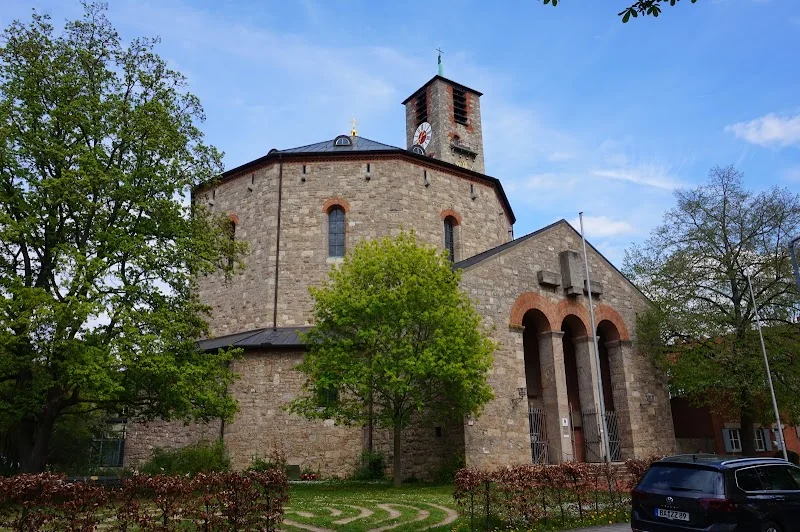
Architecturally, the church is extraordinary. It was designed as a powerful central building with a decagonal floor plan, which particularly suits the Protestant focus on preaching. At the time of its construction, Kunigundendamm was still at a different level; behind it was a damp meadow located four meters lower. To bring the church to street level, Bestelmeyer placed it on a four-meter-high basement made of reinforced concrete. The architect oriented himself in the overall composition to early Christian churches in Italy and shaped it into a unique work of art. The facade is predominantly made of rubble stones from surrounding quarries; red bricks create contrasts and emphasize the windows. The so-called waiting stones are noticeable at the forecourt, which were originally intended for figures but could not be further shaped due to lack of funds. The interior is strictly organized towards the center, with ten niches, an altar niche, a baptismal niche, and a pulpit niche, offering around 700 seats. ([erloeserkirche-bamberg.de](https://www.erloeserkirche-bamberg.de/erloeserkirche))
The bell tower complements this architecture in a striking way. The campanile is 55 meters high, connected only by an intermediate building with a sacristy and caretaker's apartment, and is a widely visible landmark on the right Regnitz riverbank. The tower houses the only mechanical church clock in a Bamberg church; the largest clock face measures six meters in diameter. The four bells are tuned to g, e, d, and h and were consecrated in 1959. The tower tours are also a conscious offering from the community: they connect the clockwork, bells, and Bamberg panorama, making the construction history directly experienceable. Those who only know the Redeemer Church from the outside easily underestimate its design depth. Those who experience it from the inside and from the tower quickly understand why it is considered one of the most distinctive Protestant buildings in Bamberg. ([erloeserkirche-bamberg.de](https://www.erloeserkirche-bamberg.de/glockenturm))
Bell Tower, Organ, and View of Bamberg
For many visitors, the bell tower of the Redeemer Church is an attraction in its own right. The community describes the tower ascent as a unique triad of clockwork, bells, and Bamberg panorama. This combination is precisely what makes it appealing: one experiences not only architecture but also technology, sound, and view in a single tour. The tower tour lasts about 45 to 60 minutes and costs a voluntary contribution starting at 5 euros. The meeting point is the entrance door of the tower on Martin-Luther-Straße at the back of the church. The 55-meter-high campanile offers unobstructed views of Bamberg in all directions and conveys a very immediate sense of how the church is anchored in the urban landscape. Especially for visitors looking for photos, views, and special experiences, this adds a strong additional dimension. ([erloeserkirche-bamberg.de](https://www.erloeserkirche-bamberg.de/turmfuehrungen))
Inside the tower is also a piece of technical uniqueness. The mechanical church clock was manufactured in 1937 and is one of the details that make the historical character of the building visible. The bells were recast after the war and were ceremoniously consecrated in 1959; they accompany the services and set acoustic markers in the daily rhythm of the community. It is particularly interesting that the community gives much space to the sound of the bells and the organ. The church music page presents the project Organ 5.0 in detail, and the organ itself is understood not only as an instrument but as a sound center of the community. The current Steinmeyer organ dates from 1975; 24 stops, two manuals, and a pedal give it a clear profile. Thus, the Redeemer Church is not only a historical church space but also a place where sound care is actively practiced. ([erloeserkirche-bamberg.de](https://www.erloeserkirche-bamberg.de/glockenturm))
The view from the tower connects with the location of the church directly on the right Regnitz riverbank. The campanile is widely visible, and therein lies its urban planning value: it is a point of orientation, a landmark, and a symbol of identity at the same time. In conjunction with the open church, daily opening hours, and cycling paths in direct proximity, a place is created that is present not only during liturgical events but also in the everyday life of the city. Visitors looking for a special Bamberg experience get a view over the city, an encounter with history, and a good sense of how sacred architecture was conceived in the 20th century. The tower, organ, bells, and interior together form exactly the profile that makes the Redeemer Church so attractive for events, culture, and spirituality. ([erloeserkirche-bamberg.de](https://www.erloeserkirche-bamberg.de/turmfuehrungen))
Parish Office, Confirmation, Exhibition, and Community Life
The parish office of the Redeemer Church is the practical center for many concerns: baptisms, weddings, funerals, confirmations, discussions, events, or questions about community life. The opening hours are well structured: Monday to Thursday from 9 AM to 12 PM and Wednesdays additionally from 2 PM to 5 PM. Several pastors are also mentioned in the contact area, including Anette Simojoki, Dorothea Münch, and Anne Schneider. This is particularly important for search queries related to “parish office” and “pastor” because the community makes its accessibility transparent. So, those looking for information on church life stages or the preparation of special services will find a clearly named contact point here. The community also communicates an emergency phone number and refers to the current weekly outlook as well as its upcoming events. This makes it clear that the parish office is not just administration but also a pastoral and organizational hub. ([erloeserkirche-bamberg.de](https://www.erloeserkirche-bamberg.de/kontaktadressen))
The community life also includes a wide range of offerings that go beyond the main service. The community center in the basement offers good spatial conditions for groups, discussion rounds, and celebrations, with a large foyer, two combinable halls, a youth room, a club room, and a kitchen. Additionally, thematic formats such as the soup church, which offers a plate of warmth, bread, drinks, and community during the winter months, are included. Thus, the community works not only liturgically but also socially and diaconally. This fits with the fact that the website offers a current community newsletter and informs about various activities. Search terms like “community newsletter,” “confirmation,” “events,” and “opening hours” are thus covered by real, regularly maintained content. This interplay of organization and closeness makes the Redeemer Church relevant for families, volunteers, and regular attendees alike. ([erloeserkirche-bamberg.de](https://www.erloeserkirche-bamberg.de/gemeindezentrum))
The exhibition “Bonhoeffer in Harlem” is also part of community life and gives the Redeemer Church an artistic profile. The exhibition is freely accessible, was gifted to the community in 2013, and connects theology, art, and memory in a vivid way. Those searching for photos will also find numerous image and theme areas on the website related to history, the tower, and special projects; the community additionally refers to YouTube, Facebook, and Instagram. This makes the Redeemer Church also digitally well visible and excellently positioned for search queries related to images, impressions, and backgrounds. Overall, it presents a place that does not separate confirmation, music, exhibition, pastoral care, and Sunday services but brings them together as parts of a vibrant community picture. For users, this means: The Redeemer Church Bamberg is not just a search result but a versatile place with real depth. ([erloeserkirche-bamberg.de](https://www.erloeserkirche-bamberg.de/austellung-bonhoeffer-in-harlem))
Sources:
Mehr anzeigenWeniger anzeigen
Redeemer Church Bamberg | Services & Events
The Redeemer Church Bamberg is much more than just a church landmark on Kunigundendamm. It is a place for services, music, encounters, exhibitions, and quiet reflection, embedded in the history of the right Regnitz riverbank area and simultaneously open to the present. Visitors to the church experience a striking central building with a strong architectural signature, a 55-meter high tower, an interior with around 700 seats, and a community life that extends far beyond the classic Sunday service. The church was consecrated in 1934, heavily damaged in 1945, and rebuilt by 1950; today, its open accessibility, church music, and special location by the Main-Danube Canal shape the profile of the house. As a cycling church and a spiritual stop for people on the go, it has a firm place in everyday life in Bamberg. ([erloeserkirche-bamberg.de](https://www.erloeserkirche-bamberg.de/erloeserkirche))
Services on Sundays at the Redeemer Church
Those looking for the Sunday services of the Redeemer Church Bamberg will find a clear and reliable offering. The community typically celebrates two services in the church on Sundays: the early service at 8:30 AM and the main service at 10:00 AM. The early service is particularly quiet and contemplative, while the 10 AM service is often accompanied by baptisms, creating a lively community atmosphere that can last into the late morning. The community describes this rhythm as a service from early on into the afternoon, highlighting the significance of the Redeemer Church as a spiritual center in eastern Bamberg. The 10 AM service is also recorded and later offered as an audio track for download, aligning with the desire for digital participation and an open, accessible church. ([erloeserkirche-bamberg.de](https://www.erloeserkirche-bamberg.de/gottesdienste-an-sonntagen))
The church's opening hours also reflect this open understanding. The contact page states that the church is open daily until dusk; on the cycling church page, it is additionally described as open daily from 8 AM until twilight. This makes the Redeemer Church interesting not only for community members but also for guests, walkers, cyclists, and tourists. Furthermore, the community, with around 4,900 members, is one of the two major Protestant city church communities in Bamberg. For seeking visitors, this is important as it shows: This is not just a pure monument, but a very lively community with regular services, devotions, and a reliable church routine. Those wanting to know about current dates can also find a weekly outlook on the website, as well as references to the community's event offerings. ([erloeserkirche-bamberg.de](https://www.erloeserkirche-bamberg.de/kontaktadressen))
In terms of content, the Redeemer Church focuses not only on the classic Sundays but also on services throughout the year and special formats. These include, among others, ecumenical services, peace prayers, communion celebrations, and services for different target groups. Once or twice a year, the community also celebrates the 10 AM service not at Kunigundendamm but at a location within the community area; these “Redeemer on the move” services demonstrate how flexible and approachable the community is. For SEO, the combination of liturgy, regularity, and good findability is particularly important: Those searching for “services,” “opening hours,” or “parish office” will find a church that connects clear times, open doors, and well-structured information. This blend of reliability and closeness makes the Redeemer Church a strong church location in Bamberg. ([erloeserkirche-bamberg.de](https://www.erloeserkirche-bamberg.de/erloeser-unterwegs))
Events, Concerts, and Church Music at the Redeemer Church
The keyword signals for “events,” “concert,” and “community newsletter” clearly show that the Redeemer Church Bamberg is not only a place of worship but also a cultural venue. On the website, the community dedicates a separate page to church music, making it clear that music here is not a mere accompaniment but a fundamental part of the profile. The offerings include Redeemer Choir, Redeemer Children's Choir, Redeemer Brass Band, Redeemer Band, and the organ. Additionally, there is a support group for church music that supports this work and makes it clear that music in the community is thought of long-term. For 2026 and 2027, readings, lectures, and benefit concerts are already announced on the church music page, including formats with choirs and brass ensembles. This fits well with a church that sees itself as a place for spiritual music, communal singing, and larger musical evenings. ([erloeserkirche-bamberg.de](https://www.erloeserkirche-bamberg.de/kirchenmusik))
Particularly important in this context is the organ. The current Steinmeyer organ was built in 1975 and has two manuals, 24 stops, and a pedal. At the same time, a renovation and fundraising project called “Organ 5.0” is underway to secure the future of the instrument. The fact that the organ has its own project page shows its significance for the house. The bells and the tower are also part of the musical identity of the Redeemer Church: Four bronze bells were consecrated in 1959, their sound is part of the Sunday rhythm of the community, and the only mechanical church clock in a Bamberg church is also located up there. Those searching for concerts will therefore find not only individual events but a comprehensive sound and cultural profile that ranges from choir work to benefit evenings to organ projects. ([erloeserkirche-bamberg.de](https://www.erloeserkirche-bamberg.de/orgel))
The exhibition “Bonhoeffer in Harlem” is also part of this cultural and spiritual overall picture. It has been housed in the Redeemer Church since 2013 and can be visited during opening hours; admission is free. This is relevant for search queries related to “exhibition,” “photos,” and “events,” as the church thus becomes visible not only religiously but also artistically. Additionally, there is a special connection between music and community: The website invites people to take a peek into the musical work, welcome new members to the choirs, and think musically about the community. The Redeemer Church thus presents itself as a place where church music is not merely museum-like but actively lived. For visitors looking for a concert venue with atmosphere, history, and good acoustics, this is a strong argument. ([erloeserkirche-bamberg.de](https://www.erloeserkirche-bamberg.de/austellung-bonhoeffer-in-harlem))
Parking, Directions, and Barrier-Free Access at Kunigundendamm
Those wishing to visit the Redeemer Church Bamberg should also be aware of the practical side. The church is surrounded by four streets: Kunigundendamm, Martin-Luther-Straße, Hopfferstraße, and Heumannstraße. This is very helpful for orientation on-site, as the church is located in a densely structured urban area. For visitors with cars, it is particularly relevant that the city of Bamberg indicates two disabled parking spaces directly next to the Redeemer Church on Martin-Luther-Straße (Mon-Fri, 8 AM-6 PM) as well as another space at Kunigundendamm 27. Those arriving with limited mobility can thus plan accordingly. This information is valuable, especially for services, concerts, or weddings, as it reduces travel stress and makes the stay at the church significantly more pleasant. ([erloeserkirche-bamberg.de](https://www.erloeserkirche-bamberg.de/hopffer-und-heumannstrasse))
The barrier-free usage is also clearly visible. The community center is located in the basement of the church; its entrance is on Hopfferstraße and is accessible via stairs or a barrier-free elevator. There is a large foyer, two halls, a youth room, a club room, and a spacious kitchen. This is important not only for events but also for community meetings, confirmation preparation, discussions, and smaller celebrations. The church itself has had barrier-free access since 2018. Together with the daily opening until dusk and its function as a cycling church, this creates a very accessible overall picture. The Redeemer Church is not just a monument but a place that consciously responds to different needs: on foot, by bike, with a wheelchair, or with a stroller. ([erloeserkirche-bamberg.de](https://www.erloeserkirche-bamberg.de/gemeindezentrum?utm_source=openai))
For cyclists, the location on the Regnitz cycling path is particularly attractive. The cycling path runs directly below the church, and the Redeemer Church has been recognized as the first cycling church in Bavaria. The community explicitly invites people on two wheels to stop, take a break, and recharge at a spiritual place. This connection between movement and contemplation is very characteristic of Bamberg, as the church is thus directly integrated into the everyday paths of the city. So, those searching for “parking,” “address,” or “opening hours” will find a location that offers good conditions for both motorized and non-motorized visitors. For Google optimization, it is important: The Redeemer Church is not remote but very well located within the urban structure, with clear paths, understandable street references, and a barrier-free community center. ([erloeserkirche-bamberg.de](https://www.erloeserkirche-bamberg.de/radwegekirche))
History and Architecture of the Redeemer Church
The history of the Redeemer Church begins well before its consecration. As early as 1898, initial plans were made for a second Protestant church in Bamberg because the Protestant population in the eastern part of the city was growing and needed an easily accessible place of worship. After World War I, a Protestant church building association resumed the project, raised funds, and eventually acquired the property on Kunigundendamm. In 1926, the renowned architect Prof. German Bestelmeyer was commissioned with the design, and construction began in 1929. After the shell construction and further delays due to the economic crisis, the church was consecrated on October 28, 1934. The bombing raid on February 22, 1945, severely damaged the building, but 500 people who had sought refuge under the church were unharmed. By 1950, the church was rebuilt according to the original plans and was reconsecrated on June 4, 1950. This chronology makes the Redeemer Church a place where urban development, war experience, and reconstruction history overlap directly. ([erloeserkirche-bamberg.de](https://www.erloeserkirche-bamberg.de/erloeserkirche))
Architecturally, the church is extraordinary. It was designed as a powerful central building with a decagonal floor plan, which particularly suits the Protestant focus on preaching. At the time of its construction, Kunigundendamm was still at a different level; behind it was a damp meadow located four meters lower. To bring the church to street level, Bestelmeyer placed it on a four-meter-high basement made of reinforced concrete. The architect oriented himself in the overall composition to early Christian churches in Italy and shaped it into a unique work of art. The facade is predominantly made of rubble stones from surrounding quarries; red bricks create contrasts and emphasize the windows. The so-called waiting stones are noticeable at the forecourt, which were originally intended for figures but could not be further shaped due to lack of funds. The interior is strictly organized towards the center, with ten niches, an altar niche, a baptismal niche, and a pulpit niche, offering around 700 seats. ([erloeserkirche-bamberg.de](https://www.erloeserkirche-bamberg.de/erloeserkirche))
The bell tower complements this architecture in a striking way. The campanile is 55 meters high, connected only by an intermediate building with a sacristy and caretaker's apartment, and is a widely visible landmark on the right Regnitz riverbank. The tower houses the only mechanical church clock in a Bamberg church; the largest clock face measures six meters in diameter. The four bells are tuned to g, e, d, and h and were consecrated in 1959. The tower tours are also a conscious offering from the community: they connect the clockwork, bells, and Bamberg panorama, making the construction history directly experienceable. Those who only know the Redeemer Church from the outside easily underestimate its design depth. Those who experience it from the inside and from the tower quickly understand why it is considered one of the most distinctive Protestant buildings in Bamberg. ([erloeserkirche-bamberg.de](https://www.erloeserkirche-bamberg.de/glockenturm))
Bell Tower, Organ, and View of Bamberg
For many visitors, the bell tower of the Redeemer Church is an attraction in its own right. The community describes the tower ascent as a unique triad of clockwork, bells, and Bamberg panorama. This combination is precisely what makes it appealing: one experiences not only architecture but also technology, sound, and view in a single tour. The tower tour lasts about 45 to 60 minutes and costs a voluntary contribution starting at 5 euros. The meeting point is the entrance door of the tower on Martin-Luther-Straße at the back of the church. The 55-meter-high campanile offers unobstructed views of Bamberg in all directions and conveys a very immediate sense of how the church is anchored in the urban landscape. Especially for visitors looking for photos, views, and special experiences, this adds a strong additional dimension. ([erloeserkirche-bamberg.de](https://www.erloeserkirche-bamberg.de/turmfuehrungen))
Inside the tower is also a piece of technical uniqueness. The mechanical church clock was manufactured in 1937 and is one of the details that make the historical character of the building visible. The bells were recast after the war and were ceremoniously consecrated in 1959; they accompany the services and set acoustic markers in the daily rhythm of the community. It is particularly interesting that the community gives much space to the sound of the bells and the organ. The church music page presents the project Organ 5.0 in detail, and the organ itself is understood not only as an instrument but as a sound center of the community. The current Steinmeyer organ dates from 1975; 24 stops, two manuals, and a pedal give it a clear profile. Thus, the Redeemer Church is not only a historical church space but also a place where sound care is actively practiced. ([erloeserkirche-bamberg.de](https://www.erloeserkirche-bamberg.de/glockenturm))
The view from the tower connects with the location of the church directly on the right Regnitz riverbank. The campanile is widely visible, and therein lies its urban planning value: it is a point of orientation, a landmark, and a symbol of identity at the same time. In conjunction with the open church, daily opening hours, and cycling paths in direct proximity, a place is created that is present not only during liturgical events but also in the everyday life of the city. Visitors looking for a special Bamberg experience get a view over the city, an encounter with history, and a good sense of how sacred architecture was conceived in the 20th century. The tower, organ, bells, and interior together form exactly the profile that makes the Redeemer Church so attractive for events, culture, and spirituality. ([erloeserkirche-bamberg.de](https://www.erloeserkirche-bamberg.de/turmfuehrungen))
Parish Office, Confirmation, Exhibition, and Community Life
The parish office of the Redeemer Church is the practical center for many concerns: baptisms, weddings, funerals, confirmations, discussions, events, or questions about community life. The opening hours are well structured: Monday to Thursday from 9 AM to 12 PM and Wednesdays additionally from 2 PM to 5 PM. Several pastors are also mentioned in the contact area, including Anette Simojoki, Dorothea Münch, and Anne Schneider. This is particularly important for search queries related to “parish office” and “pastor” because the community makes its accessibility transparent. So, those looking for information on church life stages or the preparation of special services will find a clearly named contact point here. The community also communicates an emergency phone number and refers to the current weekly outlook as well as its upcoming events. This makes it clear that the parish office is not just administration but also a pastoral and organizational hub. ([erloeserkirche-bamberg.de](https://www.erloeserkirche-bamberg.de/kontaktadressen))
The community life also includes a wide range of offerings that go beyond the main service. The community center in the basement offers good spatial conditions for groups, discussion rounds, and celebrations, with a large foyer, two combinable halls, a youth room, a club room, and a kitchen. Additionally, thematic formats such as the soup church, which offers a plate of warmth, bread, drinks, and community during the winter months, are included. Thus, the community works not only liturgically but also socially and diaconally. This fits with the fact that the website offers a current community newsletter and informs about various activities. Search terms like “community newsletter,” “confirmation,” “events,” and “opening hours” are thus covered by real, regularly maintained content. This interplay of organization and closeness makes the Redeemer Church relevant for families, volunteers, and regular attendees alike. ([erloeserkirche-bamberg.de](https://www.erloeserkirche-bamberg.de/gemeindezentrum))
The exhibition “Bonhoeffer in Harlem” is also part of community life and gives the Redeemer Church an artistic profile. The exhibition is freely accessible, was gifted to the community in 2013, and connects theology, art, and memory in a vivid way. Those searching for photos will also find numerous image and theme areas on the website related to history, the tower, and special projects; the community additionally refers to YouTube, Facebook, and Instagram. This makes the Redeemer Church also digitally well visible and excellently positioned for search queries related to images, impressions, and backgrounds. Overall, it presents a place that does not separate confirmation, music, exhibition, pastoral care, and Sunday services but brings them together as parts of a vibrant community picture. For users, this means: The Redeemer Church Bamberg is not just a search result but a versatile place with real depth. ([erloeserkirche-bamberg.de](https://www.erloeserkirche-bamberg.de/austellung-bonhoeffer-in-harlem))
Sources:

Frequently Asked Questions
Reviews
Sadiq Hannan
1. September 2020
Nice place to visit!
Umm Ul Baneen
18. June 2024
Historical church!
manuela möhring
20. May 2026
A church that does without showiness and ostentation. Simple and elegant, powerful.
Alma Mater
2. May 2026
I heard a very beautiful concert there with 2 soloists, the choir, and the Gundelsheim Big Band.
Tanja Wolf
15. January 2026
Very beautiful church to pause and find peace.