
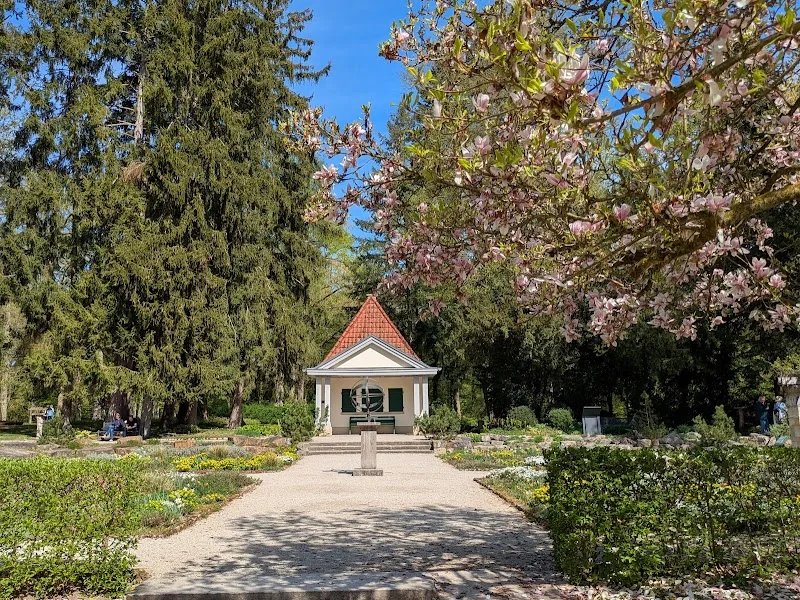
Mühlwörth 21, Bamberg
Mühlwörth 21, 96047 Bamberg, Germany
Bamberg Botanical Garden | Directions & Opening Hours
The Bamberg Botanical Garden is not a loud excursion destination with great spectacle, but a quiet place that derives its charm from the connection of nature, history, and structure. It is located in Hainpark in the southern part of the island city of Bamberg, more precisely in the northeastern part of the park, and is freely accessible. Those who come here do not experience a classic winter garden with exotic overwhelmingness, but a carefully conceived display and educational facility that changes constantly throughout the year and is therefore worth visiting multiple times a year. The Hain itself is considered one of the oldest public parks in the style of English landscape gardens in Bavaria and covers around 48 hectares; the Botanical Garden is part of this larger green ensemble and is also one of the most distinctive places in the park. Its current form was restructured in 2018 and 2019 and is based on a concept that not only showcases plants beautifully but also organizes them according to habitats, relationships, and horticultural significance. This makes the garden a destination for walkers, families, plant enthusiasts, and anyone looking for a quieter yet content-rich place in Bamberg. ([botanische-gaerten.de](https://www.botanische-gaerten.de/botanischer-garten-hainpark-bamberg.html))
Directions, Parking, and Opening Hours at the Bamberg Botanical Garden
For practical planning, it is important to note: The Botanical Garden is, according to the citizens' park association, freely accessible at all times, so there is no classic ticket area with fixed entry times. This makes it an uncomplicated destination for a spontaneous walk, a photo stop, or a short break in the greenery. Those arriving by public transport can take the city bus line 909 from the central bus station (ZOB) to the Wilhelm-Löhe-Heim stop and then walk on to Hainpark. By car, the citizens' park association mentions several options: the Hain parking lot in the Theresienhain area with an electric car charging station, the Galgenfuhr 30 parking lot, the Mühlwörth 18A parking lot in limited numbers, as well as the P+R Heinrichsdamm, which is also suitable for motorhomes and also offers a charging station. This information is particularly helpful for Bamberg, as the city center and the adjacent parking areas are often well occupied. Therefore, the combination of park-and-ride and a short walk through the park is often more worthwhile than searching directly at the garden. Those traveling by bike also benefit from the location in the greenery: The Botanical Garden is situated so that a visit can be easily combined with a round in the Hain, a walk by the Hainweiher, or a detour into the remaining park landscape. ([buergerparkverein.de](https://www.buergerparkverein.de/kontakt))
The History from 1923 to the Revival in 2019
The history of the Bamberg Botanical Garden does not begin by chance, but with a clear planning ambition. In 1923, garden office director Viktor Luster created a plan for a Botanical Garden, building on considerations from 1909 to design a school garden according to plant sociological principles, that is, according to relationships within the plant kingdom. This basic principle is still palpable today: Plants are not only presented as decorative individual pieces but in understandable contexts that connect education and observation. Luster aimed to display families such as crucifers, buttercup family, or rose family in a didactically readable order, supplemented by vegetation images of different locations, such as an alpine garden, stream and water plants, mountain plants, climbing plants, or shade plants. Additionally, technically important plants, medicinal plants, a herb garden, ornamental perennials, and resting places were included. This was remarkably modern for the time because it did not pit aesthetics against knowledge but brought them together. For the 100th anniversary of the garden in 2023, this origin was once again remembered. The revival as a high-quality display facility with thematic focuses was completed in 2019 and consciously connects to the original concept without simply copying it. Thus, a historical educational idea has become a contemporary park facility that shows its roots but functions in the present. ([buergerparkverein.de](https://www.buergerparkverein.de/der-hain/botanischer-garten))
Themed Beds, Plant Equipment, and Educational Garden Concept
The Bamberg Botanical Garden is particularly strong where it showcases its themed beds. The plant equipment is divided into several clearly named fields, including habitat sand, habitat Franconian Jura, four parterre beds, insect beds, medicinal plants, cottage garden, Karl Foerster cultivars, colorful foliage, hostas, ferns, hydrangeas, and the herb garden. This order is interesting not only for experts but also for visitors who want to better understand why certain plants are in certain places and what their neighborhood reveals about their location while strolling through the garden. For example, the habitat sand area showcases native flora in different biotope types from open sandy areas to closed sandy dry grasslands, while the Franconian Jura area addresses rock vegetation, calcareous dry grasslands, and juniper heaths. The insect beds work with unfilled or half-filled flowers that attract pollinators with scent, color, shape, or nectar and pollen. The medicinal plant beds, in turn, link botanical knowledge with application history and make the plant as a cultural and useful object comprehensible. The cottage garden and the Karl Foerster cultivars combine tradition, robustness, and seasonal effects, while colorful foliage and the combination of hostas, ferns, and hydrangeas also make shadier areas attractive. Since summer 2019, information panels have explained these themes on-site and provided technical and historical background information. Thus, the garden is not only a place to look at but also a place to learn, compare, and discover repeatedly. ([buergerparkverein.de](https://www.buergerparkverein.de/fileadmin/user_upload/BotGart_Pflanzenausstattung.pdf))
Hainpark, Swan Pond, and Metznerhäuschen
The Botanical Garden thrives on its embedding in Hainpark. The Hain is a historical public park in the style of an English landscape garden and is one of the most popular excursion destinations in Bamberg. It is precisely this combination of wide meadows, watercourses, old park structures, and botanical focuses that makes the area appealing. The Botanical Garden is not isolated but is in direct relation to the Swan Pond, Hainweiher, and the famous Metznerhäuschen, which was also shaped by Viktor Luster in the vicinity of the garden and the later Hainweiher. Those who embark on the circular path experience not only plant fields but an ensemble of garden art, monument preservation, and local recreation. The citizens' park association also emphasizes that there is a bronze relief tactile model with Braille in the Botanical Garden, which makes the place interesting for barrier-conscious and tactile orientation-dependent visitors. These details show that the garden not only looks beautiful from above but offers many levels during the walk: historical traces, formal paths, water surfaces, quiet sight axes, and thematically framed plant images. For visitors who want to experience Bamberg beyond the old town, the Hain is therefore a real alternative with its own character. The Botanical Garden is not an accessory here but a centerpiece of the park experience. ([buergerparkverein.de](https://www.buergerparkverein.de/der-hain?utm_source=openai))
Free Visit, Orientation, and Practical Tips
Those visiting the Bamberg Botanical Garden should take their time, even if the place seems small at first glance. Its free accessibility allows for spontaneous visits, and the compact layout invites one not to rush. It makes sense to combine the visit with a walk through Hainpark and to read the themed beds not just as individual areas but as a coherent narrative. The information panels help with this, and the proximity to Hainweiher and Swan Pond enhances the impression of a lively, water-rich park area. Because the garden is outdoors, it changes significantly with light, season, and weather. Therefore, it is worthwhile not only in spring or early summer but also on quieter autumn days or during a short winter walk when the structure of the facility becomes more visible. For visitors with dogs, it is important to note that there is a year-round leash requirement in the vicinity of Hainweiher and in the adjacent Botanical Garden. Those traveling with children benefit from the clear paths, quiet zones, and the mix of nature and information. Photographers will find constantly new motifs in the plant fields, water references, and changing leaf decoration combinations. And those who want to get to know the city of Bamberg away from the major attractions will discover a place that does not advertise loudly but convinces with substance. The city portal's reference to the Botanical Garden with sensory path fits well: It is not just about plants, but about conscious perception. ([botanische-gaerten.de](https://www.botanische-gaerten.de/botanischer-garten-hainpark-bamberg.html))
Why the Bamberg Botanical Garden is Worth Visiting Again
The actual added value of the Bamberg Botanical Garden lies in the fact that it cannot be reduced to a single strong moment. It is neither merely a historical facility nor exclusively a modern redesigned show garden. Rather, it unites both: the clear idea of an educational garden from 1923 and the carefully renewed presentation from 2019. This dual structure makes it interesting for various target groups. Plant enthusiasts appreciate the understandable order of the themed beds, families benefit from the free accessibility and easy paths, walkers find a quiet counterpoint to the city center, and visitors with a sense of urban history experience a place where landscape gardening, Hainpark, and botanical education intertwine. The fact that Hainpark itself has a history of over 200 years as a public park enhances the impression of moving in a cultivated landscape rather than in a randomly created green space. Especially in Bamberg, a city with many heavily frequented attractions, this is an advantage: The Botanical Garden offers no overwhelming experience but depth. Those who have been there once will notice different plants, different colors, and different perspectives on their next visit. That is precisely why it is a good place for repeat visits, for short breaks, for factual information, and for quiet, decelerated hours in the green. ([buergerparkverein.de](https://www.buergerparkverein.de/?utm_source=openai))
Sources:
Mehr anzeigenWeniger anzeigen
Bamberg Botanical Garden | Directions & Opening Hours
The Bamberg Botanical Garden is not a loud excursion destination with great spectacle, but a quiet place that derives its charm from the connection of nature, history, and structure. It is located in Hainpark in the southern part of the island city of Bamberg, more precisely in the northeastern part of the park, and is freely accessible. Those who come here do not experience a classic winter garden with exotic overwhelmingness, but a carefully conceived display and educational facility that changes constantly throughout the year and is therefore worth visiting multiple times a year. The Hain itself is considered one of the oldest public parks in the style of English landscape gardens in Bavaria and covers around 48 hectares; the Botanical Garden is part of this larger green ensemble and is also one of the most distinctive places in the park. Its current form was restructured in 2018 and 2019 and is based on a concept that not only showcases plants beautifully but also organizes them according to habitats, relationships, and horticultural significance. This makes the garden a destination for walkers, families, plant enthusiasts, and anyone looking for a quieter yet content-rich place in Bamberg. ([botanische-gaerten.de](https://www.botanische-gaerten.de/botanischer-garten-hainpark-bamberg.html))
Directions, Parking, and Opening Hours at the Bamberg Botanical Garden
For practical planning, it is important to note: The Botanical Garden is, according to the citizens' park association, freely accessible at all times, so there is no classic ticket area with fixed entry times. This makes it an uncomplicated destination for a spontaneous walk, a photo stop, or a short break in the greenery. Those arriving by public transport can take the city bus line 909 from the central bus station (ZOB) to the Wilhelm-Löhe-Heim stop and then walk on to Hainpark. By car, the citizens' park association mentions several options: the Hain parking lot in the Theresienhain area with an electric car charging station, the Galgenfuhr 30 parking lot, the Mühlwörth 18A parking lot in limited numbers, as well as the P+R Heinrichsdamm, which is also suitable for motorhomes and also offers a charging station. This information is particularly helpful for Bamberg, as the city center and the adjacent parking areas are often well occupied. Therefore, the combination of park-and-ride and a short walk through the park is often more worthwhile than searching directly at the garden. Those traveling by bike also benefit from the location in the greenery: The Botanical Garden is situated so that a visit can be easily combined with a round in the Hain, a walk by the Hainweiher, or a detour into the remaining park landscape. ([buergerparkverein.de](https://www.buergerparkverein.de/kontakt))
The History from 1923 to the Revival in 2019
The history of the Bamberg Botanical Garden does not begin by chance, but with a clear planning ambition. In 1923, garden office director Viktor Luster created a plan for a Botanical Garden, building on considerations from 1909 to design a school garden according to plant sociological principles, that is, according to relationships within the plant kingdom. This basic principle is still palpable today: Plants are not only presented as decorative individual pieces but in understandable contexts that connect education and observation. Luster aimed to display families such as crucifers, buttercup family, or rose family in a didactically readable order, supplemented by vegetation images of different locations, such as an alpine garden, stream and water plants, mountain plants, climbing plants, or shade plants. Additionally, technically important plants, medicinal plants, a herb garden, ornamental perennials, and resting places were included. This was remarkably modern for the time because it did not pit aesthetics against knowledge but brought them together. For the 100th anniversary of the garden in 2023, this origin was once again remembered. The revival as a high-quality display facility with thematic focuses was completed in 2019 and consciously connects to the original concept without simply copying it. Thus, a historical educational idea has become a contemporary park facility that shows its roots but functions in the present. ([buergerparkverein.de](https://www.buergerparkverein.de/der-hain/botanischer-garten))
Themed Beds, Plant Equipment, and Educational Garden Concept
The Bamberg Botanical Garden is particularly strong where it showcases its themed beds. The plant equipment is divided into several clearly named fields, including habitat sand, habitat Franconian Jura, four parterre beds, insect beds, medicinal plants, cottage garden, Karl Foerster cultivars, colorful foliage, hostas, ferns, hydrangeas, and the herb garden. This order is interesting not only for experts but also for visitors who want to better understand why certain plants are in certain places and what their neighborhood reveals about their location while strolling through the garden. For example, the habitat sand area showcases native flora in different biotope types from open sandy areas to closed sandy dry grasslands, while the Franconian Jura area addresses rock vegetation, calcareous dry grasslands, and juniper heaths. The insect beds work with unfilled or half-filled flowers that attract pollinators with scent, color, shape, or nectar and pollen. The medicinal plant beds, in turn, link botanical knowledge with application history and make the plant as a cultural and useful object comprehensible. The cottage garden and the Karl Foerster cultivars combine tradition, robustness, and seasonal effects, while colorful foliage and the combination of hostas, ferns, and hydrangeas also make shadier areas attractive. Since summer 2019, information panels have explained these themes on-site and provided technical and historical background information. Thus, the garden is not only a place to look at but also a place to learn, compare, and discover repeatedly. ([buergerparkverein.de](https://www.buergerparkverein.de/fileadmin/user_upload/BotGart_Pflanzenausstattung.pdf))
Hainpark, Swan Pond, and Metznerhäuschen
The Botanical Garden thrives on its embedding in Hainpark. The Hain is a historical public park in the style of an English landscape garden and is one of the most popular excursion destinations in Bamberg. It is precisely this combination of wide meadows, watercourses, old park structures, and botanical focuses that makes the area appealing. The Botanical Garden is not isolated but is in direct relation to the Swan Pond, Hainweiher, and the famous Metznerhäuschen, which was also shaped by Viktor Luster in the vicinity of the garden and the later Hainweiher. Those who embark on the circular path experience not only plant fields but an ensemble of garden art, monument preservation, and local recreation. The citizens' park association also emphasizes that there is a bronze relief tactile model with Braille in the Botanical Garden, which makes the place interesting for barrier-conscious and tactile orientation-dependent visitors. These details show that the garden not only looks beautiful from above but offers many levels during the walk: historical traces, formal paths, water surfaces, quiet sight axes, and thematically framed plant images. For visitors who want to experience Bamberg beyond the old town, the Hain is therefore a real alternative with its own character. The Botanical Garden is not an accessory here but a centerpiece of the park experience. ([buergerparkverein.de](https://www.buergerparkverein.de/der-hain?utm_source=openai))
Free Visit, Orientation, and Practical Tips
Those visiting the Bamberg Botanical Garden should take their time, even if the place seems small at first glance. Its free accessibility allows for spontaneous visits, and the compact layout invites one not to rush. It makes sense to combine the visit with a walk through Hainpark and to read the themed beds not just as individual areas but as a coherent narrative. The information panels help with this, and the proximity to Hainweiher and Swan Pond enhances the impression of a lively, water-rich park area. Because the garden is outdoors, it changes significantly with light, season, and weather. Therefore, it is worthwhile not only in spring or early summer but also on quieter autumn days or during a short winter walk when the structure of the facility becomes more visible. For visitors with dogs, it is important to note that there is a year-round leash requirement in the vicinity of Hainweiher and in the adjacent Botanical Garden. Those traveling with children benefit from the clear paths, quiet zones, and the mix of nature and information. Photographers will find constantly new motifs in the plant fields, water references, and changing leaf decoration combinations. And those who want to get to know the city of Bamberg away from the major attractions will discover a place that does not advertise loudly but convinces with substance. The city portal's reference to the Botanical Garden with sensory path fits well: It is not just about plants, but about conscious perception. ([botanische-gaerten.de](https://www.botanische-gaerten.de/botanischer-garten-hainpark-bamberg.html))
Why the Bamberg Botanical Garden is Worth Visiting Again
The actual added value of the Bamberg Botanical Garden lies in the fact that it cannot be reduced to a single strong moment. It is neither merely a historical facility nor exclusively a modern redesigned show garden. Rather, it unites both: the clear idea of an educational garden from 1923 and the carefully renewed presentation from 2019. This dual structure makes it interesting for various target groups. Plant enthusiasts appreciate the understandable order of the themed beds, families benefit from the free accessibility and easy paths, walkers find a quiet counterpoint to the city center, and visitors with a sense of urban history experience a place where landscape gardening, Hainpark, and botanical education intertwine. The fact that Hainpark itself has a history of over 200 years as a public park enhances the impression of moving in a cultivated landscape rather than in a randomly created green space. Especially in Bamberg, a city with many heavily frequented attractions, this is an advantage: The Botanical Garden offers no overwhelming experience but depth. Those who have been there once will notice different plants, different colors, and different perspectives on their next visit. That is precisely why it is a good place for repeat visits, for short breaks, for factual information, and for quiet, decelerated hours in the green. ([buergerparkverein.de](https://www.buergerparkverein.de/?utm_source=openai))
Sources:
Bamberg Botanical Garden | Directions & Opening Hours
The Bamberg Botanical Garden is not a loud excursion destination with great spectacle, but a quiet place that derives its charm from the connection of nature, history, and structure. It is located in Hainpark in the southern part of the island city of Bamberg, more precisely in the northeastern part of the park, and is freely accessible. Those who come here do not experience a classic winter garden with exotic overwhelmingness, but a carefully conceived display and educational facility that changes constantly throughout the year and is therefore worth visiting multiple times a year. The Hain itself is considered one of the oldest public parks in the style of English landscape gardens in Bavaria and covers around 48 hectares; the Botanical Garden is part of this larger green ensemble and is also one of the most distinctive places in the park. Its current form was restructured in 2018 and 2019 and is based on a concept that not only showcases plants beautifully but also organizes them according to habitats, relationships, and horticultural significance. This makes the garden a destination for walkers, families, plant enthusiasts, and anyone looking for a quieter yet content-rich place in Bamberg. ([botanische-gaerten.de](https://www.botanische-gaerten.de/botanischer-garten-hainpark-bamberg.html))
Directions, Parking, and Opening Hours at the Bamberg Botanical Garden
For practical planning, it is important to note: The Botanical Garden is, according to the citizens' park association, freely accessible at all times, so there is no classic ticket area with fixed entry times. This makes it an uncomplicated destination for a spontaneous walk, a photo stop, or a short break in the greenery. Those arriving by public transport can take the city bus line 909 from the central bus station (ZOB) to the Wilhelm-Löhe-Heim stop and then walk on to Hainpark. By car, the citizens' park association mentions several options: the Hain parking lot in the Theresienhain area with an electric car charging station, the Galgenfuhr 30 parking lot, the Mühlwörth 18A parking lot in limited numbers, as well as the P+R Heinrichsdamm, which is also suitable for motorhomes and also offers a charging station. This information is particularly helpful for Bamberg, as the city center and the adjacent parking areas are often well occupied. Therefore, the combination of park-and-ride and a short walk through the park is often more worthwhile than searching directly at the garden. Those traveling by bike also benefit from the location in the greenery: The Botanical Garden is situated so that a visit can be easily combined with a round in the Hain, a walk by the Hainweiher, or a detour into the remaining park landscape. ([buergerparkverein.de](https://www.buergerparkverein.de/kontakt))
The History from 1923 to the Revival in 2019
The history of the Bamberg Botanical Garden does not begin by chance, but with a clear planning ambition. In 1923, garden office director Viktor Luster created a plan for a Botanical Garden, building on considerations from 1909 to design a school garden according to plant sociological principles, that is, according to relationships within the plant kingdom. This basic principle is still palpable today: Plants are not only presented as decorative individual pieces but in understandable contexts that connect education and observation. Luster aimed to display families such as crucifers, buttercup family, or rose family in a didactically readable order, supplemented by vegetation images of different locations, such as an alpine garden, stream and water plants, mountain plants, climbing plants, or shade plants. Additionally, technically important plants, medicinal plants, a herb garden, ornamental perennials, and resting places were included. This was remarkably modern for the time because it did not pit aesthetics against knowledge but brought them together. For the 100th anniversary of the garden in 2023, this origin was once again remembered. The revival as a high-quality display facility with thematic focuses was completed in 2019 and consciously connects to the original concept without simply copying it. Thus, a historical educational idea has become a contemporary park facility that shows its roots but functions in the present. ([buergerparkverein.de](https://www.buergerparkverein.de/der-hain/botanischer-garten))
Themed Beds, Plant Equipment, and Educational Garden Concept
The Bamberg Botanical Garden is particularly strong where it showcases its themed beds. The plant equipment is divided into several clearly named fields, including habitat sand, habitat Franconian Jura, four parterre beds, insect beds, medicinal plants, cottage garden, Karl Foerster cultivars, colorful foliage, hostas, ferns, hydrangeas, and the herb garden. This order is interesting not only for experts but also for visitors who want to better understand why certain plants are in certain places and what their neighborhood reveals about their location while strolling through the garden. For example, the habitat sand area showcases native flora in different biotope types from open sandy areas to closed sandy dry grasslands, while the Franconian Jura area addresses rock vegetation, calcareous dry grasslands, and juniper heaths. The insect beds work with unfilled or half-filled flowers that attract pollinators with scent, color, shape, or nectar and pollen. The medicinal plant beds, in turn, link botanical knowledge with application history and make the plant as a cultural and useful object comprehensible. The cottage garden and the Karl Foerster cultivars combine tradition, robustness, and seasonal effects, while colorful foliage and the combination of hostas, ferns, and hydrangeas also make shadier areas attractive. Since summer 2019, information panels have explained these themes on-site and provided technical and historical background information. Thus, the garden is not only a place to look at but also a place to learn, compare, and discover repeatedly. ([buergerparkverein.de](https://www.buergerparkverein.de/fileadmin/user_upload/BotGart_Pflanzenausstattung.pdf))
Hainpark, Swan Pond, and Metznerhäuschen
The Botanical Garden thrives on its embedding in Hainpark. The Hain is a historical public park in the style of an English landscape garden and is one of the most popular excursion destinations in Bamberg. It is precisely this combination of wide meadows, watercourses, old park structures, and botanical focuses that makes the area appealing. The Botanical Garden is not isolated but is in direct relation to the Swan Pond, Hainweiher, and the famous Metznerhäuschen, which was also shaped by Viktor Luster in the vicinity of the garden and the later Hainweiher. Those who embark on the circular path experience not only plant fields but an ensemble of garden art, monument preservation, and local recreation. The citizens' park association also emphasizes that there is a bronze relief tactile model with Braille in the Botanical Garden, which makes the place interesting for barrier-conscious and tactile orientation-dependent visitors. These details show that the garden not only looks beautiful from above but offers many levels during the walk: historical traces, formal paths, water surfaces, quiet sight axes, and thematically framed plant images. For visitors who want to experience Bamberg beyond the old town, the Hain is therefore a real alternative with its own character. The Botanical Garden is not an accessory here but a centerpiece of the park experience. ([buergerparkverein.de](https://www.buergerparkverein.de/der-hain?utm_source=openai))
Free Visit, Orientation, and Practical Tips
Those visiting the Bamberg Botanical Garden should take their time, even if the place seems small at first glance. Its free accessibility allows for spontaneous visits, and the compact layout invites one not to rush. It makes sense to combine the visit with a walk through Hainpark and to read the themed beds not just as individual areas but as a coherent narrative. The information panels help with this, and the proximity to Hainweiher and Swan Pond enhances the impression of a lively, water-rich park area. Because the garden is outdoors, it changes significantly with light, season, and weather. Therefore, it is worthwhile not only in spring or early summer but also on quieter autumn days or during a short winter walk when the structure of the facility becomes more visible. For visitors with dogs, it is important to note that there is a year-round leash requirement in the vicinity of Hainweiher and in the adjacent Botanical Garden. Those traveling with children benefit from the clear paths, quiet zones, and the mix of nature and information. Photographers will find constantly new motifs in the plant fields, water references, and changing leaf decoration combinations. And those who want to get to know the city of Bamberg away from the major attractions will discover a place that does not advertise loudly but convinces with substance. The city portal's reference to the Botanical Garden with sensory path fits well: It is not just about plants, but about conscious perception. ([botanische-gaerten.de](https://www.botanische-gaerten.de/botanischer-garten-hainpark-bamberg.html))
Why the Bamberg Botanical Garden is Worth Visiting Again
The actual added value of the Bamberg Botanical Garden lies in the fact that it cannot be reduced to a single strong moment. It is neither merely a historical facility nor exclusively a modern redesigned show garden. Rather, it unites both: the clear idea of an educational garden from 1923 and the carefully renewed presentation from 2019. This dual structure makes it interesting for various target groups. Plant enthusiasts appreciate the understandable order of the themed beds, families benefit from the free accessibility and easy paths, walkers find a quiet counterpoint to the city center, and visitors with a sense of urban history experience a place where landscape gardening, Hainpark, and botanical education intertwine. The fact that Hainpark itself has a history of over 200 years as a public park enhances the impression of moving in a cultivated landscape rather than in a randomly created green space. Especially in Bamberg, a city with many heavily frequented attractions, this is an advantage: The Botanical Garden offers no overwhelming experience but depth. Those who have been there once will notice different plants, different colors, and different perspectives on their next visit. That is precisely why it is a good place for repeat visits, for short breaks, for factual information, and for quiet, decelerated hours in the green. ([buergerparkverein.de](https://www.buergerparkverein.de/?utm_source=openai))
Sources:
Upcoming Events
No events found
Frequently Asked Questions
Reviews
Kathi H
29. September 2019
Hands down one of my favourite places in Bamberg. Always worth a visit all year round. The pond is super photogenic and there's lots of ducks around that are pretty tame. There are carp and other fish in the pond and if you're lucky you can also see some turtles sunbathe on the rocks. The botanical garden changes with the seasons and there's always new stuff to look at.
Graham Michie
14. January 2025
Not in full bloom in December/January, so very quiet and not a lot to see.
Karl Welsh
15. February 2020
Actually the area is large. Could be the reason for not keeping the grounds looking as a Botanical Garden should if it is such. Cemetery flowers are not my favorite for Botanical Gardens!!!
Douglas Evangelista
17. July 2024
Nice walking area with beautiful landscapes!
Cordula Richards
28. December 2022
Beautiful garden for a nice winter walk.