
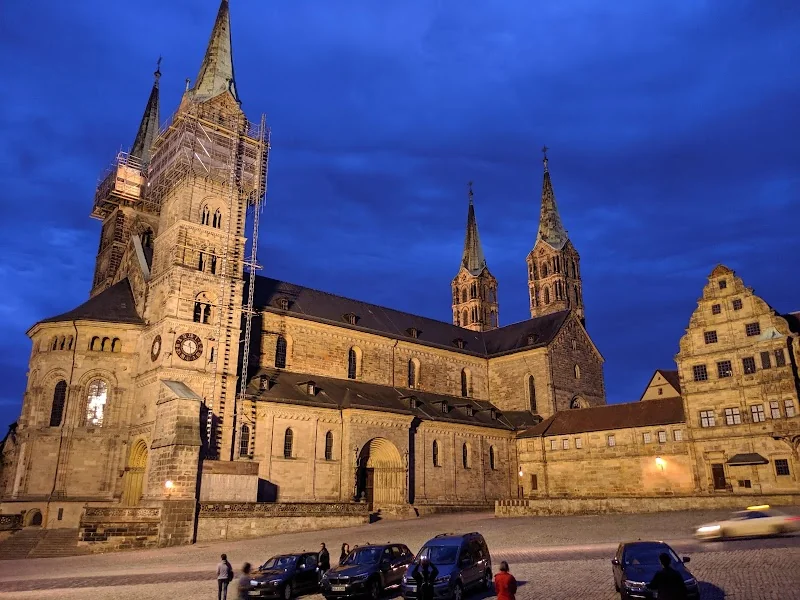
Bamberg
Dompl., 96049 Bamberg, Deutschland
Bamberg Cathedral | Opening Hours & Tours
The Bamberg Cathedral of St. Peter and St. George is much more than just a famous building in the old town of Bamberg. It is a cathedral, a memorial site, an art museum of faith, and a vibrant place of worship all at once. Its history begins with the founding of the diocese in 1007 and the consecration of the cathedral in 1012; its current form developed after the fire of the Heinrich Cathedral in 1185, in the tension between Romanesque and Gothic styles. Visitors to the Bamberg Cathedral encounter a four-towered landmark that, along with the Bamberg Rider, the imperial tomb, and the strong presence of the cathedral chapter, ranks among the most impressive church buildings in southern Germany. For visitors, it is important to note: Outside of worship times, the cathedral is freely accessible, but opening hours, tours, and quiet times follow the liturgical order of the house. Those searching for Bamberg Cathedral photos will find particularly striking perspectives at the cathedral square, the west building, and the prince's portal, which impressively showcase the monumental effect of the building.([bamberger-dom.de](https://bamberger-dom.de/geschichte/Domgruender/index.html?utm_source=openai))
Opening Hours, Visiting Times, and Services at Bamberg Cathedral
The visiting hours of Bamberg Cathedral are staggered seasonally and do not simply follow a classic museum logic. In the winter half-year, shorter time slots apply than from April to October, and on Saturdays as well as during musical formats, there are additional interruptions. For visitors, this means: Those who want to experience the cathedral in the morning or early afternoon should always check the current times in advance. Particularly important is Saturday from May to October, as a public organ concert takes place at 12 noon; silence applies from 11:30 a.m., and visits and tours are not possible during this time. On Sundays and public holidays, the times also differ depending on the season. This makes it clear that Bamberg Cathedral is not just a sight to see, but a house of worship where sacred practice and visitor interest are closely intertwined.([bamberger-dom.de](https://bamberger-dom.de/besuch/besichtigungszeiten/?utm_source=openai))
The liturgy takes precedence in Bamberg Cathedral. During services and liturgical celebrations, the cathedral is closed for visits and tours, as moving around the space would disturb the celebration. There are also quiet days such as Christmas Eve, Ash Wednesday, Maundy Thursday, Good Friday, Holy Saturday, All Saints' Day, or All Souls' Day, on which the cathedral is requested to remain quiet and no tours take place. This regulation should not be understood as a restriction but as part of the identity of the place: The cathedral remains primarily a place of prayer and celebration, and only afterwards a tourist destination. Those who respect this order often experience the space even more intensely, as silence, sound, and liturgy create a special atmosphere.([bamberger-dom.de](https://bamberger-dom.de/besuch/besichtigungszeiten/?utm_source=openai))
A unique highlight in the weekly rhythm is the spiritual midday impulse. From Monday to Friday, the short moment at noon begins with the ringing of the 12 o'clock bell, where the cathedral organ, silence, and a spiritual impulse appeal to tourists as well as locals. This offering takes place between Easter and October 3, as well as during the Advent and Christmas season. Especially for those who wish to understand the cathedral not just as a historical monument but as a living spiritual space, this provides an ideal access point. The Bamberg Cathedral thus demonstrates how an outstanding medieval building can continue to function as a space for gathering, music, and devotion in the 21st century.([bamberger-dom.de](https://bamberger-dom.de/gotteshaus/besucherpastoral/Moment-am-Mittag/index.html?utm_source=openai))
Guided Tours and Admission Prices for Bamberg Cathedral
Those who truly want to understand Bamberg Cathedral should plan for a guided tour. According to the cathedral tourism office, public tours for individual guests take place daily, with reduced offerings on Sundays. Tickets cost regularly 12 euros, reduced 9 euros; children up to 18 years are free when accompanied by their parents. The meeting point for the tours is the Adams portal at the cathedral, and tickets are available at the diocesan museum ticket office or directly at the tour, depending on the day of the week. This is a sensible way for travelers visiting the cathedral as part of a day trip, as the most important artworks and historical contexts can be grasped much more quickly with a guide than during a free tour.([bamberger-dom.de](https://bamberger-dom.de/besuch/allgemein/Kurzinfo/index.html?utm_source=openai))
The tour offerings are thematically well developed. The classic Dom.Schatz.Kreuzgang connects the cathedral, diocesan museum, and the medieval cloister, while Dom.Premium particularly focuses on the major artworks and architecture. Additionally, there are short tours that concentrate on the highlights of the cathedral in about 25 minutes. All group tours require registration, the group size is limited to 20 people, and the visitor service DoMus is the official booking partner. This is practical for visitors, as it allows for very different interests to be covered: art lovers, families, school classes, pilgrims, and first-time visitors each find a suitable format. Therefore, those searching for Bamberg Cathedral tours or Bamberg Cathedral admission prices should distinguish between free visits outside of worship times and paid tours with professional guidance.([bamberger-dom.de](https://bamberger-dom.de/besuch/Startseite/?utm_source=openai))
The tour itself is not just an explanation of dates but a journey through images, figures, and meanings. This is particularly worthwhile in Bamberg Cathedral, as many details can easily be overlooked by the untrained eye: the portal figures, the choir stalls, the crypts, and the art-historical transitions between the construction phases. Therefore, those planning to visit the cathedral as part of a Bamberg visit should allow enough time and reserve as early as possible. Especially in the summer season, visitor traffic is high, while at the same time, liturgical use and musical formats occupy fixed time slots. A well-planned visit thus ensures more tranquility and greater content gain.([bamberger-dom.de](https://bamberger-dom.de/besuch/Startseite/?utm_source=openai))
Construction Time, Architectural Style, and History of the Imperial Cathedral
The history of Bamberg Cathedral begins with the political and ecclesiastical project of Emperor Henry II and his wife Kunigunde. In 1007, they founded the diocese of Bamberg, and in 1012 the first cathedral was consecrated. After a fire at the Heinrich Cathedral in 1185, a new building was constructed in the 12th and early 13th centuries, which was consecrated in 1237. This current cathedral is therefore not the result of a single construction phase but a long development in which religious, political, and artistic claims overlapped. It is precisely this layering that makes it appealing: The cathedral preserves the memory of the founding will of the ruling couple, of medieval saint veneration, and of the power of the cathedral chapter as a church institution.([bamberger-dom.de](https://bamberger-dom.de/geschichte/Domgruender/index.html?utm_source=openai))
From an architectural history perspective, the cathedral is a fascinating transitional work. The east building shows late Romanesque forms, while the west building exhibits early Gothic features. The cathedral is therefore not a harmoniously unified structure but a conscious interplay of different epochs. Particularly characteristic are the four towers, which pairwise enclose the two choirs. This double choir arrangement makes the floor plan and silhouette of the cathedral unmistakable and explains why the building appears so impressive even from a distance. For visitors, this also serves as an aesthetic key: Those standing before the building see not just a church but a stone history book in which Romanesque, Gothic, and later transformations combine into a unique overall picture.([bamberger-dom.de](https://bamberger-dom.de/architektur/Romanik-und-Gotik/index.html?utm_source=openai))
The current significance of the cathedral extends beyond mere architectural history. It remains a sovereign memory, bishop's church, and pilgrimage site at the same time. The cathedral founders Henry and Kunigunde are not only remembered in the cathedral but are also kept present through the imperial tomb and the liturgical tradition. For visitors searching for Bamberg Cathedral in the 11th century, this historical depth is crucial: The beginnings lie in the 11th century, but the visible substance of today's cathedral is the result of upheavals, fires, reconstructions, and artistic decisions. It is precisely this exceptional status that defines it. It is not a monument of a single epoch but the condensed narrative of more than a thousand years of church history in Bamberg.([bamberger-dom.de](https://bamberger-dom.de/geschichte/Domgruender/index.html?utm_source=openai))
Interior, Figures, and the Bamberg Rider
The interior of Bamberg Cathedral is rich in figures and artworks that make the visit a journey of discovery. The most famous work is undoubtedly the Bamberg Rider. It is considered the oldest preserved, lifelike medieval equestrian sculpture made of stone and was created around 1230. Its exact identity is not secured; traditionally, it is often associated with St. Stephen of Hungary, and according to legend, he was baptized in Bamberg Cathedral. Art historically, the figure is particularly exciting because it does not appear isolated in the space but directs the gaze and shapes the entire east choir situation as an iconic focal point. Those searching for Bamberg Cathedral figures or Bamberg Cathedral interior will quickly come across this artwork, which ranks among the most famous sculptures of German Gothic worldwide.([bamberger-dom.de](https://bamberger-dom.de/kirchenraum/skulpturen/Bamberger-Reiter/?utm_source=openai))
Equally significant is the imperial tomb of Henry II and Kunigunde. The high tomb created by Tilman Riemenschneider was completed between 1499 and 1513. The grave slab features the childless imperial couple, while the side reliefs tell legends from their lives, including the weighing of the emperor's soul. Henry II was canonized in 1146, and Kunigunde in 1200. This makes the tomb not only a monument to two rulers but also a center of saintly cult in the cathedral. For visitors, it is one of the most powerful moments in the entire interior, as art, piety, and representation of power come together directly.([bamberger-dom.de](https://bamberger-dom.de/kirchenraum/skulpturen/Kaisergrab/index.html?utm_source=openai))
The choir stalls and other altars also deserve attention. In the west choir, the choir stalls flank the cathedra and offer 66 foldable benches that have been reserved for the cathedral chapter for centuries. This makes the social order of the cathedral visible: The space is not only beautiful but functionally oriented towards liturgy and communal prayer. Additionally, there are the Riemenschneider altar, the Marian altar by Veit Stoß, and other sculptures that make Bamberg Cathedral a house of outstanding art. Therefore, those planning photos should not only include the exterior view at the cathedral square but also the perspectives inside and the artworks in the choir area. This reveals why the cathedral is fascinating for art historians, pilgrims, and travelers alike.([bamberger-dom.de](https://bamberger-dom.de/kirchenraum/westchor/Chorgestuehl/?utm_source=openai))
Cathedral Music, Organ, and Quiet Moments in the Cathedral
The musical tradition of Bamberg Cathedral is closely linked to its liturgical function. The first organ is already documented around 1415, as organ music was an early hallmark of festive services. The current organ was inaugurated in 1976 and has 77 registers. Annually, about 40 concerts take place involving the cathedral organ. Thus, cathedral music is not merely a supporting program but an essential part of the identity of the house. Therefore, when visiting the cathedral, one experiences not only stone and history but also sound and spiritual depth. It is especially in the interplay of architecture and music that the space unfolds its special effect.([bamberger-dom.de](https://bamberger-dom.de/kirchenraum/mittelschiff/Orgel/index.html?utm_source=openai))
A special offering is the Saturday concerts from May to October. They take place at noon and are freely accessible; at the same time, they lead to a short interruption of accessibility, as a silence phase begins beforehand. Additionally, the moment at noon occurs from Monday to Friday between Easter and October 3, as well as during the Advent and Christmas season. For visitors searching for Bamberg Cathedral music, this is important information, as the church is not only adorned by music but deepened in its spiritual function. The cathedral is thus a place where sound must be understood not as an addition but as part of the experience.([bamberger-dom.de](https://bamberger-dom.de/gotteshaus/Nachrichten/nachricht-im-detail/Samstagskonzerte-im-Bamberger-Dom/?utm_source=openai))
The Bamberg Cathedral music also collaborates with several choirs and ensembles, including the cathedral choir, girls' choir, cathedral choir, and other musical formations. The choir house on Mittlerer Kaulberg has provided these groups with their own domicile since 2007, complete with rehearsal rooms, lounges, and communal areas. This is particularly interesting for families and music-interested visitors, as the cathedral not only refers back to history but also has an impact on the present. Music is cultivated here as a living tradition that involves children, young people, and adults. Therefore, when visiting the cathedral, one should not only look at the great artworks but also listen to what has sustained this place for centuries.([bamberger-dommusik.de](https://bamberger-dommusik.de/domchoere/chorhaus?utm_source=openai))
Access, Parking, and Entrance at the Cathedral Square
Bamberg Cathedral is located right in the middle of the cathedral square, in an urban planning area that is particularly sensitive. For those arriving by car, it is important to know that the cathedral square is not a public parking lot. The area is only available for parking during certain times of the service; otherwise, the surrounding parking garages should be used. Specifically mentioned are City Altstadt in Geyerswörth, Zentrum Süd in Schützenstraße, and Zentrum Nord at Georgendamm. Those arriving by car should therefore not rely on spontaneous parking options directly at the cathedral but consider the old town logic of Bamberg. This often makes the journey more relaxed, as one does not have to drive into the narrow historical core zone.([bamberger-dom.de](https://bamberger-dom.de/gotteshaus/parken-und-zugang/index.html?utm_source=openai))
There are also clear rules for buses and public transport. Tour buses are not allowed to drive onto the cathedral square, and visitor groups should use the designated stopping and bus parking zones outside the sensitive core area. From the central bus station, the cathedral square can be reached by line 910. This is important for day guests who want to explore Bamberg without their own car. The cathedral is also part of a closely connected old town area, where paths are short and sightseeing, city walks, and museum visits can be well combined. Those who understand Bamberg Cathedral not just as a single destination but as part of the cathedral hill particularly benefit from this urban density.([bamberger-dom.de](https://bamberger-dom.de/gotteshaus/parken-und-zugang/index.html?utm_source=openai))
In practice, this means: Arrive early, plan for a parking garage, then walk to the cathedral square and arrive there in peace. This short walk is part of the experience, as with each step the historical backdrop becomes denser. The cathedral is framed by other cathedral hill locations such as the Old Court, the New Residence, and the Diocesan Museum, allowing visitors to experience a cohesive ensemble. Those searching for Bamberg Cathedral photos or the best perspective will often find it at the edge of the square, where the towers, facades, and arrangement of the buildings can be particularly well captured. The way to the cathedral is therefore not just logistics but already part of the visit.([bamberg.info](https://www.bamberg.info/poi/domplatz-5017/?utm_source=openai))
Cathedral Canons, Cathedral Chapter, and the Role of the Cathedral Hill
The term canon initially leads many seekers to a simple crossword puzzle clue but refers to a very old ecclesiastical institution in content. Since the Middle Ages, cathedral communities of priests have been part of cathedrals, serving the choral prayer and worship as the cathedral chapter while also being involved in the administration of the diocese. In the Bamberg context, the cathedral chapter is therefore not just a historical footnote but remains part of the functioning of the house to this day. The cathedral is a space where liturgical order, communal prayer, and spiritual responsibility become visible. Therefore, those searching for Bamberg canon or Bamberg canon crossword puzzle will ultimately encounter the question of the internal structure of this church space.([bamberger-dom.de](https://bamberger-dom.de/sonstiges/Domberg/Kapitelhaus/?utm_source=openai))
The architectural counterpart of this community is particularly well visible in the cathedral. The choir stalls in the west choir have been reserved for the cathedral chapter for centuries, and there are two choir stalls in Bamberg Cathedral, one in the east and one in the west choir. This spatial order shows that the church is not simply an open hall but an ordered liturgical architecture. The chapter house on the cathedral hill also belongs in this context. There, the historical functions of the canons and the chapter are still discernible today. This makes the cathedral hill itself an ensemble of faith space, administrative history, and cultural memory.([bamberger-dom.de](https://bamberger-dom.de/sonstiges/Domberg/Kapitelhaus/?utm_source=openai))
For visitors, this perspective is valuable as it explains the cathedral from the viewpoint of its users. The space was never just a monument but always also a workplace, a place of prayer, and a representation of ecclesiastical authority. Exactly this makes Bamberg Cathedral so extraordinary: It is not frozen in time but lives from a centuries-old order that has left visible traces to this day. Those who engage with this understand the cathedral not just as a photographic motif or sight but as a living cathedral with a distinctive spiritual and historical depth.([bamberger-dom.de](https://bamberger-dom.de/sonstiges/Domberg/Kapitelhaus/?utm_source=openai))
Sources:
- Bamberg Cathedral - Visiting Hours
- Bamberg Cathedral - Public Tours
- Bamberg Cathedral - Parking and Access
- Bamberg Cathedral - Founders of the Cathedral
- Bamberg Cathedral - Romanesque and Gothic
- Bamberg Cathedral - Bamberg Rider
- Bamberg Cathedral - Imperial Tomb
- Bamberg Cathedral - Choir Stalls
- Bamberg Cathedral Music - Homepage
- Bamberg Cathedral - Chapter House
Mehr anzeigenWeniger anzeigen
Bamberg Cathedral | Opening Hours & Tours
The Bamberg Cathedral of St. Peter and St. George is much more than just a famous building in the old town of Bamberg. It is a cathedral, a memorial site, an art museum of faith, and a vibrant place of worship all at once. Its history begins with the founding of the diocese in 1007 and the consecration of the cathedral in 1012; its current form developed after the fire of the Heinrich Cathedral in 1185, in the tension between Romanesque and Gothic styles. Visitors to the Bamberg Cathedral encounter a four-towered landmark that, along with the Bamberg Rider, the imperial tomb, and the strong presence of the cathedral chapter, ranks among the most impressive church buildings in southern Germany. For visitors, it is important to note: Outside of worship times, the cathedral is freely accessible, but opening hours, tours, and quiet times follow the liturgical order of the house. Those searching for Bamberg Cathedral photos will find particularly striking perspectives at the cathedral square, the west building, and the prince's portal, which impressively showcase the monumental effect of the building.([bamberger-dom.de](https://bamberger-dom.de/geschichte/Domgruender/index.html?utm_source=openai))
Opening Hours, Visiting Times, and Services at Bamberg Cathedral
The visiting hours of Bamberg Cathedral are staggered seasonally and do not simply follow a classic museum logic. In the winter half-year, shorter time slots apply than from April to October, and on Saturdays as well as during musical formats, there are additional interruptions. For visitors, this means: Those who want to experience the cathedral in the morning or early afternoon should always check the current times in advance. Particularly important is Saturday from May to October, as a public organ concert takes place at 12 noon; silence applies from 11:30 a.m., and visits and tours are not possible during this time. On Sundays and public holidays, the times also differ depending on the season. This makes it clear that Bamberg Cathedral is not just a sight to see, but a house of worship where sacred practice and visitor interest are closely intertwined.([bamberger-dom.de](https://bamberger-dom.de/besuch/besichtigungszeiten/?utm_source=openai))
The liturgy takes precedence in Bamberg Cathedral. During services and liturgical celebrations, the cathedral is closed for visits and tours, as moving around the space would disturb the celebration. There are also quiet days such as Christmas Eve, Ash Wednesday, Maundy Thursday, Good Friday, Holy Saturday, All Saints' Day, or All Souls' Day, on which the cathedral is requested to remain quiet and no tours take place. This regulation should not be understood as a restriction but as part of the identity of the place: The cathedral remains primarily a place of prayer and celebration, and only afterwards a tourist destination. Those who respect this order often experience the space even more intensely, as silence, sound, and liturgy create a special atmosphere.([bamberger-dom.de](https://bamberger-dom.de/besuch/besichtigungszeiten/?utm_source=openai))
A unique highlight in the weekly rhythm is the spiritual midday impulse. From Monday to Friday, the short moment at noon begins with the ringing of the 12 o'clock bell, where the cathedral organ, silence, and a spiritual impulse appeal to tourists as well as locals. This offering takes place between Easter and October 3, as well as during the Advent and Christmas season. Especially for those who wish to understand the cathedral not just as a historical monument but as a living spiritual space, this provides an ideal access point. The Bamberg Cathedral thus demonstrates how an outstanding medieval building can continue to function as a space for gathering, music, and devotion in the 21st century.([bamberger-dom.de](https://bamberger-dom.de/gotteshaus/besucherpastoral/Moment-am-Mittag/index.html?utm_source=openai))
Guided Tours and Admission Prices for Bamberg Cathedral
Those who truly want to understand Bamberg Cathedral should plan for a guided tour. According to the cathedral tourism office, public tours for individual guests take place daily, with reduced offerings on Sundays. Tickets cost regularly 12 euros, reduced 9 euros; children up to 18 years are free when accompanied by their parents. The meeting point for the tours is the Adams portal at the cathedral, and tickets are available at the diocesan museum ticket office or directly at the tour, depending on the day of the week. This is a sensible way for travelers visiting the cathedral as part of a day trip, as the most important artworks and historical contexts can be grasped much more quickly with a guide than during a free tour.([bamberger-dom.de](https://bamberger-dom.de/besuch/allgemein/Kurzinfo/index.html?utm_source=openai))
The tour offerings are thematically well developed. The classic Dom.Schatz.Kreuzgang connects the cathedral, diocesan museum, and the medieval cloister, while Dom.Premium particularly focuses on the major artworks and architecture. Additionally, there are short tours that concentrate on the highlights of the cathedral in about 25 minutes. All group tours require registration, the group size is limited to 20 people, and the visitor service DoMus is the official booking partner. This is practical for visitors, as it allows for very different interests to be covered: art lovers, families, school classes, pilgrims, and first-time visitors each find a suitable format. Therefore, those searching for Bamberg Cathedral tours or Bamberg Cathedral admission prices should distinguish between free visits outside of worship times and paid tours with professional guidance.([bamberger-dom.de](https://bamberger-dom.de/besuch/Startseite/?utm_source=openai))
The tour itself is not just an explanation of dates but a journey through images, figures, and meanings. This is particularly worthwhile in Bamberg Cathedral, as many details can easily be overlooked by the untrained eye: the portal figures, the choir stalls, the crypts, and the art-historical transitions between the construction phases. Therefore, those planning to visit the cathedral as part of a Bamberg visit should allow enough time and reserve as early as possible. Especially in the summer season, visitor traffic is high, while at the same time, liturgical use and musical formats occupy fixed time slots. A well-planned visit thus ensures more tranquility and greater content gain.([bamberger-dom.de](https://bamberger-dom.de/besuch/Startseite/?utm_source=openai))
Construction Time, Architectural Style, and History of the Imperial Cathedral
The history of Bamberg Cathedral begins with the political and ecclesiastical project of Emperor Henry II and his wife Kunigunde. In 1007, they founded the diocese of Bamberg, and in 1012 the first cathedral was consecrated. After a fire at the Heinrich Cathedral in 1185, a new building was constructed in the 12th and early 13th centuries, which was consecrated in 1237. This current cathedral is therefore not the result of a single construction phase but a long development in which religious, political, and artistic claims overlapped. It is precisely this layering that makes it appealing: The cathedral preserves the memory of the founding will of the ruling couple, of medieval saint veneration, and of the power of the cathedral chapter as a church institution.([bamberger-dom.de](https://bamberger-dom.de/geschichte/Domgruender/index.html?utm_source=openai))
From an architectural history perspective, the cathedral is a fascinating transitional work. The east building shows late Romanesque forms, while the west building exhibits early Gothic features. The cathedral is therefore not a harmoniously unified structure but a conscious interplay of different epochs. Particularly characteristic are the four towers, which pairwise enclose the two choirs. This double choir arrangement makes the floor plan and silhouette of the cathedral unmistakable and explains why the building appears so impressive even from a distance. For visitors, this also serves as an aesthetic key: Those standing before the building see not just a church but a stone history book in which Romanesque, Gothic, and later transformations combine into a unique overall picture.([bamberger-dom.de](https://bamberger-dom.de/architektur/Romanik-und-Gotik/index.html?utm_source=openai))
The current significance of the cathedral extends beyond mere architectural history. It remains a sovereign memory, bishop's church, and pilgrimage site at the same time. The cathedral founders Henry and Kunigunde are not only remembered in the cathedral but are also kept present through the imperial tomb and the liturgical tradition. For visitors searching for Bamberg Cathedral in the 11th century, this historical depth is crucial: The beginnings lie in the 11th century, but the visible substance of today's cathedral is the result of upheavals, fires, reconstructions, and artistic decisions. It is precisely this exceptional status that defines it. It is not a monument of a single epoch but the condensed narrative of more than a thousand years of church history in Bamberg.([bamberger-dom.de](https://bamberger-dom.de/geschichte/Domgruender/index.html?utm_source=openai))
Interior, Figures, and the Bamberg Rider
The interior of Bamberg Cathedral is rich in figures and artworks that make the visit a journey of discovery. The most famous work is undoubtedly the Bamberg Rider. It is considered the oldest preserved, lifelike medieval equestrian sculpture made of stone and was created around 1230. Its exact identity is not secured; traditionally, it is often associated with St. Stephen of Hungary, and according to legend, he was baptized in Bamberg Cathedral. Art historically, the figure is particularly exciting because it does not appear isolated in the space but directs the gaze and shapes the entire east choir situation as an iconic focal point. Those searching for Bamberg Cathedral figures or Bamberg Cathedral interior will quickly come across this artwork, which ranks among the most famous sculptures of German Gothic worldwide.([bamberger-dom.de](https://bamberger-dom.de/kirchenraum/skulpturen/Bamberger-Reiter/?utm_source=openai))
Equally significant is the imperial tomb of Henry II and Kunigunde. The high tomb created by Tilman Riemenschneider was completed between 1499 and 1513. The grave slab features the childless imperial couple, while the side reliefs tell legends from their lives, including the weighing of the emperor's soul. Henry II was canonized in 1146, and Kunigunde in 1200. This makes the tomb not only a monument to two rulers but also a center of saintly cult in the cathedral. For visitors, it is one of the most powerful moments in the entire interior, as art, piety, and representation of power come together directly.([bamberger-dom.de](https://bamberger-dom.de/kirchenraum/skulpturen/Kaisergrab/index.html?utm_source=openai))
The choir stalls and other altars also deserve attention. In the west choir, the choir stalls flank the cathedra and offer 66 foldable benches that have been reserved for the cathedral chapter for centuries. This makes the social order of the cathedral visible: The space is not only beautiful but functionally oriented towards liturgy and communal prayer. Additionally, there are the Riemenschneider altar, the Marian altar by Veit Stoß, and other sculptures that make Bamberg Cathedral a house of outstanding art. Therefore, those planning photos should not only include the exterior view at the cathedral square but also the perspectives inside and the artworks in the choir area. This reveals why the cathedral is fascinating for art historians, pilgrims, and travelers alike.([bamberger-dom.de](https://bamberger-dom.de/kirchenraum/westchor/Chorgestuehl/?utm_source=openai))
Cathedral Music, Organ, and Quiet Moments in the Cathedral
The musical tradition of Bamberg Cathedral is closely linked to its liturgical function. The first organ is already documented around 1415, as organ music was an early hallmark of festive services. The current organ was inaugurated in 1976 and has 77 registers. Annually, about 40 concerts take place involving the cathedral organ. Thus, cathedral music is not merely a supporting program but an essential part of the identity of the house. Therefore, when visiting the cathedral, one experiences not only stone and history but also sound and spiritual depth. It is especially in the interplay of architecture and music that the space unfolds its special effect.([bamberger-dom.de](https://bamberger-dom.de/kirchenraum/mittelschiff/Orgel/index.html?utm_source=openai))
A special offering is the Saturday concerts from May to October. They take place at noon and are freely accessible; at the same time, they lead to a short interruption of accessibility, as a silence phase begins beforehand. Additionally, the moment at noon occurs from Monday to Friday between Easter and October 3, as well as during the Advent and Christmas season. For visitors searching for Bamberg Cathedral music, this is important information, as the church is not only adorned by music but deepened in its spiritual function. The cathedral is thus a place where sound must be understood not as an addition but as part of the experience.([bamberger-dom.de](https://bamberger-dom.de/gotteshaus/Nachrichten/nachricht-im-detail/Samstagskonzerte-im-Bamberger-Dom/?utm_source=openai))
The Bamberg Cathedral music also collaborates with several choirs and ensembles, including the cathedral choir, girls' choir, cathedral choir, and other musical formations. The choir house on Mittlerer Kaulberg has provided these groups with their own domicile since 2007, complete with rehearsal rooms, lounges, and communal areas. This is particularly interesting for families and music-interested visitors, as the cathedral not only refers back to history but also has an impact on the present. Music is cultivated here as a living tradition that involves children, young people, and adults. Therefore, when visiting the cathedral, one should not only look at the great artworks but also listen to what has sustained this place for centuries.([bamberger-dommusik.de](https://bamberger-dommusik.de/domchoere/chorhaus?utm_source=openai))
Access, Parking, and Entrance at the Cathedral Square
Bamberg Cathedral is located right in the middle of the cathedral square, in an urban planning area that is particularly sensitive. For those arriving by car, it is important to know that the cathedral square is not a public parking lot. The area is only available for parking during certain times of the service; otherwise, the surrounding parking garages should be used. Specifically mentioned are City Altstadt in Geyerswörth, Zentrum Süd in Schützenstraße, and Zentrum Nord at Georgendamm. Those arriving by car should therefore not rely on spontaneous parking options directly at the cathedral but consider the old town logic of Bamberg. This often makes the journey more relaxed, as one does not have to drive into the narrow historical core zone.([bamberger-dom.de](https://bamberger-dom.de/gotteshaus/parken-und-zugang/index.html?utm_source=openai))
There are also clear rules for buses and public transport. Tour buses are not allowed to drive onto the cathedral square, and visitor groups should use the designated stopping and bus parking zones outside the sensitive core area. From the central bus station, the cathedral square can be reached by line 910. This is important for day guests who want to explore Bamberg without their own car. The cathedral is also part of a closely connected old town area, where paths are short and sightseeing, city walks, and museum visits can be well combined. Those who understand Bamberg Cathedral not just as a single destination but as part of the cathedral hill particularly benefit from this urban density.([bamberger-dom.de](https://bamberger-dom.de/gotteshaus/parken-und-zugang/index.html?utm_source=openai))
In practice, this means: Arrive early, plan for a parking garage, then walk to the cathedral square and arrive there in peace. This short walk is part of the experience, as with each step the historical backdrop becomes denser. The cathedral is framed by other cathedral hill locations such as the Old Court, the New Residence, and the Diocesan Museum, allowing visitors to experience a cohesive ensemble. Those searching for Bamberg Cathedral photos or the best perspective will often find it at the edge of the square, where the towers, facades, and arrangement of the buildings can be particularly well captured. The way to the cathedral is therefore not just logistics but already part of the visit.([bamberg.info](https://www.bamberg.info/poi/domplatz-5017/?utm_source=openai))
Cathedral Canons, Cathedral Chapter, and the Role of the Cathedral Hill
The term canon initially leads many seekers to a simple crossword puzzle clue but refers to a very old ecclesiastical institution in content. Since the Middle Ages, cathedral communities of priests have been part of cathedrals, serving the choral prayer and worship as the cathedral chapter while also being involved in the administration of the diocese. In the Bamberg context, the cathedral chapter is therefore not just a historical footnote but remains part of the functioning of the house to this day. The cathedral is a space where liturgical order, communal prayer, and spiritual responsibility become visible. Therefore, those searching for Bamberg canon or Bamberg canon crossword puzzle will ultimately encounter the question of the internal structure of this church space.([bamberger-dom.de](https://bamberger-dom.de/sonstiges/Domberg/Kapitelhaus/?utm_source=openai))
The architectural counterpart of this community is particularly well visible in the cathedral. The choir stalls in the west choir have been reserved for the cathedral chapter for centuries, and there are two choir stalls in Bamberg Cathedral, one in the east and one in the west choir. This spatial order shows that the church is not simply an open hall but an ordered liturgical architecture. The chapter house on the cathedral hill also belongs in this context. There, the historical functions of the canons and the chapter are still discernible today. This makes the cathedral hill itself an ensemble of faith space, administrative history, and cultural memory.([bamberger-dom.de](https://bamberger-dom.de/sonstiges/Domberg/Kapitelhaus/?utm_source=openai))
For visitors, this perspective is valuable as it explains the cathedral from the viewpoint of its users. The space was never just a monument but always also a workplace, a place of prayer, and a representation of ecclesiastical authority. Exactly this makes Bamberg Cathedral so extraordinary: It is not frozen in time but lives from a centuries-old order that has left visible traces to this day. Those who engage with this understand the cathedral not just as a photographic motif or sight but as a living cathedral with a distinctive spiritual and historical depth.([bamberger-dom.de](https://bamberger-dom.de/sonstiges/Domberg/Kapitelhaus/?utm_source=openai))
Sources:
- Bamberg Cathedral - Visiting Hours
- Bamberg Cathedral - Public Tours
- Bamberg Cathedral - Parking and Access
- Bamberg Cathedral - Founders of the Cathedral
- Bamberg Cathedral - Romanesque and Gothic
- Bamberg Cathedral - Bamberg Rider
- Bamberg Cathedral - Imperial Tomb
- Bamberg Cathedral - Choir Stalls
- Bamberg Cathedral Music - Homepage
- Bamberg Cathedral - Chapter House
Bamberg Cathedral | Opening Hours & Tours
The Bamberg Cathedral of St. Peter and St. George is much more than just a famous building in the old town of Bamberg. It is a cathedral, a memorial site, an art museum of faith, and a vibrant place of worship all at once. Its history begins with the founding of the diocese in 1007 and the consecration of the cathedral in 1012; its current form developed after the fire of the Heinrich Cathedral in 1185, in the tension between Romanesque and Gothic styles. Visitors to the Bamberg Cathedral encounter a four-towered landmark that, along with the Bamberg Rider, the imperial tomb, and the strong presence of the cathedral chapter, ranks among the most impressive church buildings in southern Germany. For visitors, it is important to note: Outside of worship times, the cathedral is freely accessible, but opening hours, tours, and quiet times follow the liturgical order of the house. Those searching for Bamberg Cathedral photos will find particularly striking perspectives at the cathedral square, the west building, and the prince's portal, which impressively showcase the monumental effect of the building.([bamberger-dom.de](https://bamberger-dom.de/geschichte/Domgruender/index.html?utm_source=openai))
Opening Hours, Visiting Times, and Services at Bamberg Cathedral
The visiting hours of Bamberg Cathedral are staggered seasonally and do not simply follow a classic museum logic. In the winter half-year, shorter time slots apply than from April to October, and on Saturdays as well as during musical formats, there are additional interruptions. For visitors, this means: Those who want to experience the cathedral in the morning or early afternoon should always check the current times in advance. Particularly important is Saturday from May to October, as a public organ concert takes place at 12 noon; silence applies from 11:30 a.m., and visits and tours are not possible during this time. On Sundays and public holidays, the times also differ depending on the season. This makes it clear that Bamberg Cathedral is not just a sight to see, but a house of worship where sacred practice and visitor interest are closely intertwined.([bamberger-dom.de](https://bamberger-dom.de/besuch/besichtigungszeiten/?utm_source=openai))
The liturgy takes precedence in Bamberg Cathedral. During services and liturgical celebrations, the cathedral is closed for visits and tours, as moving around the space would disturb the celebration. There are also quiet days such as Christmas Eve, Ash Wednesday, Maundy Thursday, Good Friday, Holy Saturday, All Saints' Day, or All Souls' Day, on which the cathedral is requested to remain quiet and no tours take place. This regulation should not be understood as a restriction but as part of the identity of the place: The cathedral remains primarily a place of prayer and celebration, and only afterwards a tourist destination. Those who respect this order often experience the space even more intensely, as silence, sound, and liturgy create a special atmosphere.([bamberger-dom.de](https://bamberger-dom.de/besuch/besichtigungszeiten/?utm_source=openai))
A unique highlight in the weekly rhythm is the spiritual midday impulse. From Monday to Friday, the short moment at noon begins with the ringing of the 12 o'clock bell, where the cathedral organ, silence, and a spiritual impulse appeal to tourists as well as locals. This offering takes place between Easter and October 3, as well as during the Advent and Christmas season. Especially for those who wish to understand the cathedral not just as a historical monument but as a living spiritual space, this provides an ideal access point. The Bamberg Cathedral thus demonstrates how an outstanding medieval building can continue to function as a space for gathering, music, and devotion in the 21st century.([bamberger-dom.de](https://bamberger-dom.de/gotteshaus/besucherpastoral/Moment-am-Mittag/index.html?utm_source=openai))
Guided Tours and Admission Prices for Bamberg Cathedral
Those who truly want to understand Bamberg Cathedral should plan for a guided tour. According to the cathedral tourism office, public tours for individual guests take place daily, with reduced offerings on Sundays. Tickets cost regularly 12 euros, reduced 9 euros; children up to 18 years are free when accompanied by their parents. The meeting point for the tours is the Adams portal at the cathedral, and tickets are available at the diocesan museum ticket office or directly at the tour, depending on the day of the week. This is a sensible way for travelers visiting the cathedral as part of a day trip, as the most important artworks and historical contexts can be grasped much more quickly with a guide than during a free tour.([bamberger-dom.de](https://bamberger-dom.de/besuch/allgemein/Kurzinfo/index.html?utm_source=openai))
The tour offerings are thematically well developed. The classic Dom.Schatz.Kreuzgang connects the cathedral, diocesan museum, and the medieval cloister, while Dom.Premium particularly focuses on the major artworks and architecture. Additionally, there are short tours that concentrate on the highlights of the cathedral in about 25 minutes. All group tours require registration, the group size is limited to 20 people, and the visitor service DoMus is the official booking partner. This is practical for visitors, as it allows for very different interests to be covered: art lovers, families, school classes, pilgrims, and first-time visitors each find a suitable format. Therefore, those searching for Bamberg Cathedral tours or Bamberg Cathedral admission prices should distinguish between free visits outside of worship times and paid tours with professional guidance.([bamberger-dom.de](https://bamberger-dom.de/besuch/Startseite/?utm_source=openai))
The tour itself is not just an explanation of dates but a journey through images, figures, and meanings. This is particularly worthwhile in Bamberg Cathedral, as many details can easily be overlooked by the untrained eye: the portal figures, the choir stalls, the crypts, and the art-historical transitions between the construction phases. Therefore, those planning to visit the cathedral as part of a Bamberg visit should allow enough time and reserve as early as possible. Especially in the summer season, visitor traffic is high, while at the same time, liturgical use and musical formats occupy fixed time slots. A well-planned visit thus ensures more tranquility and greater content gain.([bamberger-dom.de](https://bamberger-dom.de/besuch/Startseite/?utm_source=openai))
Construction Time, Architectural Style, and History of the Imperial Cathedral
The history of Bamberg Cathedral begins with the political and ecclesiastical project of Emperor Henry II and his wife Kunigunde. In 1007, they founded the diocese of Bamberg, and in 1012 the first cathedral was consecrated. After a fire at the Heinrich Cathedral in 1185, a new building was constructed in the 12th and early 13th centuries, which was consecrated in 1237. This current cathedral is therefore not the result of a single construction phase but a long development in which religious, political, and artistic claims overlapped. It is precisely this layering that makes it appealing: The cathedral preserves the memory of the founding will of the ruling couple, of medieval saint veneration, and of the power of the cathedral chapter as a church institution.([bamberger-dom.de](https://bamberger-dom.de/geschichte/Domgruender/index.html?utm_source=openai))
From an architectural history perspective, the cathedral is a fascinating transitional work. The east building shows late Romanesque forms, while the west building exhibits early Gothic features. The cathedral is therefore not a harmoniously unified structure but a conscious interplay of different epochs. Particularly characteristic are the four towers, which pairwise enclose the two choirs. This double choir arrangement makes the floor plan and silhouette of the cathedral unmistakable and explains why the building appears so impressive even from a distance. For visitors, this also serves as an aesthetic key: Those standing before the building see not just a church but a stone history book in which Romanesque, Gothic, and later transformations combine into a unique overall picture.([bamberger-dom.de](https://bamberger-dom.de/architektur/Romanik-und-Gotik/index.html?utm_source=openai))
The current significance of the cathedral extends beyond mere architectural history. It remains a sovereign memory, bishop's church, and pilgrimage site at the same time. The cathedral founders Henry and Kunigunde are not only remembered in the cathedral but are also kept present through the imperial tomb and the liturgical tradition. For visitors searching for Bamberg Cathedral in the 11th century, this historical depth is crucial: The beginnings lie in the 11th century, but the visible substance of today's cathedral is the result of upheavals, fires, reconstructions, and artistic decisions. It is precisely this exceptional status that defines it. It is not a monument of a single epoch but the condensed narrative of more than a thousand years of church history in Bamberg.([bamberger-dom.de](https://bamberger-dom.de/geschichte/Domgruender/index.html?utm_source=openai))
Interior, Figures, and the Bamberg Rider
The interior of Bamberg Cathedral is rich in figures and artworks that make the visit a journey of discovery. The most famous work is undoubtedly the Bamberg Rider. It is considered the oldest preserved, lifelike medieval equestrian sculpture made of stone and was created around 1230. Its exact identity is not secured; traditionally, it is often associated with St. Stephen of Hungary, and according to legend, he was baptized in Bamberg Cathedral. Art historically, the figure is particularly exciting because it does not appear isolated in the space but directs the gaze and shapes the entire east choir situation as an iconic focal point. Those searching for Bamberg Cathedral figures or Bamberg Cathedral interior will quickly come across this artwork, which ranks among the most famous sculptures of German Gothic worldwide.([bamberger-dom.de](https://bamberger-dom.de/kirchenraum/skulpturen/Bamberger-Reiter/?utm_source=openai))
Equally significant is the imperial tomb of Henry II and Kunigunde. The high tomb created by Tilman Riemenschneider was completed between 1499 and 1513. The grave slab features the childless imperial couple, while the side reliefs tell legends from their lives, including the weighing of the emperor's soul. Henry II was canonized in 1146, and Kunigunde in 1200. This makes the tomb not only a monument to two rulers but also a center of saintly cult in the cathedral. For visitors, it is one of the most powerful moments in the entire interior, as art, piety, and representation of power come together directly.([bamberger-dom.de](https://bamberger-dom.de/kirchenraum/skulpturen/Kaisergrab/index.html?utm_source=openai))
The choir stalls and other altars also deserve attention. In the west choir, the choir stalls flank the cathedra and offer 66 foldable benches that have been reserved for the cathedral chapter for centuries. This makes the social order of the cathedral visible: The space is not only beautiful but functionally oriented towards liturgy and communal prayer. Additionally, there are the Riemenschneider altar, the Marian altar by Veit Stoß, and other sculptures that make Bamberg Cathedral a house of outstanding art. Therefore, those planning photos should not only include the exterior view at the cathedral square but also the perspectives inside and the artworks in the choir area. This reveals why the cathedral is fascinating for art historians, pilgrims, and travelers alike.([bamberger-dom.de](https://bamberger-dom.de/kirchenraum/westchor/Chorgestuehl/?utm_source=openai))
Cathedral Music, Organ, and Quiet Moments in the Cathedral
The musical tradition of Bamberg Cathedral is closely linked to its liturgical function. The first organ is already documented around 1415, as organ music was an early hallmark of festive services. The current organ was inaugurated in 1976 and has 77 registers. Annually, about 40 concerts take place involving the cathedral organ. Thus, cathedral music is not merely a supporting program but an essential part of the identity of the house. Therefore, when visiting the cathedral, one experiences not only stone and history but also sound and spiritual depth. It is especially in the interplay of architecture and music that the space unfolds its special effect.([bamberger-dom.de](https://bamberger-dom.de/kirchenraum/mittelschiff/Orgel/index.html?utm_source=openai))
A special offering is the Saturday concerts from May to October. They take place at noon and are freely accessible; at the same time, they lead to a short interruption of accessibility, as a silence phase begins beforehand. Additionally, the moment at noon occurs from Monday to Friday between Easter and October 3, as well as during the Advent and Christmas season. For visitors searching for Bamberg Cathedral music, this is important information, as the church is not only adorned by music but deepened in its spiritual function. The cathedral is thus a place where sound must be understood not as an addition but as part of the experience.([bamberger-dom.de](https://bamberger-dom.de/gotteshaus/Nachrichten/nachricht-im-detail/Samstagskonzerte-im-Bamberger-Dom/?utm_source=openai))
The Bamberg Cathedral music also collaborates with several choirs and ensembles, including the cathedral choir, girls' choir, cathedral choir, and other musical formations. The choir house on Mittlerer Kaulberg has provided these groups with their own domicile since 2007, complete with rehearsal rooms, lounges, and communal areas. This is particularly interesting for families and music-interested visitors, as the cathedral not only refers back to history but also has an impact on the present. Music is cultivated here as a living tradition that involves children, young people, and adults. Therefore, when visiting the cathedral, one should not only look at the great artworks but also listen to what has sustained this place for centuries.([bamberger-dommusik.de](https://bamberger-dommusik.de/domchoere/chorhaus?utm_source=openai))
Access, Parking, and Entrance at the Cathedral Square
Bamberg Cathedral is located right in the middle of the cathedral square, in an urban planning area that is particularly sensitive. For those arriving by car, it is important to know that the cathedral square is not a public parking lot. The area is only available for parking during certain times of the service; otherwise, the surrounding parking garages should be used. Specifically mentioned are City Altstadt in Geyerswörth, Zentrum Süd in Schützenstraße, and Zentrum Nord at Georgendamm. Those arriving by car should therefore not rely on spontaneous parking options directly at the cathedral but consider the old town logic of Bamberg. This often makes the journey more relaxed, as one does not have to drive into the narrow historical core zone.([bamberger-dom.de](https://bamberger-dom.de/gotteshaus/parken-und-zugang/index.html?utm_source=openai))
There are also clear rules for buses and public transport. Tour buses are not allowed to drive onto the cathedral square, and visitor groups should use the designated stopping and bus parking zones outside the sensitive core area. From the central bus station, the cathedral square can be reached by line 910. This is important for day guests who want to explore Bamberg without their own car. The cathedral is also part of a closely connected old town area, where paths are short and sightseeing, city walks, and museum visits can be well combined. Those who understand Bamberg Cathedral not just as a single destination but as part of the cathedral hill particularly benefit from this urban density.([bamberger-dom.de](https://bamberger-dom.de/gotteshaus/parken-und-zugang/index.html?utm_source=openai))
In practice, this means: Arrive early, plan for a parking garage, then walk to the cathedral square and arrive there in peace. This short walk is part of the experience, as with each step the historical backdrop becomes denser. The cathedral is framed by other cathedral hill locations such as the Old Court, the New Residence, and the Diocesan Museum, allowing visitors to experience a cohesive ensemble. Those searching for Bamberg Cathedral photos or the best perspective will often find it at the edge of the square, where the towers, facades, and arrangement of the buildings can be particularly well captured. The way to the cathedral is therefore not just logistics but already part of the visit.([bamberg.info](https://www.bamberg.info/poi/domplatz-5017/?utm_source=openai))
Cathedral Canons, Cathedral Chapter, and the Role of the Cathedral Hill
The term canon initially leads many seekers to a simple crossword puzzle clue but refers to a very old ecclesiastical institution in content. Since the Middle Ages, cathedral communities of priests have been part of cathedrals, serving the choral prayer and worship as the cathedral chapter while also being involved in the administration of the diocese. In the Bamberg context, the cathedral chapter is therefore not just a historical footnote but remains part of the functioning of the house to this day. The cathedral is a space where liturgical order, communal prayer, and spiritual responsibility become visible. Therefore, those searching for Bamberg canon or Bamberg canon crossword puzzle will ultimately encounter the question of the internal structure of this church space.([bamberger-dom.de](https://bamberger-dom.de/sonstiges/Domberg/Kapitelhaus/?utm_source=openai))
The architectural counterpart of this community is particularly well visible in the cathedral. The choir stalls in the west choir have been reserved for the cathedral chapter for centuries, and there are two choir stalls in Bamberg Cathedral, one in the east and one in the west choir. This spatial order shows that the church is not simply an open hall but an ordered liturgical architecture. The chapter house on the cathedral hill also belongs in this context. There, the historical functions of the canons and the chapter are still discernible today. This makes the cathedral hill itself an ensemble of faith space, administrative history, and cultural memory.([bamberger-dom.de](https://bamberger-dom.de/sonstiges/Domberg/Kapitelhaus/?utm_source=openai))
For visitors, this perspective is valuable as it explains the cathedral from the viewpoint of its users. The space was never just a monument but always also a workplace, a place of prayer, and a representation of ecclesiastical authority. Exactly this makes Bamberg Cathedral so extraordinary: It is not frozen in time but lives from a centuries-old order that has left visible traces to this day. Those who engage with this understand the cathedral not just as a photographic motif or sight but as a living cathedral with a distinctive spiritual and historical depth.([bamberger-dom.de](https://bamberger-dom.de/sonstiges/Domberg/Kapitelhaus/?utm_source=openai))
Sources:
- Bamberg Cathedral - Visiting Hours
- Bamberg Cathedral - Public Tours
- Bamberg Cathedral - Parking and Access
- Bamberg Cathedral - Founders of the Cathedral
- Bamberg Cathedral - Romanesque and Gothic
- Bamberg Cathedral - Bamberg Rider
- Bamberg Cathedral - Imperial Tomb
- Bamberg Cathedral - Choir Stalls
- Bamberg Cathedral Music - Homepage
- Bamberg Cathedral - Chapter House
Upcoming Events
No events found
Frequently Asked Questions
Reviews
Shema Biswas
14. March 2026
An impressive and majestic cathedral with beautiful Romanesque architecture. The building is truly remarkable, both outside and inside, with a very peaceful and spiritual atmosphere. The cathedral dates back to the 13th century and holds important historical treasures, including the famous Bamberg Horseman statue and the tomb of Emperor Henry II and Empress Kunigunde. It’s one of the most important landmarks in Bamberg and definitely worth visiting while exploring the old town.
Stephen Barrios
6. June 2026
The Bamberg Cathedral (Bamberger Dom) is an absolutely beautiful cathedral that is rich with history and architectural stunning detail. Exploring the interior is a fantastic experience on its own, but we were lucky enough to be treated to some incredible live organ music echoing through the massive space while we walked around, which made the atmosphere truly magical. There is so much to look at, but whatever you do, don't miss the famous guy on the horse (the Bamberg Horseman) located just inside to the left. It is a peaceful, awe-inspiring stop that you definitely need to add to your itinerary!
Aslihan Arikan-Zammit
6. January 2026
This early 11th century Romanesque / Gothic architecture cathedral holds impressive sights such as Bamberg Horseman, Sculptures of the King Heinrich II and his queen Kunigund framing Adamspforte ( Adam's Gate ). It is a UNESCO World Heritage Site located on top of a hill opposite the New Residence, an impressive Baroque palace at Domplatz, the Cathedral Square in Bamberg. We went there after New Year and had the chance to see the beautifully decorated Christmas trees and the crib inside. The entrance is free.
Johannes Krause
12. April 2026
The cathedral is large and is located across from the New Residence. Compared to other cathedrals and given its reputation, Bamberg Cathedral is not as magnificent as one might expect. What is interesting, however, is that there is another smaller chapel on a lower, open level. In terms of its architecture, then, it is quite unique.
M P (MariP)
6. June 2026
This church I visited in 2004 can be seen from the city center as the largest one on the very top of the hill with 2 green shiny tower rooftops, standing tall of many buildings in its old gothic artistry. Its a hallmark of the city and when shown in photos is actually a hallmark to identify Bamberg in Bavaria. Other churches can be visited on the way up the hills. This is probably ONE of the oldest gothic churches in the area. Some famous persons are buried here. Church dates to the 1000s and Sculptures and art date to the 1300s and older and gloriously look so. The inside is very dark and for lack of better description has many darker corners throughout. It is a mix of woodwork and stonework wherever you go. Mass is still celebrated here. Unfortunately, when I visited I was told most Catholic churches are nearly empty in attendance in Germany, but visitors do come. Maybe this has changed over the years. It is highly visited with lots of documentation on every art piece and history inside and outside. I recommend getting a tour or trying several different tours of the place to enjoy its full appeal and experience. I recommend to taxi up halfway or hike with a full day or half day+ planned for a great experience. I do NOT recommend to perform this hike if you require accessibility items, wheelchairs, crutches, or other. I recommend to drive in or have someone drive you in if you require these.