
Bamberg
96052 Bamberg, Deutschland
Bamberg Station/Ludwigstr. | Access & Parking
Bamberg Station/Ludwigstr. is primarily one thing for many inquiries: the practical address for arrival, transfer, and onward travel in the city of Bamberg. The official station address is Ludwigstr. 6, 96052 Bamberg. Those arriving here do not land at an anonymous edge point, but at a location that brings together rail traffic, city buses, the walking path to the city center, bicycles, and several parking options in a compact space. This mix makes the station highly relevant for commuters, visitors, day-trippers, and travelers with luggage. The station is equipped with a DB Travel Center, DB Information, elevators, a bicycle parking garage, toilets, taxis, and other travel services; additionally, the station map and station data clearly show the routes to the exits towards Ludwigstraße, Brennerstraße, and the city center. For a city like Bamberg, where short distances and reliable orientation play a significant role, this is a real advantage. The surrounding area is also not arbitrary: The station is close to central urban axes and within reach of attractions and neighborhoods that shape Bamberg as a city of short distances. Therefore, the location is interesting not only as a transport point but also as a base for city visits, business trips, and daily mobility. ([bahnhof.de](https://www.bahnhof.de/bamberg))
Access by Train and Bus at Station/Ludwigstraße
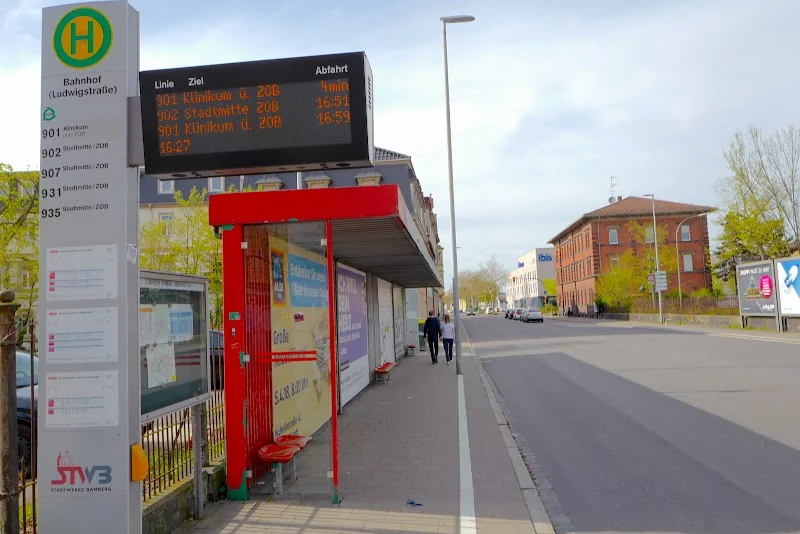
Those searching for Bamberg Station/Ludwigstr. are practically always referring to the best combination of train connection and city bus. This is where the strength of the location lies: The Bamberg station is embedded in regional and urban traffic and serves as a hub for transfers to the city center, local districts, or the region. The city transport map of VGN shows several bus lines around the station and Ludwigstraße, including 901, 902, 907, 911, 914, 919, 931, and 935. These lines connect the station with ZOB, the stadium, Hertzstraße, Kramersfeld, Kronacher Straße, Gartenstadt, and other destinations in the city area. This is important for travelers because they do not have to search complicatedly at the station but quickly understand in which direction the next connection is heading. Additionally, the structure of the station itself is strong: The station map shows clear exits to Ludwigstraße, Brennerstraße, and towards the city center. So, if one does not immediately board the bus, they can continue on foot to the old town or the urban core. The rail connection is also strong: The VGN city transport map and the train information show Bamberg as an important station on connections to Nuremberg, Forchheim, Coburg, Hof, Haßfurt, Ebern, and other destinations. Thus, the location is not only the starting and ending point of individual journeys but also a place of transition between regional transport, long-distance transport, and urban mobility. Especially for users searching for terms like bamberg station access or ludwigstraße station bamberg, this is the most important information: Here, train and bus do not meet by chance but are closely intertwined as a mobility space. ([vgn.de](https://www.vgn.de/media/stadtverkehr_bamberg.pdf))
For practical planning, it also helps that the stop names in the vicinity are very clear. Official documents list Bamberg Station/Ludwigstr., Bamberg Bf/Ludwigstr., Station/Brennerstraße, and other adjacent points. This is useful because it makes it easier for visitors to navigate through timetable information, apps, or maps. Those disembarking from the train should not only look for the station name but also pay attention to the direction: towards the city, away from the city, or towards the city center. The Bamberg public utilities also point out that the system is connected to the VGN fare logic and that city boundary rides can be planned as usual through the timetable information. For visitors, this means: A transfer from the train to the city bus is relatively uncomplicated in Bamberg, as long as one pays attention to the line direction and the stop name. Especially at a station with so many connections, a quick look at the line route is worthwhile before heading out. For example, those traveling with luggage want to know whether the next bus departs from the station forecourt, Ludwigstraße, or one of the neighboring stops. The official maps make this orientation possible and show that the location is not just a station but a well-structured transfer point where the paths between train, bus, and city center remain short. ([vgn.de](https://www.vgn.de/media/stadtverkehr_bamberg.pdf))
Parking at Bamberg Station: Forecourt, Left, and P+R
The keyword parking is one of the most important inquiries for this location, and the official DB BahnPark page provides concrete answers. Directly at the station forecourt, there is an open parking area with 34 spaces, including one accessible space, and the distance to the station is less than 50 meters. The Bamberg Station left parking lot offers 80 spaces, including two barrier-free spaces, and is less than 100 meters away. This offer is complemented by the P+R lot at Bahnhof/Brennerstraße with 113 spaces and five barrier-free spaces. This is interesting for short-term guests, commuters, and travelers with hand luggage alike, as they can choose between very close parking spaces and a classic park-and-ride approach. According to DB, the facilities are accessible around the clock, making them suitable not only for day guests but also for travelers with early departures or late arrivals. The payment options are practical: depending on the facility, coins, Visa, MasterCard, bank cards, and mobile payment via Parkster are possible. The prices are also transparently displayed, for example, for 30 minutes, one hour, one day, one week, or one month. For people with longer stays, it is particularly important that there is not just one option but several parking zones with different walking distances and rates. This way, visitors can choose the parking lot according to their travel duration. So, those searching for bamberg station parking or bamberg main station ludwigstraße 6 not only get an address here but a functioning parking system with understandable prices and clear signage. ([bahnhof.de](https://www.bahnhof.de/en/bamberg/parking-spaces))
The advantage of this parking structure lies primarily in the mix of proximity and choice. The forecourt is the quickest solution for short errands, picking up or dropping off, while the facilities to the left of the station and on Brennerstraße offer more space for longer stays. For travelers with multiple suitcases or families with children, it is helpful that the paths remain short and the entrances to the station do not have to be searched through large detours. Additionally, the station map shows other stationary elements such as taxis, lockers, public toilets, ticket sales, and access to the travel center. Those parking their car can therefore take care of several things at once: buying a ticket, obtaining travel information, storing luggage, and then continuing by train or city bus. It is also practical that the P+R concept in Bamberg is not just theoretical but is implemented directly at the station. For commuters from the surrounding area, this is a real advantage as car and train can be connected in a well-thought-out system. Especially since Bamberg offers both regional train connections and urban routes, parking spaces at the station are not just a minor issue. They are part of the mobility promise of the location. So, those looking for a place to park quickly, transfer, and continue their journey will find a relatively comfortable overall package at Bamberg Station. ([bahnhof.de](https://www.bahnhof.de/en/bamberg/parking-spaces))
Accessibility, Elevators, and Traveler Services
A frequent search need around Bamberg Station concerns accessibility. The official DB infrastructure data shows that the station is equipped with four elevators and that the platforms are accessible without steps. For tracks 2 to 6 and 8, step-free access via elevator is indicated, and there are tactile guide strips and platform section markings at the platforms. This is an important note for travelers with wheelchairs, walkers, strollers, or heavy luggage, as the station is not only formally accessible but also practically oriented towards a broad user base. Furthermore, DB recommends prior registration with the mobility service for reliable assistance with boarding, transfers, and alighting. On-site, mobile service staff are available, as well as DB Information and a video travel center with clearly indicated opening hours. Additionally, the station page mentions a 3-S-Center North Franconia, which can be contacted for questions about service, safety, or cleanliness. Even if such details are only marginal information for some travelers, they make a significant difference in everyday life: Those arriving with little time do not want to first search for contact persons but need clear help, immediate orientation, and quick paths. This is exactly what the station provides with its combination of information, service personnel, and technical equipment. Therefore, the keyword bamberg station accessibility is particularly worthwhile, as it describes a real added value of the location. The station is not only reachable but prepared for many user situations. ([dbinfrago.com](https://www.dbinfrago.com/web/bahnhoefe/leistungen/stationsnutzung/stationshalt/stationsausstattung/Bamberg-12674678))
The service concept also includes practical facilities that one often only appreciates when they are truly needed. The station map indicates lockers, toilets, taxis, ticket sales, travel services, information, and an EC cash machine. The equipment list also includes a bicycle parking garage and bicycle parking spaces, which are relevant for commuters and tourists with bikes alike. Especially in a city like Bamberg, where many paths are short and the bicycle can be a sensible complement to the train, this is a useful part of the overall concept. The station is also smoke-free and monitored by cameras, which increases the sense of security for many users. Those not only wanting to arrive but also reliably plan further can benefit from the clear structure: up-to-date travel information, site plans, timetables as PDF, replacement transport information, elevators, station maps, and service points are directly accessible via the station page. The video travel center is also practical for many as it allows personal advice without every question being tied to a traditional counter. Taken together, this creates a station that works for different groups: for older travelers, for families, for commuters, for cyclists, and for guests who are just looking for a good transfer station. From an SEO perspective, this is important because search queries for toilets, travel centers, elevators, lockers, or bicycle parking garages are not just additions but reflect real usage intentions. ([dbinfrago.com](https://www.dbinfrago.com/web/bahnhoefe/leistungen/stationsnutzung/stationshalt/stationsausstattung/Bamberg-12674678))
Tracks, Platforms, and Transfers at Bamberg Station
Those searching for bamberg station tracks or for the seating and platform area need precise information about the structure of the station. DB InfraGO indicates that Bamberg has seven usable platform tracks, namely 1, 2, 3, 4, 5, 6, and 8. Track 1 is located at the main platform, while the other tracks are accessed via platforms with heights of 76 centimeters or, at the main platform, also 55 centimeters. The platform lengths vary and range from shorter sections to very long platform edges, which is important for accommodating different types of trains. For travelers, this means above all that Bamberg is not a small stop system but a station with real transport significance in the regional network. The station page and VGN documents make it clear that the location is integrated into various transport relations, such as towards Nuremberg, Forchheim, Hartmannshof, Coburg, Hof, Haßfurt, Ebern, and other destinations. So, those transferring here not only have the next city bus in sight but often also the choice between regional trains, regional express trains, and connecting services. This is one of the reasons why search queries around Bamberg main station or Bamberg station focus so heavily on orientation and routes. The station is a transfer point where the correct platform side, the right direction, and the next connecting line matter. With four elevators, tactile guide strips, and clear platform sections, orientation is pleasantly straightforward compared to many other stations. Especially the connection between technical equipment and well-readable train connections makes the location practical. ([dbinfrago.com](https://www.dbinfrago.com/web/bahnhoefe/leistungen/stationsnutzung/stationshalt/stationsausstattung/Bamberg-12674678))
For daily use, it is also important that the arrival and departure logic at the station is easy to understand. The bahnhof.de page offers live departures and arrivals, timetables as PDF, replacement transport information, and an orientation site plan. This initially sounds standard, but in everyday life, it is precisely what travelers need. Those arriving by train or regional express want to know where the exits are, how to get to Ludwigstraße, where the bus connection is located, and whether there is a taxi directly on site. This information is clearly bundled at Bamberg Station. The fact that Bamberg city transport serves several important lines from the station makes the station particularly valuable for transfers into the city. Additionally, the railway company considers the station a service location and not just a track facility. This is evident from the DB Information, the travel center, the mobile service staff, and the video travel center. For travelers arriving spontaneously, this is a reassuring factor. And for commuters who board and alight daily, the clear connection between platform, elevator, bus, and exits is the actual added value. In search terms like access, tracks, bus lines, and DB travel center, there is always a desire for reliable orientation. Bamberg fulfills this wish with a remarkably dense and well-readable station structure for a city of this size. ([bahnhof.de](https://www.bahnhof.de/bamberg))
Location, Surroundings, and Routes to the City Center
The location of the station is a central reason why the site is searched so often. The station map explicitly shows an exit towards the city center, and the city guide from visitBamberg mentions nearby places including the Gardener's and Hackers' Museum, the Gardener's City, the Fässla Brewery, and the Spezial Brewery. This makes it clear that the station is not isolated but located on one of the most important urban axes in the transition between traffic and urban life. So, those disembarking from the train and wanting to continue directly in Bamberg find themselves in an area where short distances actually work. Ludwigstraße is also a good indication of this: It runs towards the station and connects the station area with the historical urban structure. Especially visitors who use the station not just as a stopping point but as a starting point for a city stroll benefit from this location. The proximity to the Gardener's City and urban attractions is therefore not only of tourist interest but also functional. One saves paths, finds orientation more quickly, and can explore the city on foot or by bus. For search queries like bamberg station city center or bamberg ludwigstraße station, this is the decisive answer: The station belongs to the city center logic and not to a remote edge area. It is thus a typical urban entrance station where arrival, stay, and onward movement are directly connected. ([bahnhof.de](https://www.bahnhof.de/downloads/station-plans/393.pdf))
From a cultural-historical perspective, the surroundings are also exciting because they embed the station's location into an older urban and trade memory. The UNESCO World Heritage documents for the Gardener's District show that Luitpoldstraße runs directly towards the station and that the station has been an important point for the transport of garden products since its opening in 1844. This clarifies why the station must be read not only as technical infrastructure but as part of urban development. The location has changed the paths of Bamberg's gardeners, who previously transported their products differently, and has simultaneously triggered new construction and growth dynamics. Today, the location is of course relevant for modern travelers, but the basic principle remains: Those arriving at the station stand at a place that opens the city outward. This makes it interesting for business travelers, tourists, and people who simply need a good connection. The mix of short distance to the city center, direct access to bus and train, and an environment with distinctive urban spaces is a significant location advantage. Therefore, Bamberg Station/Ludwigstr. is rightly often searched via very concrete navigation terms. Users do not want just any station but exactly the point where city, traffic, and everyday paths meet. And this is precisely what this location describes very accurately. ([welterbe.bamberg.de](https://welterbe.bamberg.de/media/attachments/2017/11/09/kinderfuhrer-druckfreigabe-1.pdf))
History of the Station and Its Significance for Bamberg
The history of Bamberg Station is closely linked to the economic development of the city. The UNESCO World Heritage documents for the Gardener's District mention the year 1844 as the opening year of the station and explain how important the railway became for the city gardening. After the station was opened, the gardeners recognized the benefits of the fast means of transport and ceased mass seed production in favor of fresh vegetable sales. This is a remarkable detail because it shows that the station not only transported travelers but also influenced entire economic structures. The railway was thus a lever for the transition from the local sales market to a broader distribution. The city of Bamberg itself also describes that it has historically been shaped by structural change on many levels; the station is clearly one of these shaping elements. From an SEO perspective, this is valuable because search queries about history, special features, or background are not mere supplementary topics but genuine information needs. Those visiting station pages often want to know why this place is important, and in Bamberg, the answer is: because here mobility, urban development, and gardening history are closely intertwined. The station is therefore not randomly located at this point but forms a junction in the development of the city. The official World Heritage publication also makes it clear that Luitpoldstraße runs directly towards the station and that the surrounding buildings were connected to growth around 1850. This underscores the role of the station as an organizing motor of a growing city. ([welterbe.bamberg.de](https://welterbe.bamberg.de/media/attachments/2017/11/09/kinderfuhrer-druckfreigabe-1.pdf))
Even today, this historical influence continues to resonate when one considers the location in relation to the surroundings and transport routes. The station was early on not just an endpoint of a route but part of an expanding network. For travelers, this is today primarily visible as good accessibility: The station offers platforms, bus connections, parking options, and service points in a compact environment. Historically, this compactness is precisely the result of urban development around Ludwigstraße and the station area. The location has thus become increasingly integrated into the city over time. The connection between past and present is particularly appealing: Previously, the rapid transport of vegetables and goods was central; today, the focus is on fast, comfortable passenger transport. Nevertheless, the basic idea remains the same, namely the integration of movement, supply, and urban life. So, those searching for bamberg station or bamberg ludwigstr 6 are essentially looking for the same place that has already shaped the development of the district in the 19th century. This gives the station a special depth that goes beyond mere function. It is not just a stop but a place with history, urban relevance, and lasting significance for everyday life and tourism. This mix of practical relevance and historical embedding makes Bamberg Station/Ludwigstr. a location that one not only wants to pass through but also to learn about. ([welterbe.bamberg.de](https://welterbe.bamberg.de/media/attachments/2017/11/09/kinderfuhrer-druckfreigabe-1.pdf))
Practical Orientation for Visitors, Commuters, and Day Guests
For visitors, commuters, and day guests, Bamberg Station/Ludwigstr. can best be described as a compact, well-connected mobility hub. The search intent behind terms like access, parking, accessibility, timetable, or DB travel center shows that people prefer to know what to expect on-site even before arrival. This is precisely what makes this station strong: It bundles rail, bus, taxi, bicycle, and parking at one address, creating a clear starting point for everything else. Those disembarking from the train can quickly orient themselves towards Ludwigstraße or the city center based on the exits. Those arriving by car find several parking options in very short distance. Those in need of assistance can rely on elevators, barrier-free access, and service personnel. Those wanting to explore the city by bus have a direct connection to several city transport lines. And those needing to take care of something on-site can use the travel center, information, lockers, or lost property service. Overall, this is a very rounded profile for a station page, as it answers real questions instead of just providing general platitudes. From an SEO perspective, these points are the key topics: access, parking, bus lines, accessibility, tracks, service, and location. The station in Bamberg provides reliable, official information for all these topics. Therefore, it is worthwhile to view the address Ludwigstr. 6 not just as a location on a map but as a hub of a functioning mobility mix. ([bahnhof.de](https://www.bahnhof.de/bamberg))
Those wanting to use the location efficiently particularly benefit from a small rule: first clarify the direction, then choose the connection. This applies to arriving by regional train as well as transferring to the city bus or continuing by car. This is precisely why the station is so well suited for search queries with very specific additional terms like Ludwigstraße, Station/Ludwigstr., main station, parking, or city center. The location answers these search queries with genuine substance: It is located at a clearly named address, has visible exits, is connected to several urban lines, and offers practical facilities on-site. When all this is combined, a useful place for daily mobility in Bamberg emerges. The description of this station does not need to be artificially complicated. It can directly say: Here you arrive, here you transfer, here you park, here you orient yourself, and here you quickly reach the city. This simplicity makes the location attractive. And that is why Bamberg Station/Ludwigstr. remains a sensible starting point for all those arriving in Bamberg or continuing their journey from here. ([bahnhof.de](https://www.bahnhof.de/downloads/station-plans/393.pdf))
Sources:
Mehr anzeigenWeniger anzeigen
Bamberg Station/Ludwigstr. | Access & Parking
Bamberg Station/Ludwigstr. is primarily one thing for many inquiries: the practical address for arrival, transfer, and onward travel in the city of Bamberg. The official station address is Ludwigstr. 6, 96052 Bamberg. Those arriving here do not land at an anonymous edge point, but at a location that brings together rail traffic, city buses, the walking path to the city center, bicycles, and several parking options in a compact space. This mix makes the station highly relevant for commuters, visitors, day-trippers, and travelers with luggage. The station is equipped with a DB Travel Center, DB Information, elevators, a bicycle parking garage, toilets, taxis, and other travel services; additionally, the station map and station data clearly show the routes to the exits towards Ludwigstraße, Brennerstraße, and the city center. For a city like Bamberg, where short distances and reliable orientation play a significant role, this is a real advantage. The surrounding area is also not arbitrary: The station is close to central urban axes and within reach of attractions and neighborhoods that shape Bamberg as a city of short distances. Therefore, the location is interesting not only as a transport point but also as a base for city visits, business trips, and daily mobility. ([bahnhof.de](https://www.bahnhof.de/bamberg))
Access by Train and Bus at Station/Ludwigstraße
Those searching for Bamberg Station/Ludwigstr. are practically always referring to the best combination of train connection and city bus. This is where the strength of the location lies: The Bamberg station is embedded in regional and urban traffic and serves as a hub for transfers to the city center, local districts, or the region. The city transport map of VGN shows several bus lines around the station and Ludwigstraße, including 901, 902, 907, 911, 914, 919, 931, and 935. These lines connect the station with ZOB, the stadium, Hertzstraße, Kramersfeld, Kronacher Straße, Gartenstadt, and other destinations in the city area. This is important for travelers because they do not have to search complicatedly at the station but quickly understand in which direction the next connection is heading. Additionally, the structure of the station itself is strong: The station map shows clear exits to Ludwigstraße, Brennerstraße, and towards the city center. So, if one does not immediately board the bus, they can continue on foot to the old town or the urban core. The rail connection is also strong: The VGN city transport map and the train information show Bamberg as an important station on connections to Nuremberg, Forchheim, Coburg, Hof, Haßfurt, Ebern, and other destinations. Thus, the location is not only the starting and ending point of individual journeys but also a place of transition between regional transport, long-distance transport, and urban mobility. Especially for users searching for terms like bamberg station access or ludwigstraße station bamberg, this is the most important information: Here, train and bus do not meet by chance but are closely intertwined as a mobility space. ([vgn.de](https://www.vgn.de/media/stadtverkehr_bamberg.pdf))
For practical planning, it also helps that the stop names in the vicinity are very clear. Official documents list Bamberg Station/Ludwigstr., Bamberg Bf/Ludwigstr., Station/Brennerstraße, and other adjacent points. This is useful because it makes it easier for visitors to navigate through timetable information, apps, or maps. Those disembarking from the train should not only look for the station name but also pay attention to the direction: towards the city, away from the city, or towards the city center. The Bamberg public utilities also point out that the system is connected to the VGN fare logic and that city boundary rides can be planned as usual through the timetable information. For visitors, this means: A transfer from the train to the city bus is relatively uncomplicated in Bamberg, as long as one pays attention to the line direction and the stop name. Especially at a station with so many connections, a quick look at the line route is worthwhile before heading out. For example, those traveling with luggage want to know whether the next bus departs from the station forecourt, Ludwigstraße, or one of the neighboring stops. The official maps make this orientation possible and show that the location is not just a station but a well-structured transfer point where the paths between train, bus, and city center remain short. ([vgn.de](https://www.vgn.de/media/stadtverkehr_bamberg.pdf))
Parking at Bamberg Station: Forecourt, Left, and P+R
The keyword parking is one of the most important inquiries for this location, and the official DB BahnPark page provides concrete answers. Directly at the station forecourt, there is an open parking area with 34 spaces, including one accessible space, and the distance to the station is less than 50 meters. The Bamberg Station left parking lot offers 80 spaces, including two barrier-free spaces, and is less than 100 meters away. This offer is complemented by the P+R lot at Bahnhof/Brennerstraße with 113 spaces and five barrier-free spaces. This is interesting for short-term guests, commuters, and travelers with hand luggage alike, as they can choose between very close parking spaces and a classic park-and-ride approach. According to DB, the facilities are accessible around the clock, making them suitable not only for day guests but also for travelers with early departures or late arrivals. The payment options are practical: depending on the facility, coins, Visa, MasterCard, bank cards, and mobile payment via Parkster are possible. The prices are also transparently displayed, for example, for 30 minutes, one hour, one day, one week, or one month. For people with longer stays, it is particularly important that there is not just one option but several parking zones with different walking distances and rates. This way, visitors can choose the parking lot according to their travel duration. So, those searching for bamberg station parking or bamberg main station ludwigstraße 6 not only get an address here but a functioning parking system with understandable prices and clear signage. ([bahnhof.de](https://www.bahnhof.de/en/bamberg/parking-spaces))
The advantage of this parking structure lies primarily in the mix of proximity and choice. The forecourt is the quickest solution for short errands, picking up or dropping off, while the facilities to the left of the station and on Brennerstraße offer more space for longer stays. For travelers with multiple suitcases or families with children, it is helpful that the paths remain short and the entrances to the station do not have to be searched through large detours. Additionally, the station map shows other stationary elements such as taxis, lockers, public toilets, ticket sales, and access to the travel center. Those parking their car can therefore take care of several things at once: buying a ticket, obtaining travel information, storing luggage, and then continuing by train or city bus. It is also practical that the P+R concept in Bamberg is not just theoretical but is implemented directly at the station. For commuters from the surrounding area, this is a real advantage as car and train can be connected in a well-thought-out system. Especially since Bamberg offers both regional train connections and urban routes, parking spaces at the station are not just a minor issue. They are part of the mobility promise of the location. So, those looking for a place to park quickly, transfer, and continue their journey will find a relatively comfortable overall package at Bamberg Station. ([bahnhof.de](https://www.bahnhof.de/en/bamberg/parking-spaces))
Accessibility, Elevators, and Traveler Services
A frequent search need around Bamberg Station concerns accessibility. The official DB infrastructure data shows that the station is equipped with four elevators and that the platforms are accessible without steps. For tracks 2 to 6 and 8, step-free access via elevator is indicated, and there are tactile guide strips and platform section markings at the platforms. This is an important note for travelers with wheelchairs, walkers, strollers, or heavy luggage, as the station is not only formally accessible but also practically oriented towards a broad user base. Furthermore, DB recommends prior registration with the mobility service for reliable assistance with boarding, transfers, and alighting. On-site, mobile service staff are available, as well as DB Information and a video travel center with clearly indicated opening hours. Additionally, the station page mentions a 3-S-Center North Franconia, which can be contacted for questions about service, safety, or cleanliness. Even if such details are only marginal information for some travelers, they make a significant difference in everyday life: Those arriving with little time do not want to first search for contact persons but need clear help, immediate orientation, and quick paths. This is exactly what the station provides with its combination of information, service personnel, and technical equipment. Therefore, the keyword bamberg station accessibility is particularly worthwhile, as it describes a real added value of the location. The station is not only reachable but prepared for many user situations. ([dbinfrago.com](https://www.dbinfrago.com/web/bahnhoefe/leistungen/stationsnutzung/stationshalt/stationsausstattung/Bamberg-12674678))
The service concept also includes practical facilities that one often only appreciates when they are truly needed. The station map indicates lockers, toilets, taxis, ticket sales, travel services, information, and an EC cash machine. The equipment list also includes a bicycle parking garage and bicycle parking spaces, which are relevant for commuters and tourists with bikes alike. Especially in a city like Bamberg, where many paths are short and the bicycle can be a sensible complement to the train, this is a useful part of the overall concept. The station is also smoke-free and monitored by cameras, which increases the sense of security for many users. Those not only wanting to arrive but also reliably plan further can benefit from the clear structure: up-to-date travel information, site plans, timetables as PDF, replacement transport information, elevators, station maps, and service points are directly accessible via the station page. The video travel center is also practical for many as it allows personal advice without every question being tied to a traditional counter. Taken together, this creates a station that works for different groups: for older travelers, for families, for commuters, for cyclists, and for guests who are just looking for a good transfer station. From an SEO perspective, this is important because search queries for toilets, travel centers, elevators, lockers, or bicycle parking garages are not just additions but reflect real usage intentions. ([dbinfrago.com](https://www.dbinfrago.com/web/bahnhoefe/leistungen/stationsnutzung/stationshalt/stationsausstattung/Bamberg-12674678))
Tracks, Platforms, and Transfers at Bamberg Station
Those searching for bamberg station tracks or for the seating and platform area need precise information about the structure of the station. DB InfraGO indicates that Bamberg has seven usable platform tracks, namely 1, 2, 3, 4, 5, 6, and 8. Track 1 is located at the main platform, while the other tracks are accessed via platforms with heights of 76 centimeters or, at the main platform, also 55 centimeters. The platform lengths vary and range from shorter sections to very long platform edges, which is important for accommodating different types of trains. For travelers, this means above all that Bamberg is not a small stop system but a station with real transport significance in the regional network. The station page and VGN documents make it clear that the location is integrated into various transport relations, such as towards Nuremberg, Forchheim, Hartmannshof, Coburg, Hof, Haßfurt, Ebern, and other destinations. So, those transferring here not only have the next city bus in sight but often also the choice between regional trains, regional express trains, and connecting services. This is one of the reasons why search queries around Bamberg main station or Bamberg station focus so heavily on orientation and routes. The station is a transfer point where the correct platform side, the right direction, and the next connecting line matter. With four elevators, tactile guide strips, and clear platform sections, orientation is pleasantly straightforward compared to many other stations. Especially the connection between technical equipment and well-readable train connections makes the location practical. ([dbinfrago.com](https://www.dbinfrago.com/web/bahnhoefe/leistungen/stationsnutzung/stationshalt/stationsausstattung/Bamberg-12674678))
For daily use, it is also important that the arrival and departure logic at the station is easy to understand. The bahnhof.de page offers live departures and arrivals, timetables as PDF, replacement transport information, and an orientation site plan. This initially sounds standard, but in everyday life, it is precisely what travelers need. Those arriving by train or regional express want to know where the exits are, how to get to Ludwigstraße, where the bus connection is located, and whether there is a taxi directly on site. This information is clearly bundled at Bamberg Station. The fact that Bamberg city transport serves several important lines from the station makes the station particularly valuable for transfers into the city. Additionally, the railway company considers the station a service location and not just a track facility. This is evident from the DB Information, the travel center, the mobile service staff, and the video travel center. For travelers arriving spontaneously, this is a reassuring factor. And for commuters who board and alight daily, the clear connection between platform, elevator, bus, and exits is the actual added value. In search terms like access, tracks, bus lines, and DB travel center, there is always a desire for reliable orientation. Bamberg fulfills this wish with a remarkably dense and well-readable station structure for a city of this size. ([bahnhof.de](https://www.bahnhof.de/bamberg))
Location, Surroundings, and Routes to the City Center
The location of the station is a central reason why the site is searched so often. The station map explicitly shows an exit towards the city center, and the city guide from visitBamberg mentions nearby places including the Gardener's and Hackers' Museum, the Gardener's City, the Fässla Brewery, and the Spezial Brewery. This makes it clear that the station is not isolated but located on one of the most important urban axes in the transition between traffic and urban life. So, those disembarking from the train and wanting to continue directly in Bamberg find themselves in an area where short distances actually work. Ludwigstraße is also a good indication of this: It runs towards the station and connects the station area with the historical urban structure. Especially visitors who use the station not just as a stopping point but as a starting point for a city stroll benefit from this location. The proximity to the Gardener's City and urban attractions is therefore not only of tourist interest but also functional. One saves paths, finds orientation more quickly, and can explore the city on foot or by bus. For search queries like bamberg station city center or bamberg ludwigstraße station, this is the decisive answer: The station belongs to the city center logic and not to a remote edge area. It is thus a typical urban entrance station where arrival, stay, and onward movement are directly connected. ([bahnhof.de](https://www.bahnhof.de/downloads/station-plans/393.pdf))
From a cultural-historical perspective, the surroundings are also exciting because they embed the station's location into an older urban and trade memory. The UNESCO World Heritage documents for the Gardener's District show that Luitpoldstraße runs directly towards the station and that the station has been an important point for the transport of garden products since its opening in 1844. This clarifies why the station must be read not only as technical infrastructure but as part of urban development. The location has changed the paths of Bamberg's gardeners, who previously transported their products differently, and has simultaneously triggered new construction and growth dynamics. Today, the location is of course relevant for modern travelers, but the basic principle remains: Those arriving at the station stand at a place that opens the city outward. This makes it interesting for business travelers, tourists, and people who simply need a good connection. The mix of short distance to the city center, direct access to bus and train, and an environment with distinctive urban spaces is a significant location advantage. Therefore, Bamberg Station/Ludwigstr. is rightly often searched via very concrete navigation terms. Users do not want just any station but exactly the point where city, traffic, and everyday paths meet. And this is precisely what this location describes very accurately. ([welterbe.bamberg.de](https://welterbe.bamberg.de/media/attachments/2017/11/09/kinderfuhrer-druckfreigabe-1.pdf))
History of the Station and Its Significance for Bamberg
The history of Bamberg Station is closely linked to the economic development of the city. The UNESCO World Heritage documents for the Gardener's District mention the year 1844 as the opening year of the station and explain how important the railway became for the city gardening. After the station was opened, the gardeners recognized the benefits of the fast means of transport and ceased mass seed production in favor of fresh vegetable sales. This is a remarkable detail because it shows that the station not only transported travelers but also influenced entire economic structures. The railway was thus a lever for the transition from the local sales market to a broader distribution. The city of Bamberg itself also describes that it has historically been shaped by structural change on many levels; the station is clearly one of these shaping elements. From an SEO perspective, this is valuable because search queries about history, special features, or background are not mere supplementary topics but genuine information needs. Those visiting station pages often want to know why this place is important, and in Bamberg, the answer is: because here mobility, urban development, and gardening history are closely intertwined. The station is therefore not randomly located at this point but forms a junction in the development of the city. The official World Heritage publication also makes it clear that Luitpoldstraße runs directly towards the station and that the surrounding buildings were connected to growth around 1850. This underscores the role of the station as an organizing motor of a growing city. ([welterbe.bamberg.de](https://welterbe.bamberg.de/media/attachments/2017/11/09/kinderfuhrer-druckfreigabe-1.pdf))
Even today, this historical influence continues to resonate when one considers the location in relation to the surroundings and transport routes. The station was early on not just an endpoint of a route but part of an expanding network. For travelers, this is today primarily visible as good accessibility: The station offers platforms, bus connections, parking options, and service points in a compact environment. Historically, this compactness is precisely the result of urban development around Ludwigstraße and the station area. The location has thus become increasingly integrated into the city over time. The connection between past and present is particularly appealing: Previously, the rapid transport of vegetables and goods was central; today, the focus is on fast, comfortable passenger transport. Nevertheless, the basic idea remains the same, namely the integration of movement, supply, and urban life. So, those searching for bamberg station or bamberg ludwigstr 6 are essentially looking for the same place that has already shaped the development of the district in the 19th century. This gives the station a special depth that goes beyond mere function. It is not just a stop but a place with history, urban relevance, and lasting significance for everyday life and tourism. This mix of practical relevance and historical embedding makes Bamberg Station/Ludwigstr. a location that one not only wants to pass through but also to learn about. ([welterbe.bamberg.de](https://welterbe.bamberg.de/media/attachments/2017/11/09/kinderfuhrer-druckfreigabe-1.pdf))
Practical Orientation for Visitors, Commuters, and Day Guests
For visitors, commuters, and day guests, Bamberg Station/Ludwigstr. can best be described as a compact, well-connected mobility hub. The search intent behind terms like access, parking, accessibility, timetable, or DB travel center shows that people prefer to know what to expect on-site even before arrival. This is precisely what makes this station strong: It bundles rail, bus, taxi, bicycle, and parking at one address, creating a clear starting point for everything else. Those disembarking from the train can quickly orient themselves towards Ludwigstraße or the city center based on the exits. Those arriving by car find several parking options in very short distance. Those in need of assistance can rely on elevators, barrier-free access, and service personnel. Those wanting to explore the city by bus have a direct connection to several city transport lines. And those needing to take care of something on-site can use the travel center, information, lockers, or lost property service. Overall, this is a very rounded profile for a station page, as it answers real questions instead of just providing general platitudes. From an SEO perspective, these points are the key topics: access, parking, bus lines, accessibility, tracks, service, and location. The station in Bamberg provides reliable, official information for all these topics. Therefore, it is worthwhile to view the address Ludwigstr. 6 not just as a location on a map but as a hub of a functioning mobility mix. ([bahnhof.de](https://www.bahnhof.de/bamberg))
Those wanting to use the location efficiently particularly benefit from a small rule: first clarify the direction, then choose the connection. This applies to arriving by regional train as well as transferring to the city bus or continuing by car. This is precisely why the station is so well suited for search queries with very specific additional terms like Ludwigstraße, Station/Ludwigstr., main station, parking, or city center. The location answers these search queries with genuine substance: It is located at a clearly named address, has visible exits, is connected to several urban lines, and offers practical facilities on-site. When all this is combined, a useful place for daily mobility in Bamberg emerges. The description of this station does not need to be artificially complicated. It can directly say: Here you arrive, here you transfer, here you park, here you orient yourself, and here you quickly reach the city. This simplicity makes the location attractive. And that is why Bamberg Station/Ludwigstr. remains a sensible starting point for all those arriving in Bamberg or continuing their journey from here. ([bahnhof.de](https://www.bahnhof.de/downloads/station-plans/393.pdf))
Sources:
Bamberg Station/Ludwigstr. | Access & Parking
Bamberg Station/Ludwigstr. is primarily one thing for many inquiries: the practical address for arrival, transfer, and onward travel in the city of Bamberg. The official station address is Ludwigstr. 6, 96052 Bamberg. Those arriving here do not land at an anonymous edge point, but at a location that brings together rail traffic, city buses, the walking path to the city center, bicycles, and several parking options in a compact space. This mix makes the station highly relevant for commuters, visitors, day-trippers, and travelers with luggage. The station is equipped with a DB Travel Center, DB Information, elevators, a bicycle parking garage, toilets, taxis, and other travel services; additionally, the station map and station data clearly show the routes to the exits towards Ludwigstraße, Brennerstraße, and the city center. For a city like Bamberg, where short distances and reliable orientation play a significant role, this is a real advantage. The surrounding area is also not arbitrary: The station is close to central urban axes and within reach of attractions and neighborhoods that shape Bamberg as a city of short distances. Therefore, the location is interesting not only as a transport point but also as a base for city visits, business trips, and daily mobility. ([bahnhof.de](https://www.bahnhof.de/bamberg))
Access by Train and Bus at Station/Ludwigstraße
Those searching for Bamberg Station/Ludwigstr. are practically always referring to the best combination of train connection and city bus. This is where the strength of the location lies: The Bamberg station is embedded in regional and urban traffic and serves as a hub for transfers to the city center, local districts, or the region. The city transport map of VGN shows several bus lines around the station and Ludwigstraße, including 901, 902, 907, 911, 914, 919, 931, and 935. These lines connect the station with ZOB, the stadium, Hertzstraße, Kramersfeld, Kronacher Straße, Gartenstadt, and other destinations in the city area. This is important for travelers because they do not have to search complicatedly at the station but quickly understand in which direction the next connection is heading. Additionally, the structure of the station itself is strong: The station map shows clear exits to Ludwigstraße, Brennerstraße, and towards the city center. So, if one does not immediately board the bus, they can continue on foot to the old town or the urban core. The rail connection is also strong: The VGN city transport map and the train information show Bamberg as an important station on connections to Nuremberg, Forchheim, Coburg, Hof, Haßfurt, Ebern, and other destinations. Thus, the location is not only the starting and ending point of individual journeys but also a place of transition between regional transport, long-distance transport, and urban mobility. Especially for users searching for terms like bamberg station access or ludwigstraße station bamberg, this is the most important information: Here, train and bus do not meet by chance but are closely intertwined as a mobility space. ([vgn.de](https://www.vgn.de/media/stadtverkehr_bamberg.pdf))
For practical planning, it also helps that the stop names in the vicinity are very clear. Official documents list Bamberg Station/Ludwigstr., Bamberg Bf/Ludwigstr., Station/Brennerstraße, and other adjacent points. This is useful because it makes it easier for visitors to navigate through timetable information, apps, or maps. Those disembarking from the train should not only look for the station name but also pay attention to the direction: towards the city, away from the city, or towards the city center. The Bamberg public utilities also point out that the system is connected to the VGN fare logic and that city boundary rides can be planned as usual through the timetable information. For visitors, this means: A transfer from the train to the city bus is relatively uncomplicated in Bamberg, as long as one pays attention to the line direction and the stop name. Especially at a station with so many connections, a quick look at the line route is worthwhile before heading out. For example, those traveling with luggage want to know whether the next bus departs from the station forecourt, Ludwigstraße, or one of the neighboring stops. The official maps make this orientation possible and show that the location is not just a station but a well-structured transfer point where the paths between train, bus, and city center remain short. ([vgn.de](https://www.vgn.de/media/stadtverkehr_bamberg.pdf))
Parking at Bamberg Station: Forecourt, Left, and P+R
The keyword parking is one of the most important inquiries for this location, and the official DB BahnPark page provides concrete answers. Directly at the station forecourt, there is an open parking area with 34 spaces, including one accessible space, and the distance to the station is less than 50 meters. The Bamberg Station left parking lot offers 80 spaces, including two barrier-free spaces, and is less than 100 meters away. This offer is complemented by the P+R lot at Bahnhof/Brennerstraße with 113 spaces and five barrier-free spaces. This is interesting for short-term guests, commuters, and travelers with hand luggage alike, as they can choose between very close parking spaces and a classic park-and-ride approach. According to DB, the facilities are accessible around the clock, making them suitable not only for day guests but also for travelers with early departures or late arrivals. The payment options are practical: depending on the facility, coins, Visa, MasterCard, bank cards, and mobile payment via Parkster are possible. The prices are also transparently displayed, for example, for 30 minutes, one hour, one day, one week, or one month. For people with longer stays, it is particularly important that there is not just one option but several parking zones with different walking distances and rates. This way, visitors can choose the parking lot according to their travel duration. So, those searching for bamberg station parking or bamberg main station ludwigstraße 6 not only get an address here but a functioning parking system with understandable prices and clear signage. ([bahnhof.de](https://www.bahnhof.de/en/bamberg/parking-spaces))
The advantage of this parking structure lies primarily in the mix of proximity and choice. The forecourt is the quickest solution for short errands, picking up or dropping off, while the facilities to the left of the station and on Brennerstraße offer more space for longer stays. For travelers with multiple suitcases or families with children, it is helpful that the paths remain short and the entrances to the station do not have to be searched through large detours. Additionally, the station map shows other stationary elements such as taxis, lockers, public toilets, ticket sales, and access to the travel center. Those parking their car can therefore take care of several things at once: buying a ticket, obtaining travel information, storing luggage, and then continuing by train or city bus. It is also practical that the P+R concept in Bamberg is not just theoretical but is implemented directly at the station. For commuters from the surrounding area, this is a real advantage as car and train can be connected in a well-thought-out system. Especially since Bamberg offers both regional train connections and urban routes, parking spaces at the station are not just a minor issue. They are part of the mobility promise of the location. So, those looking for a place to park quickly, transfer, and continue their journey will find a relatively comfortable overall package at Bamberg Station. ([bahnhof.de](https://www.bahnhof.de/en/bamberg/parking-spaces))
Accessibility, Elevators, and Traveler Services
A frequent search need around Bamberg Station concerns accessibility. The official DB infrastructure data shows that the station is equipped with four elevators and that the platforms are accessible without steps. For tracks 2 to 6 and 8, step-free access via elevator is indicated, and there are tactile guide strips and platform section markings at the platforms. This is an important note for travelers with wheelchairs, walkers, strollers, or heavy luggage, as the station is not only formally accessible but also practically oriented towards a broad user base. Furthermore, DB recommends prior registration with the mobility service for reliable assistance with boarding, transfers, and alighting. On-site, mobile service staff are available, as well as DB Information and a video travel center with clearly indicated opening hours. Additionally, the station page mentions a 3-S-Center North Franconia, which can be contacted for questions about service, safety, or cleanliness. Even if such details are only marginal information for some travelers, they make a significant difference in everyday life: Those arriving with little time do not want to first search for contact persons but need clear help, immediate orientation, and quick paths. This is exactly what the station provides with its combination of information, service personnel, and technical equipment. Therefore, the keyword bamberg station accessibility is particularly worthwhile, as it describes a real added value of the location. The station is not only reachable but prepared for many user situations. ([dbinfrago.com](https://www.dbinfrago.com/web/bahnhoefe/leistungen/stationsnutzung/stationshalt/stationsausstattung/Bamberg-12674678))
The service concept also includes practical facilities that one often only appreciates when they are truly needed. The station map indicates lockers, toilets, taxis, ticket sales, travel services, information, and an EC cash machine. The equipment list also includes a bicycle parking garage and bicycle parking spaces, which are relevant for commuters and tourists with bikes alike. Especially in a city like Bamberg, where many paths are short and the bicycle can be a sensible complement to the train, this is a useful part of the overall concept. The station is also smoke-free and monitored by cameras, which increases the sense of security for many users. Those not only wanting to arrive but also reliably plan further can benefit from the clear structure: up-to-date travel information, site plans, timetables as PDF, replacement transport information, elevators, station maps, and service points are directly accessible via the station page. The video travel center is also practical for many as it allows personal advice without every question being tied to a traditional counter. Taken together, this creates a station that works for different groups: for older travelers, for families, for commuters, for cyclists, and for guests who are just looking for a good transfer station. From an SEO perspective, this is important because search queries for toilets, travel centers, elevators, lockers, or bicycle parking garages are not just additions but reflect real usage intentions. ([dbinfrago.com](https://www.dbinfrago.com/web/bahnhoefe/leistungen/stationsnutzung/stationshalt/stationsausstattung/Bamberg-12674678))
Tracks, Platforms, and Transfers at Bamberg Station
Those searching for bamberg station tracks or for the seating and platform area need precise information about the structure of the station. DB InfraGO indicates that Bamberg has seven usable platform tracks, namely 1, 2, 3, 4, 5, 6, and 8. Track 1 is located at the main platform, while the other tracks are accessed via platforms with heights of 76 centimeters or, at the main platform, also 55 centimeters. The platform lengths vary and range from shorter sections to very long platform edges, which is important for accommodating different types of trains. For travelers, this means above all that Bamberg is not a small stop system but a station with real transport significance in the regional network. The station page and VGN documents make it clear that the location is integrated into various transport relations, such as towards Nuremberg, Forchheim, Hartmannshof, Coburg, Hof, Haßfurt, Ebern, and other destinations. So, those transferring here not only have the next city bus in sight but often also the choice between regional trains, regional express trains, and connecting services. This is one of the reasons why search queries around Bamberg main station or Bamberg station focus so heavily on orientation and routes. The station is a transfer point where the correct platform side, the right direction, and the next connecting line matter. With four elevators, tactile guide strips, and clear platform sections, orientation is pleasantly straightforward compared to many other stations. Especially the connection between technical equipment and well-readable train connections makes the location practical. ([dbinfrago.com](https://www.dbinfrago.com/web/bahnhoefe/leistungen/stationsnutzung/stationshalt/stationsausstattung/Bamberg-12674678))
For daily use, it is also important that the arrival and departure logic at the station is easy to understand. The bahnhof.de page offers live departures and arrivals, timetables as PDF, replacement transport information, and an orientation site plan. This initially sounds standard, but in everyday life, it is precisely what travelers need. Those arriving by train or regional express want to know where the exits are, how to get to Ludwigstraße, where the bus connection is located, and whether there is a taxi directly on site. This information is clearly bundled at Bamberg Station. The fact that Bamberg city transport serves several important lines from the station makes the station particularly valuable for transfers into the city. Additionally, the railway company considers the station a service location and not just a track facility. This is evident from the DB Information, the travel center, the mobile service staff, and the video travel center. For travelers arriving spontaneously, this is a reassuring factor. And for commuters who board and alight daily, the clear connection between platform, elevator, bus, and exits is the actual added value. In search terms like access, tracks, bus lines, and DB travel center, there is always a desire for reliable orientation. Bamberg fulfills this wish with a remarkably dense and well-readable station structure for a city of this size. ([bahnhof.de](https://www.bahnhof.de/bamberg))
Location, Surroundings, and Routes to the City Center
The location of the station is a central reason why the site is searched so often. The station map explicitly shows an exit towards the city center, and the city guide from visitBamberg mentions nearby places including the Gardener's and Hackers' Museum, the Gardener's City, the Fässla Brewery, and the Spezial Brewery. This makes it clear that the station is not isolated but located on one of the most important urban axes in the transition between traffic and urban life. So, those disembarking from the train and wanting to continue directly in Bamberg find themselves in an area where short distances actually work. Ludwigstraße is also a good indication of this: It runs towards the station and connects the station area with the historical urban structure. Especially visitors who use the station not just as a stopping point but as a starting point for a city stroll benefit from this location. The proximity to the Gardener's City and urban attractions is therefore not only of tourist interest but also functional. One saves paths, finds orientation more quickly, and can explore the city on foot or by bus. For search queries like bamberg station city center or bamberg ludwigstraße station, this is the decisive answer: The station belongs to the city center logic and not to a remote edge area. It is thus a typical urban entrance station where arrival, stay, and onward movement are directly connected. ([bahnhof.de](https://www.bahnhof.de/downloads/station-plans/393.pdf))
From a cultural-historical perspective, the surroundings are also exciting because they embed the station's location into an older urban and trade memory. The UNESCO World Heritage documents for the Gardener's District show that Luitpoldstraße runs directly towards the station and that the station has been an important point for the transport of garden products since its opening in 1844. This clarifies why the station must be read not only as technical infrastructure but as part of urban development. The location has changed the paths of Bamberg's gardeners, who previously transported their products differently, and has simultaneously triggered new construction and growth dynamics. Today, the location is of course relevant for modern travelers, but the basic principle remains: Those arriving at the station stand at a place that opens the city outward. This makes it interesting for business travelers, tourists, and people who simply need a good connection. The mix of short distance to the city center, direct access to bus and train, and an environment with distinctive urban spaces is a significant location advantage. Therefore, Bamberg Station/Ludwigstr. is rightly often searched via very concrete navigation terms. Users do not want just any station but exactly the point where city, traffic, and everyday paths meet. And this is precisely what this location describes very accurately. ([welterbe.bamberg.de](https://welterbe.bamberg.de/media/attachments/2017/11/09/kinderfuhrer-druckfreigabe-1.pdf))
History of the Station and Its Significance for Bamberg
The history of Bamberg Station is closely linked to the economic development of the city. The UNESCO World Heritage documents for the Gardener's District mention the year 1844 as the opening year of the station and explain how important the railway became for the city gardening. After the station was opened, the gardeners recognized the benefits of the fast means of transport and ceased mass seed production in favor of fresh vegetable sales. This is a remarkable detail because it shows that the station not only transported travelers but also influenced entire economic structures. The railway was thus a lever for the transition from the local sales market to a broader distribution. The city of Bamberg itself also describes that it has historically been shaped by structural change on many levels; the station is clearly one of these shaping elements. From an SEO perspective, this is valuable because search queries about history, special features, or background are not mere supplementary topics but genuine information needs. Those visiting station pages often want to know why this place is important, and in Bamberg, the answer is: because here mobility, urban development, and gardening history are closely intertwined. The station is therefore not randomly located at this point but forms a junction in the development of the city. The official World Heritage publication also makes it clear that Luitpoldstraße runs directly towards the station and that the surrounding buildings were connected to growth around 1850. This underscores the role of the station as an organizing motor of a growing city. ([welterbe.bamberg.de](https://welterbe.bamberg.de/media/attachments/2017/11/09/kinderfuhrer-druckfreigabe-1.pdf))
Even today, this historical influence continues to resonate when one considers the location in relation to the surroundings and transport routes. The station was early on not just an endpoint of a route but part of an expanding network. For travelers, this is today primarily visible as good accessibility: The station offers platforms, bus connections, parking options, and service points in a compact environment. Historically, this compactness is precisely the result of urban development around Ludwigstraße and the station area. The location has thus become increasingly integrated into the city over time. The connection between past and present is particularly appealing: Previously, the rapid transport of vegetables and goods was central; today, the focus is on fast, comfortable passenger transport. Nevertheless, the basic idea remains the same, namely the integration of movement, supply, and urban life. So, those searching for bamberg station or bamberg ludwigstr 6 are essentially looking for the same place that has already shaped the development of the district in the 19th century. This gives the station a special depth that goes beyond mere function. It is not just a stop but a place with history, urban relevance, and lasting significance for everyday life and tourism. This mix of practical relevance and historical embedding makes Bamberg Station/Ludwigstr. a location that one not only wants to pass through but also to learn about. ([welterbe.bamberg.de](https://welterbe.bamberg.de/media/attachments/2017/11/09/kinderfuhrer-druckfreigabe-1.pdf))
Practical Orientation for Visitors, Commuters, and Day Guests
For visitors, commuters, and day guests, Bamberg Station/Ludwigstr. can best be described as a compact, well-connected mobility hub. The search intent behind terms like access, parking, accessibility, timetable, or DB travel center shows that people prefer to know what to expect on-site even before arrival. This is precisely what makes this station strong: It bundles rail, bus, taxi, bicycle, and parking at one address, creating a clear starting point for everything else. Those disembarking from the train can quickly orient themselves towards Ludwigstraße or the city center based on the exits. Those arriving by car find several parking options in very short distance. Those in need of assistance can rely on elevators, barrier-free access, and service personnel. Those wanting to explore the city by bus have a direct connection to several city transport lines. And those needing to take care of something on-site can use the travel center, information, lockers, or lost property service. Overall, this is a very rounded profile for a station page, as it answers real questions instead of just providing general platitudes. From an SEO perspective, these points are the key topics: access, parking, bus lines, accessibility, tracks, service, and location. The station in Bamberg provides reliable, official information for all these topics. Therefore, it is worthwhile to view the address Ludwigstr. 6 not just as a location on a map but as a hub of a functioning mobility mix. ([bahnhof.de](https://www.bahnhof.de/bamberg))
Those wanting to use the location efficiently particularly benefit from a small rule: first clarify the direction, then choose the connection. This applies to arriving by regional train as well as transferring to the city bus or continuing by car. This is precisely why the station is so well suited for search queries with very specific additional terms like Ludwigstraße, Station/Ludwigstr., main station, parking, or city center. The location answers these search queries with genuine substance: It is located at a clearly named address, has visible exits, is connected to several urban lines, and offers practical facilities on-site. When all this is combined, a useful place for daily mobility in Bamberg emerges. The description of this station does not need to be artificially complicated. It can directly say: Here you arrive, here you transfer, here you park, here you orient yourself, and here you quickly reach the city. This simplicity makes the location attractive. And that is why Bamberg Station/Ludwigstr. remains a sensible starting point for all those arriving in Bamberg or continuing their journey from here. ([bahnhof.de](https://www.bahnhof.de/downloads/station-plans/393.pdf))
Sources:

Frequently Asked Questions
Reviews
No reviews found