
Ob. Brücke 1, Bamberg
Ob. Brücke 1, 96047 Bamberg, Germany
Old Town Hall | Bamberg Attraction & Porcelain Museum
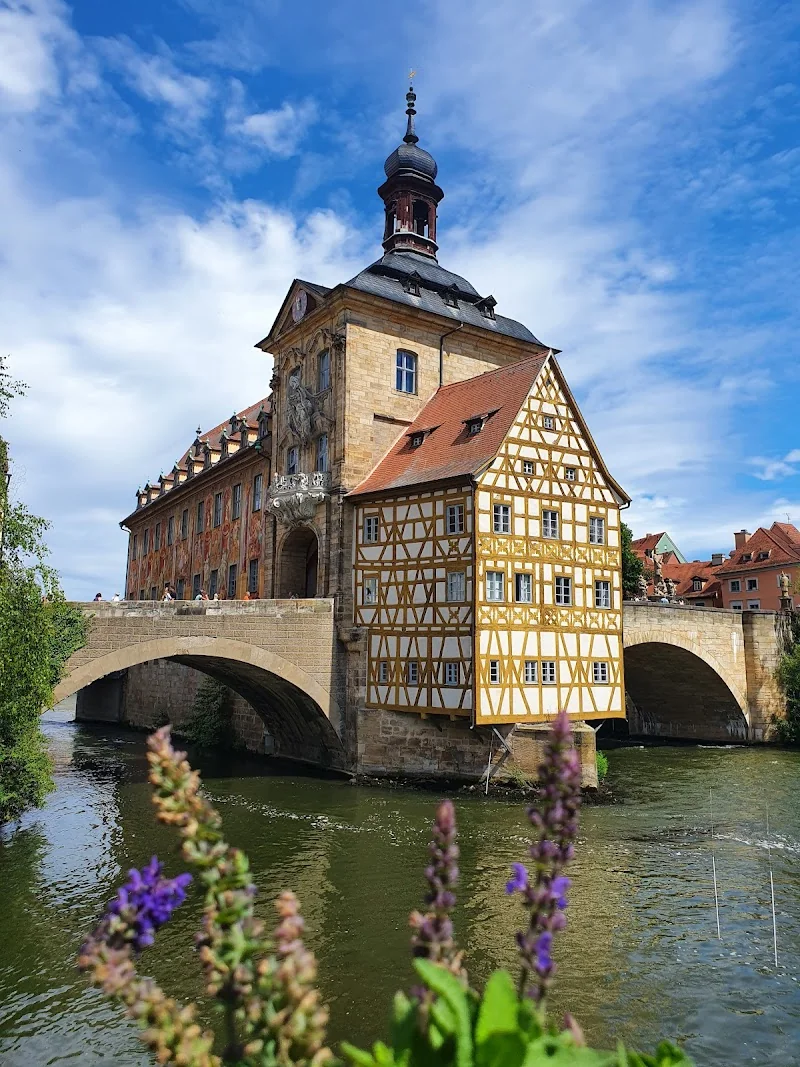
In the middle of the river, between the civic island town and the episcopal hill town, the Old Town Hall of Bamberg rises like a stage set, casting the city's history into an impressive backdrop. The bridge town hall is located on an artificially created island in the left arm of the Regnitz and is framed by two bridges – the Upper and Lower Bridge. This special location is no coincidence: it symbolically marks the historical boundary between spiritual and secular spheres and makes the building to this day a landmark that uniquely combines architecture, urban history, and cityscape. The address Upper Bridge 1, 96047 Bamberg, refers to a place that has been documented since the 14th century, and whose current form was created in the 15th century, later reshaped in the 18th century in a Baroque and Rococo style. Visitors here experience not only an iconic photo motif but also – as soon as the building is reopened – world-class craftsmanship in the Ludwig Collection. Until then, the external tour is worthwhile: paths and walkways around the town hall lead to perspectives that are rarely found even in Europe. And on top of that, from here, the UNESCO World Heritage Old Town of Bamberg with its churches, alleys, and picturesque river loop can be reached in just a few steps.
History, Legend, and Architecture of the Bridge Town Hall
The historical trace of the Old Town Hall can be traced back to the year 1387. Between 1461 and 1467, the building received its defining late medieval form. The peculiarity of the location explains a popular legend that still exists today: The Bishop of Bamberg supposedly did not grant the citizens any land for a town hall; in response, the citizens drove piles into the Regnitz, created an island, and symbolically placed the building right in the river. While this legend does not serve as a precise historical explanation, it conveys a message that is still tangible today: The town hall stands at the intersection of spiritual and civic power and thus at a place where Bamberg negotiates its balance between tradition and independence. Architecturally, several layers shape the appearance. After the Gothic phase, the building was extensively redesigned in the 18th century under Johann Jakob Michael Küchel in the style of Baroque and Rococo. Particularly impressive are the illusionistic facade paintings: Originally created in 1755 by the Rococo painter Johann Anwander, they underwent a new version in the 20th century by Anton Greiner (1959–1962). Those who approach the eastern facade closely will discover a famous detail of the Trompe-l’Œil painting: a three-dimensional-looking leg of a putto that seemingly emerges from the mural, enhancing the illusion spatially. The so-called Rottmeisterhäuschen also catches the eye on the bridge front – a picturesque half-timbered bay window that once served as accommodation for the leaders of the guard units and today is one of the most photographed elements of the ensemble. Inside, the representative Rococo hall is a highlight of courtly spatial art. Stucco work, carvings, gilding, and paintings combine to create a symbolic world of images that thematizes the four elements and cardinal virtues – an aesthetic staging that once aimed to remind council members of morality and measure. A cultural-historical detail underscores the significance of the place for more recent history: On January 25, 1921, the German Red Cross was founded in the Rococo hall; a memorial plaque on site commemorates this. Over the centuries, the bridge town hall thus functioned not only as an administrative building but also as a representative hall for significant events. Its image has shaped numerous artists since the 19th century; to this day, it remains an iconic motif in paintings, photographs, and travel guides. Why is it so fascinating? Because here city, river, and bridge achieve a rare balance: The massive base zone emerges from the water, above which the bridge structure spans, and on the facade, figures and ornaments glide into a second, painted architecture – a masterpiece that remains unmistakable even in the dense canon of European cities.
Ludwig Collection: Porcelain Museum in the Old Town Hall (Current Opening Status)
Internationally known, the Old Town Hall is not only a photo motif but also an exhibition venue: Since 1995, it has housed the Ludwig Collection Bamberg – one of the most significant private collections of porcelain and faience in Europe. The pieces come from the possession of the collector couple Peter and Irene Ludwig and were entrusted as a permanent loan to the museums of the city of Bamberg. Special focuses are on Meissen porcelain and Strasbourg faiences; in addition, exquisite vessels and service pieces, whose forms, paintings, and glazes resemble a compendium of Baroque table and court culture. In the museum tour, visitors have so far experienced the sparkling material aesthetics in interplay with the historical ambiance of the Rococo hall – a combination that is unparalleled in Europe. Important for planning a visit is the current status: The museums of the city of Bamberg inform that the Old Town Hall, including the Ludwig Collection, is closed for the time being due to an upcoming general renovation; this also affects the Ludwig Collection. During the renovation phase, selected contents are being and will be presented at other locations, partly in cooperation with partner institutions, to keep the collection visible. Once the building is reopened, a contemporary, inclusive, and experience-oriented re-staging is to be expected, as municipal documents on museum development suggest. Until then, it is advisable to check the official information channels shortly before your visit. For those who want to experience culture in Bamberg, there are still numerous alternatives within walking distance: the Historical Museum in the Old Courtyard, the Cathedral with the Imperial Couple and Bamberg Rider, the Rose Garden of the New Residence, and the World Heritage Center, which explains the features of the UNESCO Old Town. For all those specifically interested in porcelain art, the portals of the museums of the city of Bamberg and Bavaria-wide museum directories offer compact overviews of collections, opening hours, and accessibility. Planning assistance is provided by the tourism and congress service team, which, along with the tourist information, offers up-to-date information via online maps and brochures – from special tours to temporary exhibition locations during the renovation. Thus, the theme of porcelain can also be well integrated into a visit to Bamberg during the transition period.
Directions & Parking at the Old Town Hall Bamberg
The location of the Old Town Hall is central and excellently accessible on foot. From Bamberg Central Station, a pleasant walk of about 15–20 minutes leads to the Old Town; alternatively, city buses run frequently to the ZOB (Central Bus Station). From the ZOB, it is about a ten-minute walk over the Lower or Upper Bridge to the bridge town hall. Those arriving by car should best use parking garages on the outskirts of the Old Town. Particularly convenient is the City-Old Town Underground Garage Geyerswörth (Geyerswörthstraße 5, 96049 Bamberg): It is open around the clock according to tourism information, has 344 parking spaces, and is only a few minutes' walk from the Old Town Hall. The route leads, depending on the starting point, over the Geyerwörth Bridge – a pedestrian bridge with excellent views of the town hall – or through the alleys of the island town to the Upper Bridge. Other central parking options exist, among others, at Georgendamm and the Concert and Congress Hall; additionally, the city works website provides information on P+R spaces on the access roads. Those who want to travel sustainably benefit in Bamberg from short distances: Within the UNESCO Old Town, much is within walking distance, and especially the perspectives on the Old Town Hall reveal their charm when strolling along the banks. A tip for navigation devices: Use the destination address Geyerswörthstraße 5 (underground garage) or alternatively Upper Bridge 1 (for orientation only, no access). For bus groups and tour operators, the tourist information provides separate notes; tour buses should observe Old Town regulations and stop at designated points. Cyclists can easily reach the ensemble via city bike paths; nearby, there are parking facilities from which the bridges and walkways can be accessed on foot. And those arriving by train can excellently integrate a visit to the bridge town hall into a tour of the Old Town – passing by Little Venice, the Old Crane, and the churches of the hill town.
Rococo Hall, Use, and Events: What You Should Know
The Rococo hall of the Old Town Hall is considered one of the most magnificent representative rooms in Franconia. It was created during the Baroque redesign under Johann Jakob Michael Küchel (1744–1756) and combines ceiling stucco, carvings, gilding, and paintings into a total work of art. In its center, a sun in an elongated quatrefoil shines, flanked by putti; on the walls, paintings by the Rococo painter Johann Anwander illustrate the four cardinal virtues – justice, prudence, temperance, and courage – as a moral compass for political action. Historically, the hall served not only for representative receptions but was also the venue for significant events, including the founding of the German Red Cross in 1921. Today, the hall, depending on the renovation status of the building, is occasionally usable for city formats; however, regular cultural and concert series are not hosted in the Old Town Hall. Therefore, a classic seating plan like in theaters or multipurpose halls does not exist. Nevertheless, it is worthwhile to plan the hall into future tours or special openings: The connection of spatial art and city iconography – visible, for example, in the coat of arms reliefs and balconies – creates an atmosphere that immediately transports visitors into the courtly-urban culture of the 18th century. For photography and architecture enthusiasts, the interior offers exciting details: the craftsmanship precision in cornices, consoles, and doors, the fine transitions between stucco and painting, and the light guidance over window axes that accentuates the play of shine and shadow on the gilding. Until the reopening, the outer view remains the main stage: The Rottmeisterhäuschen, the bridge tower, and the completely painted facades transport the aesthetics of the hall outside – a reason why the ensemble is so often described as “theater in urban space.” Those planning their Bamberg program should check whether accompanying exhibitions of the museums or city tours on the topic of Rococo and porcelain are offered: They bridge the gap between the arts and the city's history, very much in the spirit of the house.
Photo Spots, Views, and Best Times for Photos
Hardly any motif in Bamberg is as photogenic as the Old Town Hall – and the most beautiful perspectives literally lie “around the corner.” The Geyerwörth Bridge offers a lateral overall view, where the painted illusionary architectures and the half-timbered bay window (Rottmeisterhäuschen) come into the picture optimally. From the Upper Bridge, one gets a frontal view of the bridge tower and the facade paintings; if you walk a few steps further towards the island town, you can frame the town hall with the passing river arms and bank vegetation. The Lower Bridge allows for a deeper view along the river – particularly appealing during the blue hour when the evening light breaks in the windows and in the water. The riverbank path at Leinritt is also popular, from which the town hall can be related to the row of houses of “Little Venice.” For reflections, calm weather in the early morning or late evening is recommended; then the water surface smooths out, and the painted figures as well as the half-timbered bay window are clearly reflected in the river. Those who love details should bring a telephoto lens: This way, the famous “putto leg,” coat of arms reliefs, window axes, and the wooden structures of the half-timbering can be precisely highlighted. The motif becomes particularly atmospheric with the seasonal change: In spring, young leaves on the banks form a natural frame; in summer, lush green contrasts with the ochre and pastel tones of the facade; in autumn, foliage colors set warm accents; in winter, diffuse light creates an almost graphic clarity. Photographic etiquette is part of it: Consideration for passersby on the narrow bridges, short standing times at popular viewpoints, and no entry into closed riverbank areas. Those who want to combine city views will find further motifs within a few minutes' walk: the Old Crane as a technical monument by the river, the Gothic St. Martin's Church at the Green Market, and the silhouette of the hill town with the Cathedral and New Residence. Tip: During peak hours at lunchtime, it is worthwhile to shift to the morning hours or dusk; then not only is the light softer, but the visitor rush is also lower – ideal conditions for clear image compositions.
Accessibility & Practical Tips for the Visit
The Old Town Hall is a historic bridge structure with narrow passages and steps. Official city information explicitly states that the building is not accessible. Those who rely on step-free access should plan alternative cultural venues in the Old Town: The World Heritage Center, selected museums, and the tourist information generally offer better accessible facilities; details on accessible offers are published by the city on its info pages. For all visitors: Fixed railings on the bridges facilitate orientation, yet slip-resistant footwear is recommended in wet conditions. Strollers can be pushed over the bridges; however, due to stairs and narrow spots, a bit more time should be planned on site. Photography is freely possible in the outdoor area; in the interior, different regulations applied – depending on the exhibition and loan situation – before the closure. Pets are not a problem in the outdoor area; in the museum, it is typically: no animals except assistance dogs (after reopening). The central location makes breaks uncomplicated: Gastronomy addresses, traditional brewery inns, and cafés are located in immediate proximity. For tour groups, the city’s guided tours offer thematic walks – for example, on UNESCO, waterways, or Baroque. Those arriving by car should pay for their parking ticket in the City-Old Town Underground Garage upon arrival to avoid waiting times when exiting. Charging points for e-mobility are available in municipal parking garages; the city works provide information on locations. Safety note: At high water levels, riverbank paths may be temporarily closed. Pay attention to local notices. And another planning plus: Many destinations in the Old Town – from the Old Crane to Little Venice to the Cathedral – are within a 5–20 minute walk. This way, the photo stop at the bridge town hall can be seamlessly integrated into a walk through the World Heritage site.
Sources:
- Bamberg Tourism & Congress Service – Old Town Hall (Official Tourism Website)
- Wikipedia – Old Town Hall (Bamberg) – History, Architecture, Rococo Hall
- Museums of the City of Bamberg – Ludwig Collection (Status & Information on Closure)
- Bamberg Tourism – City-Old Town Underground Garage Geyerswörth (Parking, Address, Opening Hours)
- visitBamberg – Old Town Hall (Address, Opening Hours Information, Viewpoints)
- Wikipedia – Bamberg (UNESCO World Heritage Site and Context)
Mehr anzeigenWeniger anzeigen
Old Town Hall | Bamberg Attraction & Porcelain Museum
In the middle of the river, between the civic island town and the episcopal hill town, the Old Town Hall of Bamberg rises like a stage set, casting the city's history into an impressive backdrop. The bridge town hall is located on an artificially created island in the left arm of the Regnitz and is framed by two bridges – the Upper and Lower Bridge. This special location is no coincidence: it symbolically marks the historical boundary between spiritual and secular spheres and makes the building to this day a landmark that uniquely combines architecture, urban history, and cityscape. The address Upper Bridge 1, 96047 Bamberg, refers to a place that has been documented since the 14th century, and whose current form was created in the 15th century, later reshaped in the 18th century in a Baroque and Rococo style. Visitors here experience not only an iconic photo motif but also – as soon as the building is reopened – world-class craftsmanship in the Ludwig Collection. Until then, the external tour is worthwhile: paths and walkways around the town hall lead to perspectives that are rarely found even in Europe. And on top of that, from here, the UNESCO World Heritage Old Town of Bamberg with its churches, alleys, and picturesque river loop can be reached in just a few steps.
History, Legend, and Architecture of the Bridge Town Hall
The historical trace of the Old Town Hall can be traced back to the year 1387. Between 1461 and 1467, the building received its defining late medieval form. The peculiarity of the location explains a popular legend that still exists today: The Bishop of Bamberg supposedly did not grant the citizens any land for a town hall; in response, the citizens drove piles into the Regnitz, created an island, and symbolically placed the building right in the river. While this legend does not serve as a precise historical explanation, it conveys a message that is still tangible today: The town hall stands at the intersection of spiritual and civic power and thus at a place where Bamberg negotiates its balance between tradition and independence. Architecturally, several layers shape the appearance. After the Gothic phase, the building was extensively redesigned in the 18th century under Johann Jakob Michael Küchel in the style of Baroque and Rococo. Particularly impressive are the illusionistic facade paintings: Originally created in 1755 by the Rococo painter Johann Anwander, they underwent a new version in the 20th century by Anton Greiner (1959–1962). Those who approach the eastern facade closely will discover a famous detail of the Trompe-l’Œil painting: a three-dimensional-looking leg of a putto that seemingly emerges from the mural, enhancing the illusion spatially. The so-called Rottmeisterhäuschen also catches the eye on the bridge front – a picturesque half-timbered bay window that once served as accommodation for the leaders of the guard units and today is one of the most photographed elements of the ensemble. Inside, the representative Rococo hall is a highlight of courtly spatial art. Stucco work, carvings, gilding, and paintings combine to create a symbolic world of images that thematizes the four elements and cardinal virtues – an aesthetic staging that once aimed to remind council members of morality and measure. A cultural-historical detail underscores the significance of the place for more recent history: On January 25, 1921, the German Red Cross was founded in the Rococo hall; a memorial plaque on site commemorates this. Over the centuries, the bridge town hall thus functioned not only as an administrative building but also as a representative hall for significant events. Its image has shaped numerous artists since the 19th century; to this day, it remains an iconic motif in paintings, photographs, and travel guides. Why is it so fascinating? Because here city, river, and bridge achieve a rare balance: The massive base zone emerges from the water, above which the bridge structure spans, and on the facade, figures and ornaments glide into a second, painted architecture – a masterpiece that remains unmistakable even in the dense canon of European cities.
Ludwig Collection: Porcelain Museum in the Old Town Hall (Current Opening Status)
Internationally known, the Old Town Hall is not only a photo motif but also an exhibition venue: Since 1995, it has housed the Ludwig Collection Bamberg – one of the most significant private collections of porcelain and faience in Europe. The pieces come from the possession of the collector couple Peter and Irene Ludwig and were entrusted as a permanent loan to the museums of the city of Bamberg. Special focuses are on Meissen porcelain and Strasbourg faiences; in addition, exquisite vessels and service pieces, whose forms, paintings, and glazes resemble a compendium of Baroque table and court culture. In the museum tour, visitors have so far experienced the sparkling material aesthetics in interplay with the historical ambiance of the Rococo hall – a combination that is unparalleled in Europe. Important for planning a visit is the current status: The museums of the city of Bamberg inform that the Old Town Hall, including the Ludwig Collection, is closed for the time being due to an upcoming general renovation; this also affects the Ludwig Collection. During the renovation phase, selected contents are being and will be presented at other locations, partly in cooperation with partner institutions, to keep the collection visible. Once the building is reopened, a contemporary, inclusive, and experience-oriented re-staging is to be expected, as municipal documents on museum development suggest. Until then, it is advisable to check the official information channels shortly before your visit. For those who want to experience culture in Bamberg, there are still numerous alternatives within walking distance: the Historical Museum in the Old Courtyard, the Cathedral with the Imperial Couple and Bamberg Rider, the Rose Garden of the New Residence, and the World Heritage Center, which explains the features of the UNESCO Old Town. For all those specifically interested in porcelain art, the portals of the museums of the city of Bamberg and Bavaria-wide museum directories offer compact overviews of collections, opening hours, and accessibility. Planning assistance is provided by the tourism and congress service team, which, along with the tourist information, offers up-to-date information via online maps and brochures – from special tours to temporary exhibition locations during the renovation. Thus, the theme of porcelain can also be well integrated into a visit to Bamberg during the transition period.
Directions & Parking at the Old Town Hall Bamberg
The location of the Old Town Hall is central and excellently accessible on foot. From Bamberg Central Station, a pleasant walk of about 15–20 minutes leads to the Old Town; alternatively, city buses run frequently to the ZOB (Central Bus Station). From the ZOB, it is about a ten-minute walk over the Lower or Upper Bridge to the bridge town hall. Those arriving by car should best use parking garages on the outskirts of the Old Town. Particularly convenient is the City-Old Town Underground Garage Geyerswörth (Geyerswörthstraße 5, 96049 Bamberg): It is open around the clock according to tourism information, has 344 parking spaces, and is only a few minutes' walk from the Old Town Hall. The route leads, depending on the starting point, over the Geyerwörth Bridge – a pedestrian bridge with excellent views of the town hall – or through the alleys of the island town to the Upper Bridge. Other central parking options exist, among others, at Georgendamm and the Concert and Congress Hall; additionally, the city works website provides information on P+R spaces on the access roads. Those who want to travel sustainably benefit in Bamberg from short distances: Within the UNESCO Old Town, much is within walking distance, and especially the perspectives on the Old Town Hall reveal their charm when strolling along the banks. A tip for navigation devices: Use the destination address Geyerswörthstraße 5 (underground garage) or alternatively Upper Bridge 1 (for orientation only, no access). For bus groups and tour operators, the tourist information provides separate notes; tour buses should observe Old Town regulations and stop at designated points. Cyclists can easily reach the ensemble via city bike paths; nearby, there are parking facilities from which the bridges and walkways can be accessed on foot. And those arriving by train can excellently integrate a visit to the bridge town hall into a tour of the Old Town – passing by Little Venice, the Old Crane, and the churches of the hill town.
Rococo Hall, Use, and Events: What You Should Know
The Rococo hall of the Old Town Hall is considered one of the most magnificent representative rooms in Franconia. It was created during the Baroque redesign under Johann Jakob Michael Küchel (1744–1756) and combines ceiling stucco, carvings, gilding, and paintings into a total work of art. In its center, a sun in an elongated quatrefoil shines, flanked by putti; on the walls, paintings by the Rococo painter Johann Anwander illustrate the four cardinal virtues – justice, prudence, temperance, and courage – as a moral compass for political action. Historically, the hall served not only for representative receptions but was also the venue for significant events, including the founding of the German Red Cross in 1921. Today, the hall, depending on the renovation status of the building, is occasionally usable for city formats; however, regular cultural and concert series are not hosted in the Old Town Hall. Therefore, a classic seating plan like in theaters or multipurpose halls does not exist. Nevertheless, it is worthwhile to plan the hall into future tours or special openings: The connection of spatial art and city iconography – visible, for example, in the coat of arms reliefs and balconies – creates an atmosphere that immediately transports visitors into the courtly-urban culture of the 18th century. For photography and architecture enthusiasts, the interior offers exciting details: the craftsmanship precision in cornices, consoles, and doors, the fine transitions between stucco and painting, and the light guidance over window axes that accentuates the play of shine and shadow on the gilding. Until the reopening, the outer view remains the main stage: The Rottmeisterhäuschen, the bridge tower, and the completely painted facades transport the aesthetics of the hall outside – a reason why the ensemble is so often described as “theater in urban space.” Those planning their Bamberg program should check whether accompanying exhibitions of the museums or city tours on the topic of Rococo and porcelain are offered: They bridge the gap between the arts and the city's history, very much in the spirit of the house.
Photo Spots, Views, and Best Times for Photos
Hardly any motif in Bamberg is as photogenic as the Old Town Hall – and the most beautiful perspectives literally lie “around the corner.” The Geyerwörth Bridge offers a lateral overall view, where the painted illusionary architectures and the half-timbered bay window (Rottmeisterhäuschen) come into the picture optimally. From the Upper Bridge, one gets a frontal view of the bridge tower and the facade paintings; if you walk a few steps further towards the island town, you can frame the town hall with the passing river arms and bank vegetation. The Lower Bridge allows for a deeper view along the river – particularly appealing during the blue hour when the evening light breaks in the windows and in the water. The riverbank path at Leinritt is also popular, from which the town hall can be related to the row of houses of “Little Venice.” For reflections, calm weather in the early morning or late evening is recommended; then the water surface smooths out, and the painted figures as well as the half-timbered bay window are clearly reflected in the river. Those who love details should bring a telephoto lens: This way, the famous “putto leg,” coat of arms reliefs, window axes, and the wooden structures of the half-timbering can be precisely highlighted. The motif becomes particularly atmospheric with the seasonal change: In spring, young leaves on the banks form a natural frame; in summer, lush green contrasts with the ochre and pastel tones of the facade; in autumn, foliage colors set warm accents; in winter, diffuse light creates an almost graphic clarity. Photographic etiquette is part of it: Consideration for passersby on the narrow bridges, short standing times at popular viewpoints, and no entry into closed riverbank areas. Those who want to combine city views will find further motifs within a few minutes' walk: the Old Crane as a technical monument by the river, the Gothic St. Martin's Church at the Green Market, and the silhouette of the hill town with the Cathedral and New Residence. Tip: During peak hours at lunchtime, it is worthwhile to shift to the morning hours or dusk; then not only is the light softer, but the visitor rush is also lower – ideal conditions for clear image compositions.
Accessibility & Practical Tips for the Visit
The Old Town Hall is a historic bridge structure with narrow passages and steps. Official city information explicitly states that the building is not accessible. Those who rely on step-free access should plan alternative cultural venues in the Old Town: The World Heritage Center, selected museums, and the tourist information generally offer better accessible facilities; details on accessible offers are published by the city on its info pages. For all visitors: Fixed railings on the bridges facilitate orientation, yet slip-resistant footwear is recommended in wet conditions. Strollers can be pushed over the bridges; however, due to stairs and narrow spots, a bit more time should be planned on site. Photography is freely possible in the outdoor area; in the interior, different regulations applied – depending on the exhibition and loan situation – before the closure. Pets are not a problem in the outdoor area; in the museum, it is typically: no animals except assistance dogs (after reopening). The central location makes breaks uncomplicated: Gastronomy addresses, traditional brewery inns, and cafés are located in immediate proximity. For tour groups, the city’s guided tours offer thematic walks – for example, on UNESCO, waterways, or Baroque. Those arriving by car should pay for their parking ticket in the City-Old Town Underground Garage upon arrival to avoid waiting times when exiting. Charging points for e-mobility are available in municipal parking garages; the city works provide information on locations. Safety note: At high water levels, riverbank paths may be temporarily closed. Pay attention to local notices. And another planning plus: Many destinations in the Old Town – from the Old Crane to Little Venice to the Cathedral – are within a 5–20 minute walk. This way, the photo stop at the bridge town hall can be seamlessly integrated into a walk through the World Heritage site.
Sources:
- Bamberg Tourism & Congress Service – Old Town Hall (Official Tourism Website)
- Wikipedia – Old Town Hall (Bamberg) – History, Architecture, Rococo Hall
- Museums of the City of Bamberg – Ludwig Collection (Status & Information on Closure)
- Bamberg Tourism – City-Old Town Underground Garage Geyerswörth (Parking, Address, Opening Hours)
- visitBamberg – Old Town Hall (Address, Opening Hours Information, Viewpoints)
- Wikipedia – Bamberg (UNESCO World Heritage Site and Context)
Old Town Hall | Bamberg Attraction & Porcelain Museum
In the middle of the river, between the civic island town and the episcopal hill town, the Old Town Hall of Bamberg rises like a stage set, casting the city's history into an impressive backdrop. The bridge town hall is located on an artificially created island in the left arm of the Regnitz and is framed by two bridges – the Upper and Lower Bridge. This special location is no coincidence: it symbolically marks the historical boundary between spiritual and secular spheres and makes the building to this day a landmark that uniquely combines architecture, urban history, and cityscape. The address Upper Bridge 1, 96047 Bamberg, refers to a place that has been documented since the 14th century, and whose current form was created in the 15th century, later reshaped in the 18th century in a Baroque and Rococo style. Visitors here experience not only an iconic photo motif but also – as soon as the building is reopened – world-class craftsmanship in the Ludwig Collection. Until then, the external tour is worthwhile: paths and walkways around the town hall lead to perspectives that are rarely found even in Europe. And on top of that, from here, the UNESCO World Heritage Old Town of Bamberg with its churches, alleys, and picturesque river loop can be reached in just a few steps.
History, Legend, and Architecture of the Bridge Town Hall
The historical trace of the Old Town Hall can be traced back to the year 1387. Between 1461 and 1467, the building received its defining late medieval form. The peculiarity of the location explains a popular legend that still exists today: The Bishop of Bamberg supposedly did not grant the citizens any land for a town hall; in response, the citizens drove piles into the Regnitz, created an island, and symbolically placed the building right in the river. While this legend does not serve as a precise historical explanation, it conveys a message that is still tangible today: The town hall stands at the intersection of spiritual and civic power and thus at a place where Bamberg negotiates its balance between tradition and independence. Architecturally, several layers shape the appearance. After the Gothic phase, the building was extensively redesigned in the 18th century under Johann Jakob Michael Küchel in the style of Baroque and Rococo. Particularly impressive are the illusionistic facade paintings: Originally created in 1755 by the Rococo painter Johann Anwander, they underwent a new version in the 20th century by Anton Greiner (1959–1962). Those who approach the eastern facade closely will discover a famous detail of the Trompe-l’Œil painting: a three-dimensional-looking leg of a putto that seemingly emerges from the mural, enhancing the illusion spatially. The so-called Rottmeisterhäuschen also catches the eye on the bridge front – a picturesque half-timbered bay window that once served as accommodation for the leaders of the guard units and today is one of the most photographed elements of the ensemble. Inside, the representative Rococo hall is a highlight of courtly spatial art. Stucco work, carvings, gilding, and paintings combine to create a symbolic world of images that thematizes the four elements and cardinal virtues – an aesthetic staging that once aimed to remind council members of morality and measure. A cultural-historical detail underscores the significance of the place for more recent history: On January 25, 1921, the German Red Cross was founded in the Rococo hall; a memorial plaque on site commemorates this. Over the centuries, the bridge town hall thus functioned not only as an administrative building but also as a representative hall for significant events. Its image has shaped numerous artists since the 19th century; to this day, it remains an iconic motif in paintings, photographs, and travel guides. Why is it so fascinating? Because here city, river, and bridge achieve a rare balance: The massive base zone emerges from the water, above which the bridge structure spans, and on the facade, figures and ornaments glide into a second, painted architecture – a masterpiece that remains unmistakable even in the dense canon of European cities.
Ludwig Collection: Porcelain Museum in the Old Town Hall (Current Opening Status)
Internationally known, the Old Town Hall is not only a photo motif but also an exhibition venue: Since 1995, it has housed the Ludwig Collection Bamberg – one of the most significant private collections of porcelain and faience in Europe. The pieces come from the possession of the collector couple Peter and Irene Ludwig and were entrusted as a permanent loan to the museums of the city of Bamberg. Special focuses are on Meissen porcelain and Strasbourg faiences; in addition, exquisite vessels and service pieces, whose forms, paintings, and glazes resemble a compendium of Baroque table and court culture. In the museum tour, visitors have so far experienced the sparkling material aesthetics in interplay with the historical ambiance of the Rococo hall – a combination that is unparalleled in Europe. Important for planning a visit is the current status: The museums of the city of Bamberg inform that the Old Town Hall, including the Ludwig Collection, is closed for the time being due to an upcoming general renovation; this also affects the Ludwig Collection. During the renovation phase, selected contents are being and will be presented at other locations, partly in cooperation with partner institutions, to keep the collection visible. Once the building is reopened, a contemporary, inclusive, and experience-oriented re-staging is to be expected, as municipal documents on museum development suggest. Until then, it is advisable to check the official information channels shortly before your visit. For those who want to experience culture in Bamberg, there are still numerous alternatives within walking distance: the Historical Museum in the Old Courtyard, the Cathedral with the Imperial Couple and Bamberg Rider, the Rose Garden of the New Residence, and the World Heritage Center, which explains the features of the UNESCO Old Town. For all those specifically interested in porcelain art, the portals of the museums of the city of Bamberg and Bavaria-wide museum directories offer compact overviews of collections, opening hours, and accessibility. Planning assistance is provided by the tourism and congress service team, which, along with the tourist information, offers up-to-date information via online maps and brochures – from special tours to temporary exhibition locations during the renovation. Thus, the theme of porcelain can also be well integrated into a visit to Bamberg during the transition period.
Directions & Parking at the Old Town Hall Bamberg
The location of the Old Town Hall is central and excellently accessible on foot. From Bamberg Central Station, a pleasant walk of about 15–20 minutes leads to the Old Town; alternatively, city buses run frequently to the ZOB (Central Bus Station). From the ZOB, it is about a ten-minute walk over the Lower or Upper Bridge to the bridge town hall. Those arriving by car should best use parking garages on the outskirts of the Old Town. Particularly convenient is the City-Old Town Underground Garage Geyerswörth (Geyerswörthstraße 5, 96049 Bamberg): It is open around the clock according to tourism information, has 344 parking spaces, and is only a few minutes' walk from the Old Town Hall. The route leads, depending on the starting point, over the Geyerwörth Bridge – a pedestrian bridge with excellent views of the town hall – or through the alleys of the island town to the Upper Bridge. Other central parking options exist, among others, at Georgendamm and the Concert and Congress Hall; additionally, the city works website provides information on P+R spaces on the access roads. Those who want to travel sustainably benefit in Bamberg from short distances: Within the UNESCO Old Town, much is within walking distance, and especially the perspectives on the Old Town Hall reveal their charm when strolling along the banks. A tip for navigation devices: Use the destination address Geyerswörthstraße 5 (underground garage) or alternatively Upper Bridge 1 (for orientation only, no access). For bus groups and tour operators, the tourist information provides separate notes; tour buses should observe Old Town regulations and stop at designated points. Cyclists can easily reach the ensemble via city bike paths; nearby, there are parking facilities from which the bridges and walkways can be accessed on foot. And those arriving by train can excellently integrate a visit to the bridge town hall into a tour of the Old Town – passing by Little Venice, the Old Crane, and the churches of the hill town.
Rococo Hall, Use, and Events: What You Should Know
The Rococo hall of the Old Town Hall is considered one of the most magnificent representative rooms in Franconia. It was created during the Baroque redesign under Johann Jakob Michael Küchel (1744–1756) and combines ceiling stucco, carvings, gilding, and paintings into a total work of art. In its center, a sun in an elongated quatrefoil shines, flanked by putti; on the walls, paintings by the Rococo painter Johann Anwander illustrate the four cardinal virtues – justice, prudence, temperance, and courage – as a moral compass for political action. Historically, the hall served not only for representative receptions but was also the venue for significant events, including the founding of the German Red Cross in 1921. Today, the hall, depending on the renovation status of the building, is occasionally usable for city formats; however, regular cultural and concert series are not hosted in the Old Town Hall. Therefore, a classic seating plan like in theaters or multipurpose halls does not exist. Nevertheless, it is worthwhile to plan the hall into future tours or special openings: The connection of spatial art and city iconography – visible, for example, in the coat of arms reliefs and balconies – creates an atmosphere that immediately transports visitors into the courtly-urban culture of the 18th century. For photography and architecture enthusiasts, the interior offers exciting details: the craftsmanship precision in cornices, consoles, and doors, the fine transitions between stucco and painting, and the light guidance over window axes that accentuates the play of shine and shadow on the gilding. Until the reopening, the outer view remains the main stage: The Rottmeisterhäuschen, the bridge tower, and the completely painted facades transport the aesthetics of the hall outside – a reason why the ensemble is so often described as “theater in urban space.” Those planning their Bamberg program should check whether accompanying exhibitions of the museums or city tours on the topic of Rococo and porcelain are offered: They bridge the gap between the arts and the city's history, very much in the spirit of the house.
Photo Spots, Views, and Best Times for Photos
Hardly any motif in Bamberg is as photogenic as the Old Town Hall – and the most beautiful perspectives literally lie “around the corner.” The Geyerwörth Bridge offers a lateral overall view, where the painted illusionary architectures and the half-timbered bay window (Rottmeisterhäuschen) come into the picture optimally. From the Upper Bridge, one gets a frontal view of the bridge tower and the facade paintings; if you walk a few steps further towards the island town, you can frame the town hall with the passing river arms and bank vegetation. The Lower Bridge allows for a deeper view along the river – particularly appealing during the blue hour when the evening light breaks in the windows and in the water. The riverbank path at Leinritt is also popular, from which the town hall can be related to the row of houses of “Little Venice.” For reflections, calm weather in the early morning or late evening is recommended; then the water surface smooths out, and the painted figures as well as the half-timbered bay window are clearly reflected in the river. Those who love details should bring a telephoto lens: This way, the famous “putto leg,” coat of arms reliefs, window axes, and the wooden structures of the half-timbering can be precisely highlighted. The motif becomes particularly atmospheric with the seasonal change: In spring, young leaves on the banks form a natural frame; in summer, lush green contrasts with the ochre and pastel tones of the facade; in autumn, foliage colors set warm accents; in winter, diffuse light creates an almost graphic clarity. Photographic etiquette is part of it: Consideration for passersby on the narrow bridges, short standing times at popular viewpoints, and no entry into closed riverbank areas. Those who want to combine city views will find further motifs within a few minutes' walk: the Old Crane as a technical monument by the river, the Gothic St. Martin's Church at the Green Market, and the silhouette of the hill town with the Cathedral and New Residence. Tip: During peak hours at lunchtime, it is worthwhile to shift to the morning hours or dusk; then not only is the light softer, but the visitor rush is also lower – ideal conditions for clear image compositions.
Accessibility & Practical Tips for the Visit
The Old Town Hall is a historic bridge structure with narrow passages and steps. Official city information explicitly states that the building is not accessible. Those who rely on step-free access should plan alternative cultural venues in the Old Town: The World Heritage Center, selected museums, and the tourist information generally offer better accessible facilities; details on accessible offers are published by the city on its info pages. For all visitors: Fixed railings on the bridges facilitate orientation, yet slip-resistant footwear is recommended in wet conditions. Strollers can be pushed over the bridges; however, due to stairs and narrow spots, a bit more time should be planned on site. Photography is freely possible in the outdoor area; in the interior, different regulations applied – depending on the exhibition and loan situation – before the closure. Pets are not a problem in the outdoor area; in the museum, it is typically: no animals except assistance dogs (after reopening). The central location makes breaks uncomplicated: Gastronomy addresses, traditional brewery inns, and cafés are located in immediate proximity. For tour groups, the city’s guided tours offer thematic walks – for example, on UNESCO, waterways, or Baroque. Those arriving by car should pay for their parking ticket in the City-Old Town Underground Garage upon arrival to avoid waiting times when exiting. Charging points for e-mobility are available in municipal parking garages; the city works provide information on locations. Safety note: At high water levels, riverbank paths may be temporarily closed. Pay attention to local notices. And another planning plus: Many destinations in the Old Town – from the Old Crane to Little Venice to the Cathedral – are within a 5–20 minute walk. This way, the photo stop at the bridge town hall can be seamlessly integrated into a walk through the World Heritage site.
Sources:
- Bamberg Tourism & Congress Service – Old Town Hall (Official Tourism Website)
- Wikipedia – Old Town Hall (Bamberg) – History, Architecture, Rococo Hall
- Museums of the City of Bamberg – Ludwig Collection (Status & Information on Closure)
- Bamberg Tourism – City-Old Town Underground Garage Geyerswörth (Parking, Address, Opening Hours)
- visitBamberg – Old Town Hall (Address, Opening Hours Information, Viewpoints)
- Wikipedia – Bamberg (UNESCO World Heritage Site and Context)
Upcoming Events
No events found
Frequently Asked Questions
Reviews
Alen Fazlagic
17. February 2026
Altes Rathaus is one of those places in Bamberg you never get tired of seeing. Even after passing by many times, the view over the river and the old buildings still feels special. The details on the façade are beautiful, and the whole area has a relaxed, authentic atmosphere. It’s perfect for a short walk, photos, or just stopping for a moment to enjoy the city. Definitely one of the true highlights of Bamberg. The views from the bridges are amazing and perfect for photos. The atmosphere is calm, historic, and full of charm.
JB Lighter
30. April 2025
What a spectacular courthouse. Built on a bridge in the middle of a river, & adorned with wonderful paintings. The little portside & its wooden crane are just below it. A gondolier plies his gondola tour up the Am Kanal, a side stream beside it. In the middle of the Bamberg old town, the surrounding architecture is well worth walking around. This is a classic of Franconia.
Rob Pember
5. September 2025
Fascinating historical landmark, famous for its unique location. According to legend, the city's citizens built it on an artificial island in the middle of the Regnitz River after the bishop refused to grant them land. It now houses the Ludwig Collection, a museum of porcelain and is a UNESCO World Heritage site.
Don Dude
24. May 2025
One of the iconic images of Bamberg. Really pretty building and a really scenic view. Detailed decorative architecture and fresco-ish external painting. The best view is from the bridge that shows the front of the building. Which is by the Tower. Lots of cool stuff in that area to see as well.
Padmini M S
27. September 2024
Lovely, charming place and the most important landmark of Bamberg. The place is surrounded by restaurants, cafes, souvenir and specialty shops. It is worth checking out the architecture, design and the wall paintings.