Urban Change in Bamberg: New Neighborhoods & Housing
Urban Change in Bamberg: New Neighborhoods & Projects Set to Shape the Coming Years
In Bamberg, several urban development and infrastructure projects are in focus for the coming years: new neighborhoods on conversion and industrial sites, measures for climate-resilient drainage, mobility projects for the "city of short distances," as well as smart city applications for information and participation. This overview bundles the most important topics – with a view to the future.
Time Frame: Outlook on projects and announced steps that will become more concrete from 2026/2027 and are expected to take effect in the following years.
1) New Neighborhoods on Conversion and Reuse Sites
The greatest impulses for change are likely to arise where former military or industrial uses were located. Such areas offer the chance to create additional housing without sealing new greenfield sites – while also considering social infrastructure (daycare centers, schools, local supply) from the outset.
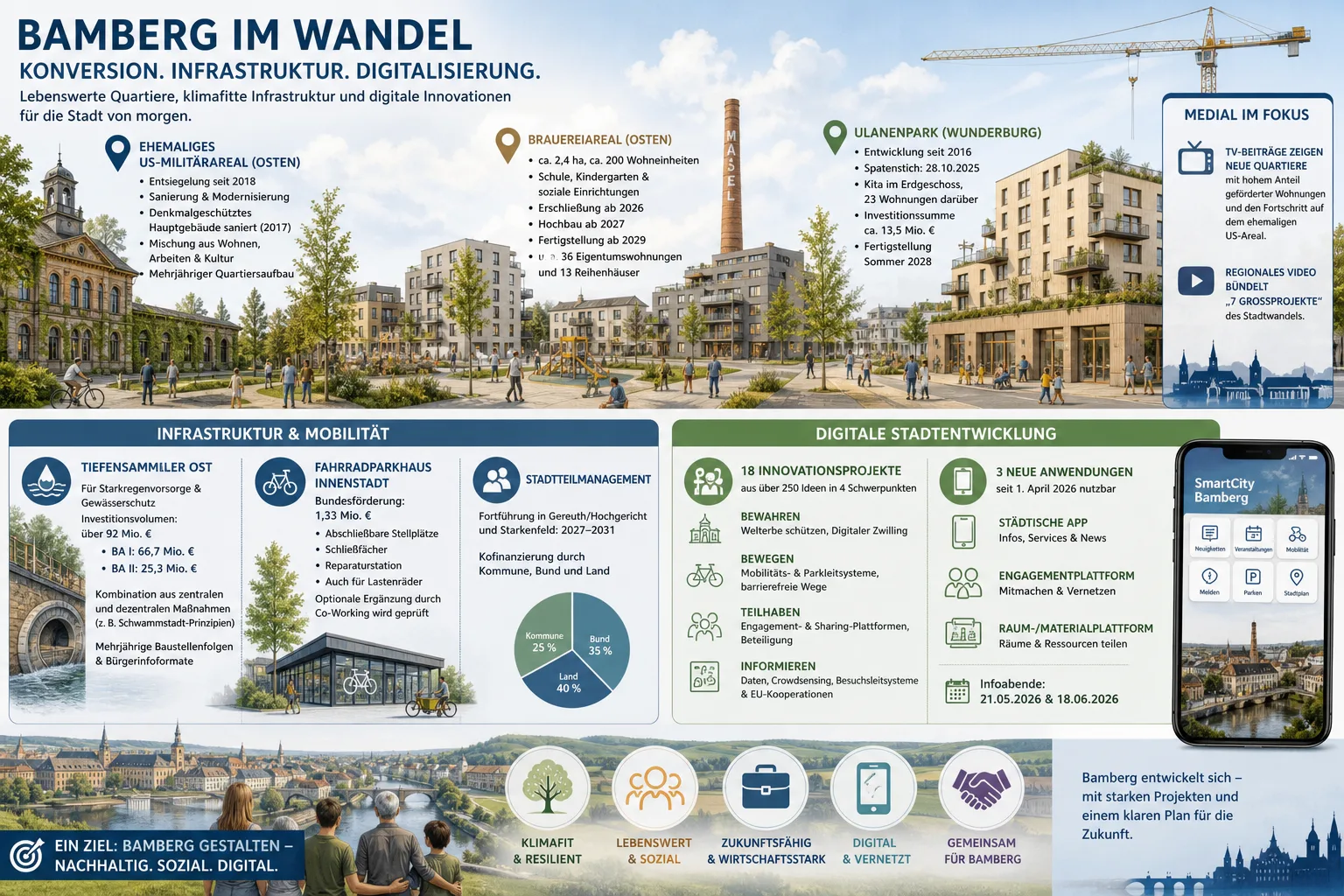
Former Military/Conversion Area in the East: Mixed Neighborhood as Urban Building Block
For a conversion area in eastern Bamberg, a mix of uses is expected in the coming years, combining housing, work, services, and possibly cultural offerings. The focus is on how an open neighborhood with good connections can be created – instead of an isolated "residential island."
- What matters: efficient public transport and cycling connections, clear routing, local supply within the neighborhood.
- Social mix: If subsidized housing and privately financed options are combined, the neighborhood can become more stable and mixed in the long term.
- Cityscape & Identity: On conversion sites, monument protection, preservation of existing structures, and new architecture are likely to play a central role in further developing the character of the place.
Reuse of a Former Industrial/Brewery Site: Housing Plus Education & Care
For a repurposed industrial site in the east, a neighborhood is being discussed that, in addition to housing, should also integrate educational and care facilities (e.g., school, daycare). Such combinations are crucial for future districts because they shorten distances and make everyday life more manageable on site.
If development, building construction, and commissioning take place in stages, there are usually transitional phases over several years (construction logistics, temporary paths, temporary restrictions). For residents, transparency is therefore particularly important: clear construction phases, accessible contacts, and reliable timeframes.
Wunderburg/Ulanenpark: Densification with Daycare and Housing
In Wunderburg, urban change can be particularly tangible in everyday life: densification projects that combine housing and social infrastructure (especially childcare) in one building are expected to create additional capacity in the coming years. This is urbanistically relevant because it enables new housing and at the same time strengthens supply within the neighborhood.
For families, seniors, and people without cars, such projects have a particularly positive effect when combined with barrier-free paths, safe crossings, good bicycle parking, and local amenities.
2) Infrastructure & Climate Resilience: Projects with Major Impact "Below the Surface"
In addition to visible new neighborhoods, measures for drainage, water protection, and traffic organization are likely to become particularly important in Bamberg in the coming years. Especially during heavy rainfall, it is often the invisible infrastructure that determines whether streets, underpasses, and basements stay dry.
Drainage and Heavy Rain Precaution ("Sponge City" Principle)
For Bamberg, it can be expected that technical drainage projects (e.g., larger collectors/storage and discharge structures) will be combined with decentralized measures that retain rainwater on site: unsealing, tree locations with retention space, swale-trench systems, or green areas. The advantage of this combination: it can cushion peak loads and at the same time improve the microclimate.
Realistic communication is important: underground construction work often means longer construction times, detours, and noise pollution. To create acceptance, understandable goals (e.g., protection of critical areas), regular construction updates, and comprehensible heavy rain information for households are helpful.
Inner City Mobility: Bicycle Parking Garage as a Building Block for Comfortable Bicycle Commuting
For the inner city, a bicycle parking garage as a mobility hub is conceivable, going beyond standard parking facilities: protected parking spaces, areas for cargo bikes, possibly lockers, and a simple service station. Such offerings are intended to have an effect especially when closely linked to train/bus, clear signage, and attractive cycling routes.
From the user's perspective, three points count: theft protection, weather protection, and reliable availability during commuting times. These are levers that can noticeably facilitate the switch to bicycles in the old town.
District Management & Neighborhood Work: Social Stability as Part of Urban Development
In parallel with new construction projects, work in existing districts is likely to become increasingly important – especially where social infrastructure, quality of stay, and participation are to be strengthened. District management approaches can help bundle concrete improvements in everyday life in the coming years: from meeting formats to small redesigns in public spaces to support services for initiatives.
For such programs to be effective, continuity is crucial: accessible contact points, clear participation paths, and visible implementation even of small measures (e.g., safe crossings, seating, good lighting, cleanliness) – especially because they often strongly influence the sense of safety and belonging in neighborhoods.
3) Digital City: Smart City Applications to Link Administration, Mobility, and Participation
Digital urban development can build a bridge between planning, operation, and participation in Bamberg in the coming years. Particularly relevant are applications that bundle information, make routes easier, and lower the threshold for participation in projects.
Smart City Strategy: From Data Models to Participation
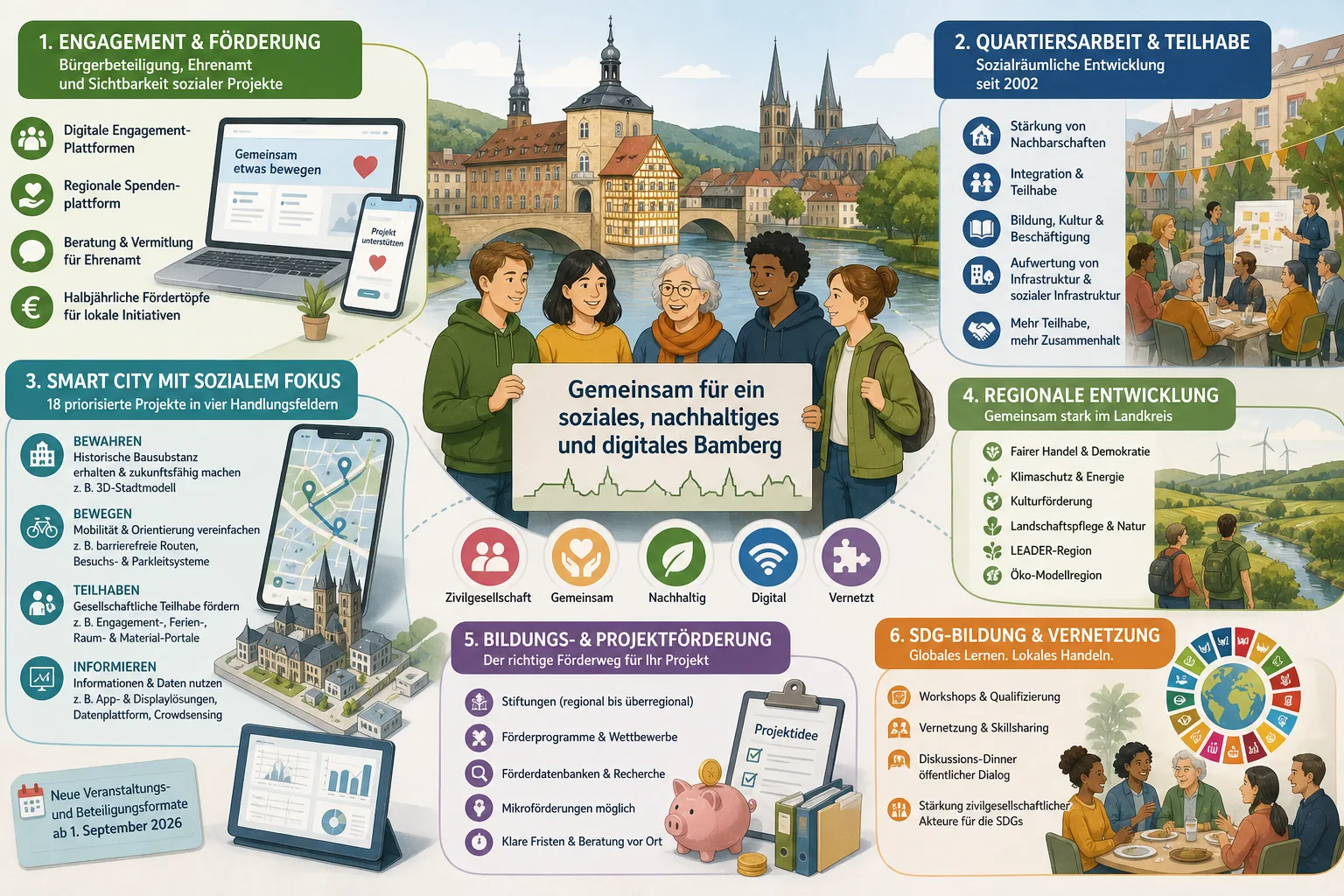
Municipal smart city programs often combine several fields of action – typically: preserving the city, improving mobility, strengthening participation, and providing understandable information. For Bamberg, the following approaches are particularly plausible:
- Digital Twin (City Model): can make planning (e.g., new construction, traffic management, climate effects) more understandable – also for citizens, if visualizations are publicly accessible.
- Visitor and Parking Information: should guide traffic flows and reduce search traffic, especially in sensitive areas of the old town.
- Barrier-free Route Planning: can reliably show people with limited mobility suitable routes (gradients, surfaces, curbs, construction site information).
- Platforms for Engagement & Sharing: make it easier to share resources (spaces, materials, know-how) and coordinate initiatives.
Trust is central to the acceptance of digital solutions: understandable data protection notices, data minimization, transparent purpose limitation, and barrier-free operation.
City App & Participation Platforms: Everyday Usefulness as a Benchmark
If Bamberg further expands digital applications (e.g., city app, engagement or space platforms), success will mainly be measured by whether they solve concrete everyday questions:
- How do I find current information on construction sites, detours, and public transport?
- Where can I find information about city projects and give effective feedback?
- How can clubs, initiatives, and neighborhoods share spaces/equipment fairly?
To ensure that digital participation is not just "additional," results from online formats should be translated into understandable decisions (documentation, feedback, next steps).
4) What These Projects Could Mean for Bamberg in the Future
Housing & Social Mix: Relief – If Infrastructure Grows Alongside
New neighborhoods can only noticeably ease housing pressure if they are planned with daycare centers, schools, local supply, green spaces, and good transport connections. Equally important is social balance: a mix of subsidized and privately financed housing can help ensure that new districts are not shaped one-sidedly.
Participation: Making Conflicts Visible Earlier, Shaping Solutions More Sustainably
Especially in a city with a strong historical heritage, urban development is often discussed controversially. If Bamberg consistently uses participation formats (digital and analog) in the coming years, this can help clarify goal conflicts early: monument protection and new construction, traffic calming and accessibility, climate adaptation and construction site burdens.
Identity: Change Should Remain Readable
So that change does not feel like a series of individual projects, a comprehensible narrative is needed: Which neighborhoods are to grow and how? What mobility goals apply in the city center? Which measures measurably increase climate resilience? The clearer these guidelines are communicated, the more residents and visitors can classify changes – and constructively accompany them.