Social Projects and Initiatives Shaping Bamberg
Social Projects & Initiatives Shaping Bamberg's Future
Bamberg is planning to interlink neighborhood work, civic engagement, and digital tools even more closely in the coming years. This overview summarizes the most important fields of action, explains how participation typically works, and shows where ideas are likely to have the best chances—in the city and the district.
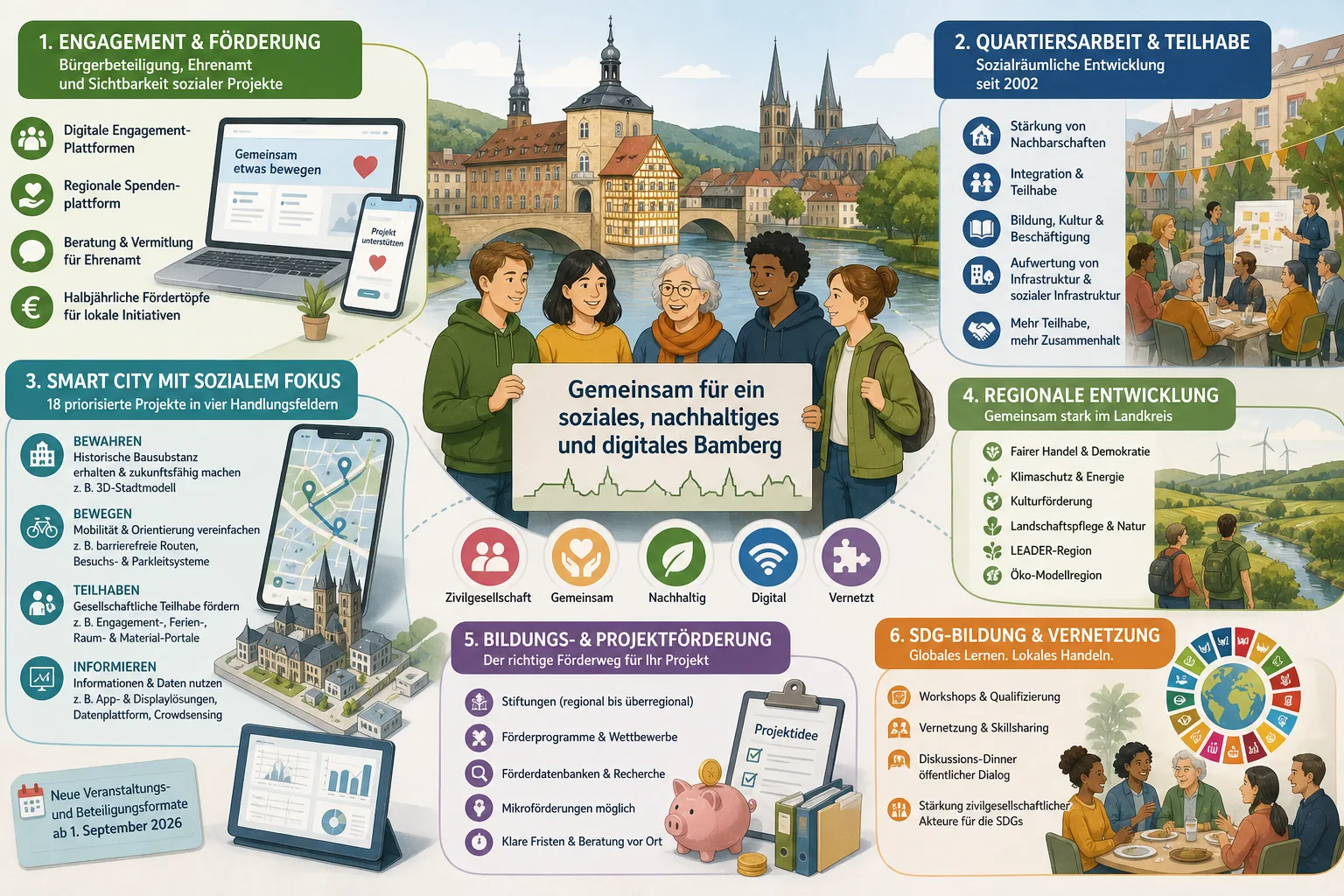
Engagement & Funding: How Projects Will Start More Easily in the Future
To ensure that engagement does not fail due to information gaps, many municipalities are increasingly relying on combined structures: digital entry points (service overviews, matching, calendars) plus personal advice (qualification, insurance, project planning, networking). For Bamberg, it will be particularly relevant in the coming years how well these elements interact.
What Helps Most in Practice
- A clear entry point: a central page or platform that explains how to get involved, what roles exist, and what support is offered.
- Mediation instead of directory: good systems ask about interests, time budget, and skills and suggest concrete tasks.
- Micro-funding: small, quickly available budgets for pilot actions (materials, room rental, fees, public relations) lower the threshold for getting started.
- Transparent criteria: comprehensible selection rules and feedback increase trust and planning security.
For associations and initiatives, it is worthwhile to consider eligibility for funding early: purpose of the statutes, non-profit status (if relevant), data protection for registrations, protection concepts when working with children and young people, as well as a realistic time and cost plan are often decisive.
Smart City: Digital Participation with a Social Focus
Digital urban development only achieves social impact when it solves concrete everyday problems and not only "considers" participation, but measurably enables it. For the next steps in Bamberg, four guiding questions are particularly helpful:
- Who benefits concretely? (e.g. people with limited mobility, families, volunteers, small initiatives)
- Which barrier is being removed? (e.g. lack of information, complex processes, lack of accessibility)
- How is participation organized? (e.g. co-design workshops, test groups, feedback loops)
- How is data used responsibly? (e.g. data protection, purpose limitation, transparency, open standards)
Possible Social Smart City Building Blocks in the Upcoming Project Phase
- Low-barrier orientation: route and information services that take obstacles (stairs, inclines, construction sites) into account.
- Sharing resources: portals for rooms, equipment, materials—so that initiatives do not fail due to infrastructure costs.
- Making engagement visible: digital marketplaces for tasks, actions, and short-term participation opportunities.
- Participation "close to the neighborhood": tools that enable feedback on specific locations (e.g. map queries, idea competitions, quick surveys)—supplemented by in-person meetings.
Important for trust: clear communication about which data is collected, what it is used for, how long it is stored, and how citizens can access it. Especially for participation platforms, accessibility (WCAG-oriented), multilingualism, and mobile usability are key quality factors.
Regional Initiatives: Urban-Rural Projects in the District
Many social innovations will increasingly emerge at interfaces: between city and countryside, between volunteering and business, between climate protection and social participation. In the Bamberg district, funding frameworks and networks play a major role—especially programs that address regional development, democracy education, culture, or sustainable nutrition.
Focus Areas Likely to Remain Particularly Relevant in the Coming Years
- LEADER/Regional Development: projects that strengthen quality of life (meeting places, culture, sustainable tourism, regional value creation).
- Sustainable nutrition & biodiversity: cooperation along the chain agriculture–processing–trade–gastronomy–education.
- Cultural participation: formats that are low-threshold and bring together different milieus (e.g. mobile offers, cooperation with schools and associations).
- Democracy & cohesion: educational and dialogue formats that reduce polarization and strengthen local capacity for action.
Anyone setting up a project regionally should clarify early on whether it is better submitted via a municipality, an association, a cooperation of several partners, or a sponsoring organization. In many funding programs, partnerships are a plus if roles and responsibilities are clearly described.
From Idea to Project: Funding Logic, Partnerships, Impact
Good ideas rarely fail due to lack of motivation—more often due to unclear objectives, missing partners, or implausible implementation. For future projects in Bamberg (city and district), an approach has proven itself that is also typically expected by funding agencies:
1) Formulate Goal & Target Group Measurably
Instead of "we strengthen community," be more precise: "Within six months, we will create a regular, low-barrier neighborhood format that reaches at least three target groups (e.g. families, seniors, immigrants) and is supported by local actors."
2) Plan Impact (Not Just Activities)
- Output: What happens concretely? (e.g. events, consultation hours, workshops)
- Outcome: What changes? (e.g. more participants, better accessibility, new cooperations)
- Learning loop: How is feedback collected and implemented?
3) Consider Risks & Protection
For projects with children/youth, sensitive topics (poverty, displacement, health), or data collection, increased requirements apply: clear responsibilities, data protection, consents, protection concepts, and qualified contact persons.
4) Use SDGs as Guidance
The UN Sustainable Development Goals (SDGs) offer an easily understandable structure for upcoming educational and social projects to link local measures with global goals—for example, in poverty prevention (SDG 1), education (SDG 4), reducing inequalities (SDG 10), or sustainable cities and communities (SDG 11).
Get Involved: Concrete Next Steps
If you want to become active in Bamberg in the coming months or years, you can start pragmatically with these steps—regardless of whether you start alone or are already part of a group:
- Clarify needs: Talk to people in the neighborhood or your target group (short interviews, small meeting, online survey).
- Find partners: Schools, church communities, associations, neighborhood centers, social organizations, or cultural initiatives can contribute spaces, reach, or know-how.
- Pilot instead of large-scale project: Plan a manageable format (e.g. 4–6 events), document participation and feedback.
- Choose appropriate funding: Micro-funding for the start, then possibly larger programs (municipal/regional, foundations, EU/LEADER).
- Ensure transparency: Communicate publicly who you are, what you do, how to get involved, and how funds are used.