Experience Political Discussions & Talks in Bamberg
Political Discussions & Talks in Bamberg (Upcoming Dates): How to Find Debates, Panels, and Citizen Dialogues
7 min readLaura Müller
Bamberg also offers many opportunities in the coming months to experience politics live: from municipal citizens' assemblies to university talks and panels organized by initiatives and associations. This guide shows which formats you can expect, how to reliably find dates, and how to prepare well.
Why It's Worth Looking at Bamberg's Debate Calendar
Political conversations don't just happen on election day, but everywhere people ask questions, demand information, and negotiate priorities. In Bamberg, this is particularly visible because several "stages" interact: municipal participation, university public, and civil society discussions.
If you want to join in or just listen in the coming weeks and months, clear orientation helps: What formats are there? Where are upcoming dates published? And how can you prepare so that the evening is really useful for you?
City of Bamberg: Citizens' Assemblies & Neighborhood Talks as Central Formats
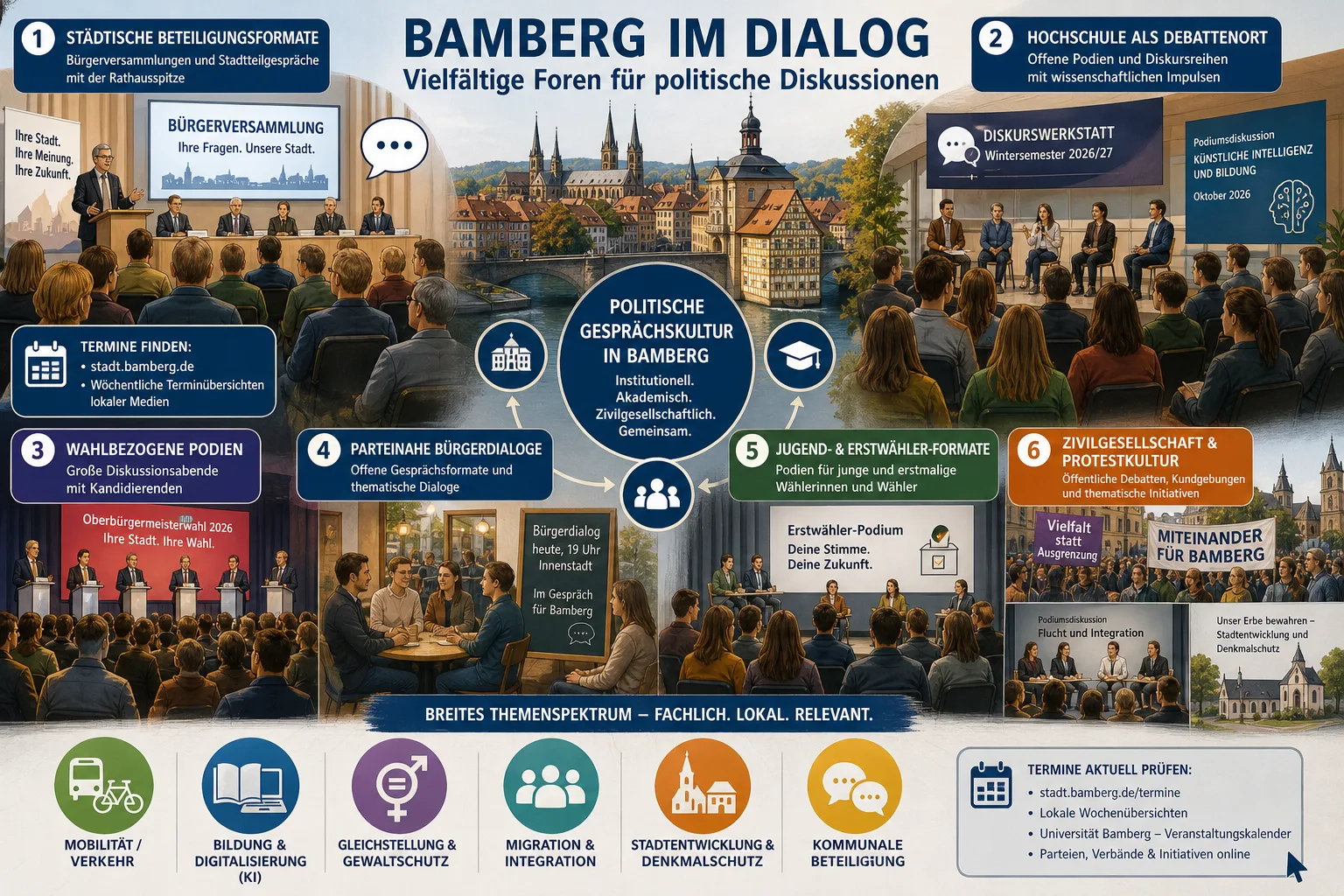
Among the most important public discussion occasions are citizens' assemblies and other participation formats of the city. They are designed to take up concerns from neighborhoods and discuss topics from administration and local politics transparently.
What Typically Happens There?
- Information section: Current projects (e.g., traffic, construction projects, social infrastructure) are presented.
- Question and discussion phase: Citizens bring up concerns, ask follow-up questions, express approval or criticism.
- Documentation & follow-up: Results and further steps are often published or taken up in subsequent formats.
Who Is This Suitable For?
These dates are especially helpful if you have specific questions about your living environment (e.g., public transport, bike paths, noise, school routes, development, neighborhood development) or want to understand how municipal decisions are made in practice.
Where Can I Find Upcoming Dates? The Most Reliable Calendar Sources
To make sure you only catch current and future events, a short "calendar workflow" is worthwhile. These sources have proven to be the most reliable:
- City of Bamberg (official announcements): Dates for citizens' assemblies, participation formats, and often also for public meetings.
- University of Bamberg (public lectures & panels): Event calendar with lecture series, discussions, and science-related discussion formats.
- Local media (event overviews): Announcements of panels, information evenings, discussion events (e.g., by associations or initiatives).
- Parties, associations, initiatives: Open regulars' tables, citizen dialogues, theme evenings, and candidate talks (often planned at short notice).
Practical Tip: How to Build a Debate Routine
Plan a realistic mix for the next few months of one municipal event (e.g., citizens' assembly) and one thematic evening (e.g., university talk or association panel). This way you get both the "administrative reality" and the "ideas and future discussion".
University as a Stage: Public Talks, Lectures, and Discourse Formats
As a university location, Bamberg regularly offers public discussion evenings where research and urban society come together. Such formats are particularly suitable if you are looking for background and different perspectives on complex topics.
Typical Topics in Upcoming Event Series
- Digitalization & AI: Effects on education, administration, working world, and social participation.
- Mobility & Urban Planning: Conflicts of objectives between traffic safety, climate protection, quality of stay, and accessibility.
- Migration & Coexistence: Integration, participation, social infrastructure, and municipal practice.
- Democracy & Public Sphere: Discussion culture, media literacy, forms of participation.
The advantage of these events: You often get a structured input (e.g., keynote speech) and then space for questions and debate. Especially if you are new to Bamberg, this is a good introduction to get to know topics and actors.
Election Years & Political Panels: When Bamberg Questions Candidates
In the coming months, depending on the election calendar and political occasions, there may be an increased number of panel discussions where candidates or office holders are publicly questioned. Such evenings are often organized by media, clubs, associations, churches, youth organizations, or initiatives.
What Matters Most in Panels
- Concrete questions: "How exactly?" beats "Whether at all?" Ask about timeline, responsibilities, funding, and trade-offs.
- Comparability: Write down 2–3 core questions and ask them (or listen for them) so that positions remain comparable.
- Traceability: Pay attention to whether answers are verifiable (data, decisions, responsibilities).
If you want to ask a question yourself: Formulate it briefly, refer to a specific place or issue, and try to ask only one question per contribution. This increases the chance of a useful, verifiable answer.
Civil Society, Youth Formats, Volunteering: Many Voices Beyond City Hall
In addition to official and academic formats, civil society discussion occasions also shape the political public in Bamberg. In the coming months, you can especially look out for three types of events:
1) Youth and First-Time Voter Formats
Youth associations, schools, youth parliaments, or youth work organizations regularly organize discussion evenings for young people. The aim is often to make political responsibilities understandable and then to question candidates or those responsible directly.
2) Rallies, Demonstrations, and Counter-Events
Public assemblies in the city space can make important debates visible in the coming months — for example, on climate, housing, migration, equality, or social issues. If you participate: Inform yourself in advance about the call, route, organizers, and legal notices, and plan to be considerate of residents and ensure safety.
3) Clubs, Lecture Evenings, and Thematic Discussion Rounds
Bamberg's club scene is a driver for thematic debates: monument protection, urban history, neighborhood development, social projects, or sustainability. Such evenings are often particularly insightful because they bring in local experiential knowledge and long-term perspectives.
Key Topics in Upcoming Discussions: What Keeps Coming Up in Bamberg
Regardless of the organizer, some topics regularly return in Bamberg. If you attend several talks in the coming months, you will encounter these fields particularly often:
- Mobility & Traffic: Cycling and pedestrian traffic, public transport offers, parking, safety, delivery traffic.
- Housing & Urban Development: Affordable housing, densification, monument protection, usage conflicts.
- Social Issues & Participation: Offers for families, seniors, inclusion, meeting places.
- Education & Digitalization: Equipment, skills, AI applications, administrative digitalization.
- Climate Adaptation & Environment: Heat protection, green spaces, energy, resilience in urban space.
- Integration & Coexistence: Language, work, education, neighborhood, conflict resolution.
Many debates are interconnected: transport policy affects climate goals, urban development influences social mix, digitalization touches education and administration. If you are prepared, you can more quickly recognize which goal conflicts lie behind seemingly simple buzzwords.
Join the Conversation – But Effectively: Preparation, Behavior, and Follow-Up
Preparation (10–20 Minutes Is Often Enough)
- Select a topic: What is specifically important to you (place, street, facility, measure)?
- Formulate a core question: as briefly as possible, without side issues.
- Bring evidence: e.g., photo, date, short notes (without private data of third parties).
In the Room (Debate Culture That Works)
- Stay respectful: a tough factual level is possible, personal attacks rarely help.
- Ask questions instead of making assumptions: "Do I understand correctly that...?" creates clarity.
- Pay attention to responsibilities: Municipal level, district, state, federal – not everything is up to the city.
Follow-Up (So It Doesn't End with the Evening)
- Check documentation: Minutes, press releases, follow-up dates.
- Stay in contact: If a topic continues, the next meeting or a follow-up date is worthwhile.
- Dosage of engagement: Better to consistently follow a few topics than everything at once.