Public Transport Bamberg: Shuttle & Bus Line to Events
Public Transport in Bamberg: How to Comfortably Get to Every Upcoming Event
Whether it's a concert, sports event, market, or city festival: With bus, train, park-and-ride, and (depending on the occasion) additional services, you can reach many event venues in Bamberg in a planned way and without parking stress. This guide helps you organize your journey for future dates so that you arrive on time and get back safely after the event ends.
1) Basic Principle: How Bamberg's Public Transport Works Around Events
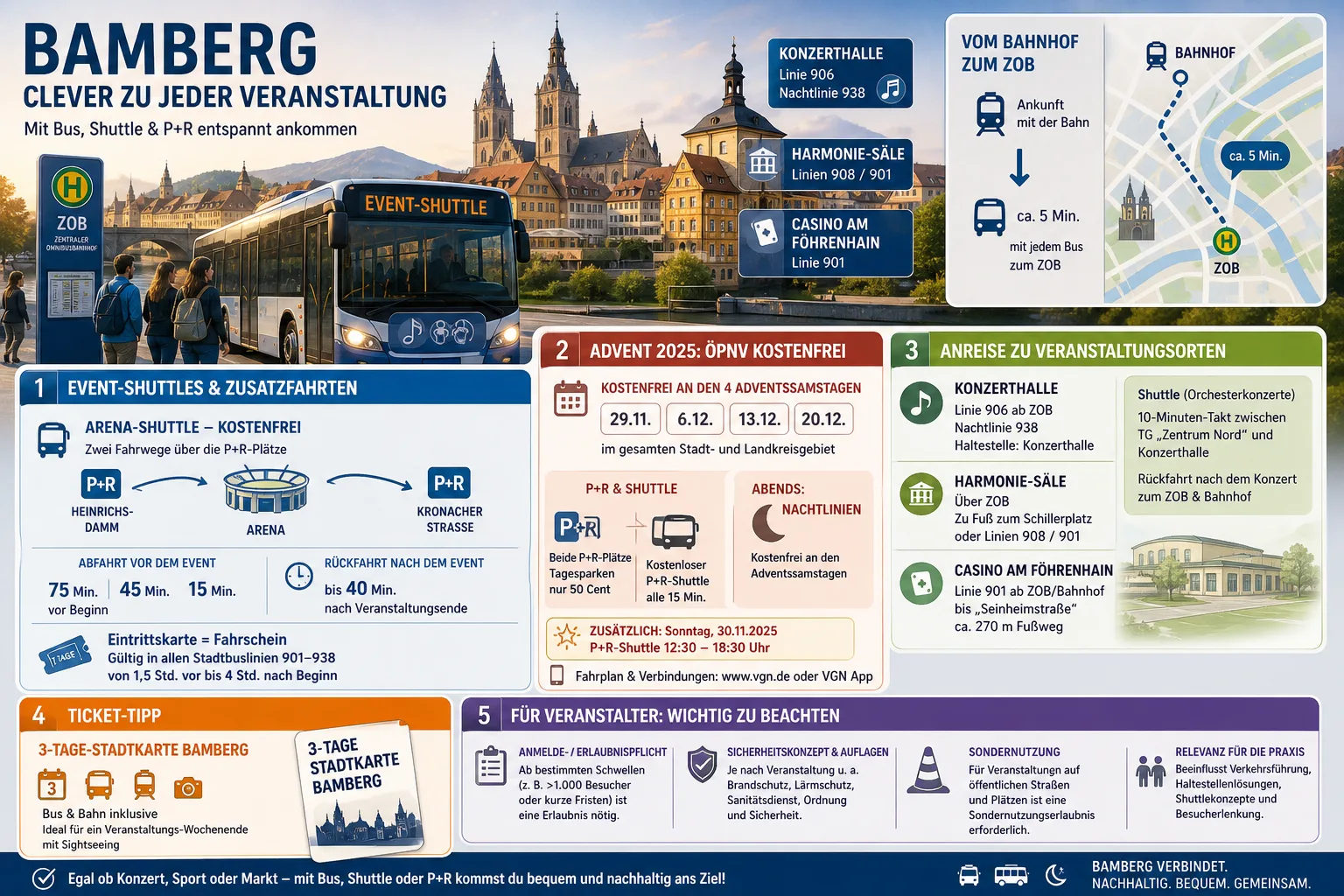
Bamberg is compact, and many routes lead through a central transfer point: the ZOB (Central Bus Station). If you arrive by train, the station is usually your starting point; from there, you can reach the city center and ZOB quickly by city bus. From the ZOB, lines branch out into the districts and to many well-known event venues.
For larger events, transport companies and the city can provide additional services, adjusted schedules, or special lines. Which measures actually apply depends on the respective event and is usually officially announced at short notice (see section "Checklist").
2) Typical Destinations: Arena, Concert Hall & Other Event Venues
Arena & Large Hall Events
For events in large halls, many cities – including Bamberg – often use relief concepts: additional bus capacity, park-and-ride recommendations, and clear routes to stops. Whether there is an event shuttle or special services for your date (and whether these are chargeable or included in the ticket) is decided by the organizer in coordination with the transport companies.
Practical tip: Check in advance whether your admission ticket is valid as a travel pass or if you need a separate public transport ticket. This information is often printed directly on the ticket, in the order confirmation, or on the event page.
Bamberg Concert Hall
The concert hall is accessible via the city bus network. Depending on the day of the week and time, different lines and schedules are relevant. For evening events, it is especially important to know how you will get back after the end (last departures, transfers, possibly night service). Therefore, consciously plan your return journey and use the real-time information on the day of the event.
Harmonie Halls, Casino am Föhrenhain & Downtown Locations
Many places in and near the city center can be easily combined: bus to near the center, then a short walk. For addresses further out: Pay special attention to the last suitable connection in the evening and whether construction sites or detours change the route.
3) Seasonal Times & Late Journeys Home: Markets, Advent, Night Transport
During times of high demand (e.g., city center festivals, pre-Christmas period, major events), public transport services are sometimes adjusted. This can include additional trips, detours, or special regulations. Whether there are special offers (e.g., temporarily discounted tickets) is usually newly announced for each season.
For safe journeys home, these points are crucial:
- Plan your return trip: Check the last departures before you leave.
- Minimize transfers: If possible, choose a connection with fewer changes – especially late at night.
- Use real-time info: Check again shortly before departure (delays/detours).
4) Travel Planning for Visitors: How to Do It in Practice
Checklist (5 Minutes): How to Plan Your Journey for Your Event
- Set the address of the event venue and desired arrival time (with time buffer).
- Choose your starting point: Train station, accommodation, or park-and-ride.
- Check the connection in the official information system (outbound and return journey).
- Clarify the ticket question: Is the event ticket valid as a travel pass? If not, choose the appropriate fare.
- On the day of the event check real-time info again (detours, departure platform, disruptions).
Park-and-Ride (P+R): Useful If You Come from Outside
If you arrive by car, park-and-ride can be a low-stress alternative: park your car on the outskirts, then continue by bus (or possibly special service). Whether parking fees apply and which lines are best depends on the location and time. Use the information from the city/transport companies and the current timetable information for this.
Digital Timetable Information & Real-Time Info
For reliable planning, official information is most helpful, as it is most likely to take detours, construction sites, and disruptions into account. Save the connection (or the stop) and check again shortly before departure to see if anything has changed.
5) For Organizers: Consider Mobility Early (Not a Substitute for Legal or Official Advice)
If you are planning a public event, it is worth coordinating early with the city and transport companies. The goal is to safely manage visitor flows, reduce traffic jams, and minimize the impact on regular services as much as possible.
Typical Components of a Mobility Concept
- Arrival and departure communication: clear information on stops, recommended routes, return journeys
- Capacity planning: expected peaks (arrival/departure) and possibly additional services
- Temporary traffic measures: detours, closures, alternative stops (if necessary)
- Safety & visitor management: safe routes, lighting, information points, crowd management
Note: This article does not replace official information. The current requirements of the responsible authorities and the published traffic information for your event always apply.
6) Conclusion: Arrive Relaxed – If You Clarify Timetable, Ticket, and Return Journey in Advance
For upcoming events in Bamberg, public transport is a plannable option: ZOB as a hub, city bus lines as a base, plus seasonal adjustments or additional services if needed. If you check the connection (including the return trip) and clarify the ticket rules in advance, you will reach your destination in most cases without searching for a parking space and with less stress.