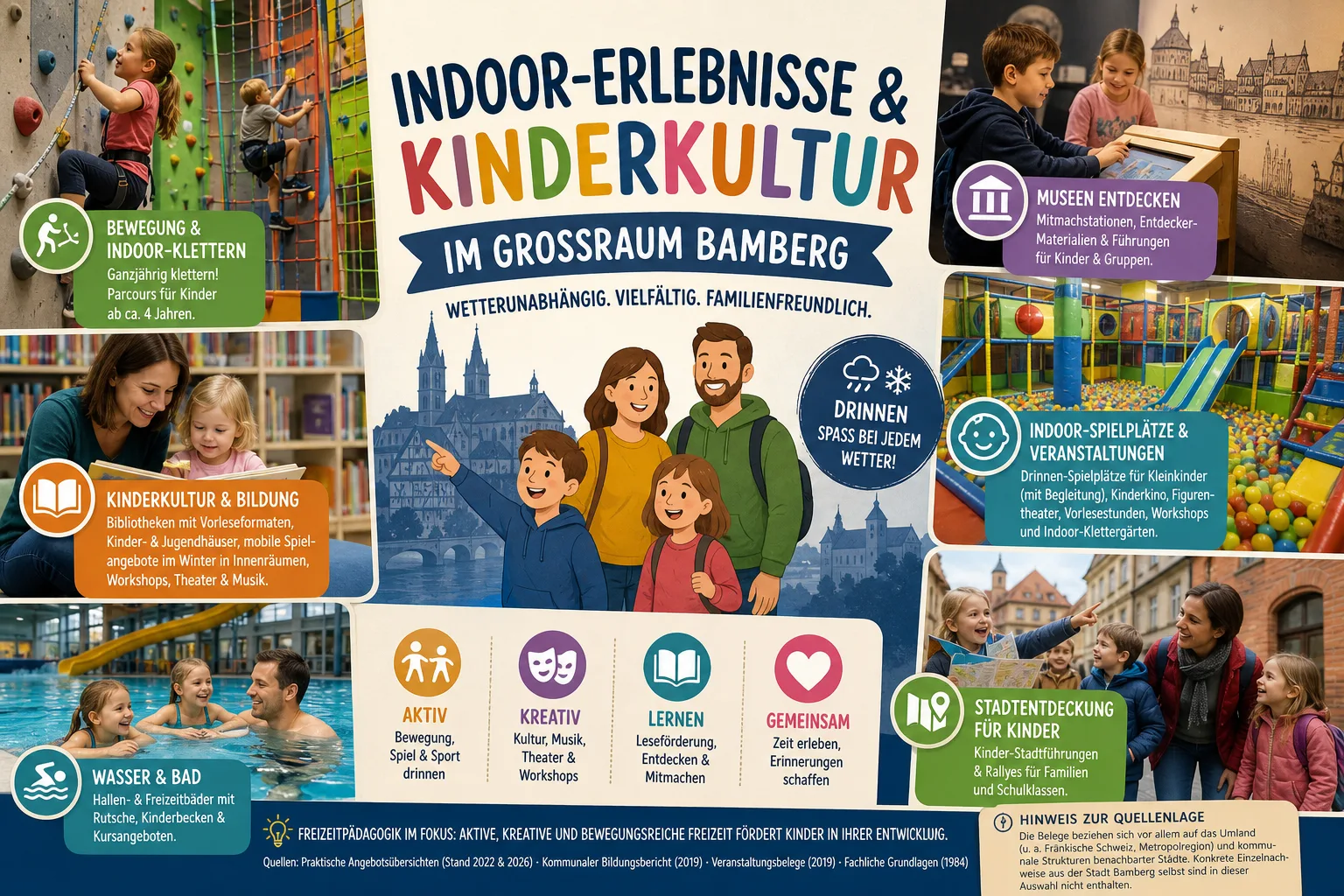
Discover Indoor Playgrounds & Children's Culture in Bamberg
Indoor Playgrounds & Children's Culture in Bamberg: Preview and Planning Guide for Upcoming Family Events (Fall/Winter 2026/27)
When the next rainy days are approaching, many families face the same question: Which upcoming indoor events and cultural formats can be combined so that children can burn off energy, discover something new – and adults can plan in a relaxed way? This guide bundles ideas and selection criteria for future excursions, holiday and weekend programs in the greater Bamberg area.
Goal: With this overview, you can proactively structure the coming months – from indoor activity offers to cultural family formats such as rallies, children's cinema, or interactive exhibitions.
Contents
- Indoor Activity: Climbing, Romping & Water Events
- Indoor Play Spaces & Family Centers: Formats That Will Work Well Soon
- Children's Culture as a Schedule: Library, Museum, Children's Cinema
- City Tours & Rallies: Upcoming Explorer Formats for Bamberg
- Planning: How to Put Together a Future Day Program
- Safety & Expectations: Age Information, Supervision, Accessibility
Indoor Activity: Climbing, Romping & Water Events
For the coming months, indoor activity in Bamberg can be planned particularly well using time-bound slots: family times, course dates, holiday programs, or themed action days. Three formats are likely to offer the greatest planning benefit:
1) Indoor Climbing and Obstacle Course Slots
- Why as an event format? Many facilities manage capacity through time windows, courses, or briefings – making future visits more predictable.
- What to pay attention to when booking next time: Minimum age/height, required indoor shoes, briefing times, accompanying supervisors, quiet areas.
- Family Value: Climbing and obstacle courses promote strength, coordination, and self-efficacy – especially when the weather disrupts outdoor plans.
2) Indoor Pool Family Times and Course Series
For a future indoor day, swimming times are especially easy to plan, as course series (e.g., beginner, technique, parent-child) and family windows are organized on a recurring basis. In the schedule overview, pay particular attention to:
- Toddler-friendly times (warm water, shallow area, less hustle and bustle)
- Slide/play times (if specified, often limited)
- Rules for groups (school classes/kindergartens often require advance registration)
3) Indoor Romping as an "Energy Buffer" Before Culture
A proven future combination principle: activity first, then culture. When children can first satisfy their urge to move, quieter program points (museum, library, cinema) often work better afterwards.
Indoor Play Spaces & Family Centers: Formats That Will Work Well Soon
In the coming fall and winter months, in addition to classic indoor play halls, time-limited play and creative offers are especially relevant: open afternoons, holiday workshops, movement construction sites, or family activities in youth work facilities.
For planning upcoming events, these three questions help:
- Open or with registration? Open offers are spontaneous – registered formats provide more reliability (capacity, duration, age group).
- Activity, creativity, or both? A balanced mix prevents over- or under-challenging.
- Is supervision provided? Some formats are "parents stay present," others work with educational supervision within clear rules.
If you want a fixed rhythm for the coming months, a recurring "indoor block" (e.g., one afternoon per week) is worthwhile – ideally with changing focuses: activity → crafting/experimenting → reading/storytelling.
Children's Culture as a Schedule: Library, Museum, Children's Cinema
For upcoming family weekends in Bamberg, children's culture can be most reliably structured via program lines: reading formats, interactive exhibitions, workshops, or performances. Instead of "sometime," it becomes a concrete calendar building block.
Library: Upcoming Reading and Media Formats
Many library programs are organized as series (reading aloud, picture book cinema, media literacy). For the next scheduling, these details are especially helpful:
- Age range (e.g., 3–5, 6–8, elementary school)
- Duration (short & ritualized usually works better for younger children)
- Participation share (crafting part, puzzles, movement breaks)
Museum: Upcoming Interactive and Family Tours
For future museum visits, interactive formats are the most plannable: family tours, rallies, explorer booklets, workshop times. For school classes or groups, it is worthwhile to select upcoming dates by complexity: preschool (short, tactile) → elementary school (puzzles, tasks) → advanced (in-depth, discussion, creative part).
Children's Cinema & Stage: Upcoming Performances as "Fixed Points"
Performances are often the most stable fixed point in family life, as start time and duration are set. For the next season planning, it makes sense to schedule a "cultural afternoon" per month – with enough buffer for travel, coat chaos, and a quiet snack break beforehand.
City Tours & Rallies: Upcoming Explorer Formats for Bamberg
For the coming months, Bamberg is particularly suitable for formats that organize city exploration as a play mission: children's tours, puzzle routes, family rallies. The focus is less on factual knowledge and more on observation, movement, and stories.
To ensure a future rally is truly "family-friendly," pay attention to the following when choosing:
- Route length (for kindergarten children rather short, with many stops)
- Weather option (covered sections, indoor break points)
- Group suitability (school class: clear rules, meeting points, toilet breaks)
For travel or bus groups visiting Bamberg in the future, a schedule with clear timing is useful: arrival → short activity or snack buffer → tour/rally → indoor stay as bad weather backup.
Planning: How to Put Together a Future Day Program
The most important difference between an "indoor day" and a successful future family program is the sequence. You can use this template for upcoming weekends and holidays:
Sample Schedule for a Future Rainy Day (without specific provider names)
- Morning (active): Indoor activity format (climbing/obstacle course or romping).
- Midday (winding down): Quiet meal break with seating; then 10–15 minutes of "downtime" (coloring sheet, audio story, book).
- Afternoon (cultural): Library program, museum rally, or children's cinema.
- Late afternoon (wind-down): Short walk, small playground stop, relaxed journey home.
Checklist for Upcoming Bookings
- Time slots: Are there fixed start times? How long does briefing/entry take?
- Age and size rules: Does the offer really suit the youngest person in the group?
- Quiet zones: Are there retreat areas (important for long indoor days)?
- Catering: Is bringing your own food allowed or only on site? Are there allergy information?
- Arrival: Public transport connections, parking options, accessible routes.
Safety & Expectations: Age Information, Supervision, Accessibility
For all upcoming indoor and cultural events: safety and success depend on clear framework conditions. Plan future visits so that children can act independently without being overwhelmed.
- Supervision: Even with offers with staff, the duty of supervision often remains with accompanying persons. Check the respective house rules in advance.
- Dosage of activity: Indoor activity is intense – consciously schedule "quiet" program points for future days (reading, museum, quiet café).
- Accessibility: If children or accompanying persons have special requirements (wheelchair, neurodiversity, sensory sensitivity), quiet time slots and clear route guidance are especially important when choosing dates.
Note: This article does not replace individual safety or health information. In case of uncertainty, the official information of the respective facilities is decisive.