Citizens' Assembly in Bamberg: Experience City Politics Up Close
Citizens' Assemblies in Bamberg: Experience City Politics Live – and Bring Your Issues to the City Council
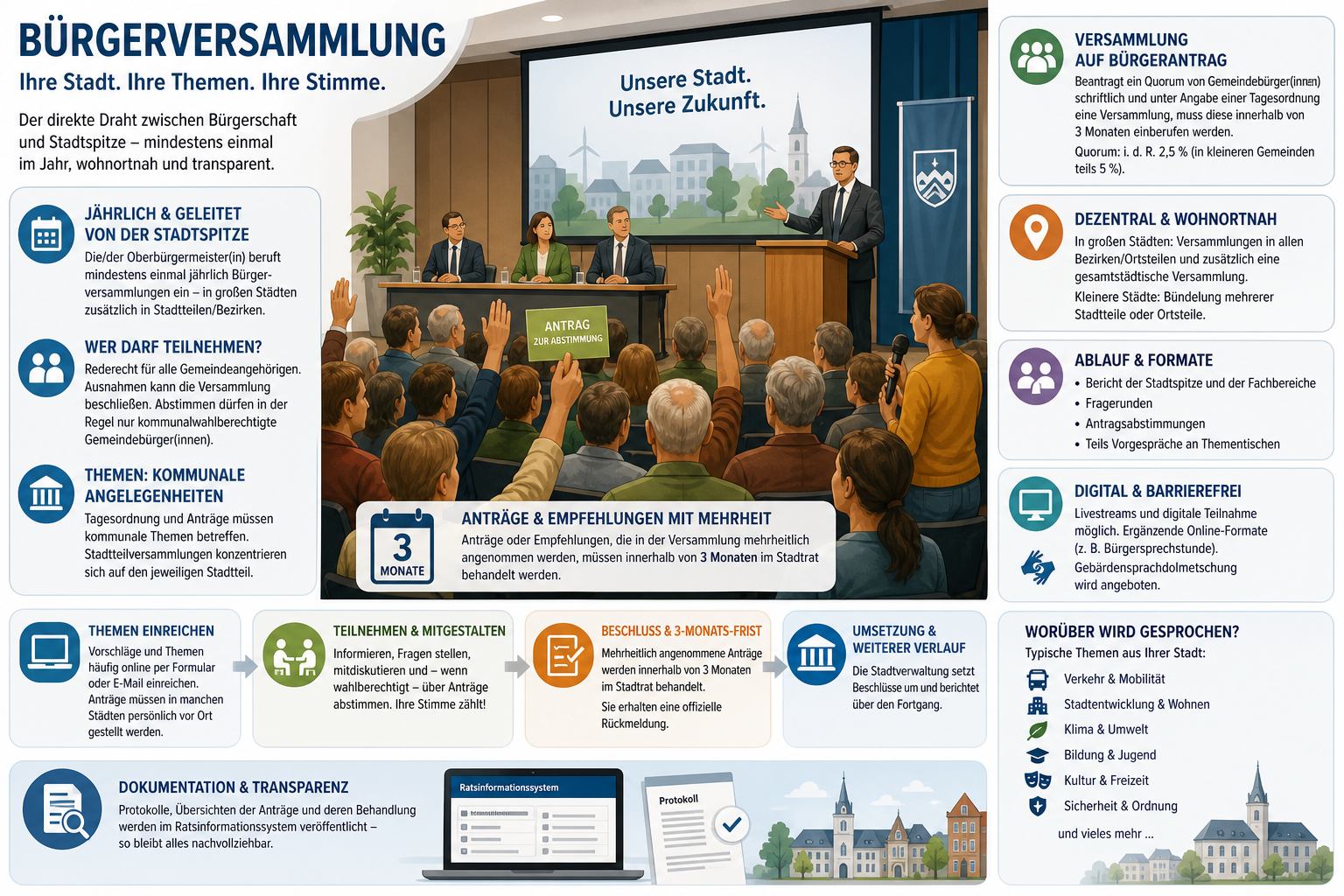
A citizens' assembly in Bamberg is one of the most direct ways to actively influence municipal decisions: You can ask questions, formulate concerns, and submit motions for a vote. This format is regulated by law and means that the city council must deal with successful recommendations within a set period. This article explains what to expect at the next citizens' assemblies in Bamberg, how to prepare, and how your concern becomes a city council topic.
Why Attending the Next Citizens' Assembly Is Worthwhile
At a citizens' assembly, you meet the city leadership and administration in a public setting where municipal issues from the everyday lives of citizens are discussed. The focus is on matters concerning the city of Bamberg, for example:
- Traffic safety, cycling and pedestrian paths, public transport
- Housing, urban development, construction projects in the neighborhood
- Schools, daycare centers, social infrastructure
- Climate protection, green spaces, noise and environmental issues
- Cultural and event spaces in the city area
For upcoming dates, this means: If a specific issue in your neighborhood affects you, the citizens' assembly is a suitable place to bring it up publicly, transparently, and with a view to the next political steps.
Legal Framework in Bavaria: Right to Speak, Right to Vote, and Consideration by the City Council
Citizens' assemblies in Bavarian municipalities are based on the Municipal Code for the Free State of Bavaria. This results in typical basic principles that are also decisive for Bamberg:
- Right to speak: Municipal residents can comment on municipal matters; the assembly may allow further contributions in individual cases (e.g., from experts).
- Right to vote: Recommendations are usually voted on by those eligible to vote in municipal elections (i.e., those who may also participate in municipal elections).
- Relevance: Topics and motions must concern the city of Bamberg as a municipality.
Important for your planning: If a recommendation (e.g., a motion) is adopted by majority vote in the assembly, the city council must deal with this issue within the legal deadline. For you, this means: A successful vote can bring your issue bindingly into the municipal political process.
Note: This article provides a clear orientation and does not replace legal advice. The legal text and the respective municipal announcements are binding.
This Is How a Citizens' Assembly Typically Proceeds (From Welcome to Vote)
For the next citizens' assemblies, you can typically expect a structured process that allows you both information and participation:
- Opening and Formalities: At the beginning, the procedure, speaking order, and notes on voting rights are explained.
- Report and Context: The city leadership and responsible staff provide insights into upcoming projects and ongoing processes relevant to the city area or the respective district.
- Questions and Contributions: You can ask questions, have connections clarified, and address specific impacts on your street or neighborhood.
- Motions/Recommendations and Votes: If you submit a motion, it will be recorded, discussed, and – depending on the assembly's procedure – put to a vote.
For your preparation, it helps to formulate your concern in one sentence (problem + desired measure). This keeps the core understandable even in a lively discussion.
How to Effectively Bring in Your Issue: From Formulation to Vote
1) Clearly Define the Issue
Effective concerns are concrete and solvable at the municipal level. Good examples of formulations (as templates) are:
- "I request that the city examine traffic safety at intersection X and propose improvements."
- "I request that the city assess the situation of bicycle parking spaces at location Y and plan additional spaces."
- "I request that the city record the noise situation in area Z and present suitable measures."
2) Present Clearly at the Assembly
When you speak at the microphone, three building blocks help:
- Location: Where exactly does the problem occur?
- Impact: Who is affected and how (safety, noise, accessibility, accessibility)?
- Request to the City: What should be examined, planned, or decided?
3) Make Support Visible (Without Exaggerating)
If several people from the neighborhood share the concern, you can mention this factually (e.g., "Several residents from the street ..."). This can show that it is not an individual issue, without having to claim numbers.
How to Find Upcoming Dates, Locations, and Official Information
So you don't miss a citizens' assembly, refer to the official publications of the city of Bamberg. There, future dates, venues, participation instructions, and, if applicable, organizational details are announced.
Practical for you:
- Note the date and location early and plan your journey and possible waiting time.
- Check for information on accessibility, admission, speaking time, or ID documents.
- If you have a more extensive topic, prepare a short, written bullet-point list (for yourself) so you stay focused during your speaking time.
What Happens After the Citizens' Assembly: How to Track the Progress of Your Concern
If your motion or a recommendation is adopted at the citizens' assembly, the next phase begins: formal consideration in the committees. For you, it is particularly important that you can track when and how the issue is discussed in the city council (or in the responsible committees).
This is how you stay on track:
- Look for the publication of result summaries, minutes, or announcements regarding the citizens' assembly.
- Monitor the agendas of city council and committee meetings when your issue is announced there.
- Keep your original core demand so you can later compare whether the discussion addresses the point (examination order, proposed measure, resolution).
This follow-up is particularly effective if you briefly and factually ask about the processing status at the next citizens' assembly.
Your Next Step: Actively Shaping City Politics in Bamberg
If you use the upcoming citizens' assemblies, you turn an everyday problem into a public concern with clear responsibility. You receive first-hand information, can ask questions, and – with a well-formulated motion – ensure that the city council deals with your issue within the prescribed period. This makes participation concrete: not abstract, but on site, in dialogue, and with visible next steps.